
 Worksheets
2.3 -AS
Total questions: 87
Worksheet time: 54mins
What is aggregate supply (AS)?
Aggregate supply (AS) is the quantity of goods and services that producers are willing and able to supply at a given level of prices in a given time period.
Aggregate supply (AS) is the total amount of money in circulation within an economy.
Aggregate supply (AS) is the total demand for goods and services in an economy at a given time.
Aggregate supply (AS) is the level of government spending in an economy during a specific period.
What is short run aggregate supply (SRAS)?
Short run aggregate supply (SRAS) is the relationship between planned national output (GDP) and the general price level.
Short run aggregate supply (SRAS) is the total value of goods and services produced in an economy over a long period of time.
Short run aggregate supply (SRAS) is the relationship between the unemployment rate and the inflation rate.
Short run aggregate supply (SRAS) is the total amount of money in circulation in an economy.
Which of the following is the main factor causing a shift in SRAS?
Consumer demand
Factor resource cost of supplying goods and services
Government spending
Exchange rates
According to the diagram, what happens when there is a rise in the price level?
Contraction of aggregate supply
Expansion of aggregate supply
No change in aggregate supply
Decrease in real GDP
When a business is not making full use of its available capacity, there are ______ factors of production including land, labour and capital.
spare
fixed
expensive
primary
Which of the following is NOT a cause of shifts in short run aggregate supply?
Changes in resource (input) prices
Business taxes, subsidies, regulations and imported costs
Consumer preferences
Energy costs such as oil, gas, and electricity
The short run AS curve is upward sloping because higher prices for goods and services make output more profitable, enabling businesses to expand their production by hiring extra labour and other resources.
True
False
Which of the following is NOT a factor that can cause a shift in short run aggregate supply (SRAS)?
Changes in the scale and size of government subsidies to certain industries
Cost of imported components
Changes in consumer preferences
Unexpected supply shocks

A shift from AS1 to AS2 in the short run aggregate supply curve is known as an ______ shift of the short run aggregate supply curve.
inward
outward
vertical
horizontal

Which of the following might cause an inward shift in the short run aggregate supply curve?
A fall in raw material prices
A rise in energy costs
A decrease in unit labour costs
A decline in business regulations

If wages rise in line with productivity, then unit labour costs will not change, and the SRAS will therefore not shift inwards.
True
False

A shift from AS1 to AS3 in the short run aggregate supply curve is an example of what type of shift?
Inward shift
Outward shift
Vertical shift
No shift
External factors from outside a country can have an impact on production costs. One example of such a factor is:
Weather conditions within the country
International oil prices
Local government policies
Domestic labor laws
Which of the following is NOT listed as a factor affecting the UK economy in the passage?
World oil and gas prices
Import tariffs / quotas
Domestic tourism rates
Foodstuff prices
According to the passage, the UK is a net importer of which of the following?
Oil
Coal
Fresh foods
Automobiles
According to Keynesians, governments will need to intervene, especially using ________, when an economy is in recession.
fiscal policy
monetary policy
trade policy
immigration policy
Match the following Keynesian and Neoclassical views:
Markets will work well, provided that the government does not intervene
Markets do not always work perfectly – prices can be inflexible
The economy is self-correcting, even in recession
Governments will need to intervene, especially using fiscal policy
There is only a trade-off between unemployment and inflation in the short run
There is a trade-off between unemployment and inflation
Unemployment always returns to its 'natural rate'
Unemployment can be persistent
Neo-classical economists use only one aggregate supply curve for both the short run and the long run.
True
False
What is the main difference between Keynesian and Neoclassical views on government intervention during a recession?
Keynesians believe government intervention is necessary, especially using fiscal policy, while Neoclassical economists believe the economy is self-correcting and government intervention is rarely needed.
Keynesians believe in minimal government intervention, while Neoclassical economists support aggressive fiscal policy during recessions.
Both Keynesians and Neoclassical economists agree that monetary policy is the only effective tool during a recession.
Neoclassical economists advocate for increased government spending, while Keynesians prefer tax cuts as the primary solution.
According to the explanation for the Keynesian aggregate supply curve, when spare capacity is high, what happens to the SRAS curve?
It becomes perfectly inelastic
It will be elastic and a rise in AD can be met easily by increased output
It becomes vertical
It causes immediate inflation
Fill in the blank: The elasticity of the SRAS curve falls as output increases because the amount of ______ declines, there is the possibility of diminishing returns in production, bottlenecks in supply of inputs and components, and resource shortages as the economy approaches full employment.
spare capacity
aggregate demand
government spending
labor unions

What happens to the general price level when AD shifts from AD1 to AD2?
It rises sharply
It falls
It remains the same
It fluctuates unpredictably

Refer to the diagram titled 'Inflationary pressures when the aggregate supply curve has become inelastic.' What is the effect of an outward shift in AD from AD3 to AD4?
No change in price level
Sharp rise in the general price level
Decrease in real GDP
Decrease in price level
When does the economy reach full employment according to the Keynesian aggregate supply curve explanation?
When the AS curve becomes vertical, the economy has reached full employment of factor resources.
When the AS curve is horizontal, the economy has reached full employment of factor resources.
When the AS curve is downward sloping, the economy has reached full employment of factor resources.
When the AS curve shifts to the left, the economy has reached full employment of factor resources.
Define full employment as stated in the worksheet.
The level of employment where everyone who wants a job has a job, except for frictional and structural unemployment.
The situation where there is zero unemployment in the economy.
The level of employment where only voluntary unemployment exists.
The state where all resources are fully utilized.

Refer to the first diagram showing the Keynesian LRAS. What does YFE represent on the Real GDP axis?
The general price level
The full employment level of output
The aggregate demand
The short run aggregate supply

According to the Neo-Classical Long Run Aggregate Supply diagram, what does a rightwards shift in LRAS represent?
A decrease in the economy's productive potential
An increase in the economy's productive potential/capacity
A fall in the general price level
A reduction in aggregate demand

In the Neo-Classical LRAS diagram, Yfe represents the economy's '__________' level of output, i.e., the maximum potential level of output in the long run.
full employment
cyclical
seasonal
nominal

An outwards shift in LRAS causes Yfe to rise, indicating an increase in the economy's maximum potential output. This is referred to as 'long run growth.'
True
False
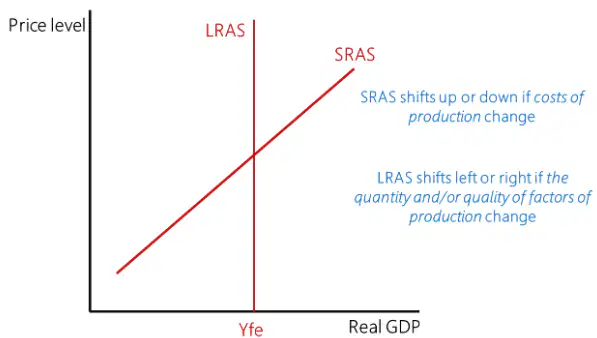
Refer to the diagram. Which curve represents the Long Run Aggregate Supply?
SRAS
LRAS
Yfe
Real GDP
What does LRAS stand for in economics?
Which of the following is NOT a factor influencing long-run aggregate supply (AS)?
Technological advances
Changes in relative productivity
Changes in weather patterns
Changes in education and skills
Long run aggregate supply (LRAS) represents the ________ possible output when all factors of production are fully and efficiently employed.
maximum
minimum
average
nominal
Which of the following is an example of higher productivity of labour and capital?
A rise in output per person employed
A decrease in the number of people in paid work
A reduction in capital investment
A fall in technological efficiency
Which factor is described as 'Product and process innovation from research and development and higher rate of increase of business start-ups'?
Capital Investment
Innovation and Enterprise
Growing Population
Stock of natural resources
List two changes that can bring about an increase in a nation's potential GDP.
What does an outward shift of LRAS signify in terms of potential output and employment?
An outward shift of LRAS signifies an increase in potential output and employment and signifies real economic growth.
An outward shift of LRAS signifies a decrease in potential output and employment and indicates economic decline.
An outward shift of LRAS signifies no change in potential output or employment, only a change in price level.
An outward shift of LRAS signifies a temporary increase in output but a long-term decrease in employment.
Which of the following is an example of investment in natural capital that can increase long run aggregate supply?
Building new shopping malls
Establishing new mangrove forests
Increasing import tariffs
Reducing education spending
Productivity measures the efficiency of the production process.
True
False
In the long run, what is a major determinant of economic growth and inflation?
Productivity
Government spending
Exchange rates
Population growth
Productivity can be measured by which of the following?
Output per worker employed
Output per person hour
Value added from each extra factor input employed
All of the above

According to the graph 'Labour Productivity in the UK, Output per worker employed, Index (2015=100)', what happened to UK labour productivity growth after the 2008/2009 recession?
It stagnated and was only 1.5% above the 2007 pre-recession peak level by 2019.
It rapidly increased and was 10% above the 2007 pre-recession peak level by 2019.
It declined and was 5% below the 2007 pre-recession peak level by 2019.
It remained unchanged at the 2007 pre-recession peak level by 2019.
What is the productivity gap as described in the text?
What is the significance of increased productivity for countries with strong labour productivity growth?
Countries with strong labour productivity growth tend to benefit from high rates of growth and low inflation. Productivity affects other macroeconomic objectives as well.
It leads to a decrease in the standard of living and higher unemployment rates.
It causes persistent trade deficits and increased government debt.
It results in lower investment in technology and infrastructure.
Match the macroeconomic objective with the correct comment on the effect of increased productivity:
Inflation
Lower – unit costs falling, outward shift of aggregate supply if productivity is rising faster than wages
Economic growth (real GDP)
Higher – gains in aggregate supply, expansion of AD
Unemployment
Lower in long run as real GDP growth rises
Balance of trade
Improved – more competitive exports – an injection of aggregate demand into the circular flow
Spare capacity
Rise from extra capacity in short run – we can get more from existing factors of production
List one economic benefit of net inward migration.
Which of the following is NOT an economic benefit of net inward migration?
Migrants provide fresh skills
Migrants increase the size of the active labour supply
Migrants increase the cost of public services
Migrants are often a driver of innovation and entrepreneurship
Remittances sent home by migrants add to the GNI of home nations, creating potential for rising exports.
True
False
Legal immigrants in work pay taxes and are likely to be net ________ to government finances.
contributors
burdens
liabilities
detriments
Which of the following is a risk or cost from net inward migration?
Positive multiplier effects if migrants find paid work
Remittances sent home by migrants
Social tensions from integrating thousands of extra workers into local areas and regions
Migrants provide fresh skills
List one risk or cost from net inward migration.
Welfare costs: Increasing cost of providing public services.
Decrease in cultural diversity.
Reduction in available workforce.
Lower demand for housing.
Migration may worsen the level of relative poverty in a society.
True
False
Which of the following factors does NOT affect the evaluation of the effects of labour migration?
The ease with which migrant workers settle into a new country
The dynamic effects of migration, such as gains in innovation
The colour of passports held by migrants
Whether migrants decide to stay in the longer term
The effects of migration are hard to ________.
quantify
ignore
celebrate
predict
The human capital of migrants may be more significant in the long run.
True
False
Which macroeconomic objective is improved by more competitive exports due to increased productivity?
Inflation
Economic growth
Balance of trade
Business investment
Productivity gains in government help to reduce ________ spending.
state
private
personal
corporate
Which of the following is a positive multiplier effect of net inward migration?
Migrants increase the cost of public services
Migrants add to government tax revenues if they find paid work
Migrants displace domestic workers
Migrants worsen relative poverty
According to the diagram, which of the following is an effect of inward migration on the Labour Market?
Increase in government spending
Increase in the active labour supply which might cause lower unit labour costs for a host country
Human capital helps to generate ideas and products
Rising demand for public services
Inward migration increases pressure on government spending but can also lead to rising _____
tax revenues
unemployment
inflation
interest rates
Which of the following is NOT listed as an effect of inward migration on consumption?
Increase in population size
Rising demand for public services
Lower unit labour costs
If housing stock is fixed, can lead to higher prices and rising rents
Match the following pillars of UK competition policy with their descriptions:
Antitrust and cartels
Investigating mergers between firms to avoid monopoly power
Market liberalisation
Eliminating illegal agreements that restrict competition
State aid control
Introducing competition in previously monopolistic sectors
Merger control
Analysing the role of the state in supporting industries
Which pillar of UK competition policy involves introducing competition or contestability in sectors that have previously been dominated by large monopolistic firms?
Antitrust and cartels
Market liberalisation
State aid control
Merger control
Effective competition policy should help to improve an economy’s _____
LRAS / productive potential
inflation rate
budget deficit
exchange rate
Technological advances can only make existing factors of production more efficient, but cannot stimulate the growth of brand-new industries.
True
False
3D printing is also known as ______ manufacturing.
additive
subtractive
formative
reductive
Cloud based ______ Intelligence is a recent advance in technology that might impact LRAS.
Artificial
Natural
Mechanical
Emotional
______ technology is a recent advance in technology that might impact LRAS, according to MIT.
Blockchain
Steam engine
Telegraph
Printing press
______ computing is a recent advance in technology that might impact LRAS, according to MIT.
Quantum
Analog
Classical
Optical
Custom ______ are a recent advance in technology that might impact LRAS, according to MIT.
vaccines
cars
phones
batteries
Nuclear ______ is a recent advance in technology that might impact LRAS, according to MIT.
fission
fusion
decay
power
______ technologies are a recent advance in technology that might impact LRAS, according to MIT.
Wearable
Analog
Steam-powered
Rotary
Which of the following is a possible advantage of automation?
Increased job loss
Improved product quality
Higher capital expenditure
Reduced flexibility
Which of the following is a possible advantage of automation?
Shorter working weeks for labour
Job loss for some workers
Initial large capital expenditure
Possible risk of hacking
Which of the following is a possible advantage of automation?
Rising productivity
Job loss for some workers
Initial large capital expenditure
Possible risk of hacking
Which of the following is a possible advantage of automation?
Safer working conditions
Job loss for some workers
Initial large capital expenditure
Possible risk of hacking
Which of the following is a possible advantage of automation?
Lower operating costs for businesses
Job loss for some workers
Initial large capital expenditure
Possible risk of hacking
Which of the following is a possible disadvantage of automation?
Improved product quality
Job loss for some workers
Rising productivity
Safer working conditions
Which of the following is a possible disadvantage of automation?
Initial large capital expenditure by businesses
Improved product quality
Rising productivity
Safer working conditions
Which of the following is a possible disadvantage of automation?
Possibility of reduced flexibility
Improved product quality
Rising productivity
Safer working conditions
Which of the following is a possible disadvantage of automation?
Possible risk of hacking
Improved product quality
Rising productivity
Safer working conditions
Human capital refers to the ______, experience, aptitudes and attitudes of human input into the production process.
skills
machines
buildings
tools
Positive externalities from education and training are usually regarded as generating ______ externalities, because society tends to benefit from having educated citizens.
positive
negative
neutral
private
Specific skills are skills that are specialist and focused on one particular ______ or task.
job
hobby
language
tool
Tertiary education is education beyond ______ education, e.g. college, university.
secondary
primary
elementary
preschool
Transferable skills are skills that can be used in a number of different ______ e.g. literacy, numeracy, IT.
occupations
colors
seasons
animals
Vocational education is known as career or ______ education; this is education that provides practical skills.
technical
historical
artistic
philosophical

