
 Worksheets
Unit 5
Total questions: 30
Worksheet time: 15mins
What was one major impact of economic development from 1648 to 1815?
Decline in European maritime competition.
Increase in agricultural production.
European maritime competition.
Rise of industrialization.

How did the nobles respond to attempts to reform the tax system during the Old Regime?
They supported the reforms
They resisted the reforms
They ignored the reforms
They initiated the reforms
Who were included in the Third Estate during the Estates General?
Only peasants
Nobility and clergy
Peasants, urban workers, middle-class shopkeepers, wealthy merchants, lawyers
Only clergy
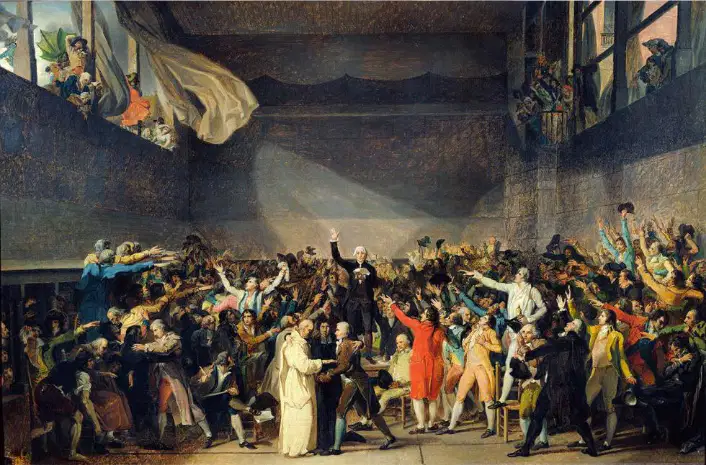
What was the Third Estate's demand regarding the meeting of the Estates?
To meet separately from the other estates.
To meet together with all Estates.
To meet only with the King.
To meet in secret.
What significant action did the mob take after storming the Bastille?
They burned it to the ground
They freed prisoners and seized weapons
They converted it into a museum
They used it as a base for further attacks
Which natural rights were included in the Declaration of the Rights of Man and the Citizen?
Liberty, property, security, and resistance to oppression.
Liberty, equality, fraternity, and justice.
Property, wealth, power, and influence.
Security, peace, prosperity, and happiness.
What argument did Mary Wollstonecraft make in her publication?
Women are naturally inferior to men
Women are not naturally inferior to men
Women should not participate in politics
Women should focus on domestic roles
What significant action did the King take in response to the Women's March on Versailles?
He abdicated the throne
He declared war
He agreed to move the royal family to Paris
He increased taxes
How were bishops and priests chosen according to the Civil Constitution of the Clergy?
Appointed by the Pope
Elected by the people and paid by the state
Selected by the king
Chosen by a council of bishops
What requirement was imposed on the clergy by the Civil Constitution of the Clergy?
To take a loyalty oath to support the new government
To pay a special tax to the state
To renounce their religious beliefs
To serve in the military
Which of the following reforms was implemented by the National Assembly?
Abolish Private Property
Give Women the Right to Vote
Establish the metric system
Maintain internal tariffs
What was one of the actions the National Assembly did not take?
Create a Constitutional Monarchy
Divide France into 83 departments
Abolish Private Property
Abolish guilds
How did the National Assembly reorganize France administratively?
Created a single centralized government
Divided France into 83 departments
Established regional monarchies
Formed independent city-states
What was one of the economic reforms carried out by the National Assembly?
Introduced new taxes
Abolished internal tariffs
Increased guild power
Nationalized industries
Which of the following was not a reform by the National Assembly?
Abolish guilds
Give Women the Right to Vote
Establish a Constitutional Monarchy
Divide France into departments
Who among the following was a prominent member of the Jacobins?
Jean-Paul Marat
Louis XVI
Marie Antoinette
Napoleon Bonaparte
What historical period does the Legislative Assembly (1791-1792) belong to?
The Renaissance
The French Revolution
The Industrial Revolution
The Enlightenment
Which faction was considered extreme within the "Left" of the Legislative Assembly?
Girondists
Conservatives
Jacobins
Moderates
What was the main purpose of the Declaration of Pillnitz issued by Leopold II of Austria and Frederick William II of Prussia in August 1791?
To declare war on France
To restore the French Monarchy
To form an alliance with France
To establish a trade agreement
In what year did the Legislative Assembly declare war against Austria and Prussia, marking the beginning of the War of the First Coalition?
1789
1791
1792
1793
By the end of 1792, what significant military movement occurred involving Austrian and Prussian forces?
Retreat to their own territories
Advancement toward Paris
Naval blockade of French ports
Occupation of southern France
What event in the summer of 1792 marked a significant shift in control during the Second French Revolution?
The fall of the Bastille
The rise of the Sans-Culottes
The execution of Louis XVI
The signing of the Treaty of Paris
What was the purpose of the national convention called by the Paris Commune?
To establish a new monarchy
To create a democratic government
To negotiate with foreign powers
To reinforce the monarchy
What was the stance of the Girondists regarding Louis XVI?
They demanded his execution as a tyrant.
They favored his imprisonment.
They wanted him to remain king.
They supported his exile.
Which countries joined Prussia and Austria to form the First Coalition against France?
England, Spain, Holland, and Sardinia
Italy, Portugal, Belgium, and Norway
Russia, Sweden, Denmark, and Finland
Greece, Turkey, Egypt, and Morocco
What was the primary purpose of the Committee of Public Safety during the Reign of Terror?
To establish a new monarchy in France
To defend France and protect the Revolution
To negotiate peace with neighboring countries
To expand French territories
What was the significance of Robespierre’s execution?
It marked the beginning of the Radical Phase
It ended the Radical Phase of the French Revolution
It started a new monarchy
It had no significant impact
What was the structure of the government under the Directory?
A single-house legislature and a council of ten men
A two-house legislature and an executive body of five men
A monarchy with a king and a council of nobles
A democratic assembly with elected representatives
How did the French Revolution influence other regions within the French Empire?
It led to the spread of democratic elections.
It inspired revolutionary revolts.
It resulted in economic prosperity.
It caused the collapse of the French Empire.
In what year did Saint-Domingue become the independent nation of Haiti?
1791
1804
1815
1820

