
 Worksheets
michela orwell
Total questions: 158
Worksheet time: 2hrs 17mins
The pig who gave rise to the inspiration of the Rebellion before he passed away was...
Napoleon.
Snowball.
Old Major.
Moses.
Wayne
Which pig represents an idealistic, passionate, and intelligent leader who genuinely seeks to improve the lives of people in a socialist state?
Napoleon
Squealer
Snowball
Boxer
Which type of animal often seen as ignorant and easily swayed by the propaganda , always repeating the slogan "two legs good four legs bad", lacking independent thinking skills.
Pigs
Sheep
Chickens
Horses
Who uses violent forces of the dogs to secure his authority as a leader?
Snowball
Squealer
Napoleon
Minimus
Which of the following characters represents the leader of the propaganda department of a dystopic socialist state?
Snowball
Napoleon
Boxer
Squealer
Trump
Which character represents the faithful working class who wholeheartedly dedicates his life to strenuous labor and never questions the intention of the leaders.
Snowball
Mollie
Boxer
Benjamin
Joe Biden
The "Rebellion" of Animal Farm by George Orwell is based on which of the following historical events?
French Revolution
American Revolution
Russian Revolution
Cultural Revolution of China
Trade War
Which character plays the role as a skeptical bystander who understands what is going on but does nothing because he believes that life will always be unpleasant no matter who is in charge.
Benjamin
Clover
Boxer
Minimus
Moses
Who are the elites who governs in this socialist dystopia?
Dogs
Horses
Pigs
Alligators
Sloths
The human solicitor whom Napoleon hires to represent Animal Farm in human society.
Mr. Whymper
Mr. Frederick
Mr. Jones
Mr. Pilkington
Mr. Ho
Which of the following most resembles the flag of the "Animal Farm"?


Which word did Major use to address the animals?
Brothers
Rebels
Comrades
Citizens
Homies
What is the theme of Animal Farm?
An outcry against animal cruelty
A satire of authoritarianism
A message to support veganism
An argument for green energy
A criticism against capitalism
What does the "windmill" represent in Animal Farm?
Green energy with no carbon emission
Prosperity due to government's control over economy
Modernization of the nation
Free trade with other countries
Idealistic Quixotism
Which of the following is a description of a totalitarian government?
a state in which nobody has power over everyone.
a form of government that is ruled by people.
a form of government that is ruled by an authoritarian leader.
a form of government that attempts to assert total control over the lives of its citizens.
An idealistic perfect society in which all citizens live in harmony.
Which of the following character is based on Joseph Stalin?
Snowball
Napoleon
Mollie
Moses
Which of the following is based on Leo Trotsky, an idealistic Russian leader.
Squealer
Minimus
Napoleon
Snowball
The untrustworthy neighbor Mr. Frederick in Animal Farm is based on...
Mao Zedong
Joseph Stalin
Adolf Hitler
Winston Churchill
Wayne Ho
The author of the book Animal Farm was...
George Washington
George Orwell
George and Peppa
George Floyd

Which of the following is a modern- day totalitarian state?
North Korea
South Korea
Panama
United Kingdom
Taiwan
Where was George Orwell born?
China
Japan
India
England
He studied at St Cyprian's School between…
1911 and 1916
1942 and 1948
1904 and 1908
1915 and 1920
What was his political opinion?
He believed on the excess of official power.
He believed a socialist economy in which the means of production are socially and collectively controlled by a democratic political system of government.
He was a democratic socialist.
He believed he could be a king.
What was George Orwell’s job?
Poet, novelist and essayist.
Publicist, literary critic and book seller.
Author and screenwriter.
All of above.
When was Animal Farm published?
1942
1948
1945
Which of these books of reportage where written by George Orwell?
Down and Out in Paris and London
The Road to Wigan Pier
Homage to Catalonia
All of above
He was considered "the best English essayist since Hazlitt, perhaps since Dr Johnson".
True
False
Why did he write Animal Farm?
He wrote Animal Farm as a comedy book.
He wrote Animal Farm as a political campaign
He wrote Animal Farm as a harsh criticism of both regimes
He wrote Animal Farm and as a warning against totalitarianism
When did he write the dystopian novel Nineteen Eighty-Four?
1952
1943
1945
1949
What types of literature did Orwell produce?
Literary criticism and poetry
Romance and biographies
Comedy and Fantasy
Fiction and polemical journalism
What event is described as beginning in the first paragraph?
The Two Minutes Hate
The Great War
The Revolution
The Peace Treaty
Who is described as the 'Enemy of the People' in the text?
Emmanuel Goldstein
Winston Smith
O'Brien
Big Brother
What emotion did the audience feel towards Emmanuel Goldstein?
Fear and disgust
Joy and relief
Indifference
Admiration
What was Emmanuel Goldstein accused of doing?
Supporting Big Brother
Engaging in counter-revolutionary activities
Writing a novel
Leading a peaceful protest
What did the dark-haired girl cry during the Hate?
"Swine!"
"Peace!"
"Help!"
"Victory!"
What was unnecessary during the Hate, according to the text?
Pretending
Listening
Watching
Reading
Who sat flushed and chest heaving during the Hate?
O'Brien
Winston
Goldstein
The dark-haired girl
What did Goldstein's voice turn into during the Hate?
A lion's roar
A sheep's bleat
A wolf's howl
A bird's chirp
What are the three slogans of the Party?
War is Peace, Freedom is Slavery, Ignorance is Strength
War is Strength, Freedom is Peace, Ignorance is Slavery
Peace is War, Slavery is Freedom, Strength is Ignorance
Strength is Ignorance, Peace is War, Slavery is Freedom
What did the little sandy-haired woman murmur?
"My Savior!"
"My Leader!"
"My Hero!"
"My Friend!"
What was the act of self-hypnosis meant to drown out?
Consciousness
Happiness
Sadness
Anger
What was Winston's instinctive reaction during the Hate?
To laugh
To cry
To hide his feelings
To shout
What did the significant thing that happened during the Hate involve?
A loud noise
A sudden silence
A change in Winston's expression
A new slogan
What did the crowd's adoration of Big Brother make him appear as?
Invincible
Weak
Confused
Angry
What did the figure of Goldstein morph into during the Hate?
A Eurasian soldier
A Big Brother supporter
A Party member
A Prole

In what superpower country does 1984 take place? (a)
Who is always watching?
(a)
Who is the main character?
Big Brother
Julia
Winston
O'Brien
What device is in every room allowing The Party to watch everyone?
television
telescreen
speakwrite
memory hole
Where does the main character work?
Ministry of Magic
Ministry of Truth
Ministry of Love
Ministry of Defense
Which is a slogan of the party?
War is Death
Freedom is Life
Ignorance is Bliss
Ignorance is Strength
In what city does the book take place?
London
Washington, D.C.
Dublin
Paris
What is the main character's first crime?
thoughtcrime
purchasing a diary
lying to Big Brother
writing in the diary
During the day, the comrades take two minutes to what?
love
hate
exercise
question
Narrowing thought is the purpose of what?
doublethink
thoughtcrime
Newspeak
Oldspeak
What does it mean when someone has been completely removed from any provable knowledge of existence?
vaporize
expel
doublethink
thoughtcrime
What is Winston's primary job?
writing novels
rewriting history
creating propoganda
writing poetry
What does Winston write in his diary?
I LOVE BIG BROTHER
DOWN WITH BIG BROTHER
I LOVE JULIA
THOUGHT CRIMINAL
Who is the enemy of the party?
O'Brien
Winston
Julia
Goldstein
2+2=
4
5
3
0
Which word best describes this situation?: A woman has to make a choice between buying groceries or buying medicine for her child.
disdainful
compromising
ignorance
magnitude
Which word best describes this situation?: A person who hasn't bathed in several weeks.
sordid
magnitude
ignorant
furtive
Which word best describes this situation?: A lawyer's argument in the case used no evidence to support it.
disdainful
furtive
ignorant
feeble
Which word best describes this situation?: The entire student body planned a skip-day without telling the staff.
feeble
furtive
ignorant
sordid
Which word best describes this situation?: A child with a high fever starts to talk to stuffed animals like they're real.
denounce
delirium
feeble
ignorance
Which word best describes this situation?: Adults in the grocery store scowled at a child throwing a tantrum.
compromising
magnitude
delirium
disdainful
Which word best describes this situation?: A senator gave a speech condemning violent riots in the city.
denounce
disdainful
feeble
sordid
Which word best describes this situation?: The victim tried to identify a criminal in a line-up, but in her mind, he had been much bigger and taller.
feeble
disdainful
sordid
perceive
Which word best describes this situation?: Someone was pulled over for driving too fast but said she hadn't seen a speed limit sign.
ignorance
furtive
compromising
sordid
Which word would be the best SYNONYM for "furtive"?
feathery
hostile
unknowing
secretive
Which word would be the best SYNONYM for "magnitude"?
importance
unknowing
secretive
ability
disgrace, criticism; to criticize, to rebuke
repudiate
reproach
shrewish
collate
to reject the truth of something; to deny; to disown
unorthodox
fathom
repudiate
inscrutable
someone who deliberately causes destruction to hinder an enemy
disdain
irrepressible
interminable
saboteur
unusual, unconventional
heretic
fathom
unorthodox
implicate
to increase in number, to spread rapidly
proliferate
repudiate
reproach
shrewish
a difficult state or situation
predicament
discountenanced
fathom
heretic
to connect or involve, in a negative way
inscrutable
interminable
irrepressible
implicate
someone who opposes a set of beliefs
heretic
sabotage
predicament
shrew
to criticize or speak out
denounce
disdain
implicate
irrepressible
to eliminate; to totally destroy
collate
annihilate
disdain
implicate
Punishment seemed __________________________, falling on both the guilty and innocent alike
rendezvous
arbitrary
cunning
iniquity
The _________________________ fox was able to evade the bloodhounds by crossing a river to obscure his scent
arbitrary
fatuous
cunning
austere
The teachers _________________________ toward her students completely changes whenever the administrators would come to observe her; she suddenly became far more cheerful.
austere
demeanor
effigy
effigy
If i am going to rectify something what am I going to do?
break it
fix it
stop it
keep doing it
What role does Big Brother play in the lives of the citizens in 1984?
He is a benevolent leader who genuinely cares for the well-being of the people.
He is a symbolic figure meant to instill fear and obedience.
He is a real person who interacts with the citizens on a daily basis.
He is a fictional character created by the opposition to challenge the Party.
The characters Stalin and Trotsky were important people in Animal Farm
True
False
The characters Stalin and Trotsky were important people in Animal Farm
True
False
Animal Farm was written
after his participation in WWII
after his escape from USSR.
before he was arrested in Russia.
as a result of Orwell's experience in Spain
George Orwell is mainly renowned for being a writer of
Fairy tales with happy endings
political matters he experienced himself
fables for children
poetry and fictional stories
In Animal Farm, who was Stalin?
Boxer
Benjamin
Napoleon
Snowball
In Animal Farm, who was Trotsky?
Boxer
Benjamin
Napoleon
Snowball
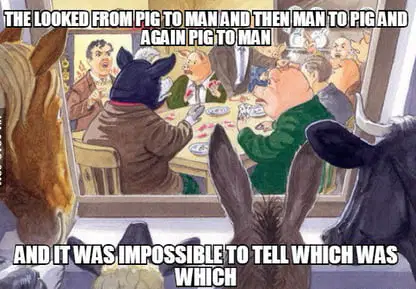
What did Napoleon do to Snowball's plans for the windmill?
He torn them.
He ate them.
He improved them.
He urinated on them.
Who used to repeat, "Four legs good, two legs bad,"
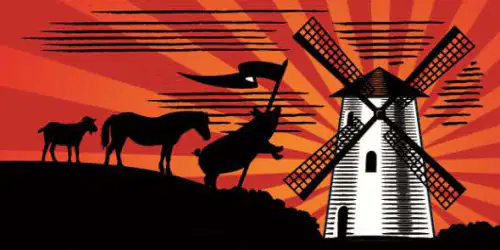
Who designed the plans for the windmill?
Who received ribbons and sugar from farmers, and eventually ran away to be with them.
Moses
What kind of animal is Boxer?
Pig
Horse
Donkey
Cow
What is the name of the previous owner of the farm that the animals have seized power over?
Mr. Jones
Mr. James
Mr. John
Mr. Joseph
When the farmer reappears to take back his farm, the animals defeat him again. What is this battle called?
The Battle of the Cowshed
The Battle of Gettysburg
The Battle of the Horse Stable
The Battle of the Titans
How many loyal attack dogs obey Napoleon’s command?
3
7
9
12
What happens to Boxer?
The pigs hurt Boxer when he is not working hard enough.
Boxer hurts himself by falling over.
Boxer gets injured while he is working hard on the farm.
Boxer is told to stop working.
Which event in history is Animal Farm representing?
World War I
The Cold War
The Russian Revolution
World War II
Which character is supposed to represent the Soviet Union leader Joseph Stalin?
Snowball
Napolean
Old Major
Squealor
What do the animals call their ideology?
Socialism
Communism
Capitalism
Animalism
Why do the pigs assume (take control) leadership in Animal Farm?
They are the bossiest animals
They are the most intelligent animals
They are voted into power
They knew how to build windmills
Who was responsible for stealing the milk?
The hens
The Pigs
The Cat
The Humans
Whenever something on the farm goes wrong, Napoleon blames it on…
Boxer
Jones
Snowball
Mollie
Orwell uses Animal Farm as a platform for
commenting of historical events
How did the first windmill collapse?
Mr. Jones takes it down
A storm
It was unstable and wrongly built
It blows away in a tornado
How does Squealer get what he wants?
He manipulates the animals
He doesn't
He is honest with the other animals
Why do Napoleon and Pilkington begin to fight each other?
Someone was found to be cheating at cards.
Pilkington is afraid Napoleon will attack his farm.
Napoleon does not like how Pilkington treats his animals.

Mister Whimper is the human who?
buys playing cards
saves the animals
kills the animals
trades with the animals
Young female horse who likes ribbons, sugar cubes and other luxuries.
Benjamin
Clover
Mollie
The cat
The raven who talks about a place called "Sugarcandy Mountain".
Mollie
Boxer
Pincher
Moses
The three adult dogs are named...
Bluebell, Jessie, Pincher
Bluebell, Mollie, Clover
Mollie, Clover, Moses
Bluebell, Mollie, Pincher
Character who disappears every time there is work to do.
the cat
a dog
the goat
Animal who doesn't believe in the rebellion.
Benjamin
Moses
Boxer
Frederick
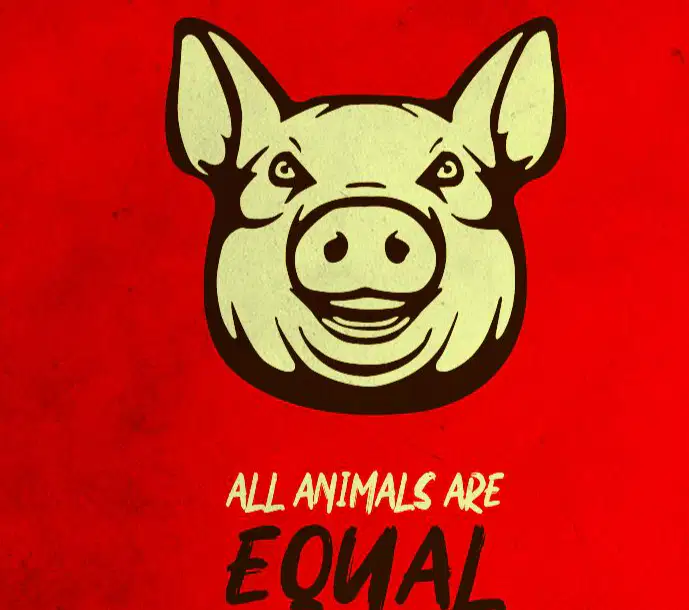
Complete the slogan: “All animals are equal, but some animals are...”
more equal than others
more intelligent than others
more powerful than others
smellier than others
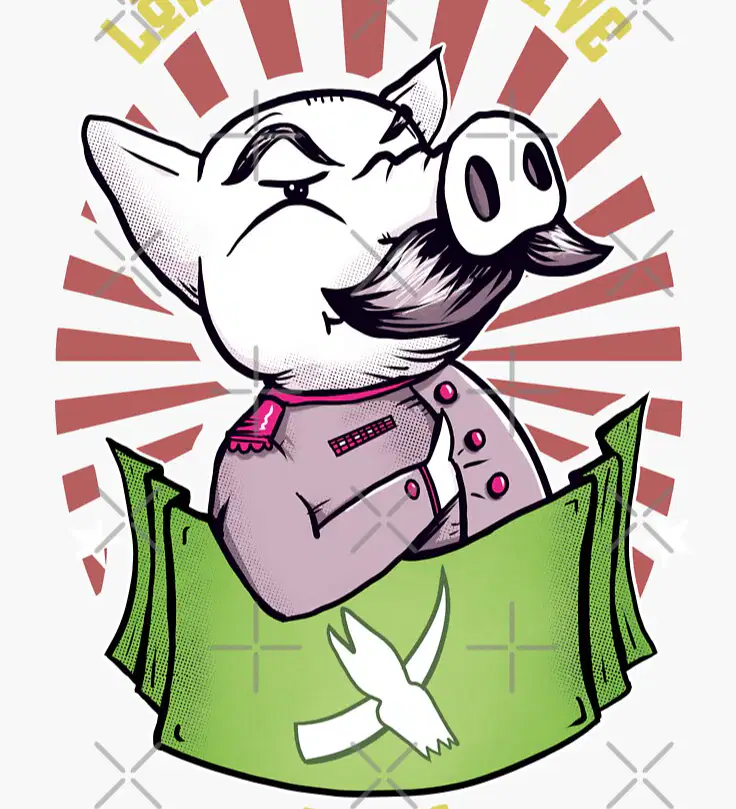
What title does Napoleon eventually assume for himself?
Lord of Manor Farm
King of the Animals
God of Beasts
President of the Republic
What is Sugarcandy Mountain?
The name of the bedtime song that Napoleon forces the pigeons to sing
The idea of animal heaven propagated by Moses the raven
The setting for the story that Mollie tells to the lambs
The mountain visible on Animal Farm's horizon
What is the term that pigs used to address others?
(a)
In which of the following Ministries does Winston work?
Ministry of Plenty
Ministry of Truth
Ministry of Love
Ministry of Peace
What is an unusual feature of Winston's apartment?
His telescreen can be shut off.
He has a small alcove where he can sit out of sight of the telescreen.
He has hot water and decent water pressure.
He is able to hook into the central electrical line using some wire he bought.
What did Winston buy while in an area of town he isn't supposed to go?
new razor blades
soap that was of decent quality
electrical wire
a journal
Nothing is technically illegal in Oceania because there are no laws.
True
False
Emmanuel Goldstein is considered the enemy of the People and the Party.
True
False
What looks in the window of a building?
a newspaper helicopter
a police drone
a cat
a creepy old man with a telescope
For which ministry does Winston work?
Ministry of Plenty
MInistry of Love
Ministry of Truth
Ministry of Peace
Who is Winston's love interest?
Judith
Jessica
Jennifer
Julia
What is newspeak?
the elimination of words
the addition of new words
the revival of old words
What is the party slogan?
Big Brother is Bogus
Big Brother is Bothered
Big Brother is Everywhere
Big Brother is Watching
Where does Winston live?
Magnificent Mansions
Victory Mansions
Victory Villas
None of the above
How old is Winston at the beginning of the book?
39
40
49
50
Where is Winston sent after his arrest?
A different country
Prison
Home
None of the above
With what do they torture Winston?
Snakes
Spiders
Rats
Roaches
At the conclusion, to whom does Winston pledge his loyalty?
Himself
Julia
His family
The Party
When was Orwell born?
1915
1903
1905
1900
What books did he write?
Animal farm
Harry potter
Lord of the flies
Antigone
What type of government did Orwell belive in?
active government
strict government
George Orwell was a novelist, journalist, essayist and critic.
True
False
Orwell’s work was divided into two parts: pre-1946 and 1946-and-after.
True
False
What year did Animal farm get published?
1925
1935
1955
1945
What year did 1984 get published?
1984
1949
1984
1950

Based on the information provided, which of the following statements is correct about George Orwell?
George Orwell lived from 1903 to 1950.
George Orwell was born in 1950.
George Orwell was a famous scientist.
George Orwell worked for ZANICHELLI.
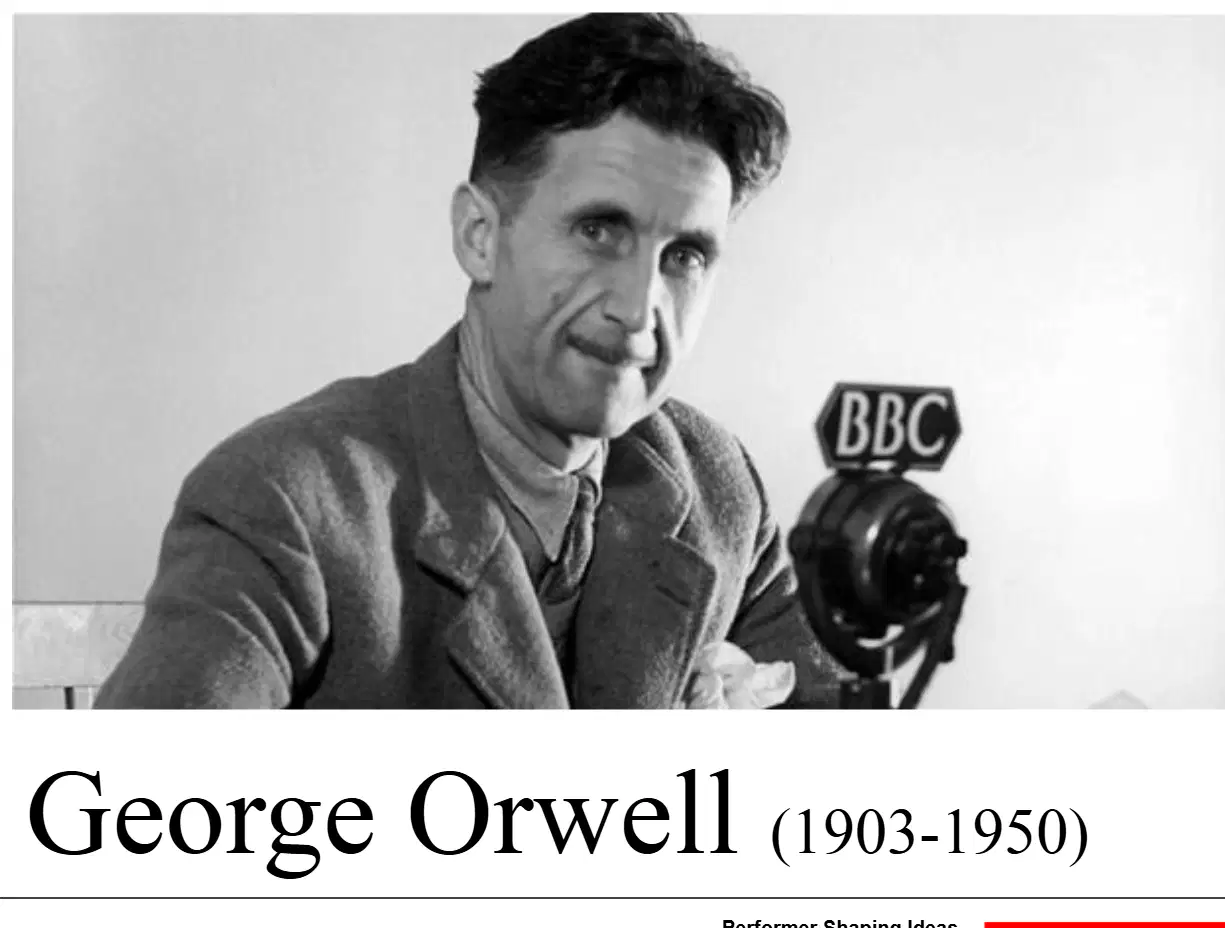
Given the image and information, what can you infer about George Orwell's professional activities?
He was involved in broadcasting or radio work.
He was a professional athlete.
He was a painter.
He was a chef.
Which of the following best describes the type of experiment George Orwell started after returning to England?
A social experiment living among the ‘down-and-outs’.
A scientific experiment in a laboratory.
A political experiment in Parliament.
A financial experiment in the stock market.
What was the significance of George Orwell joining the Workers’ Party of Marxist Unification and fighting on the Aragon front?
It demonstrated his commitment to political activism and influenced his perspective on totalitarianism.
It marked the beginning of his career as a scientist.
It was the reason he stopped writing.
It led him to become a famous painter.
What was the cause of George Orwell's death, and in which year did it occur?
Tuberculosis, 1950
Heart attack, 1943
Cancer, 1941
Pneumonia, 1955
Which of the following works by George Orwell is a non-fiction narrative describing his experience among the poor?
Down and Out in Paris and London
Burmese Days
Animal Farm
Nineteen Eighty-Four
What is the main subject of "The Road to Wigan Pier" by George Orwell?
A report on the conditions of miners in the industrial North
A satire on totalitarianism
His experiences in the colonial service
His experiences during the Spanish Civil War
How did "Animal Farm" impact George Orwell's career?
It made him internationally known and financially secure
It was his first published work
It was based on his experiences in the colonial service
It was a report on miners in the North
Why did George Orwell believe a writer should be independent?
Because a writer should not follow a party line.
Because a writer should always support the government.
Because a writer should only write fiction.
Because a writer should avoid social issues.
Analyze how George Orwell’s identification with the working class might have influenced his writing style and themes.
It likely led him to focus on social justice, class struggles, and the experiences of ordinary people.
It made him write only about upper-class lifestyles.
It caused him to avoid political topics in his works.
It resulted in him writing only poetry.

