
 Worksheets
Unit 8 Sustainability Review
Total questions: 37
Worksheet time: 22mins
What is the main difference between weather and climate?
Weather is long-term, climate is short-term
Weather is short-term, climate is long-term
Weather is about averages, climate is about daily changes
Weather is only about temperature
Fill in the blank: Weather refers to (a) changes in temperature, precipitation, clouds, and wind.

Based on the graph titled 'Monthly Climate Averages for the Nebraska Panhandle', during which months is precipitation highest?
April and May
June and July
August and September
October and November
Which of the following is a factor that affects climate?
Wind/ocean currents
Clouds/Precipitation
Longitude (East / West)
Latitude (North / South)
The unequal distribution of heat between the equator and the poles (latitude) helps shapes the climate.
True
False

Which effect is responsible for trapping heat in Earth's atmosphere and warming the planet?
The greenhouse effect
The Coriolis effect
The tidal effect
The lunar effect
Which zone receives the most direct solar energy?
Polar
Temperate
Tropical
Equatorial

According to the diagram, what is the main cause of wind and ocean currents on Earth?
Unequal heating of Earth's surface
Earth's rotation around the sun
The phases of the moon
Volcanic eruptions
What type of pressure is associated with cool air over land?
High pressure
Low pressure
No pressure
Medium pressure
Fill in the blank: Cold air/water from the ______ moves toward the equator, pushing warm air/water away from the equator.
poles
mountains
desert
forest
What does the Greenhouse Effect do to the heat energy from the Sun?
Reflects it back to space
Traps it in the atmosphere
Absorbs it in the ocean
Sends it to the Moon
The Greenhouse Effect: Which of the following gases is NOT one of the three main greenhouse gases that help retain heat on Earth?
Carbon Dioxide (CO₂)
Methane (CH₄)
Water vapor (H₂O)
Oxygen (O₂)
According to the information about The Greenhouse Effect, what happens when the concentration of greenhouse gases decreases?
The atmosphere retains more heat, and Earth warms
The atmosphere loses more heat, and Earth cools
The atmosphere retains less heat, and Earth warms
The atmosphere loses less heat, and Earth cools
According to the information about The Greenhouse Effect, what happens when the concentration of greenhouse gases increases?
The atmosphere loses more heat, and Earth cools
The atmosphere retains less heat, and Earth cools
The atmosphere retains more heat, and Earth warms
The atmosphere loses less heat, and Earth warms
Fill in the blank: When the concentration of greenhouse gases decreases, the atmosphere ______ more heat, and Earth ______.
loses, cools
gains, warms
retains, heats up
absorbs, gets hotter
What is climate change?
Short-term shifts in local weather patterns
Long-term shifts in global temperatures and weather patterns
Daily changes in temperature
Seasonal changes in rainfall
Climate change involves changes in which of the following?
Cloud cover
Temperature
All of the above
Wind
Patterns and amounts of precipitation
What is global warming?
Short-term cooling of Earth's surface
Long-term heating of Earth's surface observed, especially since the Great Acceleration
Sudden increase in rainfall
Decrease in Earth's temperature
The concentrations of greenhouse gases are driven by both nonhuman causes and human activity. Which of the following is NOT a nonhuman cause of changes in Earth's climate?
A) Solar output
B) Human industrial activity
C) Meteorite impact
D) Volcanism
The concentrations of greenhouse gases are driven by both nonhuman causes and human activity. Fill in the blank: The distribution of Earth's continents and ______ can affect Earth's climate.
oceans
mountains
deserts
forests
The concentrations of greenhouse gases are driven by both nonhuman causes and human activity. Volcanism is a nonhuman cause of changes in Earth's climate.
True
False
The concentrations of greenhouse gases are driven by both nonhuman causes and human activity. Which of the following is a nonhuman cause of changes in Earth's climate?
A) Solar energy
B) Car emissions
C) Deforestation
D) Urbanization
What are two examples of nonhuman causes of changes in Earth's climate?
Volcanic eruptions and changes in solar radiation
Deforestation and burning fossil fuels
Urbanization and agriculture
Industrial emissions and car exhaust
What is the definition of Ecological Footprints?
The total area of healthy land and water ecosystems needed to provide the resources used by one human
The amount of carbon dioxide produced by one human
The number of animals in a given area
The amount of waste produced by a city
Fill in the blank: The Anthropocene is also known as the 'Age of ______', the period of time during which human activity has become the major cause of global change.
humans
dinosaurs
machines
plants
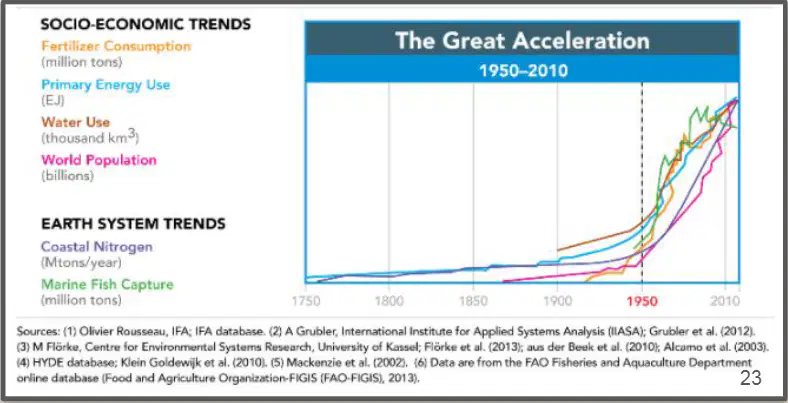
What is 'The Great Acceleration' ?
A) A period of slow human development
B) The rapid and widespread increase in human activity and its impact on Earth's natural systems
C) The extinction of species
D) The beginning of agriculture
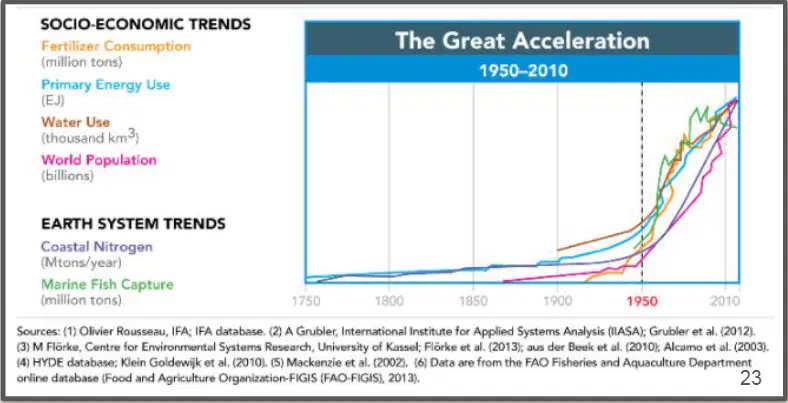
The Great Acceleration began around which year?
1750
1900
1950
2010
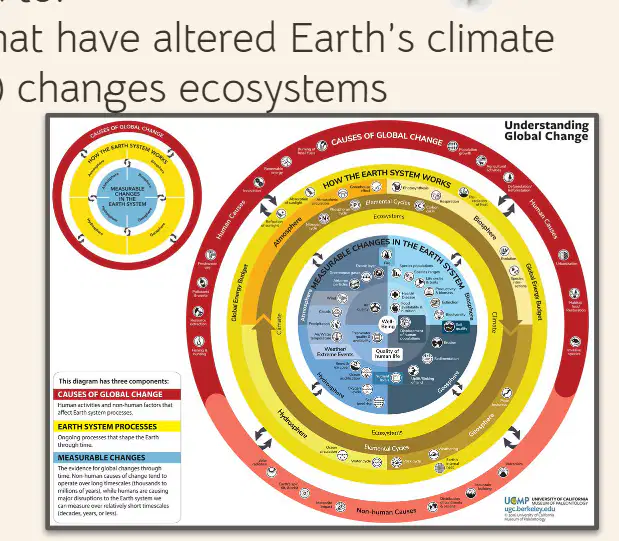
Invasive species are a human cause of global change.
True
False
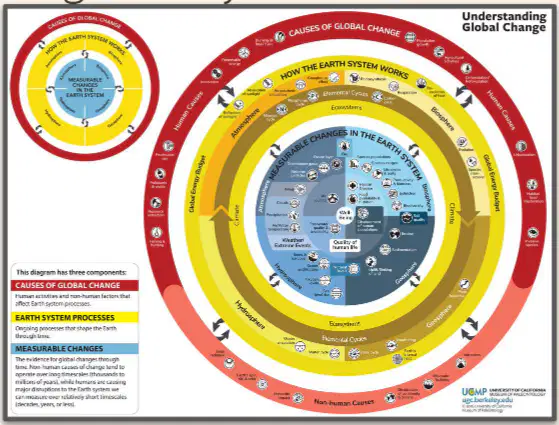
Fill in the blank. The spread of microplastics and other ________ all over the world is a human cause environmental destruction.
pollutants
nutrients
minerals
vitamins
According to quantitative data gathered all across the Earth, atmospheric carbon dioxide (CO2) levels have been (a) since the Industrial Revolution.
Most of the CO2 that is released into the atmosphere comes from:
Photosynthesis
Burning fossil fuels
Ocean absorption
Volcanic eruptions

If environmental conditions are altered beyond an organism’s tolerance range, which of the following is NOT a possible response?
Adapt (change behavior)
Emigrate to a more suitable location
Face extinction
Evolve a new trait during its life

If an organism cannot adapt, emigrate, or evolve, it may face extinction if environmental conditions change beyond its tolerance range.
True
False
________ are expected to increase or more intense due to changes in the climate.
Extreme weather events
Carbon dioxide levels
Sea level
Biodiversity
Sea ice/glaciers
What climate zone typically has the largest biodiversity?
Temperate
Tropical
Polar
Which greenhouse gas increases acid in the oceans and in rain?
Carbon dioxide
Methane
Water vapor
Nitric oxide
What helps decrease a person's ecological footprint?

