
 Worksheets
Materials Science Worksheet
Total questions: 35
Worksheet time: 18mins
________ is the term used to describe the controlled heating and cooling of materials for the purpose of altering their structures and properties.
Heat transfer
Heat treatment
Cryogenics
Thermodynamics
________ is a nonmetallic material.
Iron
Copper
Wood
Aluminum
In the equation e = ΔL/L, where ΔL is change in elongation, what is "e"?
Stress
Elongation factor
Strain
Strength
Force applied (F) to the part divided by cross-sectional area (A) resisting the force is defined as ________.
Stress
Elongation Factor
Strain
Strength
A is used to restore ductility after strain hardening of a low-carbon steel.
normalization process
stress-relief anneal
process anneal
Non-ferrous metals are usually heat-treated to .
produce a uniform, homogeneous structure
provide stress relief
bring about recrystallization
Which of the following is NOT a major way to increase the strength of metals?
Solid-solution strengthening
Strain hardening
Vulcanizing covalent bonds
Phase transformations
________ produces an increase in strength by means of plastic deformation under cold-working temperatures.
Solid-solution strengthening
Strain hardening
Precipitation hardening
Phase transformation strengthening
are selected to extract heat, providing the cooling rates needed to produce the desired structure and properties in the size and shape part being treated.
Additives
Pearlites
Austenites
Which of the following is not a common material used for quenching parts?
Water
Oil
Polymer
None of the above
If a steel doesn’t have enough carbon for hardening, the process of ______ may be used.
Laser hardening
Electron-beam hardening
Autoquenching
Carburizing
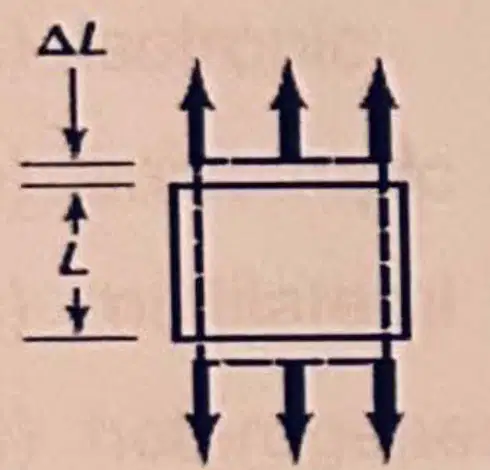
What applied force is best represented by the following picture?
Tension
Compression
Shear
Torsion
Almost 90% of all metallic fractures are in some degree attributed to ______.
corrosion
creep
plastic deformation
fatigue
The Modulus of Elasticity can best be thought of as the ______ of the material.
hardness
toughness
strength
stiffness
Malleability, workability, and formability all refer to a material's suitability for ___.
continuous process manufacturing
brittle shearing
welding and casting
The primary element in ferrous materials is ___.
Carbon
Silicon
Nickel
What kind of properties are described by features like density and melting point?
Physical properties
Mechanical properties
Metallic properties
Chemical properties
Which of the following material properties is responsible for deformation of metal without breaking/cracking?
Hardness
Endurance
Ductility
Toughness
A(n) ___ is a bond formed by sharing electrons.
ionic bond
metallic bond
Van der Waals force
In a ___ structure, atoms are placed at all corners of a cube and at the center of it.
simple cubic
face-centered cubic
hexagonal close-packed
___is responsible for the strain hardening or work hardening of a metal.
Elastic deformation
Plastic deformation
Recrystallization
Alloying
Properties that are not the same throughout the part are called ___.
isotropic
multilateral
heterogeneous
When metals are deformed, strength and hardness ___ while ductility ___.
increases, increases
decreases, decreases
Atoms in a metal are arranged in a three-dimensional geometric array known as a ___.
unit cell
nucleation
grain structure
Which of the following is considered when making equilibrium phase diagrams?
Pressure
Temperature
Composition
All of the above
Steel is primarily an alloy of ________.
iron and copper
copper and tin
iron and carbon
magnesium and carbon
What % carbon is the eutectoid composition for steel?
0.77%
5.0%
7.0%
77%
Cast iron by definition has to contain at least ________ % Carbon.
0.53
1.0
1.57
2.11
The temperature at which a material's toughness goes from high energy absorption to low energy absorption is known as the ________.
melting point
fracture appearance transition temperature
creep inducement temperature
ductile-to-brittle transition temperature
Which of the following is not a type of cast iron?
Gray
White
Nodular
Flaked
________ is a phenomenon of failure caused by long term exposure to elevated temperatures.
Fatigue
Creep
Thermal Shock
Oxidation
________ uses a 136 degree square-based diamond-tipped pyramid as an indenter.
Brinell Test
Vickers Test
Rockwell Test
Izod Test
When hardening steels, it is necessary for the steel to be heated to a temperature where it forms ___?
Bainite
Pearlite
Cementite
Which of the following is not a type of crystal imperfection?
edge dislocation
screw dislocation
substitutional atom
grain boundary
The properties and performance of a material are related to its structure and ___
shape
processing
color
country of origin

