
 Worksheets
APES Unit 4 Review
Total questions: 54
Worksheet time: 24mins

What type of plate boundary is shown here?
Convergent
Subduction
Divergent
Transform

What type of plate boundary is shown here?
Convergent
Subduction
Divergent
Transform
What type of plate boundary is most likely to cause earthquakes?
Convergent
Subduction
Divergent
Transform
What type of plate boundary is most likely to cause the formation of a new landform?
Convergent
Subduction
Divergent
Transform
Which soil particle is largest in diameter?
Clay
Silt
Sand
Loam
In which layer of the atmosphere does weather take place?
Troposphere
Stratosphere
Mesosphere
Thermosphere
Exosphere
Which layer of the atmosphere contains the ozone layer?
Troposphere
Stratosphere
Mesosphere
Thermosphere
Exosphere
What is the ozone layer?
A layer of pollution
A layer of still air with no wind
A zone that absorbs UV radiation from the sun
A zone that absorbs air pollution
Which wind system is closest to the equator?
Doldrums
Westerlies
Polar easterlies
Trade winds
As altitude increases, what happens to temperature?
Temperature increases
Temperature decreases
Temperature does not change with altitude
Which gas is there the most of in the atmosphere?
Oxygen
Nitrogen
Water vapor
Carbon dioxide
What is the shortest day of the year?
Summer solstice
Winter solstice
Spring equinox
Fall equinox
Which of the following items has the highest albedo?
Asphalt
Grass
Rooftops
Snow
ENSO events take place in which ocean basin?
Atlantic
Indian
Pacific
Arctic
Why does the Earth have seasons?
Tilt of the Earth on its axis
Earth's shape
Earth's rotation around the Sun
Earth's rotation on its own axis

What type of population growth is being shown in this population pyramid?
Rapid growth
Stable growth
Declining growth

Which month has the highest precipitation?
July
August
September
June
Which of the following would NOT lead to a decrease in TFR?
Increased access to birth control
Increased women's rights
Increased access to education
Improved drinking water
Which of the following is the largest carbon sink?
Atmosphere
Plants
Animals
Ocean
If a primary consumer contains 1,000 kcal of energy, the secondary consumer gains how much energy when it eats the primary consumer?
1,000 kcal
100 kcal
10 kcal
10,000 kcal
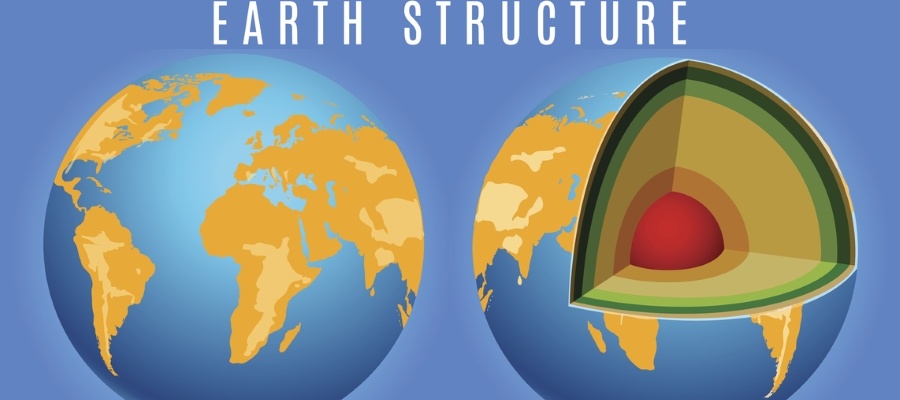
The surface of the earth, otherwise known as the ______, is broken into seven major pieces and sits atop a liquid layer called the _______
lithosphere, asthenosphere
astenosphere, mantle
crust, litosphere
asthenosphere, lithosphere
Sea surface temperature changes great than 0.5oC for greater than 5 months across the central tropical Pacific Ocean are known as
the arctic effect
the get stream
a typhoon
El Nino-Southern Oscillation

I. variation in the angle of sunlight that reaches Earth
II. variation in the amount of surface area over which the Sun's rays are distributed
III. variation in the amount of sunlight reflected from clouds


What type of event will occur at this boundary?
Earthquake
Volcano Eruption
Tornado
Mountain Building
Mountains are created when....
Two continental plates collide
Two oceanic plates pull apart
An Oceanic plate subducts under a Continental Plate
Two continental plates pull apart

The process by which the ocean floor sinks beneath a deep-ocean trench and back into the mantle is known as _______
convection.
continental drift.
subduction.
conduction.



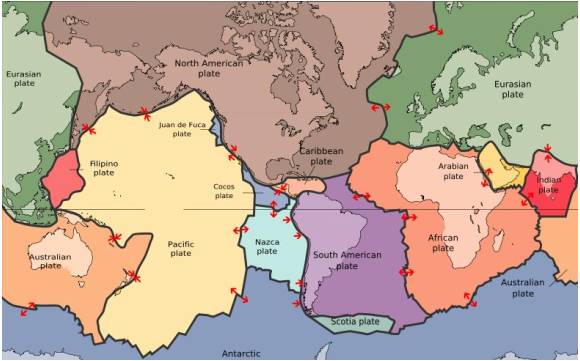
The map in the picture shows tectonic plate boundaries. This map would be useful in predicting the location of future
droughts
hurricanes
earthquakes
tornadoes
In which layer of the atmosphere does ozone help block UV radiation from striking the Earth?
troposphere
mesosphere
stratosphere
thermosphere
In which layer of the atmosphere do all the pressure, wind, and precipitation changes occur?
Outer space
stratosphere
troposphere
mesosphere

What layer of the atmosphere absorbs harmful ultraviolet radiation?
Troposphere
Stratosphere
Mesosphere
Thermosphere
Which of the following changes in eastern Pacific Ocean food webs is typically associated with La Niña events?
Decreased populations of squid
Decreased populations of anchovies
Increased phytoplankton concentrations
Increased famine among sea lions and seals

The image associated with this questions is an example of what natural phenomena?
La Nina
El Nino
Hadley Cells
Coriolis Effect

Which soil has 40% sand, 30% silt, and 30% clay?
Loam
Clay Loam
Sandy Clay Loam
Sandy Clay
The surface of the earth, otherwise known as the ______, is broken into seven major pieces and sits atop a liquid layer called the _______
lithosphere, asthenosphere
astenosphere, mantle
crust, litosphere
asthenosphere, lithosphere
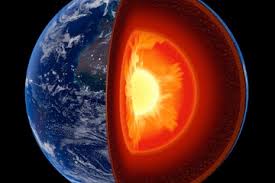
As you travel from the crust to the inner core, how would temperature and density of the material change?
The would all increase
The would all decrease.
They would stay the same.
Temperature would decrease, but pressure and density would increase.

