
 Worksheets
unit 2 adv procedures
Total questions: 52
Worksheet time: 27mins
Which sinus(es) is developed at birth and visible radiographically?
1. maxillary
2. ethmoidal
3. sphenoidal
4. frontal
1 only
1 and 4 only
2 and 3
3 and 4
Which of the following bone(s) is part of the calvarium?
Occipital
Temporals
Ethmoid
Sphenoid
Which of the following are the typical routineprojections for the following exam?
Skull
Select all that apply
Right Lateral
AP Axial Townes
PA
Left lateral
SMV
The CR location for a PA Skull projection is:
the nasion
Outer Canthus
1/2" - 1" superior to the glabella
the acanthion
A sinus series would include all of the projections below except:
Lateral
Townes
SMV
Caldwell
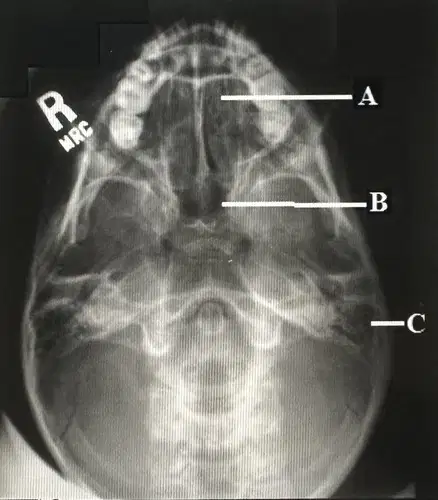
What is the anatomy at 'B'?
Temporal air cells
Ethmoid sinuses
Sphenoid sinuses
Mastoid air cells
The Rhese Method is done to demonstrate what specific anatomy?
Optic canal and foramen
Dorsum sellae
Frontal sinuses
Nasal bones
Which suture unites the frontal bone with the parietal bones?
Squanosal
Lambdoid
Sagittal
Coronal
The midpoint of the mental protuberance is termed:
mental poin
gonion
inion
vertex
When a patient cannot perform an AP Axial Townes, which method can be performed?
Haas Method; 25 degree caudal angle
Haas Method; 25 degree cephalic angle
Caldwell Method; 37 degree cephalic angle
SMV, using OML instead of IOML
Which suture unites the temporal bone with the parietal bones?
coronal
frontal
squamosal
sagittal
The protuberance on the posterior side of the occipital bone is called:
inion
exterion
lambda
asterion
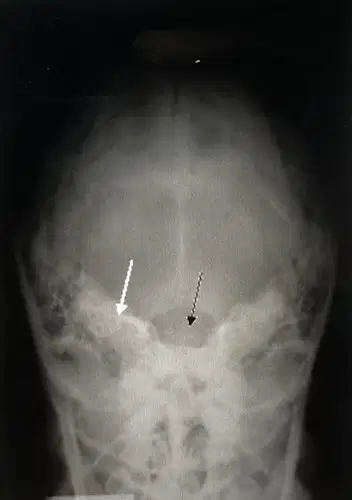
When accurately positioned, what is shown by the BLACK arrow in the image below?
Dorsum Sella of the sphenoid bone
Anterior clinoids of the sphenoid bone
Posterior arch of the Atlas
Clivus of the occipital bone
Which topographical line is parallel to the image receptor for an SMV?
ACL
IOML
MML
OML
The long axis of the orbit is projected obliquely at ___ to the MSP, and superiorly at ___ from the OML.
30 degrees, 37 degrees
37 degrees, 30 degrees
37 degrees, 53 degrees
53 degrees, 37 degrees
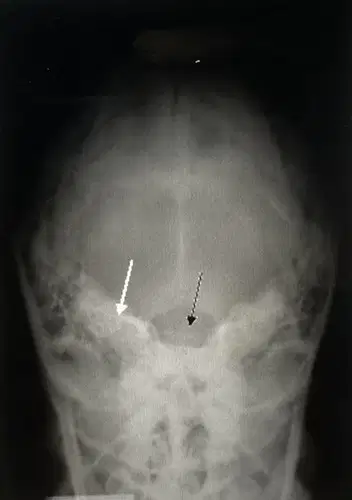
Which projection is shown in the image below?
PA Axial Caldwell for Skull
AP Axial Townes for Skull
PA Axial Modified Waters for Foramen magnum
PA Waters Method for Skull
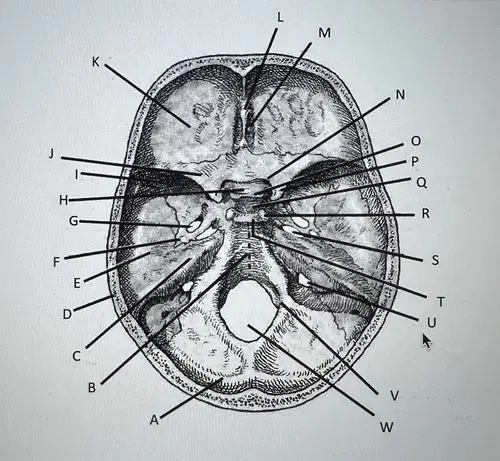
In the image below, what anatomy is labeled E?
Temporal bone
Parietal bone
Occipital bone
Sphenoid bone
The CR location for the SMV Skull projection is:
On MSP, passing 1 inch posterior to outer canthus
entering 1 inch inferior to the mental point
On MSP, 3/4 inch anterior to EAM
exiting 1 inch superior to inion
The CR angulation for the AP Axial Skull projection (reverse of a Caldwell) is:
30 degrees caudal
15 degrees caudal
37 degrees cephalic
15 degrees cephalic
When using the IOML for a AP Axial Townes Method for skull, what tube angulation is required?
15 degrees caudal
37 degrees caudal
30 degrees caudal
15 degrees cephalic
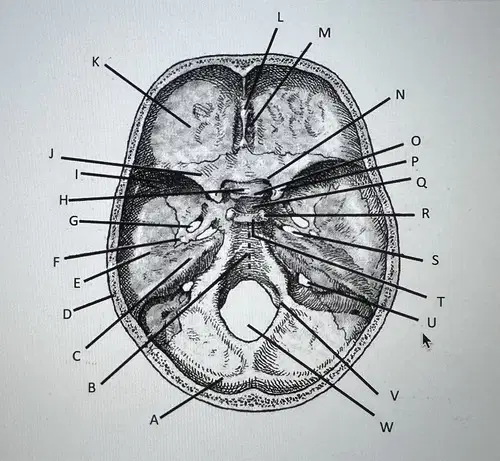
In the image below, what anatomy is labeled L?
Orbital plate
Lesser wing
Crista galli
Optic canal
Which sinus(es) are developed and distinguishable around 6 or 7 years of age.
maxillary
ethmoid and maxillary
frontal, ethmoid, and sphenoid
frontal and sphenoid
Which of the following are the typical routineprojections for the following exam?
SINUSES
Select all that apply
PA Axial Caldwell
PA Waters
SMV
Lateral of the Affected Side
PA Modified Waters
For the PA Waters method, the OML is placed at what angle to the IR?
30 degrees
35 degrees
37 degrees
55 degrees
On average, there is a ___ angle difference between the OML and IOML.
10 degree
7 degree
37 degree
53 degree
For an AP Trauma skull, which line should be placed perpendicular to the tabletop?
GML
Nasion
OML
IOML
The CR location for Lateral orbits projection is at:
the nasion
Outer Canthus
1/2 - 1" posterior to the outer canthus
2" above the EAM
Which sinus(es) will be best viewed in an SMV position?
1. Frontal
2. Ethmoid
3. Maxillary
4. Sphenoid
1 and 2
2 and 4
1 and 4
3 and 4
The junction between the sagittal suture and coronal suture is:
Lambda
Bregma
Pterion
Asterion
Which bone in the skull contains the organs for hearing and balance?
ethmoid
sphenoid
occipital
temporal
The petrous ridge and petrous portions are parts of which cranial bone?
temporal
sphenoid
ethmoid
occipital
What is the angle between the MSP and the plane of the IR for the Rhese projection?
15 degrees
20 degrees
37 degrees
53 degrees
A PA Modified Waters would require the OML to form a ___ angle to the IR.
55 degrees
37 degrees
15 degrees
30 degrees
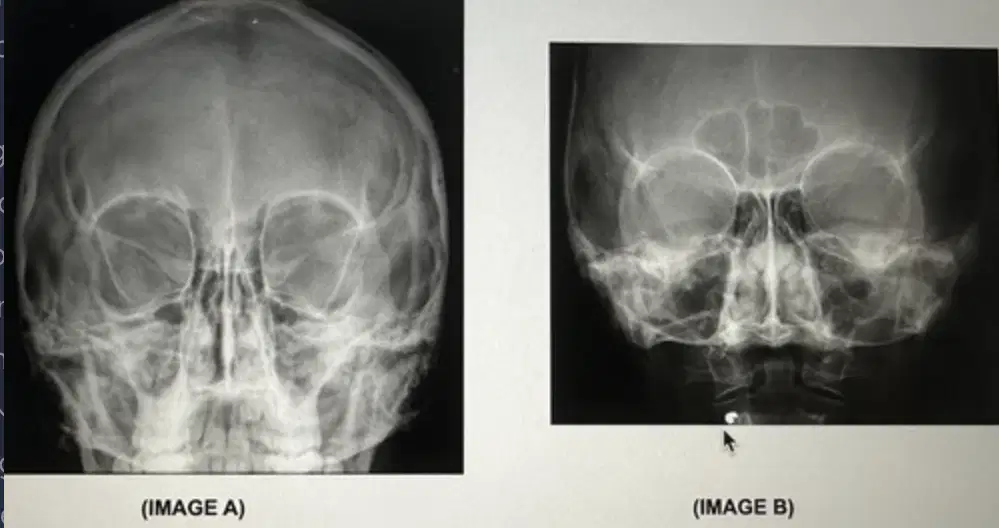
Which of the images below correctly demonstrates placement of the petrous ridges for a PA Caldwell for Orbits?
Image A
Image B
None of the images are acceptable for Orbits
Both of the images are acceptable for Orbits
A 30 degree caudal angle on a PA Axial Caldwell will place the:
Petrous ridges just below the orbits
Petrous ridges midway within the orbits
Petrous ridge midway within the maxillary sinuses
Posterior arch of C1 within the foramen magnum
Name the bony anatomy at the level of the acanthion:
nasal bones
inferior nasal spine
anterior nasal spine
frontonasal suture
Which view places the petrous pyramids below the maxillary sinuses, with the MML perpendicular to the IR?
AP Townes
PA Modified Waters
PA Waters
PA Caldwell
The open-mouth PA Waters for Sinuses is used to visualize which sinus(es) best?
1. Frontal
2. Ethmoid
3. Maxillary
4. Sphenoid
1 and 3
2 and 4
3
4
Which projection best demonstrates the frontal and anterior ethmoidal sinuses?
PA Axial Caldwell
PA Open-Mouth Waters
SMV
AP Townes
Which statement is true concerning the placement of the positioning line for the Rhese?
AML perpendicular to the plane of the IR
IOML perpendicular to the plane of the IR
GML line is 53 degrees to the plane of the IR
MML line is parallel to the plane of the IR
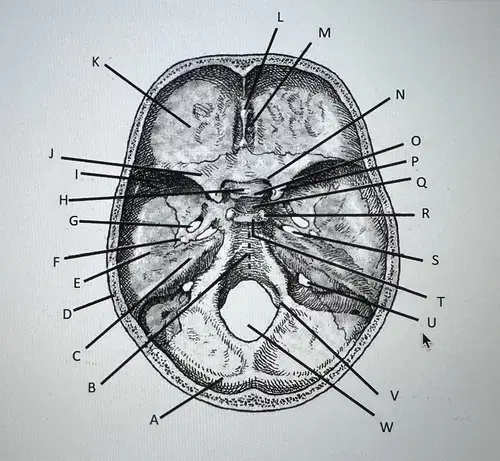
In the image below, what anatomy is labeled G?
Foramen spinosum
Foramen ovale
Foramen rotundum
Jugular foramen
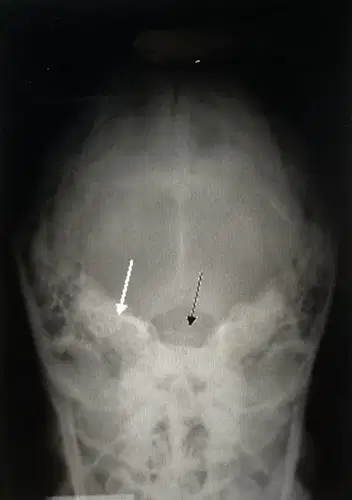
What anatomy is represented by the WHITE arrow in the image below?
Greater wing of the Sphenoid
Greater wing of the Petrous Pyramid
Petrous Pyramid of the Temporal Bone
Body of the Ethmoid Bone
The CR location for the Lateral Skull projection is:
the nasion
Outer Canthus
1/2" to 1" posterior to outer canthus
2" above the EAM
What is the proper angulation for a HAAS method?
25 degree caudal angle
25 degree cephalic angle
30 degree caudal angle
30 degree cephalic angle
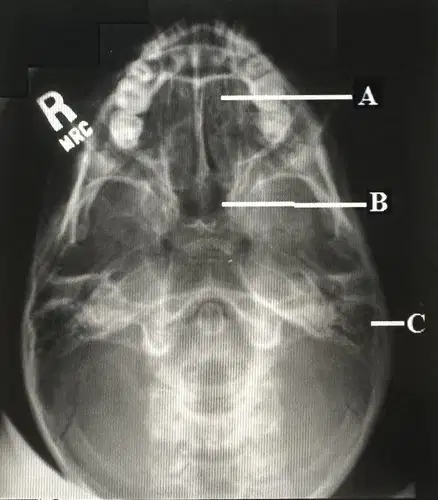
Image: What is at 'A'?
Sphenoid sinuses
Ethmoid sinuses
Frontal sinuses
Maxillary sinuses
How many cranial bones are there?
4
8
14
22
A true Lateral position would place the ______ parallel to the transverse axis of the IR.
AML
MML
OML
IOML
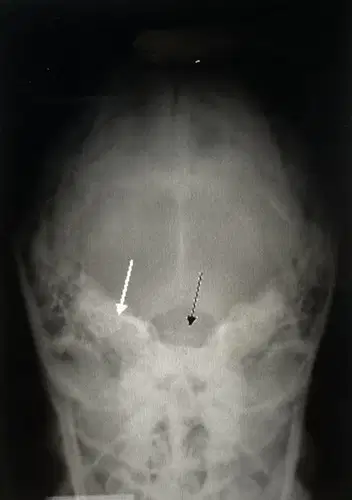
In the image below, this projection would require a 30 degree caudal angle when the _____ is perpendicular to the IR and the CR enters _______ inches above the glabella.
OML, 2 1/2
IOML, 2 1/2
OML, 1 1/2
IOML, 1 1/2
Proper CR placement for the AP Axial Townes Method will result in the beam exiting the:
Foramen Magnum
Nasion
Glabella
2 inches above the Glabella
When positioning for a PA skull, which of the following is used for accurate positioning?
A. CR exits the glabella
B. OML is perpendicular to the IR
C. IOML is perpendicular to the IR
D. MML is parallel to the front edge of the IR
CR exits the glabella
OML is perpendicular to the IR
IOML is perpendicular to the IR
MML is parallel to the front edge of the IR
Which of the following are the typical routine projections for the following exam?
ORBITS
Select all that apply
Bilateral Rhese
PA Axial Caldwell
PA Waters
Lateral of Affected Side
PA Modified Waters
Which of the following skull projections would best demonstrate the sella turcica in profile?
AP Axial Townes
SMV
PA Axial Caldwell
Latera

