
 Worksheets
Medieval Europe Unit Test
Total questions: 47
Worksheet time: 24mins
Name
Class
Date
1.
All of the following are effects of the collapse of the Roman Empire except?
a)
Disruption of trade
b)
Downfall of cities
c)
Loss of common language
d)
Increase in education
2.

What was the outcome of the Battle of Tours?
a)
Charles Martel stops the expansion of the Muslim empire into Europe
b)
Charlemagne further expanding the Frankish Empire
c)
The Crusaders take back Jerusalem from the Muslims
d)
The Vikings end the Carolingian dynasty
3.
Which of the following is a synonym for serf?
a)
Monk
b)
Noble
c)
Peasant
d)
Manor
4.
A tithe was a payment made to which type of person?
a)
A lord
b)
A vassal
c)
A priest
d)
A soldier
5.
Which Crusade was the only successful one for the Christians?
a)
First Crusade
b)
Second Crusade
c)
Third Crusade
d)
Fourth Crusade
6.
The most famous and respected Muslim leader, who create a peace treaty with Christians during the Crusades was:
a)
Richard the Lion-hearted
b)
Saladin
c)
Seljuk
d)
Pepin
7.

The English nobility forced King John to sign the Magna Carta which -
a)
Gave freedom to all English-born serfs
b)
Gave land to the nobles
c)
Increased the power of the Church
d)
Limited the King’s power
8.
The Church court used in Spain to persecute Jews and Muslims
a)
Bazaars
b)
Inquisition
c)
Moriscos
d)
Convertos
9.
Who led the French army to victory at Orleans against the English, but was burned at the stake for being a heretic?
a)
Charlemagne
b)
Pepin
c)
Joan of arc
d)
John Wycliffe
10.
The Church built religious communities called _____, where religious education was promoted.
a)
Monasteries
b)
Manors
c)
Castles
d)
Universities
11.
Which member of the feudal system was MOST tied to the land?
a)
Blacksmith
b)
Farmer
c)
King
d)
Serf
12.
One long-term effect of the Crusades was the
a)
Development of Pax Mongolia
b)
Fall of the Ming Dynasty
c)
Control of Jerusalem by Europeans
d)
Growth of trade and towns in western Europe
13.
What was the most important force in providing unity and stability throughout western Europe during the Middle Ages?
a)
Church
b)
Nobility
c)
Inquisition
d)
Military
14.
What is a primary characteristic of a feudal society?
a)
A representative government
b)
Economic equality for all
c)
Protection of individual rights
d)
An exchange of land for services
15.
Medieval is a word that means what in Latin?
a)
money
b)
prosperity
c)
middle
d)
rebirth
16.
What is another name for the Medieval Times?
a)
Golden Ages
b)
Bronze Ages
c)
Dark Ages
d)
Age of Rebirth
17.
What group formed the Germanic Kingdoms?
a)
Neanderthals
b)
Early barbarian tribes
c)
The Vikings
d)
The Frankenfurt clan
18.
Who established the most successful Germanic Kingdom?
a)
The Vikings
b)
The Vandals
c)
The Franks
d)
Germany royalty
19.
Which of the following was NOT a result of Germanic invasions?
a)
kids were forced into the military
b)
trade declined
c)
formal learning became rare
d)
loss of a common language
20.
Who founded the Merovingian dynasty that ruled the Franks for 200 years?
a)
King Cyprus
b)
King Clovinius II
c)
King Clovis I
d)
Emperor Otto IV
21.
The Battle of Tours ultimately stopped the spread of Islam into Europe. Who won this fight?
a)
Otto von Bismarck
b)
Emperor Henry IV
c)
King Clovis I
d)
Charles Martel
22.
Emperor Charlemagne was related to who?
a)
Charles Martel
b)
Otto von Bismarck
c)
Pepin the Short
d)
Lee the Great
23.
Which of the following is NOT one of Emperor Charlemagne’s accomplishments?
a)
provided women with increased rights
b)
expanded the Frankish empire
c)
spread Christianity
d)
encouraged learning
24.
Why was Charlemagne titled the “Holy Roman Emperor”?
a)
He was the most powerful ruler of all time
b)
He was of Roman descent
c)
He created a Christian empire
d)
People believed he was sent by God
25.
The Treaty of Verdun was signed in 843. What did it do?
a)
divided the empire into 3 kingdoms
b)
ended the Christian Muslim war
c)
elected King Leo as Emperor
d)
Established peace with the Ottomans
26.
Charlemagne’s death marked the end of…?
a)
Christian dominance
b)
a strong, central government in Western Europe
c)
democracy
d)
political equality
27.
Who did NOT contribute to the fall of the Carolingian empire?
a)
Turks
b)
Muslims
c)
Magyars
d)
Vikings
28.
Which group were seafaring people from Scandinavia?
a)
Vikings
b)
Vandals
c)
Mongols
d)
Magyars
29.
Which capital became the Muslim center of education/learning and the largest city in Western Europe?
a)
Sevilla
b)
Toledo
c)
Aleppo
d)
Cordoba
30.
After the fall of Rome, who filled in the power vacuum in Britain?
a)
Visigoths
b)
Vikings
c)
Angles and Saxons
d)
King Henry III
31.
What was the result of all the different invasions from foreign groups into Europe?
a)
system of feudalism
b)
dictatorship
c)
people wanted a new King
d)
people fled to the Americas
32.
What is the role of the Lord in the Manor system?
a)
he rules over the land
b)
he guards the castle
c)
he collects taxes from serfs who work the land
d)
he ensures the farmers are doing their daily jobs
33.
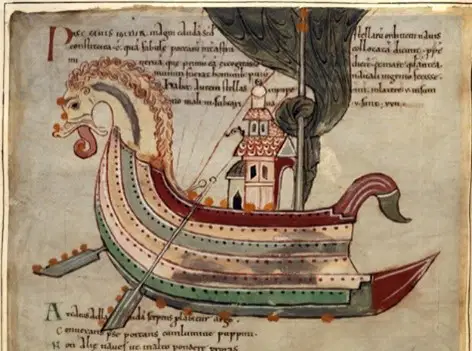
The image below depicts…?
a)
a viking ship
b)
King Leo's personal ship
c)
a traditional Chinese dragon float
d)
A Mongolian fishing boat
34.
King Alfred the Great had to defend England against…?
a)
Turkish conquest
b)
Viking conquest
c)
A Muslim war
d)
an inner revolution
35.
Henry II helped establish…?
a)
a legal system
b)
Common Law system
c)
Gender equality
d)
A European trade route
36.
The Magna Carta was a document that King John was forced to sign in 1215. This event did what for the very first time?
a)
established a tax system
b)
allowed women political freedom
c)
limited royal power
d)
implemented child labor
37.
In the Hundred Years War, who claimed that heavenly voices told him/her to save France?
a)
Charles de Gaulle
b)
General Leon de Paris
c)
Joan of Arc
d)
General Antoine of Nice
38.
In the late 700’s, who invaded Spain from North Africa?
a)
The Angolan government
b)
South Africans
c)
The Egyptian Empire
d)
Umayyad dynasty
39.
What was the only major source of religion in Medieval Europe?
a)
The Pope
b)
The Roman Catholic Church
c)
Greek Orthodox Church
d)
The Protestants
40.
Jerusalem is NOT considered the holy land for which of the following religions?
a)
Islam
b)
Christianity
c)
Buddhism
d)
Judaism
41.
What was the purpose of the Crusades?
a)
take back holy land from Muslim control
b)
expand the Christian empire
c)
build on the Muslim empire
d)
start a new religion
42.
Why did the Pope want a crusade?
a)
to maintain control of the empire
b)
to persecute all Muslims
c)
to increase power in Europe
d)
to discover new trade routes
43.
During the second crusade, who took part of Crusader states in Palestine?
a)
Arab Muslims
b)
Spanish Moors
c)
Seljuk Turks
d)
German Visigoths
44.
What was the overall effect of the Crusades?
a)
Feudalism breaks down
b)
Jews, Muslims, and Christians reunite in harmony
c)
The Byzantine empire strengthens
d)
trade declines heavily
45.
Where did the Bubonic Plague first reveal itself?
a)
Africa
b)
China
c)
India
d)
Europe
46.
Labor shortage due to the plague’s death toll eventually led to…?
a)
increased wages
b)
a decline in technological advancement
c)
industries shutting down
d)
increase in taxes
47.
How was Henry II able to own more than half the land in France?
a)
he bought it
b)
he seized the land through the use of force
c)
the people of England sacrificed their land as a sign of loyalty
d)
He married Eleanor of Aquitaine
100 %

