
NEW
Font size
 Worksheets
weather and climate
Total questions: 45
Worksheet time: 27mins
Red light has a(n) ____________________ wavelength compared to violet light.
shorter
longer
equal
A natural process called _____________________ holds heat in Earth's atmosphere.
the electromagnetic effect
the greenhouse effect
the infrared effect
the global warming effect
Energy from the sun travels to Earth in the form of ____________________________.
electromagnetic waves
electric waves
magnetic waves
sound waves
About 50% of the sun's energy that reaches Earth is _________________ by land and water, which becomes heated.
scattered
reflected
absorbed
radiated
The direct transfer of energy by electromagnetic waves is called radiation.
true
False
Electromagnetic waves are classified by the height of the wave color.
True
False
____________________ occurs when particles and gases in the atmosphere disperse light in all directions.
radiation
reflection
scattering
absorption
The form of radiation that is similar to heat is
infrared
visible light
ultraviolet
radio waves
The form of radiation that can be seen on earth is
infrared
visible light
ultraviolet
radio waves
Why are the top three layers of the atmosphere important for life on Earth?
They cool down the sun's radiation.
They reflect all of the sun's radiation.
They absorb most of the sun's radiation.
They convert the sun's radiation to power.
Warm air _____.
rises and expands
sinks and shrinks
rises and shrinks
sinks and expands
Cool air _____.
rises and expands
sinks and shrinks
rises and shrinks
sinks and expands
Wind blows from areas of ____ to ______pressure.
low to high
high to low
just kidding air pressure doesn't effect wind
Wind blows from areas of ____ to ____ TEMPERATURE
warmer to cooler
cooler to warmer
just kidding temperature doesn't effect wind
The air above the land will be warmer during the day because the air closest to the land is heated by _____.
radiation
convection
conduction
just kidding land temperature doesn't affect air temperature
Global winds are caused by ___.
mother nature being angry
the land heating faster than the water
more sunlight hitting the equator than the poles
Local winds are formed because
land heats and cools faster than water
the equator gets more sunlight than the poles
lots of people running their air conditioners and fans
We discussed two types of local winds
land breezes and sea breezes
trade winds and westerlies
jet streams and doldrums
These global wind belts occur blow from east to west between 0 and 30 degree of latitude near the equator
polar easterlies
prevailing westerlies
trade winds
doldrums
These global wind belts blow from west to east in the mid latitudes (30-60 degrees).
trade winds
doldrums
polar easterlies
prevailing westerlies
These global wind belts blow from east to west near the poles.
trade winds
doldrums
prevailing westerlies
polar easterlies
This phenomenon occurs when Earth's global winds curve because the Earth is spinning.
Trade Winds
Coriolis Effect
Jet Streams
local winds
Wind forms when warm air rises and cool air sinks and rushes in to take its place. This is an example of ___.
conduction
convection
radiation
completion
During the day a _____ blows from the sea to the land.
sea breeze
land breeze
jet stream
coriolis effect
At night, a ________ blows from the land to the sea
sea breeze
land breeze
Coriolis effect
jet stream
Winds are always named for _______________.
where they come from
where they blow towards
the person who discovered them
their temperature
What is the energy source for the water cycle?
the Sun
the Earth
water
the Moon

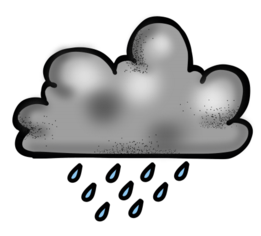
What part of the water cycle does this picture show?
condensation
precipitation
evaporation
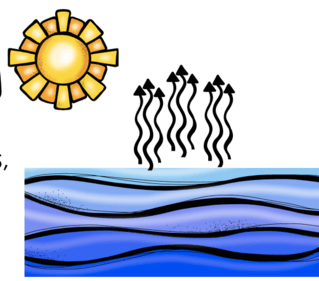
What part of the water cycle does this picture show?
condensation
precipitation
evaporation
What part of the water cycle does this picture show?
condensation
precipitation
evaporation

When water condenses, the water vapor in the air gets ___________ and changes back into liquid.
cold
hot
warm
solid
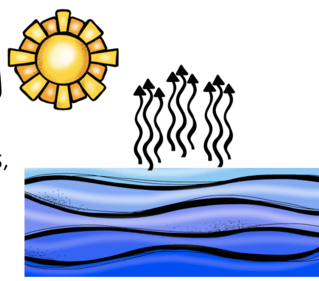
Evaporation happens when the sun ___________ water and turns it into vapor.
cools
heats up
freezes
lights up

What does groundwater do?
It sends water to our buildings, houses, and water transplant places
to the sky
to the sun
To the Earth's surfaces
Which of these is an example of precipitation?
snow
air
clouds
vapor

What is it called when plants give off water vapor as a waste product?
condensation
evaporation
sublimation
transpiration
Which best explains why runoff is important?
It returns water to other locations on Earth
It increases the chance of flooding
It makes evaporation occur faster
It increases condensation
Rain soaks into the ground
Infiltration
Condensation
Throughflow
Surface runoff
The water cycle has no start or end
True
False
Rain, snow melt, or other water that flows in surface streams, rivers, or canals.
condensation
surface runoff
humidity
evaporation

What process is happening in number 6?
transpiration
evaporation
condensation
accumulation

What is number 1 in the diagram?
condensation
evaporation
runoff
precipitation

What is number 3 in the diagram?
evaporation
precipitation
surface runoff
condensation

The process in which some water within plants evaporates into the atmosphere.
evaporation
transpiration
condensation
precipitation

The process by which molecules of water vapor become liquid water.
transpiration
evaporation
condensation
accumulation
How does water from the ocean become different forms of precipitation?
Water evaporates; precipitation falls; the sun warms the ocean water; clouds form
Clouds are formed through condensation, the sun warms the ocean water; precipitation falls; water evaportates
Precipitation falls to the ground; clouds form;the sun evaporates water from the ocean
The sun warms the ocean; water evaporates and then condenses into clouds; precipitation falls to the ground.

