
 Worksheets
World History AP Modern Review
Total questions: 28
Worksheet time: 27mins
Match the following definitions to the appropriate terms.
Roadside inns found along the silk roads that were spaced about 100 miles apart
Caravanserai
Trading cities that grew along the Silk Roads
Samarkand & Kashgar
System of credit that allowed a merchant to deposit paper money under his name in one location and withdraw the same amount at another location
Flying cash
Chinese invention; used paper bills as currency instead of heavy metal coins
Paper money
Large Chinese ship for carrying trade goods
Junk
Match the following historical developments to the theme that is MOST appropriate.
Silk Roads, paper money, and flying cash
Economics
The fall of Baghdad, the fall of the Song Dynasty, and the rise of the Mongol Empire
Politics
The magnetic compass and the stern rudder
Innovation / Technology
The spread of the Black Death from Asia to Europe due to infected fleas on rats, which followed the trade caravans
Environment
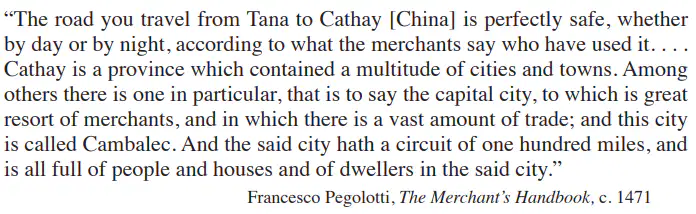
Which statement about China and trade does this passage best support?
Trade between Europe and Cathay was greatly enhanced by the security established by the Mongol and Ming Empires.
Merchants rarely traveled between Tana and Cathay because the road was very dangerous.
Cambalec was an important trading hub, but it was not a large city.
The author felt the risks of trade with China outweighed the rewards.
Which development was the turning point that led to the expansion of trade between Asia and Europe?
The formation of the Silk Roads by Marco Polo allowed goods from Asia to be imported into Europe for the frst time.
The conquests by Mongols, which led to improved trade routes and reduced trading costs.
The invention of silk cloth during the early Mongol rule allowed the Mongols to trade for pottery, wool, and other European goods.
The invention of paper money by Venetian bankers helped to facilitate trade between Europe and Asia.
Match the following definitions to the appropriate terms.
Latin for "Mongolian Peace". Century long period of peace that followed the Mongol conquest of Eurasia
Pax Mongolica
King
Khan
Establish by Kublai Khan, Genghis Khan's grandson, to replace the Song Dynasty after the Mongol conquest.
Yuan Dynasty
Established by the Buddhist monk Zhu Yuanzhang in 1368. Overthrew the Mongol's Yuan Dynasty. Ruled China from 1368-1644.
Ming Dynasty
Led by Batu, Genghis Khan's grandson. Conquered much of Russia and eastern Europe.
Golden Horde
Match the following Mongol attempts at conquest to their outcome.
Failed. The Mongol envoys were executed and their heads displayed on the Cairo gate. The Mongols lost the battle of Ain Jalut because their enemy was unified and prepared.
Mamluk Sultanate
Failed the first six attempts. Finally succeeded on the seventh invasion.
Korea
Succeeded in 1258. Executed the Caliph of the Abbasid Caliphate and massacred around 1 million citizens.
Baghdad
Failed twice. Both times the Mongols were held back by samurai armies and their fleets were destroyed by tsunamis.
Japan
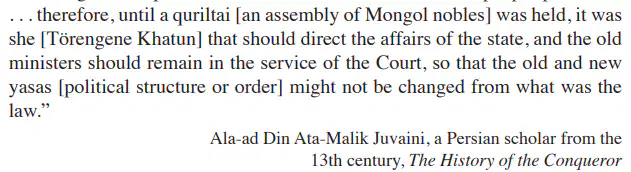
Based on the passage, what can be inferred about the status of women in Mongol society compared to women in the Song Dynasty and Dar al-Islam c. 1250?
The Mongol culture was more accepting of women in power than the cultures of the Song Dynasty or Dar al-Islam.
The women in the Song Dynasty ran the government while the men were subject to foot-binding.
The women in Dar al-Islam ran the government while the men were held as concubines in harems.
Women were of essentially equal status throughout all societies c. 1250.
Match the following definitions to the appropriate technological innovations.
Muslim navigators used it to aid navigation by determining their distance from the equator.
Astrolabe
Possibly an Arab invention; their triangular shape could easily catch winds coming from many different directions.
Lateen sail
Chinese invention which gave their ships more stability and made them easier to maneuver.
Stern rudder
Chinese invention; aided ship navigation by always pointing north.
Magnetic compass
Large Chinese ship for carrying trade goods.
Junk
Match the following trading locations to the main products they exported (sent out for trade).
Gold, ivory, and slaves.
Swahili Coastal Cities (East Africa)
Cotton, carpets, steel, and pepper.
Calicut
(Vijayanagara Empire)
Trade city at the midway point between the eastern and western Silk Roads
Samarkand
Nutmeg, cinnamon, cloves, and other spices.
Spice Islands
(Malaysia / Indonesia)
Silk, porcelain, tea, paper, gunpowder
Yuan Dynasty/ Ming Dynasty (China)
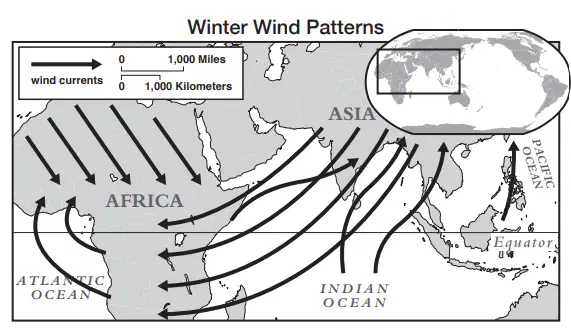
The map helps explain why South Asian merchants preferred to travel
to Africa in the winter months
to Southeast Asia in the winter months
to China in the summer months
to the Middle East in the summer months
Since merchants were often delayed in foreign ports for lengthy periods of time, they frequently
became involved in local political affairs
married wives who often converted to their religion
lost their connection to the culture of their homeland
settled in the foreign port and converted to the local faith
Some of the wind currents show in the map are monsoon winds. How did monsoon winds affect merchant activity in the Indian Ocean Basin?
Understanding of the patterns of monsoon winds facilitated merchant activity because merchants could predict the best times to make a voyage.
Lack of understanding of the monsoon winds facilitated merchant activity because merchants used technology like nuclear reactors to sail their ships.
Monsoon winds had no effect on merchant activity in the Indian Ocean Basin.
Understanding of the patterns of monsoon winds facilitated merchant activity because merchants could use monsoon winds to go where they wanted at any time.
Which of the following accurately explains an interaction between culture and economics?
Muslim merchants helped spread Islam along trade routes and the Islamic religion held merchants in high regard because the founder, Muhammad, had once been a merchant.
Buddhist merchants helped spread Buddhism along trade routes because the highest goal of Buddhism is to gain wealth.
Confucian merchants helped Confucianism spread outside of China because, in the Confucian philosophy, merchants were the highest rank in the social order.
Mongol merchants helped spread belief in the Blue Sky God as they peacefully traded because the Mongol religion forbids the taking of human life.
A diaspora is a settlement of people away from their homelands. Current examples of diasporas include the "Chinatowns" found in many American cities, the "Little Havana" Cuban neighborhood in Miami, Florida, and the 1.6 million strong Jewish community in New York City.
In one or two sentences, describe how a diaspora might affect the culture of the place they settle.
(Hint: culture includes not only religion, but also food, music, clothing, holidays, language, traditions).
Zheng He was a Muslim, Chinese admiral of the Ming Dynasty who led a great fleet throughout the Indian Ocean (1405-1433). After his voyages, the Ming Dynasty stopped such voyages and shut itself off from the world.
Which aspects of Chinese culture likely played a role in the Ming Dynasty's decision to shut itself off from the world?
Confucian philosophy had always been very open to outside influence and this interacted with the Chinese view that all societies were equal
Confucian philosophy put forth a strict social hierarchy and this interacted with the traditional Chinese sense of superiority towards the outside world.
The Chinese traditionally followed Islam which argued for equality of all believers, and this led to a Chinese sense of superiority towards the outside world.
The Chinese traditionally followed Hinduism which put forth a strict caste system, and this led to a Chinese sense of superiority towards the outside world.
Using the chart on page 104, match the best pack animal to each situation.
Carrying a heavy load across 100 miles of scorching desert with no water until you reach your destination.
Camel
Carrying the heaviest load a short distance (from one village to the next) when speed is not essential.
Ox
Carrying you into battle, where speed and precise control are essential.
Horse
Carrying a moderate load across a range of tall, snow-covered mountains.
Llama
Use pages 105-106 to match the following definitions to the appropriate terms.
Founded Mali in 1235. Known as the "Lion Prince". Established Mali's gold trade.
Sundiata
Mansa Musa, marvelous Muslim monarch of Mali, who marched to Mecca and made many mosques.
Grand nephew of Sundiata. Richest ever.
Great city in the Mali Empire that became a center of Islamic learning.
Timbuktu
Financed Mali's government and military, making them wealthy and powerful enough to conquer resource-rich areas
Taxes on the gold trade
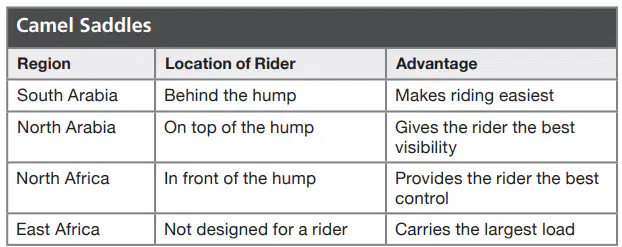
Which was the most important impact of the improvements in saddles in assisting the spread of Islam in Africa?
They allowed younger people to ride camels.
They increased the demand for camels.
They contributed to increased trans-Saharan trade.
They strengthened Islamic armies.
The information on camel saddles is an example of how
people adapted technology based on their needs
differences in camels suited them for different tasks
innovation results from outside influences
climate variations influenced the relationship between people and animals
Identify ONE example of transportation technology that led to growth in interregional trade during the period 1200–1450.
Camel saddles
The fall of the Mali Empire and the rise of the Songhai Kingdom
Muslim merchants helped spread the Islamic religion throughout North and West Africa
The Pax Mongolica ensured safety for merchants and travelers along the Silk Roads
Use page 116 to match the following descriptions to the travel writers they best describe.
Italian who traveled to China and described the Mongol Empire. As the son of a merchant, he often focused on economic matters.
Marco Polo
An Islamic scholar, he spent 30 years traveling to Muslim lands all over Afro-Eurasia and wrote about culture, especially the Islamic religion.
Ibn Battuta
English mystic and mother of 14 children. She made pilgrimages to many Christian holy sites.
Margery Kempe
Spread the Black Death plague all the way from Asia to Europe by hitching rides on caravans along the Silk Roads.
Infected fleas traveling on rats
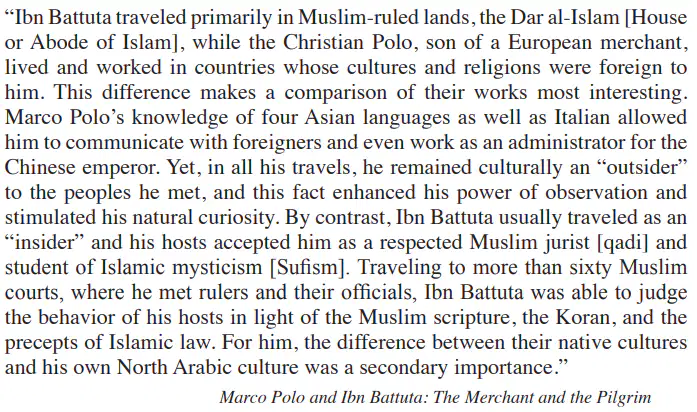
Which of the following would have been most likely to “set the stage” for Marco Polo to have been able to travel to the lands that he did?
The Pax Mongolica
The voyages of Vasco da Gama
The conquests of the Umayyad Dynasty
The development of the printing press
Which of the following were most responsible for infuencing the point of view of the travelers mentioned in the passage?
Religion and economics
Military and technology
Social hierarchy and governance
Religion and philosophy
Which of the following statements most accurately describes the difference in the worlds in which Polo and Ibn Battuta traveled?
(Hint: reread the descriptions on page 116 if you're not sure).
Polo traveled to areas that shared his language and religion while Ibn Battuta traveled to areas that did not.
Polo traveled primarily to areas that were less prosperous than where he grew up while Ibn Battuta traveled primarily to areas that were more prosperous than where he grew up.
Polo traveled to regions very different from Europe while Ibn Battuta traveled mostly within the Islamic world.
Polo traveled to regions that Europe was closely connected to while Ibn Battuta traveled to regions that were not closely connected to his home region.
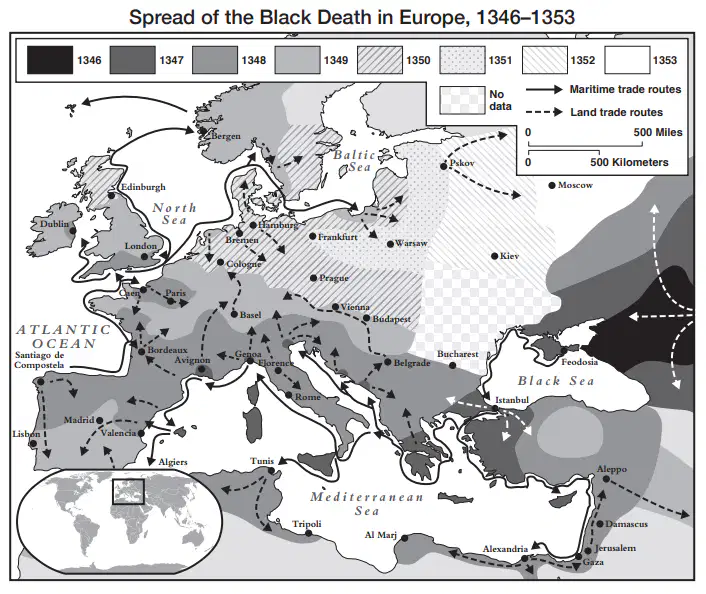
Which explanation for the cause of the rapid spread of the Black Death is best supported by this map?
The migrations of Central Asians into eastern Europe
The spread of rodents through trade
Pollution caused by growing concentrations of people in cities
Poverty among Europeans resulting from feudalism
One signifcant long-term impact of the Black Death was
the end of the Indian Ocean as a viable trade network
the decline of the feudal system in Europe
the increased use of camels in the Silk Roads trade
the rise of the Ottoman Turks
(Page 123) One way in which the Black Death affected the feudal system in Europe was:
As Black Death killed so many, agricultural production declined. However, each person’s labor became more valuable, so workers could demand higher wages.
As the population grew, agricultural production grew along with it.
As Black Death killed so many, agricultural production increased, and the manorial system became more efficient.
As Black Death killed so many, agricultural production declined. However, wages went down because there were plenty of workers available.
(Pages 121-122) Match the following agricultural advancements to the correct description.
Given to the Chinese by Vietnam. It is drought-resistant, flood-resistant, and yields two crops per year.
Champa rice
Introduced to Sub-Saharan Africa from Indonesia. Supplemented yams.
Bananas
Came from Southwest Asia but were widely grown and sold near cities like Samarkand.
Citrus fruits (Limes, oranges, etc.)

