
Font size
S
M
L
XL
 Worksheets
PMI ACP Full Mock 1
Total questions: 120
Worksheet time: 2hrs 0mins
Name
Class
Date
1.
At a product demo, stakeholders express their displeasure with a delivered feature, even though it met the acceptance criteria. What should the agile practitioner do?
a)
Reopen the story and extend the current sprint to ensure that the feature meets stakeholders’ updated criteria
b)
Translate the feedback into actionable and testable acceptance criteria and create a new story in the backlog
c)
Ask the stakeholders to approve user stories before they are added to a sprint
d)
Ask the design team to design prototypes before any story is added to a sprint
2.
A team is having difficulty engaging the customer. The customer rarely responds to questions and frequently skips the iteration reviews and demos but still expects the product to be delivered on time and meet expectations.
What should the agile practitioner do?
a)
Educate the customer on the importance of their active participation
b)
Have the team make educated decisions using expert judgment
c)
Stop development to perform additional requirements gathering
d)
Ask the product owner to obtain the necessary customer feedback
3.
A project stakeholder wants to know if a specific feature will be included in the next release. What should the agile project manager do to address this request?
a)
Add resources to the project team to increase velocity and ensure project commitments are met
b)
Divide feature size by team velocity and provide a commitment of inclusion to the stakeholder
c)
Reorganize the team structure to maximize velocity and increase the probability of delivery
d)
Communicate the priority of that feature and a degree of confidence based on team velocity
4.
An agile team is preparing for a project that involves a lot of uncertainty and potential for change. What should the agile practitioner and the project team do during initial planning to produce a reliable and realistic plan?
a)
Recommend a short duration of overtime work to mitigate schedule risk
b)
Create a buffer in the schedule to allow for changes to the product backlog
c)
Identify and incorporate extra team members into the project
d)
Mitigate schedule risk by adding extra points to all estimations
5.
A stakeholder has established goals for a new project and the project team. What should the agile practitioner do to ensure that team and stakeholder goals are aligned?
a)
Facilitate regular communication of stakeholder and team goals and expectations
b)
Implement stakeholder-provided incentive funds for attained goals
c)
Request communication of established goals by the product owner
d)
Designate a team member to review stakeholder goals during each retrospective
6.
A team member realizes that a task is taking longer than originally estimated.
What should the agile practitioner have done to avoid this situation?
a)
Divided the task into multiple parts
b)
Allocated more time for planning
c)
Planned for longer sprint times
d)
Facilitated all collaboration meetings
7.
The same product owner is assigned two projects: Project X, and Project Y. The product owner is focused primarily on Project Y because they are an expert on the features being developed for that project. Project X's iteration end dates have not yet been compromised, but the team's velocity has been reduced due to the lack of attention from the product owner.
What should the agile practitioner for Project X do to handle this situation?
a)
Engage the product owner to ensure they understand the impact on velocity
b)
Meet with the product owner to confirm vision and commitment
c)
Inform the project sponsor and request a dedicated project owner
d)
Adjust the iteration end dates to accommodate the product owner's availability
8.
A sprint review did not go well. The team has many doubts about the process, and the resulting product quality is questionable.
What should the agile practitioner do next?
a)
Conduct a team retrospective session to develop a corrective action plan
b)
Encourage the team to try to recover the time in the next iteration
c)
Submit a request to the management team for additional team members
d)
Mentor each team member and ask them to improve their velocity
9.
During an iteration planning meeting, a team can form estimates for some tasks, but more information is required for other tasks. The agile practitioner wants to ensure the meeting is efficient and finishes on time.
What should the agile practitioner do?
a)
Include research time in the iteration plan
b)
Hold a planning session to quickly resolve the issue
c)
Plan the iteration by providing overestimates of tasks
d)
Add a root cause analysis to the iteration plan
10.
During a sprint review, a stakeholder raises a concern about packaging for final deliverables. A risk has been identified that the final packaging may be unsuccessful if it follows the design of previous releases.
What should the agile practitioner do?
a)
Add packaging to the backlog and prioritize it so that it will be addressed just prior to release completion
b)
Add a story to the top of the backlog to address final packaging
c)
Consult with the product owner to determine how to proceed
d)
Document the risk for the next release because stories for this release are locked and inform the stakeholder
11.
During the initial planning session, the team identifies added nonfunctional work. The product owner sees no value in this and wants to exclude it from the product backlog.
How should the agile practitioner proceed?
a)
Allocate a portion of an iteration to address the added nonfunctional work
b)
Calculate the time needed to complete the added nonfunctional work, and increase the time estimates of individual tasks
c)
Insist that the nonfunctional work be included and prioritized in the product backlog
d)
Collaborate with the product owner and postpone developing the added nonfunctional work until project completion
12.
During an iteration, a team completes a refactoring segment of system architecture work. What should the practitioner present during the iteration review?
a)
A demonstration of the tests that prove the work was done
b)
A display of the architectural development code
c)
The details of the architectural development process
d)
The features to be presented in future iteration review meetings
13.
An organization is transitioning to an agile framework. Management mandates specific times for daily coordination meetings. How should the agile practitioner respond?
a)
Explain to management that team ground rules are owned by the team
b)
Invite management to a coordination meeting to justify the mandate
c)
Enforce the new meeting times as mandated by management
d)
Ask management to own the meeting time based on workload
14.
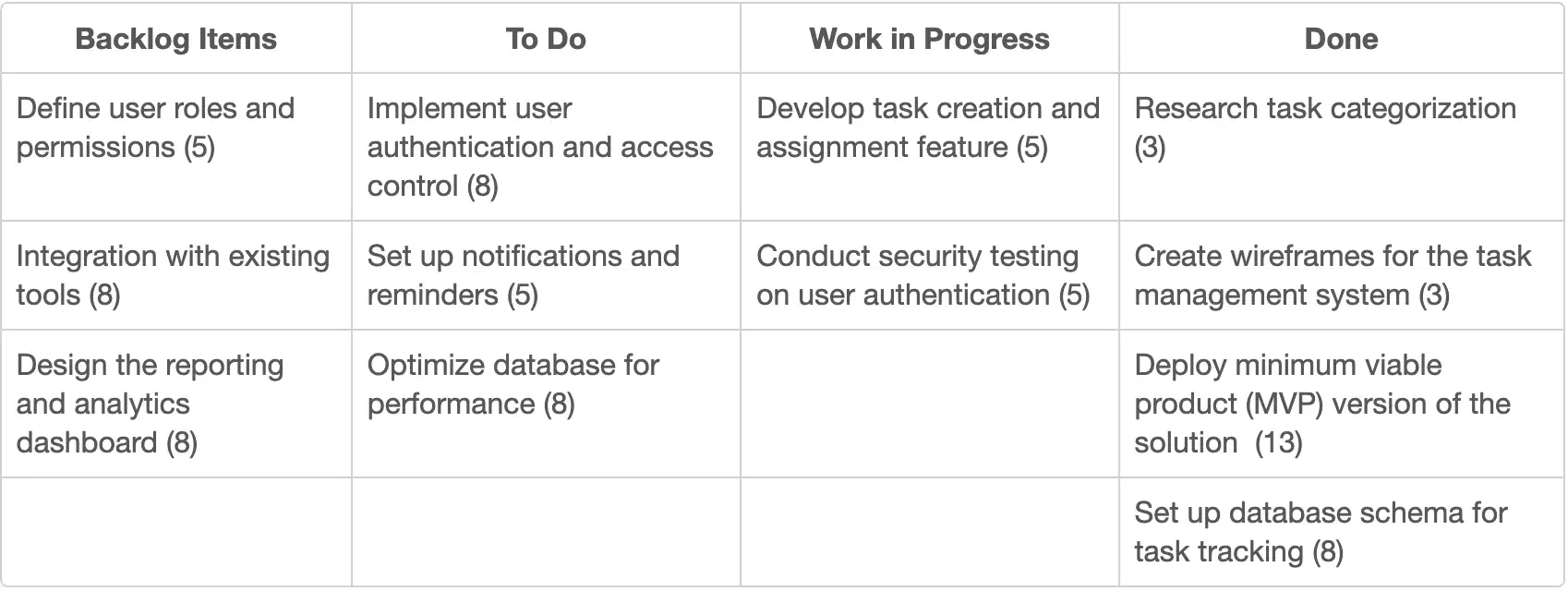
A team is building an internal task-tracking solution to improve organizational workflow management. The team is using the board below to visualize and track the progress of the work.
Based on the visual above, which statement about the project’s status is true?
a)
The project is only halfway through execution and is at risk of missing the delivery date.
b)
The backlog must be reprioritized to increase the probability of delivering the solution on time.
c)
The project is in good standing, with the MVP complete and the main features in progress.
d)
The number of tasks in the work in progress (WIP) column indicates that the team is overloaded.
15.
An agile practitioner needs to ensure that their end product satisfies business requirements. How should the agile practitioner achieve this goal?
a)
Ensure customers attend product review meetings
b)
Ask the project team to submit regular reports to key stakeholders
c)
Obtain agreement from the product owner on business requirements
d)
Invite other product owners to product review meetings
16.
A senior agile practitioner advocates an agile framework for new IT projects, but the team has reservations.
What should the agile practitioner do to ensure that the team is aligned with this?
a)
Obtain buy-in from leadership by presenting the advantages of agile principles and processes
b)
Issue a memo of understanding that agile principles should be implemented for all new projects
c)
Introduce agile principles and processes and make the change an experiment to obtain buy-in
d)
Require all staff and management to attend agile training meetings and adhere to agile principles
17.
During an iteration, the product owner insists that a feature must have a response time threshold. The team explains that this requirement presents technical challenges, but does not jeopardize the iteration’s goal.
What should the product owner do?
a)
Request that the team work overtime to satisfy this requirement
b)
Cancel the iteration if the team cannot satisfy this requirement
c)
Tell the team to prolong the iteration to satisfy this requirement
d)
Add a new user story to the backlog to satisfy this requirement
18.
Several issues were raised during the demonstration of a completed product release to the customer. The team is confused because the product matches the requirements.
How could the agile practitioner have mitigated this situation?
a)
Ensured active customer participation and feedback throughout the development process
b)
Defined all of the customer’s requirements in detail during the initial contract negotiations
c)
Implemented a change request ticketing system to initiate formal requests
d)
Delayed customer demonstrations until all product requirements are identified
19.
A stakeholder would like to understand the development plan and see the product while it is being built. However, some of the team members are not happy about the stakeholder’s involvement.
What should the agile practitioner do?
a)
Support the team and ask the stakeholder to refrain from engaging in the development process
b)
Educate the team on the importance of stakeholder engagement during the development process
c)
Inform the stakeholder of the team’s opinion about stakeholder involvement and request escalation
d)
Communicate the team’s opinion to senior management and request an official resolution strategy
20.
An agile practitioner notices that team velocity is affected because a product owner writes poorly defined requirements. What should the agile practitioner do?
a)
Work with the product owner and the team to clearly define user stories
b)
Request that the product owner take training to clearly define user stories
c)
Instruct the team to take responsibility and obtain all clarifications
d)
Empower the team by asking a team member to provide clarification
21.
A team is halfway through a project. One of the stakeholders reports to the product owner that a central component of the project is not important to users. The team has completed 25% of this component, which was included in the approved scope and was a significant selling point for the project.
What should the product owner do?
a)
Suggest that the project team stop the development of the component
b)
Discontinue the component after gaining approval from the change control board (CCB)
c)
Recommend that the project team continue the development of the component as planned
d)
Conduct a sprint review meeting to decide what to do with the component
22.
An organization that currently uses traditional methods wants to transition to agile. An initial assessment reveals that the organization’s culture is not ready to adopt agile practices. The agile practitioner spends the next three months influencing, educating, and training people in the organization.
What should the agile practitioner do next?
a)
Perform a follow-up assessment and analyze the results
b)
Recommend maintaining traditional processes
c)
Implement coordination meetings and retrospectives
d)
Conduct pilot projects using agile frameworks
23.
During the first few iterations, an agile project team created product documentation. Near the end of the contract, the customer says that the documentation inaccurately reflects the final product release and is out of date.
What should the agile practitioner have done to avoid this problem?
a)
Allocate time during each iteration to perform changes and regularly identify documentation updates
b)
Add a technical writer to the project team who will focus on continuous and timely documentation
c)
During review, remind the customer that the documentation meets the acceptance criteria for each user story
d)
Create documentation at the end of each iteration to ensure that documents are timely and complete
24.
After reviewing a requirement, a developer assumes a function that misaligns with business intent.
What should the agile practitioner do?
a)
Request that the product owner address it
b)
Code and document it in the risk register
c)
Escalate the issue to the project manager
d)
Discuss it during the daily coordination meeting
25.
An organization is undergoing a transformation from predictive to agile development. The organization plans to adopt an agile development process incrementally. A project manager is hired to lead the organizational transformation and product development.
What should the project manager do?
a)
Build a work authorization and work breakdown structure (WBS)
b)
Avoid micro-management and overhead
c)
Identify and engage with stakeholders and tailor the process
d)
Form small working groups and silos
26.
An agile practitioner notices that the team has fractured into several groups that work independently and offer different solutions to the same problem.
What should the agile practitioner do to handle this situation?
a)
Assign user stories to each group based on their expertise
b)
Log this behavior as an issue and a risk to project completion
c)
Promote competition between the groups to maximize solution variety
d)
Encourage the team to share their knowledge and reduce knowledge silos
27.
A team experiences a recurring issue that has caused delays in previous releases. Some team members are frustrated because corrective action for this issue was identified during a previous retrospective.
What should the agile practitioner do to sustain motivation?
a)
Review the corrective actions identified in the previous retrospective
b)
Wait until the next retrospective meeting to discuss the issue as a team
c)
Escalate the issue to senior management for remediation
d)
Wait until the next collaboration meeting to discuss the issue
28.
Coding for a software project has been completed. However, the team failed to detect multiple defects.
What should the agile practitioner have done to avoid this?
a)
Determined the acceptance criteria for the coding and testing before the sprint begins
b)
Ensured that developers created more detailed code by shortening the iteration lengths
c)
Used a requirements traceability matrix to provide transparency back to specifications
d)
Added resources to the testing team to ensure that optimal test cases were developed
29.
During a review meeting, a new team member expressed disagreement with some technical decisions made during the previous sprint. Another team member commented that the new team member was being overly critical.
What should the agile practitioner remind the team of?
a)
Team members should not critique or second-guess the decisions of other members of the project team.
b)
Team members should privately express disagreement with project decisions with the product owner.
c)
Team members must be comfortable transparently discussing and questioning decisions collaboratively.
d)
Team members should work on a spike individually and share their results during the next retrospective meeting.
30.
A team member expresses their dissatisfaction with their current duties and feels that they are being underutilized.
What should the agile practitioner do?
a)
Ask the team if the team member can be included in more project tasks
b)
Request that human resources transfer the team member to a different team
c)
Have a meeting with the team member to evaluate their commitment to the team
d)
Empower the functional manager to make the final decision to fix the issue
31.
During an iteration, an agile practitioner notices a problem. What should the agile practitioner do?
a)
Notify the product owner and seek a resolution from their side
b)
Raise the problem with the team in the daily coordination meeting
c)
Resolve the problem and communicate the issue to the team during the next meeting
d)
Move on to the next activity and explain the problem to the team during the retrospective
32.
A product owner marks all stories as high priority and asks the team to develop the release. What should the agile practitioner and the team do?
a)
Start developing the high-priority stories based on the value information provided by the product owner
b)
Brainstorm the user stories and assign a value to each story before developing
c)
Request a subject matter expert (SME) to help them assign a value to each story
d)
Ask the product owner to further define and prioritize the stories based on the highest deliverable value
33.
During a retrospective, a team member suggests that one of the organizational processes should be modified to maximize value delivery.
What should the agile practitioner do?
a)
Explain that the current organizational standards and processes should not be modified
b)
Recommend that this topic be brought to the project management office (PMO) for review
c)
Discuss the process concerns with the team and obtain consensus on process adjustments
d)
Finish the meeting and ask the scrum master to obtain permission to change the process
34.
Critical impediments were discovered during a status meeting that could affect the product release date. What should the agile practitioner do?
a)
Encourage the project team and product owner to collaborate to obtain a response strategy
b)
Confirm that all previous impediments are eliminated before addressing new impediments
c)
Add the risks to the risk ledger and monitor the situation for 24 hours
d)
Develop a probability and impact matrix that includes each impediment
35.
During iteration planning, a team discusses the design for a user story. One team member feels that a design document should be started since the system is complex. Another member responds that no documentation is used in agile environments.
What should the agile practitioner do?
a)
Agree that documentation should be avoided because it is not agile and will slow progress
b)
Explain that interactions are valued over documentation but that documentation is not forbidden
c)
Ask the project management office (PMO) if design documents should be part of agile projects
d)
Meet with the product owner and discuss whether design documentation is necessary
36.
At the end of an iteration, the product owner asks the team to provide the code review artifacts for compliance purposes. However, the team failed to create these during the iteration.
What should the agile practitioner suggest at the retrospective to ensure that future artifacts are created?
a)
Creating a common definition of done (DoD) between the team and the product owner
b)
Have the product owner add compliance artifacts as acceptance criteria to each user story
c)
Adding a recurring user story to each sprint so that repeating tasks will not be forgotten
d)
Designating one team member to create a list of each iteration's required artifacts
37.
A team is in an early formation stage. In order to set the right expectations, what should the agile practitioner and the team do?
a)
Provide direction to establish the authority of the team lead
b)
Schedule team performance reviews at regular intervals
c)
Offer accomplishment-based rewards for high performance
d)
Establish ground rules and a common understanding of goals
38.
At the retrospective meeting, the agile practitioner provides the burndown chart and remaining stories on the backlog. The chart shows that the project is behind schedule based on actual versus planned velocity.
What should the agile practitioner advise the project team to do?
a)
Review the product backlog and remove user stories
b)
Review the product backlog and work harder to increase velocity
c)
Remove all non-value-added items from the product roadmap
d)
Remove waste from the project's value stream map
39.
A project team has four weeks to develop a working prototype for a customer demonstration. The team previously developed a large number of stories for this demonstration.
How should an agile practitioner recommend that the project team proceed?
a)
Identify the minimum releasable feature set of stories needed and prioritize them for delivery in the first iteration.
b)
Develop a detailed schedule and respond with a more realistic timeframe for the customer review.
c)
Estimate the size of all stories and commit to delivering those that will fit the available timeframe.
d)
Add resources to increase the team size to maximize capacity and increase the probability of timely delivery.
40.
During a coordination meeting, a developer complains about not being able to deliver the features. What should the agile practitioner do?
a)
Encourage the team to figure out how to resolve the problem and prevent such instances in the future
b)
Meet to discuss this with the scrum master and request that the developer be reassigned to another project
c)
Privately meet with each team member to determine and discuss the specific reasons for the impediment
d)
Report the situation to the portfolio manager, and request that the release be postponed for two weeks
41.
A team member insists that every item in the backlog should be completely refined and estimated immediately after entering the backlog.
What is the appropriate response from the agile practitioner?
a)
The items should be refined but should be estimated in sprint planning.
b)
The items should not be refined but should be accurately estimated.
c)
The items should be progressively refined while moving up in priority but should be estimated before entering the backlog.
d)
The items should be progressively refined while moving up in priority but should be estimated in iteration planning.
42.
After a spike, a team member identifies changes that can improve quality. What should the agile practitioner do?
a)
Discuss the changes with the team and incorporate them into the next sprint
b)
Implement the changes and wait for the next iteration to discuss this with the team
c)
Organize a team meeting to discuss implementing the changes as soon as possible
d)
Arrange a meeting with the product owner and the project team
43.
Project velocity has been decreasing, and the team feels that more work would be accomplished if all meetings were eliminated.
How should the agile practitioner respond?
a)
Advise that coordination meetings are essential to agile principles
b)
Eliminate daily coordination meetings
c)
Ask the executive sponsor for direction
d)
Engage the team in a value stream analysis to identify bottlenecks
44.
A product that recently went to market is receiving a great deal of attention from a key stakeholder who expresses interest by directly emailing and calling the development team. The team expresses frustration during a coordination meeting.
What should the agile practitioner do?
a)
Ask the product owner how the key stakeholder's comments should be redirected
b)
Tell the development team to ignore the phone calls and emails
c)
Instruct the product owner to log the requests into the backlog as a high priority
d)
Personally respond to key stakeholder's phone calls and emails
45.
During an iteration review, a team receives very positive stakeholder feedback on the product demo. However, following the demo, the team identifies a feature defect.
What should the agile practitioner do?
a)
Add the defect to the iteration backlog and include it while planning the next iteration
b)
Validate that it is a defect with the customer
c)
Exclude the feature from the next iteration unless the defect is logged via quality gate
d)
Submit a formal request for a scope change
46.
The customer is asking for more product features than the team members can deliver in an iteration. How should the agile practitioner respond to the customer?
a)
Tell the customer that the team will work late to meet business needs
b)
Request that the customer prioritize the product features
c)
Agree to deliver all requested features in a single iteration
d)
Ask the customer to add the additional features to the product backlog
47.
An agile team completes an iteration and the majority of the user stories. The team wants to ensure that the features are relevant.
What should the agile practitioner do?
a)
Hold an iteration demo and review meeting with the product owner and stakeholders to obtain feedback
b)
Conduct a sprint retrospective to improve team development
c)
Incorporate the remaining user stories into the project’s next iteration so that all user stories is covered
d)
Extend the iteration’s length to finish the remaining user stories
48.
During an iteration, a product owner realizes that the current sprint work will produce unnecessary functionality and informs the agile practitioner.
What should the agile practitioner recommend?
a)
Lengthen the iteration to allow the team to shift their attention to new requirements without losing time to re-planning
b)
Shorten the iteration and do not have a retrospective meeting as no functionality has been delivered
c)
Maintain the current iteration and continue as planned since the functionality may be needed later
d)
Cancel the iteration to avoid wasting time and team resources on developing functionality that is no longer needed
49.
After a poor sprint review, a team is doubting its current process. Additionally, product quality is questionable. The agile practitioner decides to hold a sprint retrospective.
What should the agile practitioner do during this retrospective?
a)
Work with the team to develop a corrective action plan
b)
Ask the team how they can recover the time during the next iteration
c)
Write a proposal to management requesting additional team members
d)
Ask the team to improve velocity during the next sprint
50.
A product owner is working on a project with two stakeholders who have opposing requirements. The product owner is unsure of which user stories to write and wants to involve an agile practitioner.
What should the agile practitioner do?
a)
Enlist a group of subject matter experts (SMEs) to write all user stories
b)
Request that the sponsor facilitate a story-writing workshop
c)
Begin independently writing user stories using journey maps
d)
Organize a story-writing workshop with the team to define requirements
51.
During a project’s kickoff meeting, an argument ensues about who should write the initial user stories.
Who should be responsible for this task?
a)
The project team because they have the most comprehensive project knowledge
b)
The product owner because they are ultimately responsible for the product.
c)
The scrum master because they are responsible for implementing the solution.
d)
The development team because they are responsible for technical implementation.
52.
A team member points out that the product backlog contains many features, including stakeholders’ favorite projects and current emergencies, but they may not all be part of the product’s scope.
What should the agile practitioner do?
a)
Conduct a meeting to identify irrelevant features and align the backlog with the project vision
b)
Tell the team to remove all out-of-scope features from the backlog during the next retrospective
c)
Continue to have the team work on all features to satisfy all stakeholders
d)
Ask the project team to meet with stakeholders and determine the scope
53.
A team has been in place for five years, and the customer is satisfied with the team’s performance and deliverables. Now that the product is built and delivered, the customer is considering the future role of the agile practitioner.
What should the agile practitioner suggest to the customer?
a)
Extend the agile practitioner’s role to assist with additional agile projects while allowing them to support the current project.
b)
Release the agile practitioner once the project team is established and members are adequately skilled in agile practices.
c)
Adjust the product owner’s role to include acting as the agile practitioner while continuing to provide product knowledge.
d)
Increase the functional manager’s role by including the duties of the agile practitioner while providing information about functional areas.
54.
The team has finalized the initial plans for the development of a product.
What should the agile practitioner do to engage the customer?
a)
Elicit customer feedback through a review of the plans
b)
Invite the customer to the first coordination meeting
c)
Ask the customer to attend an iteration meeting to replan
d)
Finalize the detailed plans prior to the customer review
55.
A team is executing a six-iteration project release. During the iteration five review, the team discovers that they will be unable to include a must-have feature that the customer identified during the iteration three review.
What should be done to address this gap and prevent a reoccurrence?
a)
Include a release plan review as part of the iteration review
b)
Hold iteration reviews more often to obtain continuous feedback
c)
Collaborate with the product owner when planning each iteration
d)
Collaborate with users earlier in the release planning cycle
56.
A team is developing a product to be integrated with a customer’s system. The system is frequently changed, and some releases fail the integration test.
What should the agile practitioner do?
a)
Ask the customer to make less frequent changes to the system and re-test failed releases
b)
Instruct the team to do additional testing before each release
c)
Delegate the problem to an integration subject matter expert (SME)
d)
Request feedback about changes more frequently and update user stories in the backlog
57.
The team has identified a new high-severity risk with a story.
What should the agile practitioner do to make sure that this high-severity risk will not affect the delivery?
a)
Add a goal to the current iteration to fully mitigate or control the risk
b)
Ensure the story containing the risk is added to the backlog and prioritized
c)
Maintain team velocity by continuing with the current plan
d)
Promptly update the risk register and request that a risk specialist be hired
58.
A team member identifies an issue during a six-week iteration. After analyzing it, the team member determines that it will take at least two weeks to resolve.
What should the agile practitioner do?
a)
Discuss the issue with the product owner and implement a resolution
b)
Communicate the issue to the team in the next coordination meeting
c)
Immediately implement a resolution and inform the team during the retrospective
d)
Work on the next activity and communicate it to the team during the sprint review
59.
A colocated team is performing at a consistent velocity. Midway through the project, half of the team members leave and are replaced by geographically dispersed members.
What should the agile practitioner expect from this new project team?
a)
The new team will be forming and will maintain performance at the same velocity level as the previous project team.
b)
The team will be storming and norming with more frequent communication before performing at a constant velocity.
c)
The team will address and resolve any team conflict as it arises.
d)
The team members will focus on their own deliverables and velocity.
60.
An agile practitioner is tasked with engaging the team on a new project. How should the agile practitioner motivate and obtain a commitment from the entire team?
a)
Coordinate a meeting with the product owner to share the product vision with the team
b)
Send the team an email to remind them of the penalty for failing to meet specifications
c)
Invite a motivational speaker to host a team-building workshop
d)
Request that team motivators join the next collaboration meeting
61.
A product team has three weeks to create a functioning prototype for a client demonstration. The team has already developed a large number of stories.
What should the agile practitioner and the team do?
a)
Identify the minimum releasable features needed and prioritize them for delivery
b)
Create a high-level schedule and submit a more realistic timeframe for customer review
c)
Estimate story sizes and deliver those that can be delivered in the available timeframe
d)
Increase the size of the project team to maximize the chances of on-time delivery
62.
A team is assembled to undertake a large project. To ensure success, management allocates 14 people to the project. The agile practitioner notices that the team experiences frequent miscommunications, team meetings often start late, and some team members are not actively participating.
What should the agile practitioner do?
a)
Divide the project team into smaller sub-teams
b)
Conduct individual coaching sessions with each team member
c)
Add group communication time to the daily coordination meeting
d)
Use a tool to log documents and conversations
63.
A customer rejects a product because they believe requirements were missed. What should the agile practitioner and the team do to increase the likelihood that future work will be accepted?
a)
Conduct periodic product demos and progress reviews with the customer
b)
Revise the project scope to include new customer requirements
c)
Communicate project goals more clearly in cross-team meetings
d)
Schedule a product demo and review with the product owner for approval
64.
A team’s current iteration is compromised because the product owner has added new requirements. What initial action should the agile practitioner take?
a)
Work with the product owner and team to reprioritize the backlog
b)
Lengthen the time spent on prioritizing and planning iterations
c)
Meet with the product owner to coach them on agile principles
d)
Formally request that the product owner be removed from the project
65.
At the retrospective, the burndown chart shows that the project is slightly behind schedule. The project team identifies an inexperienced software engineer as the source of reduced velocity.
How should the agile practitioner address this issue?
a)
Suggest pair programming during the retrospective
b)
Ask the product owner to re-prioritize the user stories
c)
Re-estimate the story points with team members during the next iteration planning meeting
d)
Assign less complex user stories to the inexperienced engineer when planning the iteration
66.
Two members of a team experience conflict due to a gap in technical skills and personality differences. This negatively impacts team morale and performance.
What should the agile practitioner do?
a)
Allow the team to self-adjust before intervening.
b)
Address this conflict during the next retrospective.
c)
Ask the two members to resolve their conflict.
d)
Analyze the team to see if the two members are a good fit.
67.
A project team has completed initial plans and is ready to move to the next stage. What should an agile practitioner suggest as the next step?
a)
Proceed immediately to maintain team velocity.
b)
Review the plans and drawings with the customer to elicit feedback.
c)
Deliver the project according to the contract.
d)
Complete all detailed plans and drawings prior to customer review.
68.
Due to a tight delivery schedule, management asks an agile practitioner to bypass the retrospective and spend that time on development activities. How should the agile project manager respond?
a)
Since the retrospective provides the team with an opportunity to self-organize, the team will not bypass it.
b)
Since the retrospective is mandatory for every iteration, the team will not bypass it.
c)
Since the retrospective helps estimate user stories, the team will not bypass it.
d)
Since the retrospective is important for reporting project status to management, the team will not bypass it.
69.
On a project team, marketing team managers and engineering team managers prioritize requirements in a requirements pool. During the demo, the product owner requests a change that conflicts with the current architecture design.
What should the agile practitioner do?
a)
Discuss a solution with the engineering team managers.
b)
Postpone the change to the next iteration.
c)
Ask the marketing team managers for clarification.
d)
Terminate the iteration and reprioritize.
70.
A team is preparing to work on an epic story that may require the integration of a new technology.
What should the agile practitioner advise?
a)
Research and analyze the risks of using the new technology.
b)
Include the epic story in the project risk register.
c)
Raise this as an issue in the daily coordination meeting.
d)
Change the story to avoid the integration of new technology.
71.
An agile practitioner is responsible for ensuring the entire team for a new project is committed and motivated. Which strategy should the agile practitioner use?
A.
a)
Ask the product owner to lead a meeting with the team about the product vision.
b)
Organize a team meeting where the executive sponsor discusses global goals and values.
c)
Invite a well-known motivational speaker to conduct a team-building workshop.
d)
Request that a human resource representative attend daily coordination meetings.
72.
During a daily coordination meeting, a developer expresses uncertainty about being able to deliver certain features. What should the agile practitioner do?
a)
Have the team troubleshoot the problem and find ways to prevent such occurrences in the future.
b)
Report the issue to the executive committee, and request that the developer be reassigned to another project.
c)
Hold one-on-one meetings with each team member to identify the cause of the uncertainty.
d)
Communicate the issue to the portfolio manager, and request that the release be postponed for two weeks.
73.
Several stakeholders request frequent ad-hoc status reports about a current sprint.
What should the product owner do?
a)
Suggest that the stakeholders review the information radiator
b)
Direct the stakeholders to attend daily coordination meetings
c)
Organize a face-to-face, one-on-one meeting with the stakeholders
d)
Create memos with the information requested by each stakeholder
74.
A team is presenting an end-user demo at the end of the third iteration. The end user provided feedback requiring changes after each product demonstration and now believes that the agile process is flawed and should be discontinued.
What should the agile practitioner do?
a)
Ask the end user to participate in the team retrospective meeting.
b)
Train the customer on agile principles and let the team continue working.
c)
Ask the product owner to clarify expectations with the end user.
d)
Explain to the end user how their requirements were met by the project.
75.
A team discovers a new risk and identifies that its impact may be severe. What should an agile practitioner recommend?
a)
Add a goal to the current iteration to fully mitigate or control the risk
b)
Balance risk reduction and value-adding activities in the next iteration
c)
Continue with the current plan to maintain the team's velocity
d)
Update the risk register and seek direction from a risk specialist
76.
A team begins a project that requires specific skills to accomplish tasks. The project team has the skills required for all tasks, but they have limited experience.
What should the agile practitioner do?
a)
Let the team decide how to accomplish their tasks within organizational constraints.
b)
Assign tasks and roles based on each team member's strengths and weaknesses.
c)
Request that the scrum master assign all of the team's tasks.
d)
Assign a subject matter expert (SME) to act as a project leader.
77.
A team is preparing to work on an epic that involves some architectural risk. As the next iteration is planned, what should the agile practitioner do to address this risk?
a)
Postpone work on the story to maintain team velocity
b)
Revisit the requirements to create detailed work specifications
c)
Add the story to the risk register to analyze it with the customer
d)
Perform exploratory work to better understand the risk
78.
A key stakeholder asks the team to commit to a deadline. The team has recently started adopting an incremental delivery style.
What should the agile practitioner do?
a)
Attempt to finish all of the project requirements by the deadline requested by the stakeholder
b)
Prioritize the stories, identify what can be finished by the deadline, and inform the stakeholder
c)
Recruit additional project team members to increase capacity, then commit to the deadline
d)
Inform the stakeholder that the backlog will not change but all deliverables will be completed
79.
A project sponsor is upset that an enhancement will be unavailable until next year. What should the agile practitioner do?
a)
Accept complete responsibility for the product's delay
b)
Ensure that the project sponsor's priorities are in the product backlog
c)
Negotiate with the project sponsor for increased funding
d)
Empower the project sponsor to reprioritize the product backlog
80.
An agile project team has several members who are extremely vocal during meetings and offer solutions to many complex problems. Less vocal team members seem frustrated by the decisions being made.
How should the agile practitioner address this?
a)
Place the vocal team members into leadership roles to guide the team
b)
Allow the team to self-organize and use techniques to capture ideas from less vocal team members
c)
Establish an agile task force instructed to focus on complex problems
d)
Consult with other agile project teams that have a track record of success with complex problems
81.
An agile practitioner notices that the product owner has not been available to validate completed work and check requirements. What should be done to ensure that the requirements are met?
a)
Escalate the situation to senior management for resolution.
b)
Prepare a memo and distribute it to the product owner and their supervisor.
c)
Wait for the next collaboration meeting to confront the product owner.
d)
Meet with the product owner and obtain their commitment to engage in the project.
82.
A new team member notices that the team’s current process involves excessive documentation. What should the agile practitioner advise team member to do?
a)
Ask the team member to teach the team the appropriate agile principles, obtain consensus, and drive adoption
b)
Empower other team members to prepare those documents that do not appear to bring value
c)
Notify the project manager about other documentation techniques, and identify which documents bring value
d)
Request that the new team member adhere to the existing team process to avoid conflicts.
83.
During a retrospective, the team identified a nonfunctional requirement that was omitted from the release.
What should the agile practitioner and the team do?
a)
Re-plan subsequent iterations and reprioritize the product backlog
b)
Incorporate the nonfunctional requirement in the next iteration
c)
Put the requirement in the product backlog for a future release
d)
Add time to the iteration to include the nonfunctional requirement
84.
During iteration planning, the team consistently commits to work items to fill the capacity of technical specialists. As a result, technical specialists struggle to complete these work items.
What should the agile practitioner do?
a)
Cross-train the specialists to broaden their competencies
b)
Coach the team to decrease the amount of work items to which they commit
c)
Break down the work items into technical components based on expertise
d)
Break the team into smaller, separate technical teams
85.
A product owner is struggling to write a user story for a complex feature. What should the agile practitioner do to address this?
a)
Work with the product owner to divide the story and focus on its most valuable parts
b)
Increase the length of the iteration to ensure that all requirements are met
c)
Trade the complex user story for a different one from the product backlog
d)
Review the content of the story with the product owner at the next retrospective
86.
A company is using agile principles for product development. After completion of a phase, a major disruption occurs that may impact the product’s viability.
What should the agile practitioner do?
a)
Accelerate product development to reduce time-to-market
b)
Recommend product cancellation to the project sponsor
c)
Revisit plans with the project sponsor to ensure prioritized features still apply
d)
Defer product development until the disruption has been completely resolved
87.
A stakeholder asks if a particular feature will be included in the next release. What should the agile practitioner do?
a)
Raise the question with the team, product owner, and stakeholders to assess the feasibility of including the feature
b)
Tell the stakeholder that the feature will be completed in the next sprint and direct the team to add it
c)
Restructure the team to maximize velocity and increase the probability of delivering the feature in the next release
d)
Let the stakeholder know the feature's priority and state a confidence level based on team velocity
88.
A new member joins an agile team that excessively documents its processes, but that is slowing down delivery.
What should the new team member do?
a)
Suggest incremental changes to reduce unnecessary documentation.
b)
Ask another team member to prepare the documents that do not bring value.
c)
Refuse to adopt the team’s excessive documentation techniques.
d)
Avoid conflicts by adopting the team’s existing documentation processes.
89.
During a retrospective, the product owner informs the project team that the solution did not fully meet business expectations.
What should the agile practitioner and the team do to meet expectations on future releases?
a)
Work with the product owner to establish acceptance criteria
b)
Create a documentation process for requests by the product owner
c)
Establish an escalation chain for the product owner's concerns
d)
Schedule more frequent meetings with the product owner
90.
A team member tells an agile practitioner that it is unlikely their tasks will be completed on time. However, since there is still some chance of meeting their deadline, they prefer that the rest of the team not be informed.
What should the agile practitioner do?
a)
Discuss the importance of being open and transparent with the team member
b)
Ask the scrum master not to discuss the team member with the stakeholders
c)
Suggest that the team member work extra hours to finish on time
d)
Confidentially inform the scrum master that the sprint is at risk
91.
An agile practitioner is concerned about holding the iteration review with stakeholders because a feature in a user story is incomplete. What should the agile practitioner and the team do?
a)
Attend the review as planned and receive feedback on the work that is finished
b)
Survey the team and gain consensus to decide if the review meeting should be held
c)
Postpone the review, and reschedule it once all user stories are complete
d)
Determine if the review should be held by gaining stakeholder consensus
92.
A team member is arriving late to morning coordination meetings and their performance is decreasing. What should the agile practitioner do?
a)
Instruct another team member to determine the cause.
b)
Remove the team member from the team.
c)
Wait for the team member to request a meeting
d)
Approach the team member to identify ways to provide support.
93.
A team has a goal of obtaining more accurate forecasts. One reason for current unpredictability is varying story sizes.
What should the agile practitioner and the team do to backlog items to help resolve this issue?
a)
Break down and rewrite the stories into more suitable sizes
b)
Limit work-in-progress to avoid multi-tasking, and reflect it in the team capacity
c)
Move the large, unpredictable stories to a different queue
d)
Form estimates of the stories as they are, and inform management of these estimates
94.
A product owner states that the additional nonfunctional work identified as required during the initial planning session is not valuable and requests to remove it from the product backlog.
What should the agile practitioner and the team do?
a)
Ensure that the added nonfunctional work is factored into the acceptance criteria
b)
Determine the time needed to complete the added nonfunctional work and increase the time estimates for individual tasks
c)
Hold a sprint review meeting to gather feedback from all stakeholders and determine if the nonfunctional work is necessary
d)
Support the product owner and postpone the added nonfunctional work until project completion
95.
An agile practitioner identifies that a product owner is struggling to understand the iteration’s progress. What should the agile practitioner do to help the product owner comprehend the overall progress of the iteration?
a)
Invite the product owner to attend retrospectives.
b)
Provide the product owner with burndown charts.
c)
Ask the project manager to meet with the product owner.
d)
Ask the product owner to wait until the iteration is finished.
96.
A project team failed to discover a large number of defects after coding was completed. What should the agile practitioner and the team do to prevent a recurrence of this?
a)
Identify and discuss acceptance criteria before beginning coding and/or testing
b)
Reduce the iteration length so that the developers can focus on more detailed coding
c)
Build a requirements traceability matrix to provide transparency back to specifications
d)
Add resources to the testing team to ensure that ideal test cases are developed
97.
A project team is concerned that they may not be able to complete all stories in an iteration. What should the agile practitioner do?
a)
Address this with stakeholders as soon as the team is notified of this concern
b)
Communicate this with stakeholders after the iteration
c)
Discuss this only with the product manager and agree on an action plan later
d)
Inform the team and document this in the risk register
98.
Post-delivery, the client identifies quality issues that require time-consuming revisions.
What should the agile practitioner and the team do to improve internal quality?
a)
Adopt walk-throughs and inspections
b)
Review the revisions that must be refactored
c)
Suggest additional training for developers
d)
Inform the department manager
99.
Team members disagree on the use of a specific implementation method using incremental deliveries.
What should the agile practitioner and the team do?
a)
Select a method by using discussion and obtaining consensus
b)
Use the same method as other teams to ensure a common vocabulary
c)
Select a popular method that other project teams prefer to use
d)
Use a method that is utilized by the organization's senior management
100.
Stakeholders changed their product vision and reestablished goals. What should the agile practitioner do to communicate this to the team?
a)
Meet with the team to ensure understanding and commitment to the new vision and goals.
b)
Send an email to the team outlining the stakeholder's new vision and goals.
c)
Begin planning the next iteration based on the reestablished vision and goals.
d)
Update the plan to reflect the level of effort required to incorporate the new vision and goals.
101.
A project team plans multiple deliveries to complete a project. In the middle of the delivery sequence, the project team realizes that, at its current velocity, they need to increase the number of deliveries.
What should the project team do?
a)
Authorize overtime for the team and decrease the project scope
b)
Ensure that velocity needs are aligned with project task sizes
c)
Prioritize the smallest project tasks in order to complete the highest number of items
d)
Work with the product owner to negotiate the release plan and backlog priorities
102.
A team planned to complete 50 story points in an iteration but only reached 30. What is the schedule performance index (SPI)?
a)
0.6
b)
1.4
c)
0.8
d)
1.2
103.
During a review meeting, a project team realizes that the full release backlog within the agreed deadline will not be completed on time. What should the agile practitioner do?
a)
Estimate the amount of team members required to complete the scope
b)
Communicate a newly estimated completion date to the product owner
c)
Reprioritize the backlog and remove the least valuable stories
d)
Negotiate the scope and schedule with the product owner
104.
A team that is part of a distributed agile team shares a solution for a technical problem. After several iterations, the technical problem recurs. The team member responsible for the issue claims to be unaware of the previously shared solution.
How should the agile practitioner prevent this from reoccurring?
a)
Undergo cross-cultural training to understand other team members’ cultures and traditions.
b)
Inform team members to pay careful attention, as this is measured during performance evaluation.
c)
Arrange special training for the team members to help them better understand the product.
d)
Work with the team to agree on a standard method of sharing critical information among team members.
105.
A project team struggles to complete all work items within an iteration and one item remains incomplete. Discussions prior to the retrospective indicate friction among some team members.
What should the agile practitioner do to establish an open and safe environment during the retrospective?
a)
Set ground rules and encourage sharing feedback with the entire team
b)
Ask the team specific questions to identify who was responsible for the conflicts
c)
Encourage the team to continue working to remain on schedule for this iteration
d)
Use a timeline to gather data on activities completed in the last iteration
106.
A member of the team has expressed a desire to transition roles from testing to development. The team member has completed several courses and gained experience in development. The team is concerned that project velocity may decrease with this transition in roles.
What should the agile practitioner do?
a)
Remind the team that agile practices support cross-functional development and ask the team to be adaptable
b)
Discuss the transition with the team at the daily collaboration meeting to assess the impact on velocity
c)
Log the transition request in the issue log and open a risk regarding the potential velocity change
d)
Encourage the team member to apply for a development position on another team when one becomes available
107.
The sponsor is concerned that an enhancement that they requested will not be completed until later sprints.
What should the product owner do?
a)
Check the product backlog to ensure that the sponsor's priorities are there.
b)
Ensure that the sponsor knows the team takes full responsibility for the delay.
c)
Obtain increased funding by negotiating with the sponsor.
d)
Empower the sponsor to manage the product backlog.
108.
A new team member is invited to a wideband Delphi planning meeting. The agile practitioner notices that the new team member is unfamiliar with this process.
What should the agile practitioner do?
a)
Select someone on the team to train the new team member.
b)
Personally coach the new team member on agile techniques and terminology.
c)
Create a project terms dictionary and distribute it electronically.
d)
Encourage the new team member to ask questions during the meeting.
109.
Developers complain about user stories because developing small pieces of a user interface would be less productive than developing the entire interface at once. What should the agile practitioner tell the developers?
a)
Small and well-understood stories keep projects on track
b)
The user stories are improperly written and will be revised
c)
Development must progress based on user stories created by the product owner
d)
Request recommendations from more experienced technical team resources
110.
After researching a specific task, a team member identifies changes that could improve quality and shares them with the team.
What should the agile practitioner do?
a)
Gain the team's approval and include the changes in the next sprint.
b)
Implement the changes and discuss them later with the team.
c)
Conduct a meeting to discuss the timeline for implementing the changes.
d)
Plan a meeting with the product owner and the team.
111.
A team needs to communicate predictable delivery to stakeholders. What should the agile practitioner do to calculate the expected date of completion?
a)
Make a probabilistic forecast based on trends documented in a cumulative flow diagram
b)
Re-estimate the product backlog after each sprint
c)
Multiply the team’s velocity from previous sprints by the number of remaining sprints
d)
Review the burndown chart to determine an end date
112.
A new online collaboration tool is suggested by a team member located in another country. The local team objects to the tool and insists on face-to-face communication.
What should the agile practitioner do?
a)
Encourage the team to experiment with the new tool and then re-evaluate it.
b)
Explain that the team does not approve of the new tool and discuss other tools.
c)
Determine that the face-to-face communication method is best for the team.
d)
Ask the product owner to decide what communication method is best for the team.
113.
A lack of product owner clarification about user stories results in a decrease in team velocity. What should the agile practitioner do?
a)
Ask another team member for clarification because the team is self-empowered
b)
Communicate to the team that it is their responsibility to obtain all clarifications
c)
Tell the team that they should have asked all questions at the start of the iteration
d)
Inform the product owner that they are responsible for providing clarification
114.
The iteration velocity for a team shows sharp increases and decreases. The agile team lead needs to make the velocity more consistent.
What should the agile team lead do?
a)
Meet with the team to identify underlying causes and make adjustments to obtain a steady iteration velocity
b)
Use the highest velocity from previous iterations as a baseline for all future iterations
c)
Conduct a team meeting to encourage cooperation and achieve consistent velocity
d)
Facilitate pair programming activities between project team members to achieve the desired iteration results
115.
A team's deliverables need extensive rework and refactoring. How could the agile practitioner improve internal quality?
a)
Discuss the issues at the next coordination meeting
b)
Suggest that all developers attend relevant training
c)
Establish a detailed code review process
d)
Conduct peer reviews at the retrospective
116.
A developer starts implementing a feature that the customer recently requested. However, the developer did not consult with the project team first.
What should the agile practitioner and the team do?
a)
Ensure the developer understands that the feature must be prioritized by the product owner
b)
Inform the customer that their request is not supported by agile principles
c)
Support the developer’s decision to proactively address the requests made by the customer
d)
Add the requested feature to the product backlog without further discussion
117.
A project team is comprised of members from two different team locations. The team creates a risk register during a release planning meeting.
Which practice will help the team effectively use this tool?
a)
Standardize self-organization for both teams
b)
Adhering to good practices for technical excellence
c)
Establishing clear communication channels
d)
Decreasing timeframes for software production
118.
A project team encounters fluctuations in iteration velocity. What should the agile practitioner do to bring consistent velocity to an agile project environment?
a)
Foster cooperation among team members to achieve the team’s desired iteration velocity
b)
Encourage cooperative teamwork to achieve team goals and objectives
c)
Set the highest velocity from previous iterations and use it as a baseline
d)
Meet with the team to understand reasons for variation and establish optimal iteration velocity
119.
An agile practitioner is planning a new project's initial scope, schedule, and cost-range
estimates. The team will use a visual board to control work and will measure performance
using cycle time.
What additional metrics should the team use to control work?
a)
Due date performance and lead time
b)
Task board and time estimates
c)
Defect classes and work-item types
d)
Scatter plots and burndown charts
120.
During a sprint retrospective, the product owner informs the project team that the solution is not meeting business expectations. What should the agile practitioner do to ensure that expectations are met on future releases?
a)
Establish quarterly customer review meetings.
b)
Include the product owner in the daily coordination meetings.
c)
Review the success criteria for previous releases.
d)
Schedule more frequent meetings with the product owner.
Reset

