
 Worksheets
IBCS: Computer Organization
Total questions: 83
Worksheet time: 42mins
Which of the following is a function of the Arithmetic Logic Unit (ALU) in a computer?
Storing data and instructions
Performing arithmetic and logic operations on data
Controlling the flow of data between input and output devices
Managing the physical addresses of memory cells
According to the von Neumann architecture, which component is responsible for holding both data and instructions?
Arithmetic/Logic Unit
Control Unit
Memory Unit
Output Device
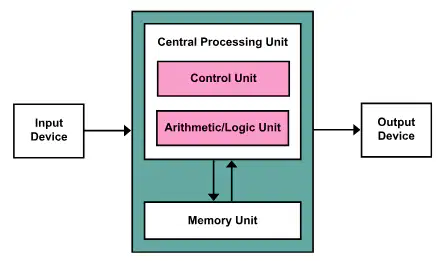
Which component in the von Neumann architecture is responsible for moving data from the outside world into the computer?
Output Device
Control Unit
Input Device
Arithmetic/Logic Unit
Match the following characteristics with their corresponding architecture types.
Data and instructions are stored in separate memory units
Harvard architecture
The units that process information are separate from the units that store information
von Neumann architecture
Only arithmetic operations can be performed
Arithmetic-only architecture
Memory is not addressable
Non-addressable memory architecture
Which of the following best describes the function of the Control Unit (CU) in a computer?
It stores data and instructions
It performs arithmetic operations
It acts as the stage unit to ensure all other components act in concert
It moves results from inside the computer to the outside world
If a computer has 4GB of RAM, how many bytes does it have?
4×210 bytes
4×220
4×230 bytes
4×240
Why are most computers today considered "byte addressable"?
Each address refers to a word of 16 bits
Each address refers to a single byte
Each address refers to a group of four bytes
Each address refers to a single bit
The ALU can perform both arithmetic and logic operations such as (a)
addition and subtraction
AND, OR, and NOT
storing all data and instructions
controlling the flow of data betwee
What is the purpose of registers in most modern ALUs?
To store large amounts of data permanently
To hold a small number of special storage units for temporary data
To control the input and output devices
To manage the physical addresses of memory cells
Which unit in a computer is responsible for interpreting and executing instructions?
Input Unit
Output Unit
Control Unit
Arithmetic Logic Unit
What is the main function of input units in a computer system?
To process data
To store data
To enter data and programs from the outside world
To display results
Which of the following is an example of an output unit?
Keyboard
Printer
Mouse
Scanner
What is the purpose of cache memory in a computer system?
To store permanent data
To provide a small amount of fast-access memory for frequently used data
To connect input and output devices
To increase the size of main memory
Which register in the control unit contains the address of the next instruction to be executed?
Instruction Register (IR)
Program Counter (PR)
Data Register (DR)
Memory Address Register (MAR)
What is the correct order of steps in the Fetch-Execute Cycle?
Decode, Fetch, Execute, Get data
Fetch, Decode, Get data, Execute
Execute, Fetch, Decode, Get data
Get data, Fetch, Decode, Execute
Why is access to registers faster than access to memory locations?
Registers are larger than memory
Registers are located closer to the CPU
Registers store more data than memory
Registers are used only for output
What is the function of the bus in a computer system?
To store data permanently
To process instructions
To transfer data, address, and control signals between components
To display output to the user
In a von Neumann machine, what does the variable 'n' in an n-bit processor usually refer to?
The number of input devices
The number of output devices
The number of bits in the CPU general registers
The number of buses in the system
The main principle of the von Neumann machine regarding data and instructions is that they are stored in memory and treated (a)
Data and instructions are stored in
Data and instructions are stored in
Only data is stored in memory, not
Instructions are stored in the CPU,
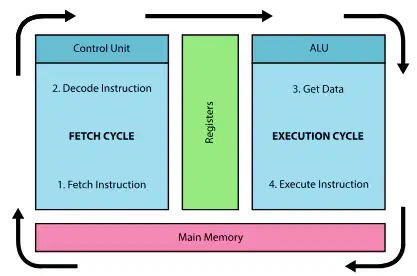
Which of the following best describes the Fetch-Execute Cycle in a computer system?
The process of fetching and executing instructions in a continuous loop.
The process of storing data in memory.
The process of compiling high-level code.
The process of shutting down the computer.
What is the primary function of the Memory Buffer Register (MBR) during the fetch cycle?
To store the address of the next instruction.
To temporarily hold data fetched from the CPU.
To execute arithmetic operations.
To decode instructions.
Which register holds the address of the next instruction to be executed?
Memory Buffer Register (MBR)
Instruction Register (IR)
Program Counter (PC)
Arithmetic Logic Unit (ALU)
What happens during the "Decode the Instruction" step of the Fetch-Execute Cycle?
The instruction is executed by the ALU.
The control unit determines which operation is to be executed.
The data is stored in memory.
The program counter is reset.
Why can a computer only execute instructions expressed in its own machine language?
Because the instructions are written in binary.
Because the instructions are literally built into the circuit.
Because the computer cannot read English.
Because the instructions are stored in RAM.
Which of the following is a characteristic of Random-Access Memory (RAM)?
Its contents are permanent and cannot be changed.
Each cell can be directly accessed and changed.
It is only used for storing instructions.
It is manufactured at the time the computer is assembled.
What is the main difference between RAM and ROM?
RAM is permanent, ROM is temporary.
RAM can be changed by a second operation, ROM cannot.
ROM is used for arithmetic operations, RAM is not.
ROM is faster than RAM.
Why is the process of placing the bit pattern in ROM called "burning"?
Because it uses high temperatures.
Because the bit pattern is set permanently at manufacturing or assembly.
Because it erases previous data.
Because it is faster than writing to RAM.
According to Alan Perlis, what is the only universal in the computing field?
The Arithmetic Logic Unit
The Fetch-Execute Cycle
The use of RAM
The use of ROM
Which of the following is NOT an example of a secondary storage device?
Magnetic Tape
Flash Drives
Main Memory (RAM)
CDs and DVDs
What is the primary difference between RAM and ROM?
RAM is stable, ROM is volatile
RAM is volatile, ROM is not
RAM is used for permanent storage, ROM is for temporary storage
RAM cannot be changed, ROM can be changed
Why is it essential to have secondary or auxiliary storage devices in a computer system?
Because main memory is permanent and unlimited
Because main memory is volatile and limited
Because secondary storage is faster than main memory
Because input devices require secondary storage
Match the following descriptions with their corresponding functions.
It provides entertainment to users
Function of a video game
It manages a computer system at a fundamental level and provides tools for application software
Function of system software
It is only used for word processing
Function of a word processor
It stores data permanently
Function of a hard drive
Which statement best describes the role of an operating system?
It only manages hardware resources
It only allows users to play games
It manages computer resources and provides an interface for user interaction
It is not necessary for running application software
Which of the following is an example of application software?
Operating System
Magnetic Disk
Word Processing Program
Flash Drive
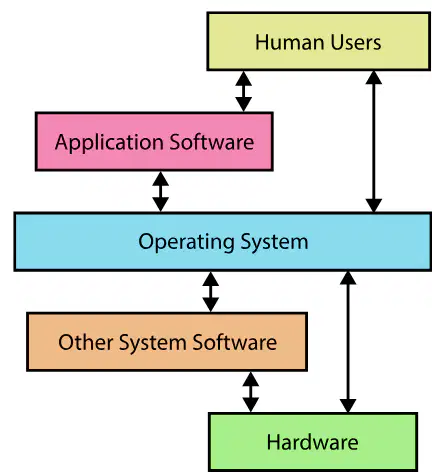
Based on the diagram, which component directly manages hardware resources in a computer system?
Application Software
Human Users
Operating System
Other System Software
Why do modern operating systems use multiprogramming?
To allow only one program to run at a time
To keep multiple programs in main memory and allow them to compete for CPU access
To store data permanently
To prevent users from accessing system resources
How does an operating system perform memory management?
By deleting all programs from memory
By keeping track of which programs are in memory and where they reside
By storing data on external hard drives
By running only one program at a time
What is a process in the context of operating systems?
A static set of instructions
A dynamic entity that represents a program while it is being executed
A type of memory management
A hardware component
Which memory management technique allows only the operating system and one other program in memory at one time?
Partition Memory Management
Paged Memory Management
Single Contiguous Memory Management
Multiprogramming
What does the base register hold in partition memory management?
The length of the current partition
The beginning address of the current partition
The number of partitions
The size of the operating system
In partition memory management, which partition selection method allocates a program to the smallest partition big enough to hold it?
First fit
Best fit
Worst fit
Last fit
What is a page in paged memory management?
A fixed-size portion of main memory that holds a process page
A variable-size portion of memory
A register in the CPU
A type of process
How many digits are there in base 8?
2
8
10
16
Which of the following best describes positional notation?
Each digit represents a fixed value regardless of position
Each digit’s value is determined by its position and the base of the number system
Only the rightmost digit is important
It is only used in base 10 systems
Why must the operating system manage processes carefully in a multiprogramming environment?
To ensure only one process runs at a time
To track the progress of each process and all its intermediate states
To increase the size of memory
To reduce the number of programs
What is the purpose of the bounds register in partition memory management?
To hold the beginning address of the current partition
To hold the length of the current partition
To store the process ID
To manage CPU scheduling
Which partition selection method allocates a program to the largest partition big enough to hold it?
First fit
Best fit
Worst fit
Last fit
Which of the following is the correct polynomial representation of the number 943 in base x?
9 × x² + 4 × x¹ + 3 × x⁰
9 × x³ + 4 × x² + 3 × x¹
9 × x¹ + 4 × x⁰ + 3 × x²
9 × x⁰ + 4 × x¹ + 3 × x²
In the base-R number system, the digit d₁ represents (a) in the number dₙ × Rⁿ⁻¹ + dₙ₋₁ × Rⁿ⁻² + (b) + d₂ × R + d₁.
The digit in the ones position
The digit in the tens position
The digit in the hundreds position
The digit in the thousands position
What is the decimal equivalent of the base-13 number 943₁₃?
1576
943
2074
754
Which of the following is NOT a valid digit in base 16 (hexadecimal)?
G
A
F
C
What is the main reason for using different number bases such as binary, octal, and hexadecimal in computing?
They are powers of 2 and simplify computer processing
They are easier to read than decimal numbers
They use more digits than decimal numbers
They are only used for encryption
Which of the following best describes the function of a NOT gate?
It inverts the input value
It adds two input values
It multiplies two input values
It stores the input value
If the input value to a NOT gate is 1, what is the output value?
0
1
2
Undefined
Why is the rightmost digit in any base system called the "ones" position?
Because any number raised to the power of zero is one
Because it is always the digit 1
Because it is the first digit written
Because it is the largest digit
What is the main purpose of assigning letters as digits in bases higher than 10?
To represent decimal values 10 and beyond
To make the numbers look more interesting
To confuse the reader
To reduce the number of digits used
Which of the following statements about number systems is TRUE?
The same number can be represented differently in different bases
A number can only be represented in base 10
Base 8 uses digits 0–9
Base 2 uses digits 0–7
Match the following logical gate symbols with their names.
A triangle with a small circle on the end
NOT gate
A rectangle with two inputs
AND gate
A circle with a plus sign inside
OR gate
A square with a minus sign inside
SUBTRACTOR gate
How many possible input combinations are there for an AND gate?
Two
Three
Four
One
Which Boolean algebra symbol is commonly used to represent the AND operation?
+
*
⊕
-
What is the output of an OR gate if both input values are 0?
1
0
2
Undefined
How does the output of an XOR gate differ from an OR gate when both input signals are 1?
Both produce 1
XOR produces 0, OR produces 1
XOR produces 1, OR produces 0
Both produce 0
What is the main difference between the NAND and AND gates?
NAND is the same as AND
NAND is the negation of AND
NAND is the same as OR
NAND is the negation of OR
Which of the following best describes the function of a NOR gate?
It outputs 1 if both inputs are 1
It outputs 0 if both inputs are 0
It outputs 1 only if both inputs are 0
It outputs 1 if either input is 1
Why is it not recommended to simply memorize truth tables for logic gates?
Because there are too many gates
Because understanding the concepts is more important
Because truth tables are not useful
Because gates are not used in real life
Which logic gate inverts its single input value?
NOT gate
AND gate
OR gate
XOR gate
What is the output of an AND gate if both input values are 1?
1
0
Depends on the previous input
Cannot be determined
(a) produces 1 if one or the other or both input values are 1.
What is the function of a NAND gate?
Produces the opposite results of an AND gate
Produces the same results as an OR gate
Inverts its single input value
Produces the opposite results of an OR gate
Which of the following is a characteristic of a combinational circuit?
Outputs are determined by the present combination of inputs
Outputs depend on previous inputs only
It does not use logic gates
It only has one input variable
What is a half adder used for?
Addition of two one-bit numbers
Multiplication of two numbers
Subtraction of two numbers
Division of two numbers
Which Boolean expression represents D1 in a multiplexer as given in the material?
X'Y
XY'
XY
X'Y'
Which logic gate produces 1 if one or the other (but not both) input values are 1?
XOR gate
AND gate
NOR gate
NAND gate
The main difference between a NAND gate and a NOR gate is that a NAND gate produces the opposite results of an AND gate, while a NOR gate produces the opposite results of an (a) gate.
Which of the following is NOT an example of a combinational circuit?
Flip-flop
Binary adder
Decimal adder
Multiplexer
Match the following licenses with their descriptions.
GNU General Public License
A free software license that allows software to be freely used, modified, and shared.
Creative Commons Attribution-Share Alike 3.0
A license that allows for sharing and adaptation of the work, even commercially, as long as attribution is given and adaptations are shared alike.
MIT License
A permissive free software license originating at the Massachusetts Institute of Technology.
Apache License 2.0
A permissive license that is similar to the MIT License but also provides an express grant of patent rights from contributors to users.
Which of the following files is associated with the Fetch-Execute Cycle according to the image sources listed?
File:Role_of_an_Operating_System.svg
File:Data_flow_through_a_von_Neumann_machine.svg
File:The_Fetch-Execute_Cycle.svg
File:XOR_ANSI.svg
According to section 5.1, which group contributed to the Computer Organisation source?
Kapothi
IB/Group 4/Computer Science
AcidBat
jibeard
What is the main purpose of section 5.2 in the document?
To list vocabulary words
To provide image sources, contributors, and licenses
To explain computer architecture
To describe programming languages
Match the following files with their corresponding logic gates credited to the original artist jibeard.
File:AND_ANSI.svg
AND logic gate
File:NAND_ANSI.svg
NAND logic gate
File:OR_ANSI.svg
OR logic gate
File:NOT_ANSI.svg
NOT logic gate
What is the primary function of the Control Unit in a CPU?
To store data permanently
To perform arithmetic operations
To manage the execution of instructions
To connect the CPU to external devices
Which of the following is a characteristic of virtual memory?
It is used to store the operating system permanently
It is faster than RAM
It allows a program to be executed even if it is larger than the physical memory
It increases the physical memory of the system
What is the role of the Program Counter in a CPU?
To manage input and output operations
To perform logical operations
To store the current instruction being executed
To hold the address of the next instruction to be executed

