
Font size
 Worksheets
Central Dogma and Transcription
Total questions: 54
Worksheet time: 32mins
According to the central dogma of molecular biology, what serves as the repository of genetic information?
RNA
Protein
DNA
Ribosome
The process by which the genetic information in DNA is used to synthesize (messenger) RNA is called _________.
transcription
translation
replication
mutation
According to the passage, the role of mRNA in the central dogma of molecular biology is to:
Store genetic information
Transfer amino acids to the ribosome
Carry genetic information from DNA to the ribosome for protein synthesis
Catalyze biochemical reactions
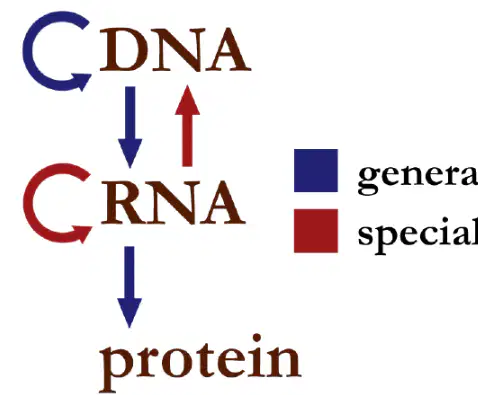
According to the central dogma diagram, what is the correct order of information flow in a cell?
Protein → RNA → DNA
DNA → RNA → Protein
RNA → DNA → Protein
DNA → Protein → RNA
The protein products can be ________ that catalyze metabolic transformations in the cell, or they can be structural proteins.
enzymes
hormones
lipids
carbohydrates
What is a functional RNA?
A type of RNA that codes for proteins
A type of RNA that has a biological function other than coding for proteins
A type of DNA that is transcribed into RNA
A protein that interacts with RNA
What does the system of molecules look like before the start of the transcription process?
The DNA is double-stranded and tightly coiled, with RNA polymerase not yet attached.
The DNA is single-stranded and RNA polymerase is already synthesizing RNA.
The mRNA is already present and translation has begun.
The ribosome is attached to the DNA.
What does the system of molecules look like at the end of the transcription process?
A DNA strand and a newly synthesized mRNA strand are present.
Two identical DNA molecules are present.
A protein and a DNA strand are present.
Only a single-stranded mRNA molecule is present.
What transformations of matter and transfers of energy happen during the transcription process, and what catalyzes the process?
RNA is synthesized from a DNA template, using nucleotides and energy from NTP hydrolysis; the process is catalyzed by RNA polymerase.
Proteins are synthesized from amino acids, using energy from ATP hydrolysis; the process is catalyzed by ribosomes.
DNA is replicated from a DNA template, using nucleotides and energy from dNTP hydrolysis; the process is catalyzed by DNA polymerase.
Lipids are broken down into fatty acids, releasing energy; the process is catalyzed by lipase.
If the biological task is to create a copy of DNA in the chemical language of RNA, what challenges can we reasonably hypothesize or expect, given our knowledge about other nucleotide polymer processes, must be overcome?
Ensuring accurate base pairing and initiation of synthesis
Maintaining cell membrane integrity
Producing energy for cellular respiration
Transporting proteins across membranes
There is evidence that Nature solved the problems of transcription in different ways. What seem to be the criteria for the success of transcription?
Accuracy and efficiency
Randomness and variability
Speed and mutation rate
Complexity and redundancy
Where should the machine start? Along the millions to billions of base pairs, where should the machine be directed?
At the origin of replication
At the end of the chromosome
At a random location
At the centromere
Where should the machine stop?
At the red line
At the green line
At the blue line
At the yellow line
If we have start and stop sites, we will need ways of encoding that information so that our machine(s) can read this information—how will that be accomplished?
By using specific codes or markers to represent start and stop sites
By ignoring start and stop sites
By randomly assigning values to start and stop sites
By deleting start and stop sites
How many RNA copies of the DNA will we need to make?
One
Two
Three
Four
How fast do the RNA copies need to be made?
Very quickly
Very slowly
At a moderate pace
Speed does not matter
How accurately do the copies need to be made?
Very accurately
Somewhat accurately
Not accurately
Accuracy does not matter
How much energy will the process take and where is the energy going to come from?
The process will take 100 kJ and the energy will come from electricity.
The process will take 50 kJ and the energy will come from sunlight.
The process will take 200 kJ and the energy will come from chemical reactions.
The process will take 10 kJ and the energy will come from mechanical work.
Which of the following is a building block of RNA but not DNA?
Deoxyribose sugar
Ribose sugar
Thymine
None of the above
In RNA, the nucleotide uracil is used instead of _______ in DNA.
thymine
adenine
guanine
cytosine
Uracil and thymine are structurally very similar, except uracil lacks a methyl (CH3) group compared to thymine.
True
False
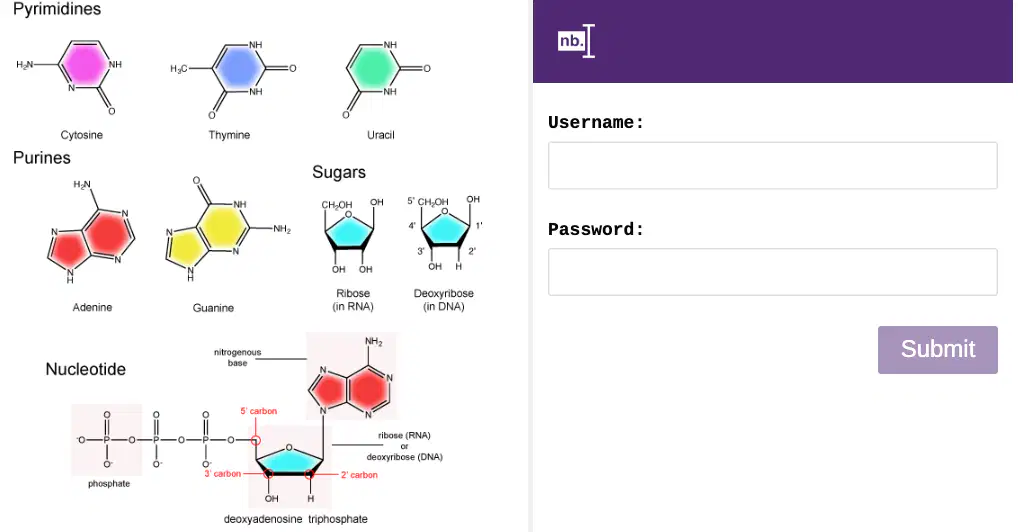
Refer to the diagram of the basic chemical components of nucleotides. Which of the following is a purine base?
Cytosine
Thymine
Adenine
Uracil
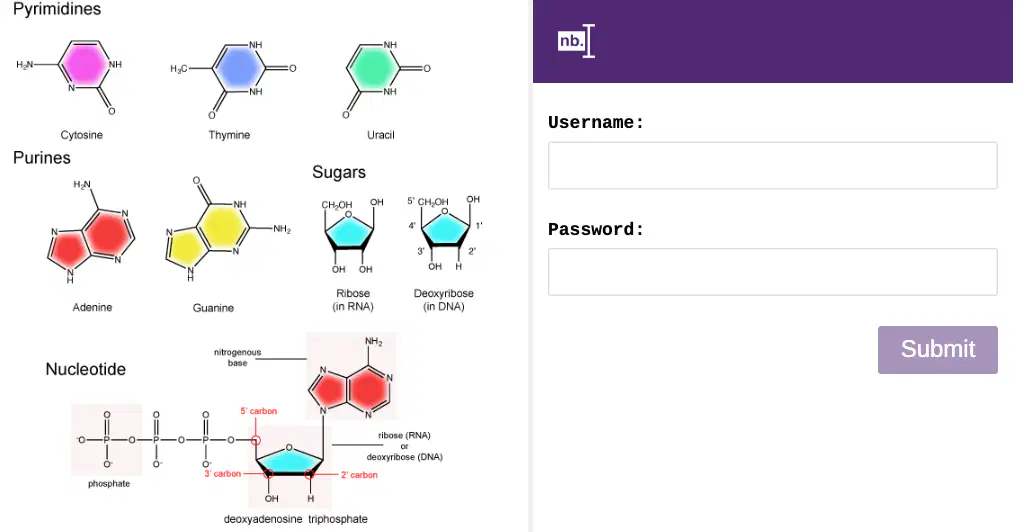
What sugar is found in RNA?
Ribose
Deoxyribose
Glucose
Sucrose
According to the passage, what is a promoter?
According to the passage, True or False: Promoters are always identical across all species.
True
False
According to the passage, what is a consensus sequence?
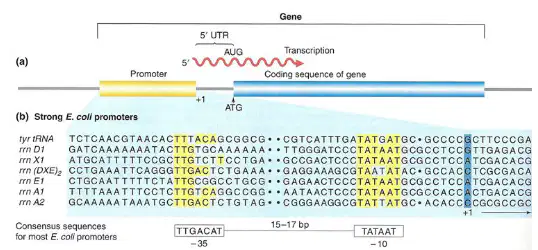
Which of the following sequences is recognized and bound by the protein σ in bacterial cells?
TATAAT
TTGACA
TATA box
AT-rich region
In eukaryotic cells, the AT-rich region is typically called a _________?
TATA box
Shine-Dalgarno sequence
Pribnow box
CAAT box
Which of the following statements is TRUE about the -10 region in bacterial promoters?
It is GC rich
It is AT rich
It is called the TATA box in bacteria
It is not recognized by protein σ
The initiation of transcription begins with the binding of RNA polymerase to the _________.
promoter
operator
exon
terminator
Which of the following is NOT a function of transcription factors in eukaryotic cells?
Recruiting RNA polymerase to the promoter
Regulating the synthesis of RNA
Acting as enhancers or silencers
Binding to the -10 region in bacterial promoters
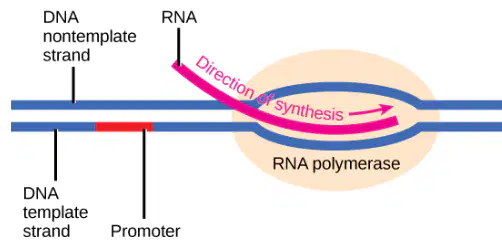
What is the region of DNA called where the double helix unwinds so that one strand can be used as the template for RNA synthesis?
Replication fork
Transcription bubble
Promoter
Coding strand
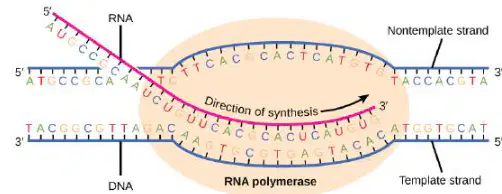
During elongation, which enzyme tracks along the DNA template and synthesizes mRNA in the 5' to 3' direction?
RNA polymerase
DNA ligase
Helicase
DNA polymerase
The RNA product is complementary to the _______ strand and is almost identical to the _______ strand, except that RNA contains uracil (U) instead of thymine (T).
template; coding
coding; template
coding; non-coding
template; non-coding
The direction of RNA synthesis during elongation is from 5' to 3'.
True
False
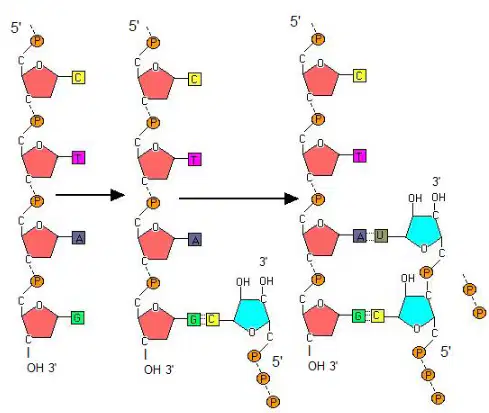
In which direction is RNA polymerized during transcription?
3' to 5'
5' to 3'
Both directions
No specific direction
In bacteria, elongation begins with the release of the σ subunit from the _________?
polymerase
ribosome
nucleus
plasmid
Compare and contrast the energy story for DNA replication initiation + elongation to the energy story for transcription initiation + elongation.
Both processes use nucleoside triphosphates as energy sources, but DNA replication uses dNTPs while transcription uses NTPs.
DNA replication uses ATP exclusively, while transcription uses GTP exclusively.
Transcription requires more energy than DNA replication.
DNA replication does not require energy input, while transcription does.
According to the passage, what is required for the bacterial polymerase to dissociate from the DNA template and liberate the newly made mRNA?
The presence of a ribosome
Termination signals
DNA replication
RNA processing
What is controlled by the rho protein in bacterial transcription termination?
Rho-dependent termination
Rho-independent termination
DNA replication
RNA processing
In rho-independent termination, the mRNA folds back on itself and forms a ______ that causes the polymerase to stall.
hairpin
loop
knot
helix
Which RNA polymerase in eukaryotes requires a specific 18-nucleotide sequence for termination?
RNA polymerase I
RNA polymerase II
RNA polymerase III
DNA polymerase
The process of termination in RNA polymerase III in eukaryotes involves a mechanism similar to rho-independent termination in prokaryotes.
True
False
In which domain is the termination of transcription least understood according to the passage?
Bacteria
Eukaryotes
Archaea
Viruses
In bacteria and archaea, where does transcription occur?
In the nucleus
In the cytoplasm
In the mitochondria
In the ribosome
In bacteria and archaea, translation often starts before transcription has finished.
True
False
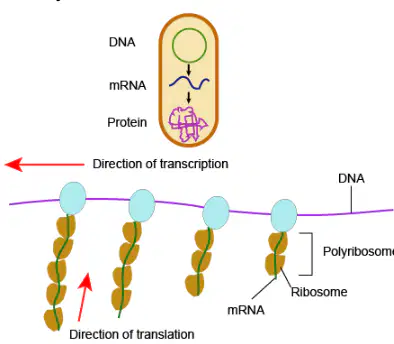
According to Figure 7, what is used as the template for a protein in bacteria and archaea before the entire mRNA is produced?
mRNA
tRNA
DNA polymerase
Ribosome
In eukaryotes, where does the process of transcription occur?
In the cytoplasm
In the ribosome
Inside the nucleus
In the mitochondria
What is the chemical modification added to the 5' end of eukaryotic mRNAs called?
5'-cap
Poly-A tail
Intron
Exon
What is added to the 3' end of eukaryotic mRNAs during processing?
5'-cap
Poly-A tail
Ribosome
DNA polymerase
Studying the transcriptome(s) can provide information about which of the following?
Gene expression levels and patterns
Protein structure and function
DNA sequence variations
Cellular organelle composition
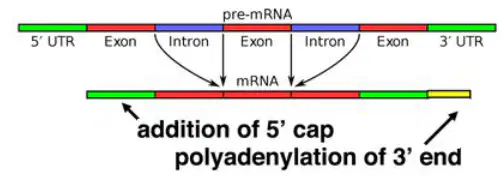
Refer to Figure 8. pre-mRNAs are processed in a series of steps. Introns are removed, a 5’ cap and poly-A tail are added. Which of the following is NOT a step in the processing of pre-mRNA?
Removal of introns
Addition of 5’ cap
Addition of poly-A tail
Addition of exons
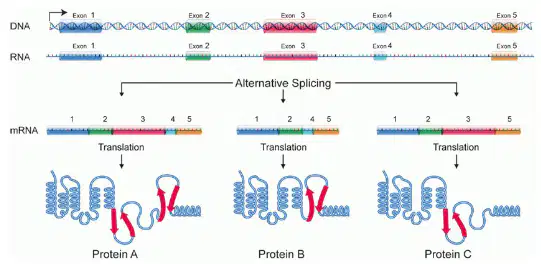
Alternative splicing allows cells to mix and match which exons are incorporated into the final mRNA product. This can lead to:
Only one protein being coded by a gene
Multiple proteins being coded by a single gene
No proteins being coded
Only introns being coded
In eukaryotes, ________ allows for the creation of different mRNA products from the same gene, which can then be translated into different proteins.
alternative splicing
transcription termination
DNA replication
chromatin remodeling

