
 Worksheets
Physical Science Final Study Guide - Question Extraction
Total questions: 39
Worksheet time: 37mins
Arrange the six steps of the scientific method in order.
1. Question 2. Background research 3. Hypothesis 4. Experiment 5. Data analysis 6. Conclusion
1. Observation 2. Experiment 3. Hypothesis 4. Data collection 5. Analysis 6. Report
1. Problem 2. Research 3. Experiment 4. Hypothesis 5. Analysis 6. Theory
1. Question 2. Hypothesis 3. Experiment 4. Data 5. Analysis 6. Law
Find the definition for the following term: Theory
Find the definition of the following term: inference
A guess based on past knowledge or observation
A direct statement from the text
A random assumption without evidence
A mathematical calculation
Find the definition of the following term: Observation
Something noticed using one of the five senses (sight, smell, hearing, taste, touch)
An inference based on prior knowledge
Scientific law
Mathematical calculation
Find the definition for the following term: Dependent variable
Find the definition of the following term: Independent variable
The variable that is explicitly manipulated or changed in an experiment
The variable that is measured or observed in an experiment
The variable that is kept constant during an experiment
The variable that is unrelated to the experiment
Find the definition of the following term: Control group/variable
A group or variable that is not changed
A group or variable that is always changed
A group or variable that is measured
A group or variable that is ignored
What are the vertical columns of the periodic table called?
Group
Period
Element
Block
What are the horizontal rows in the periodic table called?
Periods
Groups
Elements
Blocks
What is the wave that vibrates perpendicular to the direction of propagation?
Transverse wave
Longitudinal wave
Surface wave
Standing wave
What is the wave that propagates along the surface between two media?
Surface wave
Transverse wave
Longitudinal wave
Standing wave
What is the highest point above the rest position of a wave called?
Crest
Trough
Wavelength
Amplitude
What is the disturbance in a substance that carries energy from one place to another?
Mechanical wave
Static charge
Thermal conductor
Magnetic field
What is the lowest point of a wave below the rest position called?
Trough
Crest
Amplitude
Wavelength
What is the wave that vibrates in the direction of propagation?
Longitudinal wave
Transverse wave
Surface wave
Standing wave
What is the substance through which a wave travels?
Medium
Energy
Frequency
Amplitude
What is it called when a wave is displaced maximally from its rest position?
Amplitude
Frequency
Wavelength
Velocity
What is the time required for a single wave to pass a specific point?
Period
Frequency
Amplitude
Wavelength
What do you get when you multiply wavelength by frequency?
(a)
What is the distance between the same points on two adjacent waves?
Wavelength
Amplitude
Frequency
Velocity
What is the number of complete waves passing a certain point in a given time?
Frequency
Amplitude
Wavelength
Velocity
Define Newton's First Law.
An object at rest or in motion will remain at rest or in motion unless acted upon by an external (unbalanced) force. [Also known as the law of inertia]
An object will always continue to accelerate unless gravity acts on it.
The force between two objects is proportional to the product of their masses.
Energy can neither be created nor destroyed, only transformed from one form to another.
Define Newton's Second Law.
The acceleration of an object depends on its mass and the force applied to it. (Force is also known as mass × acceleration.)
An object at rest will remain at rest unless acted upon by an external force.
For every action, there is an equal and opposite reaction.
Energy cannot be created or destroyed, only transformed from one form to another.
Define Newton's Third Law.
For every action, there is an equal and opposite reaction. (Law of Action and Reaction)
An object will remain at rest unless acted upon by an external force.
The acceleration of an object depends on its mass and the magnitude of the force applied.
Energy can neither be created nor destroyed, only transformed from one form to another.
Which formula is used to calculate the force of an object?
F = ma
F = mv
F = m/g
F = m + a
What are the three subatomic particles that make up an atom, and where are they located within the atom?
Proton, neutron, and electron. Protons and neutrons are located in the nucleus, and electrons are located in the electron cloud.
Proton, electron, and photon. Protons and electrons are located in the nucleus, and photons are located in the electron cloud.
Neutron, electron, and positron. Neutrons and electrons are located in the nucleus, and positrons are located in the electron cloud.
Proton, neutron, and quark. Protons and neutrons are located in the electron cloud, and quarks are located in the nucleus.
What are the charges of protons, neutrons, and electrons?
Proton = p+ (positive charge), Neutron = n (neutral charge), Electron = e- (negative charge)
Proton = p- (negative charge), Neutron = n+ (positive charge), Electron = e (neutral charge)
Proton = p (neutral charge), Neutron = n- (negative charge), Electron = e+ (positive charge)
Proton = p+ (positive charge), Neutron = n- (negative charge), Electron = e (neutral charge)
Using the periodic table, let's find information about the following element: What are the symbol, number of protons, number of electrons, and number of neutrons for lithium?
Symbol: Li, Protons: 3, Electrons: 3, Neutrons: 4
Symbol: L, Protons: 2, Electrons: 2, Neutrons: 3
Symbol: Li, Protons: 4, Electrons: 4, Neutrons: 3
Symbol: Lu, Protons: 3, Electrons: 2, Neutrons: 4
Using the periodic table, find the following information about the element Copper: What is its symbol, number of protons, number of electrons, and number of neutrons?
Symbol: Cu, Protons: 29, Electrons: 29, Neutrons: 35
Symbol: Co, Protons: 27, Electrons: 27, Neutrons: 32
Symbol: Cu, Protons: 30, Electrons: 30, Neutrons: 35
Symbol: C, Protons: 6, Electrons: 6, Neutrons: 6
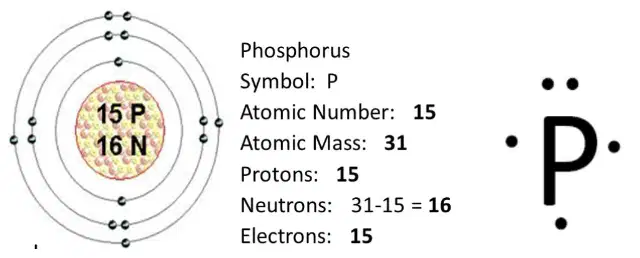
Which of the following correctly represents the Bohr model and Lewis dot model of phosphorus?
Bohr model: 2, 8, 5 electrons; Lewis dot: P with 5 dots
Bohr model: 2, 8, 6 electrons; Lewis dot: P with 6 dots
Bohr model: 2, 8, 7 electrons; Lewis dot: P with 7 dots
Bohr model: 2, 8, 8 electrons; Lewis dot: P with 8 dots
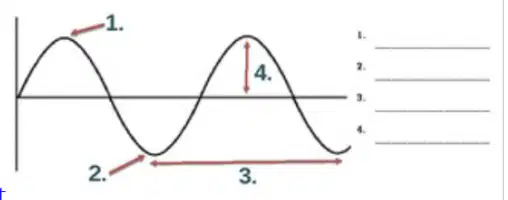
What are the parts of a transverse wave? Identify the following in the diagram below:
1. Crest, 2. Trough, 3. Wavelength, 4. Amplitude
1. Node, 2. Antinode, 3. Frequency, 4. Period
1. Compression, 2. Rarefaction, 3. Speed, 4. Direction
1. Peak, 2. Valley, 3. Cycle, 4. Phase
What are the 3 main states of matter? Describe the shape and volume of each.
Which 3 are examples of physical changes and why?
sawing wood, crushing a can, and burning a marshmallow
burning of gasoline, rotting an egg, and exploding fireworks
freezing of water, evaporation of gasoline, and rusting of a nail
boiling of water, blowing up a balloon, and melting a candle
What’s a homogenous mixture?
What’s a heterogeneous mixture?
A mixture not uniform in composition (i.e pizza, bowl of minestrone soup). A mixture made of two or more substances that are combined (mixed) together but not dissolved together. It is not the same consistency throughout and can be separated into its original parts.
A mixture that is completely uniform in composition and cannot be separated into its original parts.
A pure substance made up of only one type of atom or molecule.
A solution where all components are chemically bonded and cannot be separated.
Define viscosity (when a substance is viscous).
It is the resistance of a liquid to flow. The higher the viscosity (the thicker it is), the harder it is to flow easily (e.g., peanut butter, syrup, honey).
The ability of a liquid to conduct electricity.
The tendency of a liquid to evaporate quickly.
The change in color of a liquid when heated.
What 3 things increase the resistance of a wire?
What are the 2 types of circuits?
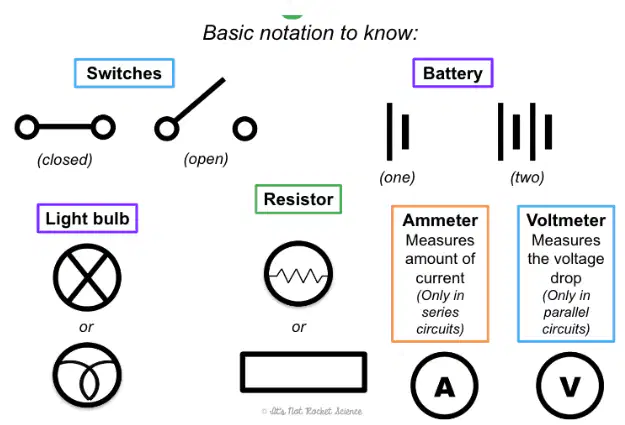
From the diagram below, identify the symbol for a closed switch.

