
 Worksheets
2025 Spring Exam - Physics 1
Total questions: 50
Worksheet time: 48mins
What does the F stand for on a free-body diagram?
Free
Fan
Net
Force
In a force diagram, or free-body diagram, the size/length of the arrow tells you this about the force:
relative strength
relative distance
relative direction
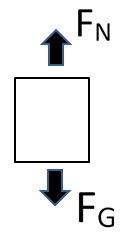
Which of the following is true about this free-body diagram?
the forces are are balanced
the object is free-falling
the object is moving upward
the forces are unbalanced
In a force diagram, or free-body diagram, the pointy-end of the arrow tells you this about the force:
relative strength
relative distance
relative direction
When determining the NET force on an object you should (TWO correct answers)
subtract forces in opposite directions
add forces in the same direction
divide by velocity
multiply by acceleration
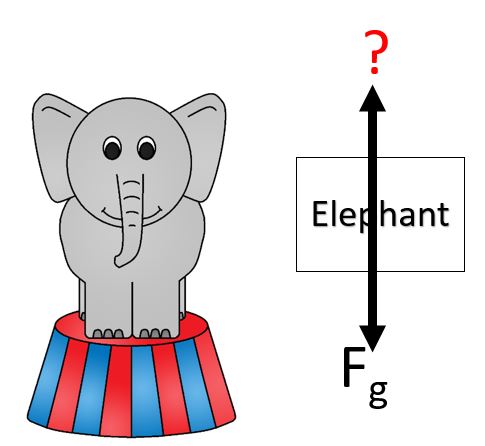
A hockey puck glides to the right across the ice at a constant speed.


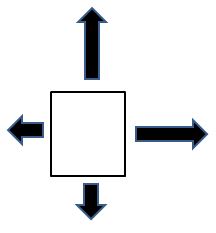
The down-arrow in this diagram is most-likely:
gravity
normal
a push or pull
friction
If this object were moving right, the left-arrow in this diagram is most-likely:
gravity
normal
a push or pull
friction
The force exerted by ropes and chains is called
tension
normal
elastic
mechanical
The force that keeps objects on top of surfaces instead of letting them sink into the surface is known as:
normal
abnormal
static
inertia

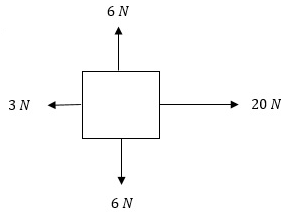
What is the NET FORCE of this diagram?
17 N, right
17 N, left
23 N, right
12 N, up

Determine the force at G:
30 N
20 N
50 N
0 N

What can you tell about the forces on F and H?
They must be unbalanced.
They are negative.
They must be the same.
They are equal to the net force.
What is the NET FORCE of this diagram?
17 N, right
17 N, left
23 N, right
12 N, up


Determine the missing force at C:
700 N
200 N
0 N
1100 N
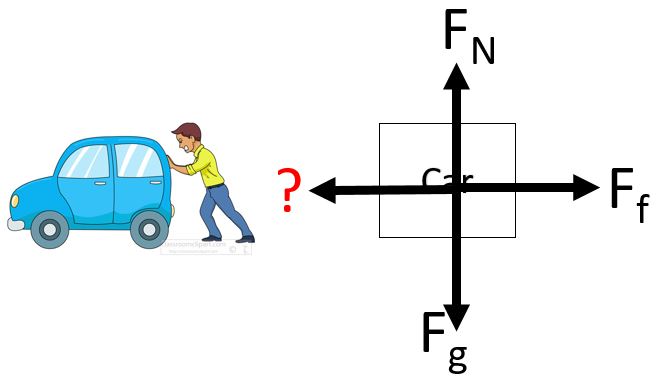
What is the NET FORCE of this diagram?
17 N, right
17 N, left
23 N, right
12 N, up

What forces are on a leopard laying on a log?
Fg & Fapp
Fb & Fg
Fg & FN
Ff & FN
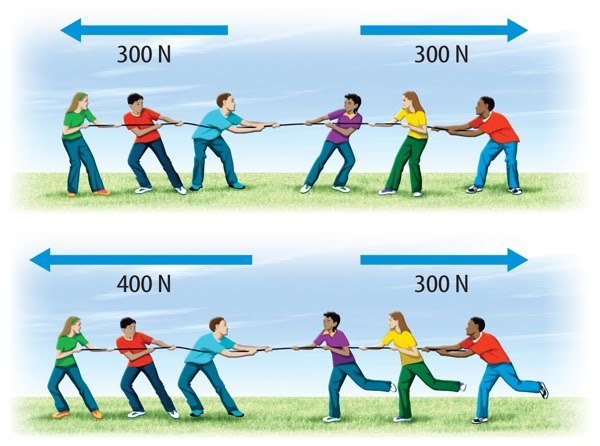


What is the Total Mechanical Energy at point A?
500,000 J
400,000 J
200,000 J
50,000 J


A spring with spring constant 16 N/m is compressed by 0.5 m. How much energy is stored in the spring?
1 J
0.25 J
2 J
16 J

Partially Elastic
Completely Inelastic
Partially Inelastic
Completely Elastic

In any collision (crash) the ______ is ALWAYS constant
total momentum
total speed
total Velocity
Energy
If an object has a momentum of 40 kgm/s and a mass of 60 kg, what is it's velocity?
2400 m/s
1.5 m/s
240 m/s
.67 m/s

