
 Worksheets
AP Physics Review
Total questions: 233
Worksheet time: 7hrs 20mins

The graph represents
no motion
constant velocity
increasing velocity
decreasing velocity

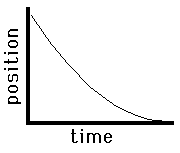
Describe the motion:
Slow to fast; Negative direction
Fast to slow; Negative direction
Fast to slow; Positive direction
Slow to fast; Positive direction
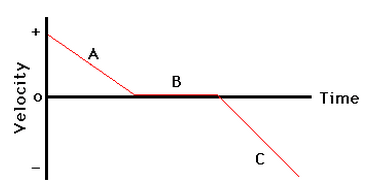
Describe the motion in segment C:
Slowing down; Positive direction
Slowing down; Negative direction
Speeding up; Negative direction
Constant velocity; Negative direction

Which diagram represents an object at rest?
A
B
C
D

The Earth pulls downward on a ping pong ball with a force of 1 N. If this is the "action" force, what is the "reaction" force?
The ground exerts a force of 1 N on the ping pong ball
The ping pong ball exerts a force of 1 N on the Earth
The ping pong ball pushes down on the Earth with a force of 1 N
There is no reaction force when a gravitational force is involved

Given the FBD, which of the following must be true?
The frictional force must be accelerating the system to the left.
The box must be accelerating to the right.
The box must be moving to the right.
The FBD is incorrectly drawn. This situation isn't possible.

Which of the following statements is true about the image above?
The accelerations of the blocks will vary according to their mass.
The net force acting on each block is the same.
The blocks will experience the same acceleration.
The 3m box will eat the 2m and the m boxes.

Sam is hoverboarding down the hall at a constant velocity. Assuming there is friction, which of the following must be true?
The force applied by the board must be greater than the frictional force.
The frictional force must equal the force applied by the board.
The force applied must equal zero.
There is not enough information.

Is this object in equilibrium?
Yes, and it's moving right.
Yes, and it's at rest.
No, it's accelerating right.
No, it's at rest.

Assuming all objects are moving at a constant velocity, which diagram would produce the largest frictional force?
A
B
C
Which of the following pairs of surfaces would have the highest coefficient of friction?
Air hockey puck and air hockey table
Sneakers and cement sidewalk
Bicycle tire and icy road
Rumble strip and car tire
What are the four types of FRQs on the AP Physics Exam?
Experimental Design
Qualitative/Quantitative Translation
Paragraph Argument Short Answer
Short Answer

Which has a greater linear velocity?
Kid near the center of the merry-go-round
Kid near the outside of the merry-go-round
Neither
The graph represents
no motion
constant velocity
increasing velocity
decreasing velocity
A person has a mass of 24 kg on Earth. What is the person's mass on the Moon (1/6 of Earth's gravity)?
24 kg
144 kg
6 kg
4 kg

Centripetal acceleration always points:
in the direction of the object's motion
in the opposite direction of the object's motion
towards the center of the circle
towards the outside of the circle
An object sliding across a surface will experience ______ friction.
static
potential
kinetic
no
The Earth pulls downward on a ping pong ball with a force of 1N. If this is the "action" force, what is the "reaction" force?
The ground exerts a force of 1N on the ping pong ball
The ping pong ball exerts a force of 1N on the Earth
The ping pong ball pushes down on the Earth with a force of 1N
There is no reaction force when a gravitational force is involved
When dealing with circular motion, the time it takes to make one revolution of the circle is called the:
rotation.
orbit.
period.
segment.
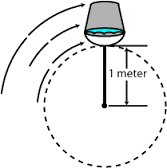
The term centripetal means
circular motion
center accepting
center seeking
center fleeing
Gravitational potential energy is defined as
What is the definition of Mechanical Energy?
a change in speed or direction
the ability to do work
a force that works against motion as surfaces rub together
the energy an object has because of its motion
True or False:
Negative work means that energy is being removed from the object.
True
False
The sum of the kinetic and potential energy in a system is known as the system's total _____________________ energy.
mechanical
chemical
thermal
combined
Work involves a force acting upon a __________ object, either with its motion or against its motion.
moving
stationary
heavy
light
True or False:
The total energy in an isolated system can be increased.
True
False
True or False:
Gravity does negative work on you when you walk up some stairs.
True
False

A spring is compressed by a force F against a wall as shown. Which of the following describes the sign of work done by the spring as it is being compressed?
The spring does positive work since it is gaining potential energy.
The spring does zero work since all the work is done by force F.
The spring does negative work since it applies a force against the direction of its compressing motion.
The spring works part-time at Chick-fil-A.
In which of the following situations is kinetic energy decreasing?
A lit tinsel llama is dropped from a building.
A satellite is moving in a circular orbit around the moon.
A baseball is headed upward after being thrown up in the air.
An elevator is moving upward at a constant velocity.
A purple ball and a gold ball each weigh 9.5 lbs. If the purple ball is moving at a velocity of 20 m/s, and the gold ball is moving at a velocity of 100 m/s, which ball has more momentum?
purple
gold
their momentums are equal
You have a 5 kg purple ball and a 1 kg gold ball. If the purple ball is moving at a velocity of 20 m/s, and the gold ball is moving at a velocity of 100 m/s, which ball has more momentum?
purple
gold
their momentums are equal

Choose the correct sentence.
This circuit will work because it is an open circuit.
This circuit will work because it is a closed circuit.
This circuit will not work because it is an open circuit.
This circuit will not work because it is a closed circuit.
When is the pendulum at its maximum velocity?
At its lowest point
At its highest point
It moves at a constant velocity
It is at rest
Which of these formulas represents momentum?
F = -kx
p = mv
F = ma
a = v/r

The SI unit for force is...
Kilograms
Newtons
Meters per second
Pounds

True or False: The SI unit for measuring speed is miles per hour (mi/hr).
true
false
When does the mass move at maximum velocity in a mass-spring system?
At equilibrium
At the farthest point from equilibrium
At its highest point
At its lowest point
What are the two requirements for a simple harmonic oscillator?
The object vibrates about the equilibrium point and the restoring force is proportional to the displacement.
The object moves left to right and the restoring force is proportional to the displacement.
The object vibrates about the equilibrium and the restoring force is greater than the displacement.
The object moves left to right and the restoring force is greater than the displacement.
When is the pendulum at 0 velocity
At its lowest point
At its highest point
It moves at a constant velocity
It is at rest
When does the mass move at 0 velocity in a mass-spring system?
At equilibrium
At the farthest point from the equilibrium
At its hightest point
At its lowest point
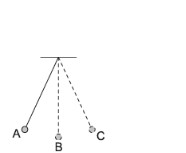
A pendulum oscillates as shown. At which of the following positions is the potential energy equal to the total energy?
A
B
C
Not enough information
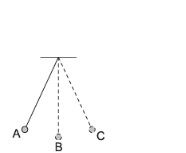
A pendulum oscillates as shown. At which of the following positions is the kinetic energy equal to the total energy?
A
B
C
Not enough information given.

The broomstick shown is in static equilibrium. The torque due to the mass to the right of the person's finger is ____________ compared to the torque due to the mass to the left of the person's finger.
more
less
equal
None of the above

The broomstick shown is in static equilibrium. The mass to the right of the person's finger is ____________ compared to the mass to the left of the person's finger.
more
less
equal
None of the above
"A point at which entire weight of object concentrated toward the earth".
Identify the concept explained in the statement above.
Free body diagram
Concurrent forces
Center of gravity
Rigid body
What does α (alpha) represent?
angular displacement
angular velocity
angular acceleration
Which of the following describes how fast you are spinning or rotating about an axis?
linear speed
angular displacement
angular speed
linear acceleration
According to convention, counter-clockwise is always considered the ______________ direction when rotating.
positive
negative
zero
If net force causes a change in velocity, then a net torque causes a ...
change in angular velocity.
change in angular position.
change in position.
change in linear momentum.
How many radians are there in one complete rotation?
π
2
1
2π
If you analyze points farther radially outwards from the center of a rotating object, the linear/tangential velocity and linear/tangential acceleration are
increasing.
decreasing.
remaining the same.
If an object has a positive ω and a positive τ , then what is the object doing?
rotating clockwise and speeding up
rotating counterclockwise and speeding up
rotating clockwise and slowing down
rotating counterclockwise and slowing down
If an object has a negative ω and a positive τ , then what is the object doing?
rotating clockwise and speeding up
rotating counterclockwise and speeding up
rotating clockwise and slowing down
rotating counterclockwise and speed up
x = x0 + vx0 + 21ax t2
A ball released from rest at the 30th floor of a building has fallen one floor after 1 second. Assume the floors are evenly spaced and assume negligible air resistance.
What is the number of floors that the ball has fallen after 4 seconds ?
Match the correct term to the variable or value.
Δx
change of x
acceleration due to gravity
9.81 m/s
velocity on the y axis
vy
v0
v naught or initial velocity
vx
velocity on the x axis
Two students want to determine the speed at which a ball is released when thrown vertically upward into the air. One student throws the ball into the air while the other student measures the total time that the ball is in the air. The students use a meterstick to measure the release height of the ball. Which of the following equations should the students use to determine the speed at which the ball was released?
Use y = y0 + vy0t + \(\frac{1}{2}\)ayt2 from the moment in time in which the ball was released to the moment in time in which the ball reaches its highest point.
Use y = y0 + vy0t + \(\frac{1}{2}\)ayt2 from the moment in time in which the ball was released to the moment in time in which the ball hits the ground.
Use v2y = v2y0 + 2ay (y - y0) from the moment in time in which the ball was released to the moment in time in which the ball reaches its highest point.
Use v2y = v2y0 + 2ay (y - y0) from the moment in time in which the ball was released to the moment in time in which the ball hits the ground.
An object undergoes an acceleration as it travels along a straight, horizontal section of a track. Which of the following graphs could represent the motion of the object?
Select two answers.


A car initially at rest accelerates at 10 m/s2 . The car’s speed after it has traveled 25 meters is most nearly
A student wants to study the motion of an object with constant acceleration. Which of the following experiments could the student conduct to best observe a situation where an object has constant acceleration? Select two answers.
Release a ball from rest near the Earth's surface.
Release a toy car from rest so that it travels along different looped sections of a track.
Launch a water-propelled rocket from rest so that it travels into the air and falls back to the Earth's surface.
Release a cart from rest so that it travels down an incline of 40 degrees with respect to the ground.
Which of the following is NOT indicated by a horizontal line on a velocity vs. time graph?
The object is at rest.
The object is speeding up.
The object is moving at a constant high speed.
The object is moving at a constant low speed.
At what angle should a projectile be launched to achieve the maximum horizontal range?
0 degrees
20 degrees
45 degrees
90 degrees
If acceleration and velocity vectors are in the same direction, the object is...
Slowing down
No change
Speeding up
Stopped
Which of the following is NOT a scalar quantity?
Mass
Acceleration
Speed
Distance
A velocity vs. time graph starts at a positive y-value at t=0 and progresses as a linear line with a negative slope that crosses the x-axis over time. Which of the following situations could it represent?
An object floating upwards.
A ball in free-fall from rest.
A ball kicked up in the air and falls back down.
A stationary object.
A truck, after having travelled 200 m at 50 m/s, suddenly decelerates at 10 m/s2 for 5 seconds. What is the total displacement of the truck at the end of 5 seconds?
200 m
500 m
325 m
424 m
What does the slope of a position vs. time graph represent?
Acceleration
Displacement
Velocity
Force
What is the acceleration of a free-falling object moving at a speed of 25 m/s after 3 seconds?
26 m/s
18 m/s
17.6 m/s
9.81 m/s²
If acceleration and velocity vectors point in opposite directions, the object will...
Speed up
Stop
Remain stationary
Slow down
What does the area under a velocity-time graph represent?
The acceleration of the object.
The displacement of the object.
The impulse on the object.
The force on the object.
A person starts from rest and runs with constant acceleration, reaching a final velocity of 20 m/s. What was their average velocity?
20 m/s
0 m/s
10 m/s
25 m/s
A car travels 500m from rest and with an final velocity of 55 m/s. What was its acceleration?

The graph above represents the position (x) versus time (t) for an object being acted upon by a constant force. What is the average speed during the interval between 1 s and 2 s?
2 m/s
4 m/s
6 m/s
8 m/s

The position vs. time graph for an object moving in a straight line is shown below. What is the instantaneous velocity at t = 2 s?
-2 m/s
4 m/s
0 m/s
0.5 m/s

The motion of a circus clown on a unicycle, moving in a straight line, is shown in the graph.
What is the clown's acceleration at 5 s?
1.6 m/s2
8 m/s2
3.4 m/s2
2 m/s2

How far is the clown from her original starting point after 12 seconds?
50 m
12 m
74 m
67 m

A ball is dropped from a building. How fast is it traveling after falling for 1.77 s? (Hint: It's a free-falling object.)
-5.54 m/s
-17.36 m/s
-11.58 m/s
-8.04 m/s
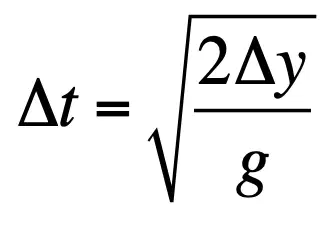
An apple falls 1 meter from a tree. How long does it take to reach the ground?
0.125 s
0.45 s
0.6 s
1 s
0.56 s

Match the section of the graph with the correct description of motion
A - B
a = 10
B - C
a = 0
D - E
v = 40
C - D
a = 20
F - G
v = 20

Largest speed
A
Vertical velocity is zero
B
Vertical velocity is negative
C
Almost all GPE transferred to KE
D
Horizontal velocity is constant
All
What does it mean when a change in velocity is negative?
The object is speeding up.
The object is slowing down.
The object is changing direction.
The object is falling down.
What is the acceleration of an object that has a constant velocity?
a. 0.0 m/s
b. 0.0 m/s2
c. 1.0 m/s
d. 1.0 m/s2
Can an object move with constant velocity and also accelerate?
Yes, if it is speeding up.
Yes, if it is slowing down.
Yes, if it is turning in a circle.
No.
Benjamin is running on a circular track. He maintains a constant speed, but his velocity changes. This is because velocity depends on _________ as well as speed. So, even if Benjamin's speed remains constant, his velocity can change.
vibration
tone
measurement
direction
A car pulls onto the highway. It accelerates at 2 m/s2, merges over a distance of 100 m, and ends with a velocity of 28 m/s. What was its initial velocity? (Round to two decimal places and use correct units.)
(a)
What is the velocity of an object that has been accelerating at 5 m/s2 for 3 seconds, starting from rest?
5 m/s
10 m/s
15 m/s
20 m/s
Which of the following graphs best represents an object moving with constant acceleration?
A straight horizontal line on a velocity vs. time graph
A straight line with a positive slope on a velocity vs. time graph
A curved line on a position vs. time graph
A straight line with a negative slope on a position vs. time graph
An object is thrown vertically upwards with an initial velocity of 20 m/s. What is its velocity at the highest point of its trajectory?
0 m/s
10 m/s
20 m/s
30 m/s
During a hurricane, the air outside a home moves much faster than the air inside the home. Which of the following is possible to happen?
The windows can burst inward.
The windows can burst outward.
The windows cannot burst because the pressure inside and outside the home are equal.
The windows cannot burst because the force inside and outside the home are equal.

Water flows through a pipe with different sized cross-sectional areas. Which section has the slowest fluid speed?
I
II
III
IV
Water flows in a horizontal pipe that is narrow but then widens. The pressure of the water moving in the pipe is
greater in the wide part
greater in the narrow part
the same in both parts

Air rushes through a tube connected to a straw. The bottom of the straw is placed in water. Which of the following results from this scenario?
Water flows out of the straw so its water level is lower than that around it.
Water flows into the straw so its water level is higher than that around it.
The water level stays equal inside and outside the straw.

Four straws are open to water on the bottom and are exposed to flowing air going through an irregular tube on the top. Which cylinder will have the highest water level?
A
B
C
D
all the same

Water flows through a pipe whose area is constant but whose height above the ground changes. How does speed v2 compare to v1?
v1 is greater
v2 is greater
both speeds are equal
Water flows through a pipe whose area is constant but whose height above the ground changes. How does speed P2 compare to P1?
P1 is greater
P2 is greater
both pressures are equal

Point A of a tube is pressurized to 8 atm so that water flows uphill to tubes B, C, and D. At which point is the water speed the greatest?
B
C
D
all the same
Rank the sections in order from greatest pressure to least.
A, B, C, D
D, C, B, A
A, B = C = D
B = C = D, A

Soda bottle has three holes in it. Which will spray its water the farthest?
top
middle
bottom
The hose nozzle has two settings: one with a small opening and one with a large opening. Which setting will make water spray the farthest?
large opening
small opening
same
The hose nozzle has two settings: one with a small opening and one with a large opening. Which setting will fill a kiddie pool fastest?
large opening
small opening
same
Which of the following pipe fittings has the least resistance to fluid flow?


Which of the following describes an open system
Water is the only fluid in open systems
In open systems, the fluid is not conserved or recirculated
Open systems are used only for hydraulic applications
When we use hydraulic pistons it's to keep a load in an exact position. Why might an air-driven piston be an inappropriate tool for this purpose?
Air is weightless.
Air is insultating.
Air is compressible.
Air is invisible.
A pneumatic tool is
powered by water.
powered by compressed gas.
powered by recirculated fluid
powered by supercooled fluid.

Which of the following locations identifies where the resistance to water flow is the greatest?
Point W
Point Y
Between Point X and Point Y
Between Point W and X
Why is a hydraulic system better than a pneumatic system for lifting a dump truck bed?
Hydraulic systems are less prone to leaks
Hydraulic systems are energy efficeint
Hydraulic systems can provide quick changes in movement
Hydraulic systems can handle heavy loads sustained for long periods of time
A gardener bought a larger diameter hose. What change should the gardener expect?
Change in the viscosity of the water
Decrease in temperature of the water
Decrease in the velocity of the water
Decrease in the denisty of water
What is drag?
slow stready flow
system where fluid is not conserved
volume per unit time
Force that fluids have on objects
What is flow rate?
Force that fluids have on objects
slow steady flow
volume rate per unit time
fast, irregular flow
What is laminar flow?
Slow, steady flow
System where fluid is not conserved
Fast, irregular flow
A system that runs on fluids
What is turbulent flow?
Slow, steady flow
Fast, irregular flow
A fluid system that conserves all fluid
A system that runs on fluid
What is viscosity?
Volume rate per units time
"stickiness" of fluid
Material that fits easily in any shape
A system that runs on fluids
What is an open system?
A system that runs on gases
A system that runs on fluids
A system that conserves all fluid
A system that does not conserve all fluid
What is a closed system?
System where fluid is not conserved
A system that runs on gases
A system that conserves all fluid
A system that runs on only liquids
What is a fluid? (Choose all that apply)
Material that fits easily in any shape
A solid
A liquid
A gas
What is a hydraulic system?
A system that runs on liquids
A system that runs on gases
A system that does not conserve fluid
In Archimedes' Principle, the buoyant force is more than the weight of the fluid displaced
true
false
A change in pressure within a confined incompressible fluid is exerted ___
in all directions unequally
in all directions equally
only towards the walls of the vessel
only towards the bottom of the vessel
Bernoulli's Principle is related to velocity and __
density
volume
pressure
buoyancy
A fluid can be any liquid or gas
true
false
Surfaface tension is due to the ___ effects of a fluid
hydrostatic
adhesive
cohesive
hydrodynamic
Atmospheric pressure is greater at a higher elevation
true
false
Laminar flow is
irregular and chaotic
smooth and streamlined
dense and fast
Saltwater is denser than freshwater
true
false
The pressure of fluids at the same elevation will be the same regardless of their
temperature
volume
taste
container shape
Hot air balloons work through the manipulation of
buoyancy
velocity
compressability
surface tension
Viscosity is the pressure a fluid exerts when it changes its shape
true
false
Boats float MOSTLY due to
surface tension
magic
buoyancy
atmospheric pressure
Hydrostatic pressure is described as the pressure generated by
an outside body
a fluid at rest
gravity
the motion of a fluid
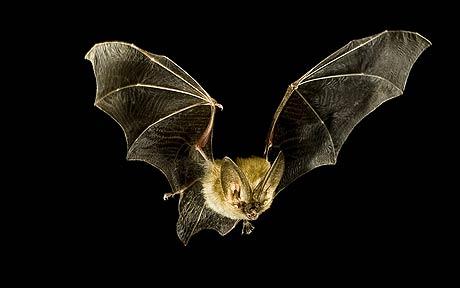
Bruno the bat has a mass of 0.58 kg and flies at a speed of 0.8 m/s in circle of radius 0.5 m. What is his acceleration?
0.25 m/s2
1.3 m/s2
1.6 m/s2
0.74 m/s2
An object sliding across a surface will experience ______ friction.
static
potential
kinetic
no
When dealing with circular motion, the time that it takes to make one revolution of the circle is called the:
rotation.
orbit.
period.
segment.
A car moves with a constant speed of 17 m/s on a circular track of 200 m radius. Calculate the acceleration of the vehicle. HINT: a = V2 / R
1.45 m/s2
0.76 m/s2
1.98 m/s2
2.34 m/s2

A pendulum bob is released from rest in a horizontal position with the string taut. Which of the following statements is correct when the pendulum reaches its vertical position at point P?
The tension attained its least value
The tension depends only on the length of the pendulum
The tension depends on the mass and length of the pendulum bob.
The magnitude of tension equals the weight of the pendulum bob
The term centripetal means
circular motion
center accepting
center seeking
center fleeing

A curved groove is place on the top of a level table as shown in the diagram. A ball is pushed in the groove at P so that it leaves at Q. Which picture shows how the ball will move when it leaves the groove at Q?


At the instant shown in the diagram, the car's centripetal acceleration is directed-
toward E
toward N
toward W
clockwise



If a ball is swinging at the end of a rope and the rope is suddenly cut, assuming there is no gravity, what best describes the path it will take?
It will fly in a straight line forward from where it was cut
It will fly in a curved line away from the circle
It will fly inward toward the circle

A toy train moves in a circular track with a velocity of 2.2 m/s, the axis of rotation is 1.8 m. What is its centripetal acceleration?
1.22 m/s2
0.81 m/s2
2.69 m/s2
1.47 m/s2
What is the tangential velocity if the centripetal force is 150 N when a 3 kg toy plane flies in a 2 m radius circle?
10 m/s
100 m/s
225 m/s
15 m/s

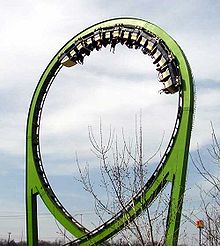
A car is doing donuts in a parking lot. It completes 5 circles in 35 seconds. What is the period of rotation, in seconds?
A object is traveling in uniform circular motion. It has a period of 6 seconds. The radius of the circle is 3 meters. What is the tangential velocity, in m/s?
(round to a whole number)
The circumference of a circle is...
2πr
πr
πr2
2πr2
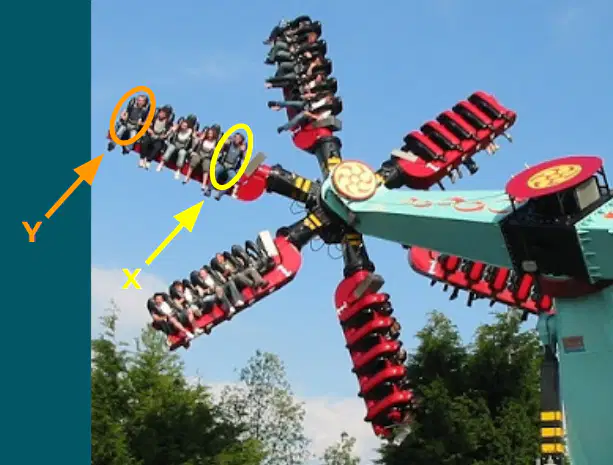
Two riders sit at positions X and Y. Do they have different periods of rotation and why / why not?
No, because they have the same tangential velocity.
No, because they take the same amount of time to complete 1 loop.
Yes, because they have different tangential velocities.
Yes, because they have different masses probably.

Two riders sit at positions X and Y. With every loop, do they travel the same distance?
Yes, since they are on the same ride
No, rider Y travels a greater circumference
Imagine a child on a merry-go-round, spinning as it turns. If the child is holding a ball, then reaches out and releases the ball off the side of the merry-go-round, in what direction will it travel?
Toward the center of the merry-go-round
Directly opposite the center of the merry-go-round
In a straight line tangential to the circular path of the merry-go-round
Around in a circular path identical to how it was traveling prior to release
In what direction does the child feel herself being pulled while on the merry-go-round?
Toward the center of the merry-go-round
Directly opposite to the center of the merry-go-round
Tangentially along the path of the circular motion
None of these
The Gravitron at the local carnival spins around, doing a full loop every 8.0 s. If a rider is against the wall, 6.5 m from the center, what is their tangential velocity?
Let's work this problem step-wise. First, we must identify given values, the desired unknown, and any other unknowns.
8.0 s
T
6.5 m
r
desired unknown
v
other unknown
a
other unknown
F
An Olympic athlete can throw a 2.00 kg discus with a release velocity of 25.7 m/s. If the athlete releases the discus coming out of a circular rotation with the object at 1.01 m from the center of rotation, what force was required to hold the discus through the rotation? Start by matching the known and desired unknown values to their corresponding variables.
2.00 kg
m
25.7 m/s
v
1.01 m
r
desired unknown
F
other unknown
a
The Colossus ferris wheel outside St. Louis, MO has a diameter of 50.3 m and travels a full loop every 35.4 s. What is the centripetal acceleration experienced by the riders on the Colossus? Don't forget your units and sig figs!
(a)
When is the pendulum at maximum velocity
At its lowest point
At its highest point
It moves at a constant velocity
It is at rest
When is a mass-spring system in simple harmonic motion?
Always
Until the spring is stretched to the point it becomes deformed
Never
Only at small amplitudes
When does the mass move at maximum velocity in a mass-spring system?
At equilibrium
At the farthest point from the equilibrium
At its hightest point
At its lowest point
What are the two requirements for a simple harmonic oscillator?
The object vibrates about the equilibrium point and the restoring force is proportional to the displacement
The object moves left to right and the restoring force is proportional to the displacement
The object vibrates about the equilibrium and the restoring force is greater than the displacement
The object moves left to right and the restoring force is greater than the displacement
When is the pendulum at 0 velocity
At its lowest point
At its highest point
It moves at a constant velocity
It is at rest
When does the mass move at 0 velocity in a mass-spring system?
At equilibrium
At the farthest point from the equilibrium
At its hightest point
At its lowest point
A pendulum oscillates as shown. At which of the following positions is the potential energy equal to the total energy?
A
B
C
Not enough information
A pendulum oscillates as shown. At which of the following positions is the kinetic energy equal to the total energy?
A
B
C
Not enough information given.
A particle oscillates with undamped simple harmonic motion. Which one of the following statements about the acceleration of the oscillating particle is true?
It is least when the speed is greatest.
It is always in the opposite direction to its velocity.
It is proportional to the frequency.
It decreases as the potential energy increases.
Which one of the following statements is true when an object performs simple harmonic motion about a central point O?
The acceleration is always away from O
The acceleration and velocity are always in opposite directions.
The acceleration and the displacement from O are always in the same direction.
The graph of acceleration against displacement is a straight line.
The frequency of a body moving with simple harmonic motion is doubled. If the amplitude remains the same, which one of the following is also doubled?
the time period
the total energy
the maximum velocity
the maximum acceleration
What are the two factors that affect the momentum of an object?
speed and velocity
time and mass
distance and displacement
mass and velocity
Momentum is a ____________________ quantity
science
scalar
vector
energy
T/F: A big truck will always have more momentum than a small car.
True
False
A 9300 kg railroad car traveling at a velocity of 5 m/s strikes a second boxcar that weighs 5000 kg at rest. The railroad car is brought to a sudden stop while the boxcar moves away from the collision. At what speed will the second boxcar move?
18.6 m/s
9.3 m/s
7.5 m/s
1.86 m/s
What would happen to the momentum of a toy car if the mass is doubled and the velocity decreases by 1/2?
It decreases by 1/4
It decreases by 1/2
Stays the same
It is doubled
A 0.15 kg mass moving at +26 m/s is slowed to a stop by a force of -390 N. How long does it take the force to stop the mass?
0.01 s
0.001 s
0.02 s
0.23 s
A car is traveling 20 m/s. It takes 4 seconds with a 7,500 N force to come to a stop. What is the mass of the car?
150 kg
1,500 kg
37,500 kg
3,750 kg
How can a tennis ball and a bowling ball have the same momentum?
have the same speed
have different speeds
one is moving backwards
they can't
A track athlete throws a discus that has a momentum of 42kg*m/s into a field with a velocity of 21 m/s. What is the mass of the discus?
1 kg
2 kg
3 kg
4 kg

The Law of Conservation of Momentum states:
The total momentum before a collision is equal to the total momentum after a collision.
The total momentum before a collision is greater than the total momentum after a collision.
The total momentum before a collision is less than the total momentum after a collision.
The total momentum before a collision is not related to the total momentum after a collision.
A Russian cosmonaut(87 kg) and USA astronaut(94 kg) are outside the ISS and decide to run a momentum experiment. They are motionless facing each other palm to palm, then push apart from each other. What happens to their momentum?
their total momentum doubles
their total momentum decreases
the guy with the smaller mass has less momentum
their momenta are opposite but equal

A body executes simple harmonic motion. Which one of the graphs, A to D, best shows the relationship between the kinetic energy, Ek, of the body and its distance from the centre of oscillation?
A
B
C
D
If a spring of mass 30kg has a spring constant of 15N/m, then its time period is
6.3 s
8.9 s
5.0 s
2.8 s

When does the mass move at maximum velocity in a mass-spring system?
At equilibrium
At the farthest point from the equilibrium
At its hightest point
At its lowest point
The acceleration of a particle in SHM is:
always zero
always constant
maximum at amplitude
maximum at the equilibrium position
The variation of the acceleration, a of a particle executing SHM with displacement, x is as shown in figure:


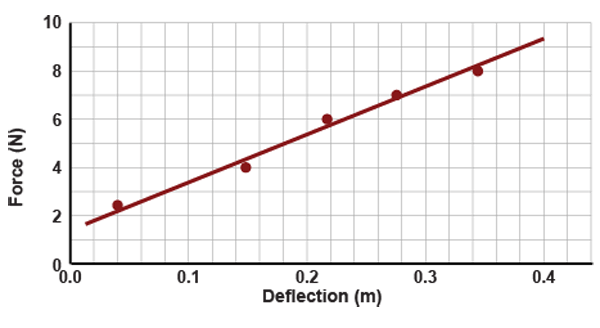
From the graph ,the elastic potential energy at 0.4m is.
7.5 J
1.8 J
20 J
200 J
A pendulum oscillates as shown. At which of the following positions is the potential energy equal to the total energy?
A
B
C
Not enough information
From the graph ,the spring constant is.
4.5 m
15 N
20 N/m
200 N/m
What is the primary factor that affects the period of a simple pendulum?
Gravitational force
Amplitude of the swing
Mass of the pendulum
Length of the pendulum
Which of the following is an example of a non-contact force?
Friction
Gravitational force
Tension
Normal force
What is the unit of measurement for electric current in the International System of Units (SI)?
Volt
Ampere
Ohm
Watt

