
 Worksheets
Resistance in series and parallel
Total questions: 40
Worksheet time: 2hrs 54mins
Four unequal resistors are connected in series with each other. Which one of the following statements is correct about this combination?
The equivalent resistance is equal to that of any one of the resistors.
The equivalent resistance is equal to average of the four resistances.
The equivalent resistance is less than that of the smallest resistor.
The equivalent resistance is less than that of the largest resistor.
The equivalent resistance is more than the largest resistance.
Four unequal resistors are connected in a parallel with each other. Which one of the following statements is correct about this combination?
The equivalent resistance is less than that of the smallest resistor.
The equivalent resistance is equal to the average of the four resistances.
The equivalent resistance is midway between the largest and smallest resistance.
The equivalent resistance is more than the largest resistance.
None of the other choices is correct.
Draw a circuit with a battery connected to four resistors, R1, R2, R3, and R4, as follows. Resistors R1 and R2 are connected in parallel with each other, resistors R3 and R4 are connected in parallel with each other, and both parallel sets of resistors are connected in series with each other across the battery.


When unequal resistors are connected in series across an ideal battery,
the same power is dissipated in each one.
the potential difference across each is the same.
the current flowing in each is the same.
the equivalent resistance of the circuit is less than that of the smallest resistor.
the equivalent resistance of the circuit is equal to the average of all the resistances.

A 9-V battery is hooked up to two resistors in series using wires of negligible resistance. One has a resistance of 5 Ω, and the other has a resistance of 10 Ω. Several locations along the circuit are marked with letters, as shown in the figure. Which statements about this circuit are true? (There could be more than one correct choice.)
The current is exactly the same at points A, B, C, and D.
The current at A is greater than the current at B, which is equal to the current at C, which is greater than the current at D.
The current at A is greater than the current at B, which is greater than the current at C, which is greater than the current at D.
The potential at B is equal to the potential at C.
The potential at D is equal to the potential at C.
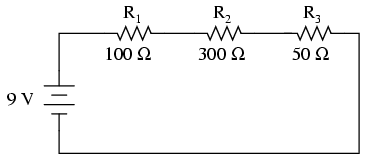
The total resistance in this circuit is
100 ohms
450 ohms
400 ohms
30 ohms
What is the total resistance of a parallel circuit with resistors of 4 ohms, 6 ohms, and 8 ohms?
10 ohms
5 ohms
1.84 ohms
3.5 ohms
In a parallel circuit, how does the total resistance compare to the individual resistances?
Unrelated to
Equal to
Greater than
Less than
If one resistor in a parallel circuit fails, what happens to the current in the other branches?
The current in the other branches increases
The current in the other branches becomes zero
The current in the other branches remains the same.
The current in the other branches decreases
What is the formula to calculate the total resistance in a parallel circuit?
Rt = R1 + R2 + R3 + ...
Rt = R1 * R2 * R3 * ...
Rt = R1 - R2 - R3 - ...
1/Rt = 1/R1 + 1/R2 + 1/R3 + ...
If the resistance of one branch in a parallel circuit is doubled, what happens to the total resistance?
Increases
Decreases
Remains the same
Becomes zero
In a parallel circuit, if the voltage across each resistor is the same, what can be said about the current through each resistor?
The current through each resistor will be different.
The current through each resistor will be negative.
The current through each resistor will be zero.
The current through each resistor will be the same.
What is the equivalent resistance of a parallel circuit with three 10-ohm resistors?
5 ohms
30 ohms
10 ohms
3.33 ohms
How does adding more branches to a parallel circuit affect the total resistance?
Total resistance decreases
Total resistance becomes zero
Total resistance remains the same
Total resistance increases
What is the advantage of using a parallel circuit in certain applications?
Redundancy and reliability
Increased resistance and inefficiency
Higher cost and complexity
Decreased reliability and safety
Explain how to calculate the total current in a parallel circuit.
Multiply the currents from each branch of the circuit
Add up the currents from each branch of the circuit then divide from 1
Subtract the currents from each branch of the circuit
Divide the currents from each branch of the circuit
What happens to the total current in a parallel circuit if one branch is removed?
The total current increases
The total current decreases
The total current remains the same
The total current becomes zero
What is the effect of adding more resistors in parallel to the total power consumed in the circuit?
The total power consumed decreases
The total power consumed increases
The total power consumed remains the same
The total power consumed becomes zero
What is the total resistance of a parallel circuit with resistors of 2 ohms, 3 ohms, and 6 ohms?
1 ohm
11 ohms
0.5 ohms
1.5 ohms
What happens to the total resistance in a parallel circuit if one branch with a resistor is added?
Total resistance decreases
Total resistance becomes zero
Total resistance remains the same
Total resistance increases
What is the total resistance of a parallel circuit with resistors of 5 ohms, 7 ohms, and 9 ohms?
12 ohms
6 ohms
2.202 ohms
4.5 ohms
If the voltage across each resistor in a parallel circuit is different, what can be said about the current through each resistor?
The current through each resistor will be different.
The current through each resistor will be negative.
The current through each resistor will be zero.
The current through each resistor will be the same.
What is the effect of removing a resistor from a parallel circuit on the total resistance?
Total resistance increases
Total resistance decreases
Total resistance remains the same
Total resistance becomes zero
What is the total resistance of a parallel circuit with resistors of 1 ohm, 2 ohms, and 3 ohms?
1.5 ohms
6 ohms
0.545 ohms
2 ohms
If the voltage across each resistor in a parallel circuit is the same, what can be said about the power dissipated in each resistor?
The power dissipated in each resistor will be different.
The power dissipated in each resistor will be negative.
The power dissipated in each resistor will be zero.
The power dissipated in each resistor will be the same.
What is the effect of removing a resistor from a parallel circuit on the total current?
Total current decreases
Total current increases
Total current remains the same
Total current becomes zero

The table describes four different resistance wires.
They are all made from the same metal.
Which wire has the smallest resistance?
A
B
C
D

The circuit shown contains a battery, a 6.0 Ω resistor and two meters X and Y.
One meter records current and one meter records potential difference.
meter X : 2.0 A
meter Y : 12.0 V
meter X : 2.0 V
meter Y : 1.0 A
meter X : 12.0 A
meter Y : 2.0 V
meter X : 12.0 V
meter Y : 2.0 A
Draw a circuit with a battery connected to four resistors, R1, R2, R3, and R4, as follows. Resistors R1 and R2 are connected in parallel with each other, resistors R3 and R4 are connected in parallel with each other, and both parallel sets of resistors are connected in series with each other across the battery.

