
NEW
Font size
 Worksheets
CSET: Science Sample Test Questions
Total questions: 79
Worksheet time: 40mins
What is the main subject of the sample test questions provided in the document?
Chemistry
Biology/Life Science
Physics
Earth and Planetary Science
According to the document, what type of calculator will be provided for examinees taking the CSET: Science subtests?
Only basic calculators
Only graphing calculators
Scientific calculators
No calculators are allowed
Which of the following is NOT a subtest mentioned as part of the CSET: Science exams?
General Science Subtest I
General Science Subtest II
Mathematics Subtest
Physics
Why are examinees encouraged to respond to the sample questions without looking at the provided responses?
To save time during the test
To compare their responses with the provided answers later
To avoid using a calculator
To practice handwriting
What restriction is placed on calculators during the CSET: Science subtests?
Only solar-powered calculators are allowed
Examinees must bring their own calculators
Only calculators provided at the test administration may be used
No calculators are allowed at all
What is the value of the acceleration of gravity on Earth (g)?
9.8 m/s²
3.00 × 10⁸ m/s
6.67 × 10⁻¹¹ N·m²/kg²
1.38 × 10⁻²³ J/K
Which of the following is the correct value for the speed of light in a vacuum (c)?
3.00 × 10⁸ m/s
9.8 m/s²
6.63 × 10⁻³⁴ J·s
8.31 L·kPa/(mol·K)
Planck's constant (h) is essential in quantum mechanics. What is its value in J·s?
6.63 × 10⁻³⁴ J·s
1.67 × 10⁻²⁷ kg
9.11 × 10⁻³¹ kg
9.0 × 10⁹ N·m²/C²
Which constant has the value 1.38 × 10⁻²³ J/K?
Boltzmann's constant (k)
Planck's constant (h)
Gas constant (R)
Coulomb's constant (kₑ)
If you need to calculate the force between two charges, which constant would you use and what is its value?
Coulomb's constant (kₑ), 9.0 × 10⁹ N·m²/C²
Gravitational constant (G), 6.67 × 10⁻¹¹ N·m²/kg²
Gas constant (R), 8.31 L·kPa/(mol·K)
Planck's constant (h), 6.63 × 10⁻³⁴ J·s
What is the value of sine 60°?
0.866
0.707
0.500
0.966
Which trigonometric function has a value of 0.707?
sine 45° and cosine 45°
sine 30° and cosine 60°
sine 60° and cosine 30°
sine 45° and cosine 60°
A student is solving a problem involving the energy of a photon. Which constant and value should they use?
Planck's constant (h), 6.63 × 10⁻³⁴ J·s
Boltzmann's constant (k), 1.38 × 10⁻²³ J/K
Gas constant (R), 8.31 L·kPa/(mol·K)
Gravitational constant (G), 6.67 × 10⁻¹¹ N·m²/kg²
Which of the following values corresponds to the cosine of 30°?
0.866
0.707
0.500
0.600
If you are given the mass of an electron, which value should you use?
9.11 × 10⁻³¹ kg
1.67 × 10⁻²⁷ kg
6.63 × 10⁻³⁴ J·s
3.00 × 10⁸ m/s
Which formula is used to solve a quadratic equation of the form ax² + bx + c = 0?
2a−b±b2−4ac
\(v = v_i + at\)
\(F = -kx\)
T=2πgL
What is the formula for the velocity of an object under constant acceleration?
\(v = v_i + at\)
a=rv2
T=2πkm
f′=f0(V±VsV±V0)
Which formula gives the centripetal acceleration for an object in circular motion?
a=rv2
\(F = -kx\)
v=μT
T=2πgL
What is the period of a mass-spring system in simple harmonic motion?
T=2πkm
T=2πgL
\(v = v_i + at\)
\(a = r\alpha\)
Which formula represents the speed of a wave on a string?
v=μT
\(v = v_i + at\)
T=2πkm
\(F = -kx\)
A pendulum has a length L. What is the formula for its period?
T=2πgL
T=2πkm
v=μT
a=rv2
If a string is fixed at both ends, what is the standing wave condition for its length?
2L = n\lambda, n is an integer
4L = n\lambda, n is odd
v = v_i + at
2πgL
Which formula describes the Doppler effect for sound?
f' = f_0\left( V±VsV±V0 \right)
v = v_i + at
2πkm
F = -kx
Given the formula PE = 21kx2 , what does PE represent in the context of a spring?
Potential energy stored in the spring
Kinetic energy of the spring
Force applied to the spring
Period of oscillation of the spring
A string fixed at one end and free at the other has a standing wave. What is the condition for its length?
4L = n\lambda, n is odd
2L = n\lambda, n is an integer
T=2πgL
v=μT
Which formula represents Snell's Law in optics?
n₁ sin θ₁ = n₂ sin θ₂
ΔU = nC_v ΔT
F = qv × B
P = IV
What is the formula for the refractive index in optics?
n = c/v
F = qv × B
ΔQ = mc ΔT
V = IR
Which equation is used to relate object distance, image distance, and focal length in optics?
1/f = 1/p + 1/q
PV = nRT
F = I × B
E = q/V
What is the formula for the change in internal energy in thermodynamics?
ΔU = nC_v ΔT
F = kq₁q₂/r²
P = IV
Q = CV
Which formula represents the ideal gas law?
PV = nRT
F = qv × B
E = q/V
V = IR
What is the formula for the force on a charge moving in a magnetic field?
F = qv × B
ΔQ = mc ΔT
P = IV
Q = CV
Which formula gives the force between two point charges?
F = kq₁q₂/r²
ΔU = nC_v ΔT
V = IR
E = q/V
If you know the current and resistance in a circuit, which formula would you use to find the voltage?
V = IR
F = qv × B
ΔQ = mc ΔT
Q = CV
Which formula expresses the relationship between power, current, and voltage in an electric circuit?
P = IV
F = kq₁q₂/r²
ΔU = nC_v ΔT
1/f = 1/p + 1/q
What does the formula Q = CV represent in electricity?
The relationship between charge, capacitance, and voltage
The force between two charges
The change in internal energy
The power in a circuit
A ball is thrown with an initial velocity of 20 m/s at an angle of 30° above the horizontal. What is the instantaneous vertical velocity of the ball when it is 5.1 m above the release point? (g = 9.8 m/s²)
0.2 m/s
6.6 m/s
10 m/s
17 m/s
A uniform disk with a mass of 20 kg and radius of 1.5 m is fixed by a pivot at its center. From rest, the disk undergoes an angular acceleration of 0.50 rad/s². What is the displacement after 3.0 s?
1.5 rad
2.3 rad
2.7 rad
3.4 rad

The diagram shows a 4.0 kg object suspended from two cables, both of which are at 45° angles with the horizontal. What is the tension in cable P?
20 N
28 N
39 N
55 N

The diagram shows a frictionless wheel with a cable wrapped around it and a block attached to the end of the cable. The wheel has a mass of 6.0 kg and the block has a mass of 2.0 kg. The block is released from rest and drops as the cable unwinds. When the block has dropped 1.0 m, its velocity is 2.8 m/s. What is the kinetic energy of the wheel?
0 J
8.4 J
12 J
20 J
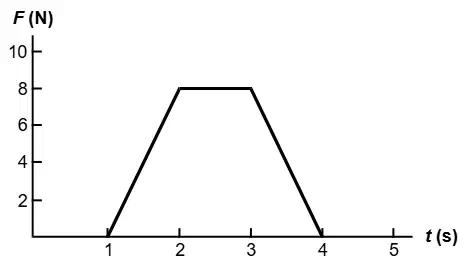
Use the graph below to answer the question that follows. The graph above shows the magnitude of a force as a function of time. At t = 0, a 10 kg object is moving at 4.0 m/s. The force shown on the graph is applied to the object in the direction of motion. What is the momentum of the object at t = 5?
16 kg·m/s
24 kg·m/s
40 kg·m/s
56 kg·m/s
An ideal gas is contained in a cylinder with a moveable piston. The cylinder is immersed in a water bath to maintain the temperature at 273 K. The piston slowly compresses the gas and does 140 J of work. Which of the following must be true?
The average kinetic energy of the gas molecules increases by 140 J.
The change in entropy of the gas is 140 J.
The internal energy of the gas increases by 140 J.
The heat energy transferred to the water bath is 140 J.
Scientists make an insulated container to hold 4.0 moles of nitrogen at a pressure of 105Pa and a temperature of 200K . What is the size of the container? (1 atm = 101kPa )
4 liters
8 liters
17 liters
67 liters
Which of the following best explains why the fluorescent bulb feels cool to the touch?
The light emitted is in the visible range, so little is infrared radiation.
The plasma exists for a short time, so the heat is quickly dissipated.
The pressure in the bulb is low, so heat is not conducted to the glass.
The density of the plasma is low, so the amount of heat is small.
Which of the following changes in a string will increase the frequency of its vibration?
increased mass
increased length
increased tension
increased cross section

The diagram shows a wave pulse with velocity v₁ traveling in a light string attached to a heavy string. Which of the following best represents the shape of the string after the pulse has passed the boundary between the two strings?
The pulse is inverted and travels with velocity v₂ in the heavy string.
The pulse is not inverted and travels with velocity v₂ in the heavy string.
The pulse is upright and travels with velocity v₁ in the light string.
The pulse is inverted and travels with velocity v₁ in the light string.
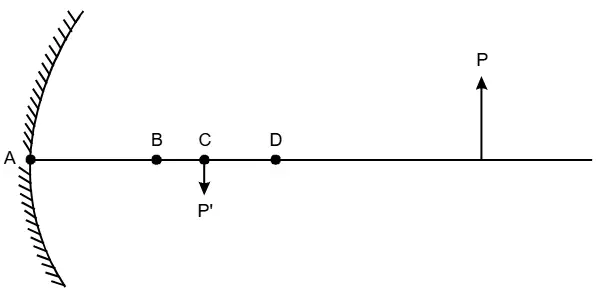
A curved mirror forms an image P' of an object P. Which of the following best indicates the location of the focal point of the mirror?
A
B
C
D

The diagram shows a Van de Graaff generator, which is a laboratory device for building up high voltage. The hollow metal sphere collects the charge while a belt carries charge from the voltage source to the sphere. The generator is 100% efficient and the potential difference between the belt and the sphere is 75 kV. Which of the following is the power needed to supply charge to the sphere at a rate of 160 μC/s?
2.1 × 10⁻⁸ W
0.083 W
12 W
4.7 × 10⁸ W

The diagram shows a circuit with three identical resistors. Which of the following is the ratio of the current through point A to the current through point B?
1/2
2/3
1
2
Which of the following postulates is necessary for the Bohr model of the atom?
Special relativity is required for correct velocity calculations as electrons are moving at speeds near the speed of light.
The intensity of a photon wave at a point determines the probability that there is a photon particle at that point.
Electrons exist as both wave and particle, but wave and particle properties can not be exhibited simultaneously.
The laws of classical mechanics apply to electrons orbiting in a stationary state, but different rules apply during transitions between states.
According to the constructed-response assignment directions, which of the following is NOT an acceptable way to submit your final response?
Typed into the on-screen response box.
Written on a response sheet and scanned using the scanner provided at your workstation.
Provided using both the on-screen response box and a response sheet for calculations or drawings.
Emailed to the test administrator after the session.
Which criterion evaluates the extent to which the response addresses the constructed-response assignment's charge in relation to relevant CSET subject matter requirements?
SUPPORT
PURPOSE
SUBJECT MATTER KNOWLEDGE
ORGANIZATION
What is the main focus of the "SUPPORT" criterion in evaluating constructed-response assignments?
The neatness of the handwriting
The appropriateness and quality of supporting evidence
The length of the response
The use of technical jargon
Which of the following best describes the intended audience for your constructed-response assignment?
A general audience with no background in education
Educators in the field
Your classmates
The test administrators only
Why is it important to monitor your time carefully during the constructed-response assignment?
Because only responses completed in the first 10 minutes will be scored
Because any response sheet not scanned before testing ends will NOT be scored
Because you can use reference materials if you finish early
Because you can submit your response after the session ends
Which of the following is a requirement for your constructed-response assignment?
It must be copied from another source
It must be your original work, written in your own words
It must be written in cursive
It must be exactly 500 words long
Which aspect is NOT evaluated in the constructed-response assignment according to the directions?
Subject matter knowledge
Writing ability
Purpose
Support

Which of the following best describes the direction of the force applied by the rope in the given scenario?
30° above the horizontal
60° above the horizontal
30° below the horizontal
Parallel to the horizontal
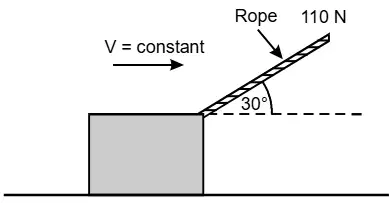
What is the mass of the block being pulled across the rough horizontal surface?
10 kg
25 kg
50 kg
110 kg

Given that the block moves at a constant velocity, what can be inferred about the net force acting on the block?
The net force is zero.
The net force is equal to the weight of the block.
The net force is equal to the tension in the rope.
The net force is equal to the frictional force.
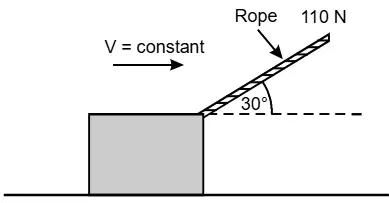
Which of the following equations correctly represents the x-component of the force applied by the rope?
110 N × cos(30°)
110 N × sin(30°)
25 kg × 9.8 m/s²
110 N × tan(30°)
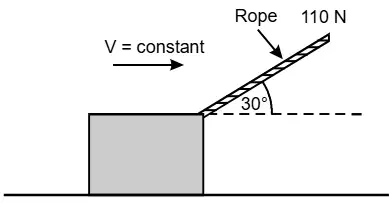
To calculate the coefficient of kinetic friction (μk) between the block and the surface, which of the following sets of information is necessary?
The normal force and the frictional force
The mass of the block and the angle of the rope
The tension in the rope and the velocity of the block
The gravitational acceleration and the block’s velocity

What is the mass of ball P before the collision?
2.12 kg
1.2 kg
4.64 kg
3.32 kg

What is the initial velocity of ball P before it collides with ball Q?
4.64 m/s
2.13 m/s
1.2 m/s
30.0 m/s
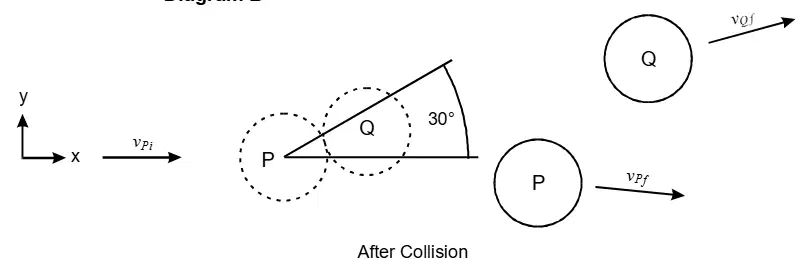
After the collision, at what angle above the x-axis does ball Q move?
30.0°
45.0°
60.0°
90.0°
Which of the following is a reasonable assumption to make when solving this collision problem?
The collision is perfectly elastic.
The balls are affected by air resistance.
The masses of the balls change during the collision.
The collision occurs in a vacuum.
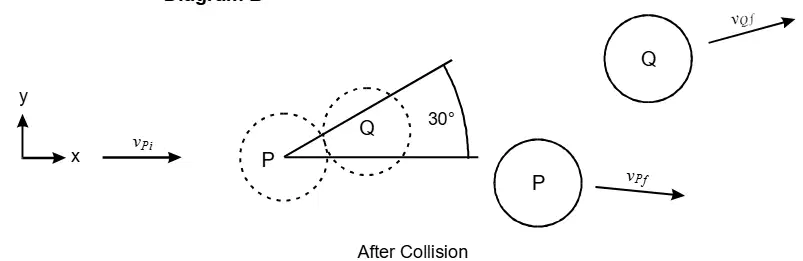
If the x-component of the velocity of ball P after the collision is 2.13 m/s, which of the following best describes the motion of ball P?
Ball P continues to move in the x-direction but at a reduced speed.
Ball P comes to a complete stop.
Ball P reverses direction.
Ball P moves only in the y-direction.

What is the direction of the magnetic field in the given diagram?
Into the page
Out of the page
To the right
Upward
What is the shape of the path that a positively charged particle follows when it enters a uniform magnetic field perpendicular to its velocity?
Straight line
Ellipse
Circle
Parabola
Given a particle of charge q = +2C , mass m = 10−4kg , and velocity v = 105m/s entering a magnetic field of B = 2T , what is the radius of the circular path it follows?
0.25 m
1.0 m
5.0 m
10.0 m
Which of the following best explains why the particle moves in a circular path in the magnetic field?
The magnetic force acts as a centripetal force perpendicular to the velocity.
The magnetic force increases the speed of the particle.
The magnetic field repels the particle out of the region.
The particle is attracted to the center of the field.
If the magnetic field strength were doubled, what would happen to the radius of the particle's path?
It would double.
It would be halved.
It would remain the same.
It would become zero.
What is the initial vertical component of the ball's velocity if the ball is launched at 20 m/s at a 30° angle?
10 m/s
20 m/s
5 m/s
15 m/s
For rotational motion, if the angular acceleration is 0.50 rad/s² and the initial angular velocity is 0, what is the angular displacement after 4 seconds?
1.0 radians
2.3 radians
4.0 radians
8.0 radians
If an object weighs 39.2 N and is supported by two cables at 45° to the horizontal, what is the tension in each cable?
19.6 N
28 N
39.2 N
56 N
As a block falls and loses potential energy, what does this energy become?
Only translational kinetic energy of the block
Only rotational kinetic energy of the wheel
Both translational kinetic energy of the block and rotational kinetic energy of the wheel
Only heat energy
If a 2.0 kg block falls 1.0 m, what is the change in potential energy of the block? (Use g = 9.8 m/s²)
-9.8 J
-19.6 J
-4.9 J
-2.0 J
What is the final kinetic energy of a 2.0 kg block moving at 2.8 m/s?
7.84 J
12 J
19.6 J
5.6 J
In a system of colliding objects, what must be true for momentum to be conserved?
No outside forces act on the system
The objects must be at rest
The system must be accelerating
The objects must have equal mass
If two objects collide in an isolated system, what happens to the overall system momentum?
It increases
It decreases
It stays constant
It becomes zero

