
 Worksheets
European and Medieval History Quiz
Total questions: 84
Worksheet time: 42mins
What time period do the Middle Ages cover?
300 CE to 1300 CE
500 CE to 1500 CE
600 CE to 1600 CE
700 CE to 1700 CE
What is the English translation of the Latin word for “medieval”?
Ancient
Modern
Middle age
New age
Which continent is primarily located in the northeastern hemisphere and combines with Asia?
Africa
Europe
Australia
South America
Which of the following is a major peninsula of Europe?
Arabian
Scandinavian
Korean
Indian
What are the natural barriers that divide Europe and Asia?
Andes Mountains
Ural Mountains
Rocky Mountains
Appalachian Mountains
What type of climate does Northwest Europe have due to winds from the Atlantic Ocean?
Hotter and drier
Milder and wetter
Colder and snowier
Warmer and drier
Which cities are examples of those established along rivers in Europe?
Madrid, Berlin, Athens
London, Paris, Venice
Rome, Lisbon, Vienna
Dublin, Oslo, Prague
What was a common religion adopted by Europeans during the Middle Ages?
Buddhism
Islam
Christianity
Hinduism
Which countries were part of the Christian areas at the start of the Middle Ages?
Spain, France, Italy
Norway, Sweden, Finland
Poland, Hungary, Czech Republic
Russia, Ukraine, Belarus
Who was the most powerful clergy member in the Christian Church during the Middle Ages?
Bishop
Cardinal
Pope
Deacon
Who sent missionaries to Northern Europe in 597 CE?
Pope Gregory I
Pope Benedict
Pope John Paul II
Pope Urban II
What is the name of the British missionary who returned to Ireland to convert the Irish?
Patrick
Benedict
Francis
Thomas
What are the communities called where monks live?
Monasteries
Convents
Temples
Churches
What did the Benedictine Rule require monks and nuns to do?
Live without personal possessions
Travel frequently
Engage in trade
Hold political office
What services did monasteries and convents provide?
School and healthcare
Military training
Political advice
Trade and commerce
What event allowed Germanic groups to establish kingdoms across Western Europe by 500 CE?
The rise of the Byzantine Empire
The fall of Rome
The unification of the Franks
The spread of Christianity
What was a key characteristic of the kingdoms established by Germanic groups?
They shared a common government
They were run independently by local warlords
They were united under the Byzantine Empire
They followed Roman laws
Who led the Franks to conquer most of Gaul in the 480s CE?
Charlemagne
Constantine
Clovis
Augustus
What was a significant cultural change during Clovis's reign?
Adoption of Roman laws
Conversion to Christianity
Establishment of a common language
Abolition of warlords
What was the main reason for the instability of the Merovingian Dynasty?
Lack of resources
Conflicts among successors for power
Invasion by the Saxons
Economic collapse
During whose reign did the Frankish kingdom reach the height of its power?
Clovis
Charlemagne
Augustus
Constantine
What was one of Charlemagne's significant military actions?
Defeating the Byzantine Empire
Waging war against the Saxons and Lombards
Conquering the Eastern Roman Empire
Establishing peace treaties with all neighbors
What was a result of Charlemagne's military campaigns?
The decline of Christianity
The expansion of the Carolingian Empire
The unification of the Byzantine Empire
The fall of the Roman Empire
What title was Charlemagne given by the pope?
King of France
Emperor of the Roman Empire
Duke of Normandy
Prince of Europe
What was one of Charlemagne's contributions to education?
He closed all schools.
He banned libraries.
He oversaw the growth of schools and libraries.
He discouraged intellectuals.
Which kingdom did West Francia become after the division of the Carolingian Empire?
Italy
Spain
France
England
Who were some of the invaders that the smaller kingdoms struggled to protect themselves from?
Romans and Greeks
Vikings and Magyars
Egyptians and Persians
Chinese and Mongols
What was the purpose of giving plots of land called fiefs to knights?
To encourage farming
To reward them for their service
To build castles
To promote trade
What was a noble who gave fiefs to knights known as?
Vassal
Serf
Lord
Peasant
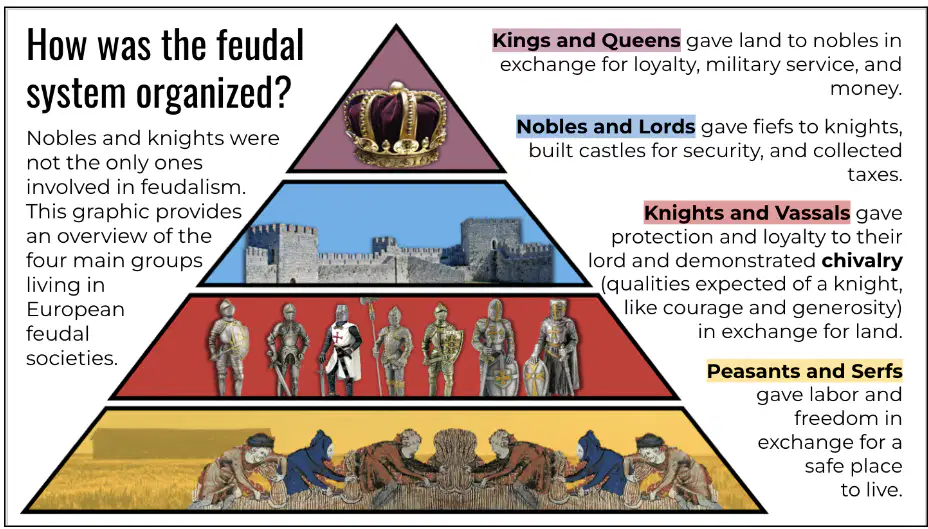
In the feudal system, what did knights and vassals provide in exchange for land?
Money
Chivalry and loyalty
Food
Taxes
How did lords and knights manage their manors?
They worked the land themselves.
They hired other knights to manage it.
They let serfs or peasants farm on their land.
They left the land unmanaged.
What portion of the land did lords/knights keep for themselves?
One-half
One-third
One-fourth
All of it
What was one of the main reasons for the collapse of the feudal system between 1100 CE and 1300 CE?
Decrease in agricultural production
Increase in food due to new agricultural inventions
Decline in trade and manufacturing
Reduction in population
How did the new banking system benefit merchants during the collapse of the feudal system?
It allowed them to carry more goods
It eliminated the need to carry large amounts of coins
It increased the value of coins
It reduced the cost of travel
What role did guilds play in the towns during the collapse of the feudal system?
They were responsible for collecting taxes
They formed associations of specialized workers
They managed the local markets
They controlled the military forces
Who became the king of Germany in 936 CE?
Charlemagne
Otto the Great
Frederick Barbarossa
Henry the Fowler
What was the purpose of the Holy Roman Empire according to the text?
To expand into Asia
To revive the perceived greatness of the Roman Empire
To establish a new religion
To conquer the Byzantine Empire
What were the two types of leaders who wielded the most power in Medieval Europe?
Kings and knights
Popes and bishops
Kings and popes
Emperors and nobles
What was the main cause of conflict between kings and popes?
Disagreements over land ownership
Different views on the role of religion in politics
Disputes over trade routes
Conflicts over military power
Who crowned Charlemagne as emperor in 800 CE?
King Henry IV
Pope Gregory VII
Pope Leo III
King Louis IX
What was the significance of the crowning of Charlemagne by Pope Leo III?
It showed that popes could give and take power from kings
It marked the end of the Roman Empire
It established Charlemagne as a religious leader
It resolved all conflicts between kings and popes
What was the major clash between Pope Gregory VII and King Henry IV about?
The appointment of bishops and clergy members
The division of land in the Holy Roman Empire
The control of trade routes
The leadership of the Christian Church
What was the main reason for the conflict between Gregory and Henry?
Disagreement over taxes
Dispute over land ownership
Authority to appoint public officials
Trade disagreements
What action did Gregory take against Henry during their conflict?
Imprisoned him
Excommunicated him
Declared war on him
Forgave him
How did Henry seek forgiveness from Gregory?
Sent a letter of apology
Offered him gifts
Stood barefoot in the snow
Built a church in his honor
What was the outcome of the Concordat of Worms in 1122 CE?
The pope could appoint bishops
The king could appoint bishops
The pope was removed from power
The king was excommunicated
Who became the new king of England after the battle in 1066 CE?
King Harald III
Harold II
William “The Conqueror”
Duke of Normandy
What system did William bring to England as king?
Feudal system
Democratic system
Capitalist system
Socialist system
Who were the new ruling class in England after William took land from local landowners?
Saxons
Normans
Vikings
Celts
What document did the barons force King John to sign in 1215 CE?
The Bill of Rights
The Magna Carta
The Declaration of Independence
The Treaty of Versailles
What did the Magna Carta require the King of England to respect?
The rights of the church
The rights of the people
The rights of the nobility
The rights of the merchants
What was one of the political changes after the signing of the Magna Carta?
Establishment of a monarchy
Creation of a council of barons
Abolition of the parliament
Introduction of a dictatorship
What did the Magna Carta protect that meant monarchs could not imprison people without reason?
Habeas corpus
Freedom of speech
Right to bear arms
Right to privacy
What was the result of the new judicial system established by the Magna Carta?
More power for the king
Fairer trials
More taxes
Longer wars
What was the significance of the Crusades regarding travel to the Holy Land?
Only Christians could travel
Only Muslims could travel
People of multiple faiths could travel
Only merchants could travel
What was the Holy Land, and why was it significant?
A region in modern-day Egypt, sacred to Hindus and Buddhists
A disputed area between modern-day Israel and Palestine, sacred to Jews, Christians, and Muslims
A territory in ancient Greece, important for its philosophers
A land in ancient China, known for its silk production
Who captured Jerusalem in 1087 CE, prompting the Crusades?
The Byzantine Empire
The Seljuk Turks
The Roman Empire
The Mongols
How many official crusades took place between 1095 CE and 1270 CE?
Five
Six
Eight
Ten
What was a major outcome of the First Crusade?
The Crusaders established four kingdoms in the Holy Land
The Crusaders were defeated and returned to Europe
The Crusaders formed an alliance with the Muslims
The Crusaders discovered new trade routes to Asia
What challenges did soldiers face during the Crusades?
Lack of weapons and armor
Disease, theft, exhaustion, and hunger
Language barriers and cultural differences
Navigating through dense forests
What was a significant outcome of the Third Crusade?
The Crusaders captured Jerusalem.
A truce was made between Richard I and Saladin.
The Crusaders gained control of Constantinople.
The Crusaders defeated the Byzantine Empire.
What was one of the consequences of the Crusades on trade?
Trade decreased between Europe and Asia.
Trade increased between Europe and Asia.
Trade remained the same between Europe and Asia.
Trade was only between Europe and Africa.
How did the Christian Church gain political power during the Middle Ages?
By conquering new lands.
By becoming one of the biggest landholders in Europe.
By forming alliances with kings.
By building more churches.
What was a major criticism of the Christian Church during the Middle Ages?
It focused too much on education.
It became more focused on wealth and power.
It was too involved in scientific research.
It ignored religious teachings.
What was the main focus of the Monks of Cluny?
Teaching Christianity to everyday people
Dedication to religious matters
Building grand cathedrals
Creating beautiful art pieces
Which group lived among everyday people to teach them about Christianity?
Monks of Cluny
Franciscans
Visigoths
Moors
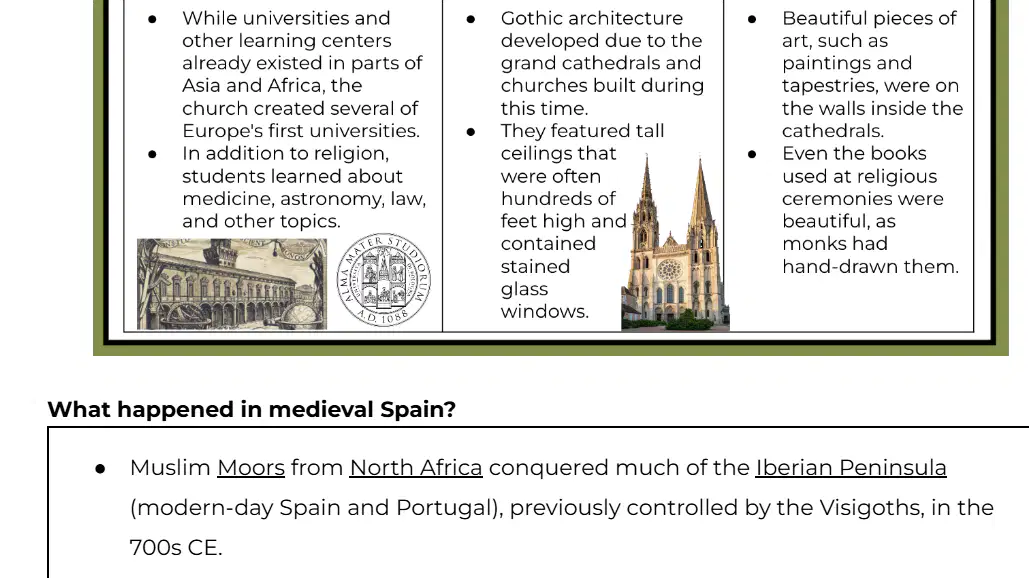
What architectural style developed due to the grand cathedrals and churches built during medieval times?
Romanesque
Baroque
Gothic
Renaissance
What was one of the cultural advancements in Córdoba during the Moors' reign?
Development of Gothic architecture
Creation of the largest city in Europe
Establishment of the first universities
Introduction of new religious orders
What did the Moors introduce to homes in Córdoba?
Stained glass windows
Mosaic floors
Hand-drawn books
Tall ceilings
What was the main motivation behind the Reconquista?
Religious devotion
Desire for wealth and gold
Scientific exploration
Cultural exchange
Which kingdom became independent as a result of the Reconquista?
France
Portugal
England
Italy
Who were the rulers that ended the Reconquista?
Charles and Diana
Ferdinand and Isabella
Henry and Anne
Louis and Marie
What was the Hundred Years’ War primarily about?
Trade routes
Religious differences
Territorial expansion
Succession to the throne
How long did the Hundred Years’ War last?
50 years
75 years
100 years
150 years
How long did the Hundred Years' War last?
100 years
116 years
120 years
130 years
Who was the young girl that joined the fight during the Hundred Years' War and inspired the French troops?
Marie Curie
Joan of Arc
Eleanor of Aquitaine
Catherine de' Medici
What was one of the effects of the Hundred Years' War on the English Parliament?
It became less powerful
It gained more power
It was dissolved
It remained unchanged
What was the Black Death?
A war
A deadly plague
A natural disaster
A political movement
What was one of the symptoms of the Black Death?
Fever
Swelling of lymph nodes
Coughing
Headache
What was one of the initial symptoms of the Black Death?
Fever
Cough
Rash
Headache
Where did the Black Death initially come from?
Europe
Central Asia
Africa
South America
How did the Black Death primarily spread?
Through water
Through air and bites of fleas or rats
Through food
Through soil
What was one effect of the Black Death on European villages and towns?
They became more populated
They became abandoned
They became wealthier
They became more industrialized
What helped reduce the impact of the Black Death in modern times?
Vaccines
Antibiotics and sanitation
Herbal medicine
Magic spells

