
 Worksheets
Speed Limits and Safe Driving Worksheet
Total questions: 40
Worksheet time: 21mins
If it's raining, snowing, or icy conditions it is always smart to drive the posted speed limit.
True
False
If vehicle problems prevent a motorist from keeping up with the normal flow of traffic, he or she should pull off and activate
Blinker
Brake lights
Hazards
Reverse lights
The purpose of the Safe Corridors Program is to:
Increase speed limits on highways
Enhance safety and reduce accidents on designated highways
Promote tourism along highways
Encourage commercial vehicle traffic
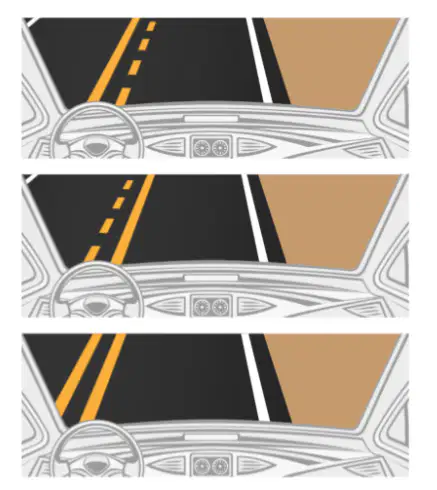
Explain the following lane markings: - (Image 1) ________ - (Image 2) ________ - (Image 3) ________
Pass when line is broken; Do not pass when the line is solid; No passing with double solid lines
Pass when the line is solid; Do not pass when the line is broken; No passing with single solid line
Pass at all times; Do not pass at any time; Passing allowed with double solid lines
Pass only when both lines are broken; Do not pass when both lines are solid; Passing allowed with one solid line
Most passing should be done on the (a) .
It is legal to pass on the right shoulder of the road.
True
False
List three times a motorist should not pass.
On a hill or curve, at a street intersection, at a railroad crossing, narrow bridges or underpasses or tunnels
When the road is clear and straight, during daylight, when there are no other vehicles
When driving in a parking lot, at a green traffic light, on a wide highway
When following a slow-moving vehicle, when the weather is clear, on a multi-lane road
A motorist must stop for pedestrians in a crosswalk. Failure to stop can result in
A fine up to $500 and 2 points on your license
Up to 25 days in jail and community service
Suspension of driving privileges up to 6 months
All of the above
What is a controlled intersection?
Intersection with no regulatory devices
Intersection blocked by parked vehicles
Intersection with traffic signals or signs in any direction
Intersection where there are no set of rules for driving
At an uncontrolled intersection, as a general rule
The vehicle to the left must yield to the vehicle on the right
The vehicle going straight through goes first
The vehicle entering the intersection must yield
The vehicle to the right must yield to the vehicle on the left
When two or more roads join and there is no traffic signal or regulatory device, it is a good practice to _______.
be cautious and yield to vehicles on the right
speed up and cross the intersection quickly
ignore other vehicles and proceed first
honk and proceed without stopping
If you see a hazard ahead while driving, what should you do?
Pull to the right lane and stop
Blow your horn as a warning
Reduce speed and be ready to stop
Always yield to traffic on the left
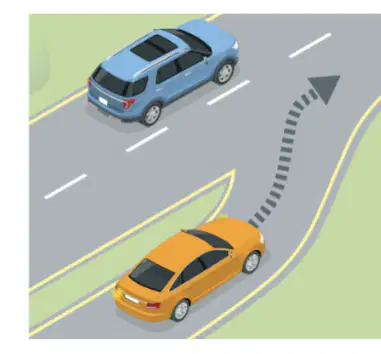
This picture shows an acceleration lane, what is the purpose of this lane?
The purpose of the acceleration lane is to allow motorists to speed up to join the flow of traffic on the highway.
The purpose of the acceleration lane is to allow vehicles to stop and rest before entering the highway.
The purpose of the acceleration lane is to provide a space for emergency vehicles only.
The purpose of the acceleration lane is to allow motorists to slow down before exiting the highway.
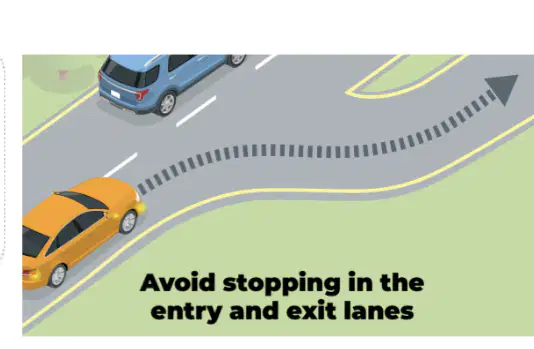
What does the picture below illustrate?
The picture illustrates a deceleration lane or exit ramp, where motorists should slow down, obey the speed limit, and look for the proper lane for exiting.
The picture illustrates a pedestrian crossing, where drivers must stop for people walking across the road.
The picture illustrates a roundabout, where vehicles must yield to traffic already in the circle.
The picture illustrates a school zone, where drivers should reduce speed and watch for children.
If a motorist misses an exit ramp on a highway, parkway or turnpike, he or she should go to the next exit.
True
False
If a motorist vehicle becomes disabled, which of the following is NOT something the motorist must do?
Pull off as far as possible onto the shoulder or median.
Turn on emergency flashers.
Leave the vehicle in the middle of the road and walk away.
Raise the hood to signal for assistance.
The best way to enter a curve is
Slow down after entering the curve
Lean in the direction of the curve
Speed up while in the curve
Slow down before entering the curve
Double solid lines in the center of a road means
A divided highway
No passing allowed
A one-way street
A "pass with care" road
When two or more roads join and there is no traffic signal or regulatory device, it is a good practice to
Pull to the right lane and stop
Blow your horn as a warning
Reduce speed and be ready to stop
Always yield to traffic on the left
Is it legal to turn right on red, if you
Make a full stop, and check for traffic
Slow down and check traffic
Blow your horn
Check traffic to the right
When two vehicles meet at an intersection and both have signaled to make a left turn, each motorist should do the following.
Flash their headlights
Continue going straight
Turn to the left of the center of the intersection
Beep their horn
At a yellow light, you should:
Speed up to cross before it turns red.
Stop if it is safe to do so.
Ignore the light and continue driving.
Make a U-turn.
Three times a motorist must stop are:
At a red traffic light, at a stop sign, and for a school bus with flashing lights.
When passing another vehicle, when turning left, and when merging onto a highway.
While driving in a parking lot, when using a GPS, and when adjusting the radio.
At a green light, when the road is clear, and when there are no pedestrians.
Which of the following are signals that a train is coming at a railroad crossing?
Flashing red lights, lowered gates, and ringing bells
Green traffic light, open gates, and no sound
Pedestrian crossing, stop sign, and parked cars
Speed bump, yield sign, and street lights
On a two-lane road when a school bus is stopped and its red lights are flashing
You must stop at least 25 ft. away
You may pass the bus with caution
You may pass the bus at a speed of 10 miles per hour or less
You may pass the bus from either direction
Police cars, fire trucks, ambulances, volunteer fire and rescue squad members responding to emergencies use sirens and red or blue flashing lights. When you see or hear these you must
Steer to the extreme right of the roadway and stop, letting them pass you
Slow down and let them pass you
Headlights must be used
From dawn to dark
From 8 p.m. to 8 a.m.
From 6 p.m. until 6 a.m.
Between one-half hour after sunset and one-half hour before sunrise and anytime during bad weather when visibility is 500 feet or less
Why is it dangerous to use bright beams when driving behind or approaching other vehicles?
Bright beams temporarily blind other drivers, it can take 3-5 seconds for a motorist to recover from bright beams.
Bright beams improve visibility for all drivers on the road.
Bright beams help other drivers see your vehicle better.
Bright beams reduce the risk of accidents in foggy conditions.
Unless directed to do so by a police officer or to avoid a crash, a motorist should never stop or park in which of the following locations?
In front of a public or private driveway, within an intersection, or on a crosswalk
In a designated parking lot, at a green light, or in a rest area
On the right side of a one-way street, in a parking garage, or at a bus stop
In a parking space, at a stop sign, or in a loading zone
On a two-lane road when a school bus is stopped and its red lights are flashing
You must stop at least 25 ft. away
You may pass the bus with caution
You may pass the bus at a speed of 10 miles per hour or less
You may pass the bus from either direction
At an uncontrolled intersection, as a general rule
The vehicle to the left must yield to the vehicle on the right
The vehicle going straight through goes first
The vehicle entering the intersection must yield
The vehicle to the right must yield to the vehicle on the left
When traveling on a dual-lane highway, a motorist should slow to ________ if a school bus is on the other side of a safety island or raised median.
10 mph
25 mph
35 mph
It doesn't matter as long as the bus is on the other side of the median
When approaching a railroad crossing with flashing lights, you must
Stop at least 15 feet from the railroad crossing
Slow down and look both ways
Slow down, blow your horn and proceed with caution
All of the above
You cannot park within how many feet of a crosswalk at an intersection?
50 feet
10 feet
20 feet
25 feet
You may not park within how many feet of a fire hydrant
20 feet
25 feet
10 feet
50 feet
If you come to a multi-way stop at the same time as another motorist, you must
Yield to passing cars
Yield to the motorist on the right
Yield to the motorist on the left
Yield to oncoming cars
When two vehicles meet at an intersection and both have signaled to make a left turn, each motorist should do the following.
Flash their headlights
Continue going straight
Turn to the left of the center of the intersection
Beep their horn
A deceleration lane is
For slow drivers only
For fast drivers only
An extra lane at a highway exit
The passing lane
Police cars, fire trucks, ambulances, volunteer fire and rescue squad members responding to emergencies use sirens and red or blue flashing lights. When you see or hear these you must
Steer to the extreme right of the roadway and stop, letting them pass you
Slow down and let them pass you
Speed up and stay at least 100 feet ahead of them
Follow them and offer assistance
Unless a "no turn on red sign" is posted, New Jersey law permits you to turn right on red after
Making a full stop and checking traffic
Checking traffic to your right
Blowing down to check traffic
Blowing your horn

