
 Worksheets
Rm 451 Biology Spring Finals 2025
Total questions: 48
Worksheet time: 25mins
What is the term for the physical appearance of an organism as a result of its genetic makeup?
Chromosome
Phenotype
Genotype
DNA sequence
If a heterozygous individual (Tt) is crossed with another heterozygous individual (Tt), what will be the genotype ratio of the offspring?
1 TT : 2 Tt : 1 tt
2 TT : 2 Tt
1 TT : 1 Tt : 1 tt
2 Tt : 2 tt
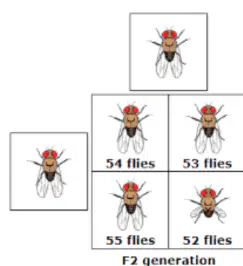
What percent of the F2 generation is expected to be heterozygous for long wings?
0%
25%
50%
75%
100%
Use “L” to represent the dominant trait (long wing), and “l” (short wing). What are the genotypes of mom and dad (F1)?
Mom: Ll, Dad: LL
Mom: Ll, Dad: ll
Mom: ll, Dad: ll
Mom: Ll, Dad: Ll
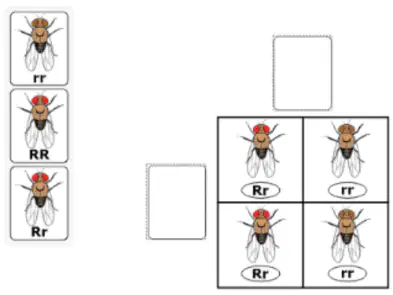
Using the Punnett square provided, identify the genotypes of the parents to produce approximately 50% homozygous brown-eyed offspring and 50% heterozygous offspring. R=dominant (red eyes), r=recessive (brown eyes)
RR x RR
Rr x Rr
Rr x rr
RR x rr
Which of the following statements best describes the relationship between dominant and recessive alleles?
Dominant alleles never overpower recessive alleles or completely hide their effects in an organism’s traits.
Recessive alleles are stronger and more likely to be expressed in an organism’s traits than dominant alleles.
An organism must have two copies of a recessive allele for the recessive trait to be expressed, while only one copy of a dominant allele is needed for the dominant trait to be expressed.
Dominant alleles and recessive alleles always blend together to produce a trait that is intermediate between the two.
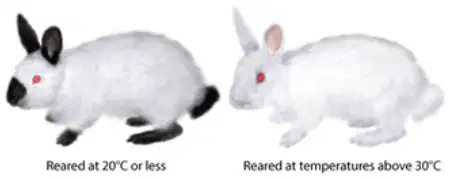
Which of the following statements is true?
Gene expression in Himalayan rabbits is influenced by both light and heat.
Only genetic factors are involved in gene expression for Himalayan rabbit fur color.
Gene expression in Himalayan rabbits is influenced by altitude.
Both genetic and environmental factors are involved in gene expression for Himalayan rabbit fur color.
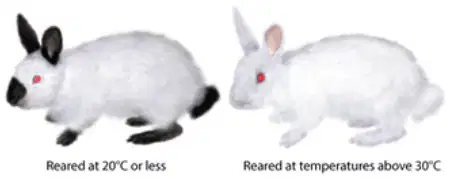
A population of wild Himalayan rabbits becomes separated from the original population. The separated population is confined to a new area that is located in a very warm (greater than 30°C) valley between two mountains. Which statement predicts what will MOST LIKELY happen to the physical appearance of the separated rabbit population over time?
The frequency of rabbits with dark coloration will be higher because expression of the C gene is influenced by environmental conditions.
The frequency of rabbits with dark coloration will be lower because the C gene will not be passed on to any future offspring.
The frequency of rabbits with dark coloration will be lower because expression of the C gene is influenced by environmental conditions.
The frequency of rabbits with dark coloration will be higher because small populations lack the biodiversity to produce individuals without the C gene.
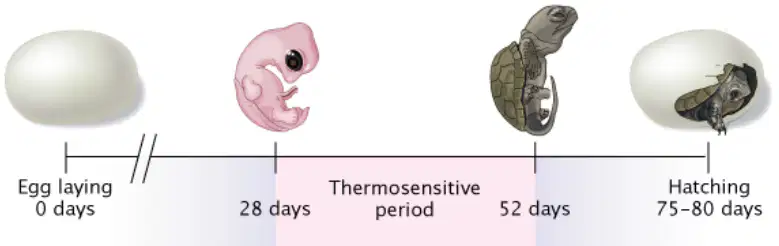
Scientists know that the temperature at which a turtle egg is incubated influences the sex of the resulting baby turtle. Research shows that if a turtle's eggs incubate below 27.7° Celsius (81.86° Fahrenheit), the turtle hatchlings will be male. If the eggs incubate above 31° Celsius (88.8° Fahrenheit), however, the hatchlings will be female. Temperatures that fluctuate between the two extremes will produce a mix of male and female baby turtles. Select the statement that is true:
Only male turtles will hatch at 25°C.
Both male and female turtles will hatch at 38.5°C
Only female turtles will hatch at 25°C
Warmer temperatures, around 34°C, hatch all males
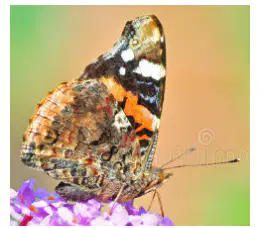
Which of the two figures likely represents caterpillars exposed to green light?
Fig. 1
Fig. 2
Both Fig. 1 & Fig. 2
Neither of the figures represents exposure to green light.
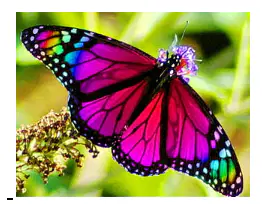
Which of the following statements is true based on the information in the passage?
urtica butterflies exposed to red light will have dusky wings.
Our genes are solely responsible for the phenotype expressed.
Light is an example of an environmental factor that influences gene expression in V.urtica butterflies.
Temperature plays a strong role in color gene expression of V.urtica butterflies.
In Mendelian genetics, what is the expected phenotypic ratio of offspring from a cross between two heterozygous parents (Aa x Aa) for a single trait?
1 dominant : 3 recessive
1 dominant : 1 recessive
3 dominant : 1 recessive
2 dominant : 2 recessive
What do we call the different forms/versions of a gene that can exist at a single locus?
Chromosomes
Alleles
Genotypes
Phenotypes
A homozygous dominant individual (AA) is crossed with a homozygous recessive individual (aa). What is the probability of producing an offspring with the dominant phenotype?
0%
25%
50%
100%
What is the primary purpose of meiosis in sexually reproducing organisms?
To produce identical daughter cells for growth and repair.
To create genetic diversity by producing haploid gametes.
To duplicate the entire set of chromosomes.
To produce diploid cells with identical genetic material.
Which term describes the process where individuals with traits best suited to their environment are more likely to survive and reproduce?
Genetic drift
Artificial selection
Survival of the fittest
Mutation
Which of the following statements best explains how natural selection leads to evolution?
Individuals develop new traits in response to environmental changes.
Organisms acquire traits during their lifetime and pass them on to offspring.
Over time, traits that increase survival and reproduction become more common in a population.
Genetic variation decreases within a population due to selective breeding.
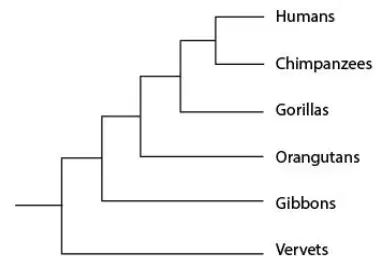
Which pair of organisms are the MOST closely related?
Chimpanzees and gibbons
Humans and chimpanzees
Orangutans and gibbons
Gibbons and vervets
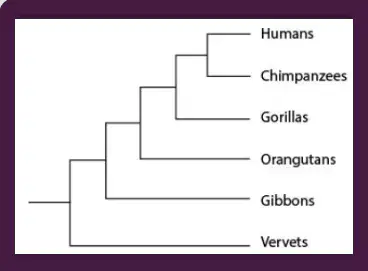
Which evidence supports that humans and vervets are least related?
They have the fewest similar anatomical features and genes.
They are the farthest apart from each other on the cladogram.
They have the fewest base pairs in common with each other.
They have the least genomic difference between them.
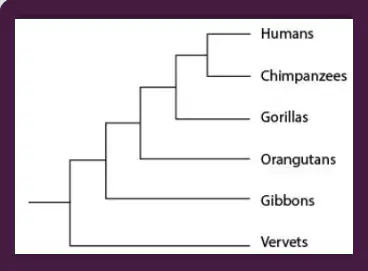
What evidence does the cladogram provide?
It provides evidence that chimpanzees are the ancestors of humans.
It provides evidence that humans are the ancestors of chimpanzees.
It provides evidence of one common ancestor of all primates.
It provides evidence that all primates had different ancestors.

Which statement BEST describes what happened to the population of red lizards?
The population remained stable because they were better able to hide and avoid being eaten by predators.
The population decreased because they were unable to survive in the environment and reach reproductive age.
The population remained stable because they were able to pass on their traits to each generation of offspring.
The population decreased because their skin coloring was the result of a mutation in the original population.
Which pair BEST identifies the cause and effect of the changes observed in the lizard population over 30 generations?
Cause: shift in distribution of lizard color; Effect: changing environment
Cause: changing environment; Effect: shift in distribution of lizard color
Cause: gene mutation; Effect: red body color
Cause: red body color; Effect: gene mutation
An environmental process changed the color of the surrounding land. This process took place from the beginning of the initial generation through the 30th generation. Select the statement that best explains why the lizards' color trait frequencies changed during that same time period.
The black color trait allowed many lizards to better survive and reproduce in the changed environment.
The red color trait allowed many lizards to better survive and reproduce in the changed environment.
The black color trait prevented most lizards from being able to survive and reproduce in the changed environment.
The brown color trait allowed many lizards to better survive and reproduce in the changed environment.
How can an environmental change cause a shift in the traits of a population?
An environmental change can cause organisms to choose traits that are more favorable.
An environmental change can make some organisms better suited for survival than others.
An environmental change can cause some organisms to change their behaviors and quit reproducing.
An environmental change can make organisms that are less suited for survival reproduce more rapidly.
Which statement is BEST supported by the data in the graph?
The percentage of birds with smaller beaks increased because they were better able to find food and survive to reach reproductive age.
The percentage of birds with larger beaks increased because they were better able to find food and survive to reach reproductive age.
The percentage of birds with smaller beaks increased because there was less competition for food with the large-beaked birds.
The percentage of birds with larger beaks decreased because there was increased competition for food with the smaller-beaked birds.
Which statement BEST describes what happened to the birds with smaller beaks?
The environment selected for them, increasing the competition for small seeds and reducing the number of birds with small beaks in the population.
The environment selected for them, decreasing the competition for small seeds and increasing the number of birds with small beaks in the population.
The environment selected against them, increasing the competition for small seeds and reducing the number of birds with small beaks in the population.
The environment selected against them, decreasing the competition for small seeds and increasing the number of birds with small beaks in the population.
Select the processes that are MOST LIKELY to cause the variation in bird beak size traits within this population.
Asexual reproduction & Mutation
Hibernation & Mutation
Sexual Reproduction & Mutation
Sexual Reproduction & Migration
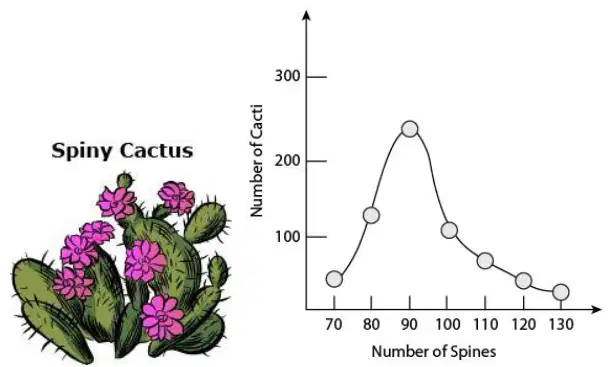
Based on the graph, what is the most common number of spines found on spiny cacti before the introduction of collared peccaries and parasitic wasps?
A) 70
B) 90
C) 110
D) 130
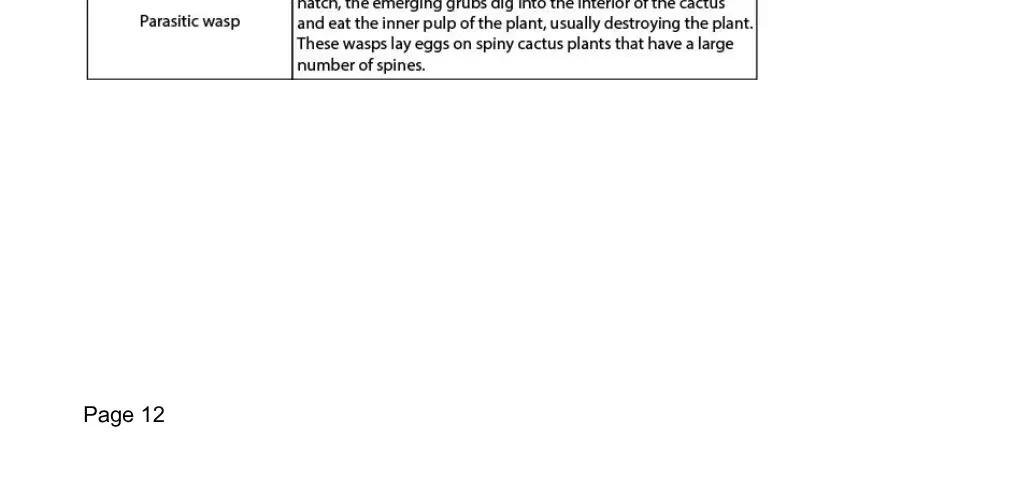
Which organism is most likely to reduce the number of spiny cacti with a small number of spines?
Collared peccary
Parasitic wasp
Both equally
Neither
Which predicts how the spiny cactus population will MOST LIKELY change over a long period of time?
Change in the Population Cacti with 70 spines: They will decrease due to the collared peccaries Cacti with 100 spines: They will increase due to their ability to survive and reproduce Cacti with 130 spines: They will decrease due to the parasitic wasps
Change in the Population Cacti with 70 spines: They will decrease due to the parasitic wasps Cacti with 100 spines: They will increase due to their ability to survive and reproduce Cacti with 130 spines: They will decrease due to the collared peccaries
Change in the Population Cacti with 70 spines: They will increase due to their ability to survive and reproduce Cacti with 100 spines: They will decrease due to the parasitic wasps Cacti with 130 spines: They will increase due to their ability to survive and reproduce
Change in the Population Cacti with 70 spines: They will increase due to their ability to survive and reproduce Cacti with 100 spines: They will decrease due to the collared peccaries Cacti with 130 spines: They will increase due to their ability to survive and reproduce
Which statement BEST explains why the pattern of data in the graph supports the claim that natural selection could occur for this spiny cactus population?
The data pattern shows variation in the spine number trait, which does not affect survival.
The data pattern shows that most spiny cacti have a small number of spines, which affects survival.
The data pattern shows variation in the spine number trait, which affects survival.
The data pattern shows that most spiny cacti have a large number of spines, which does not affect survival.
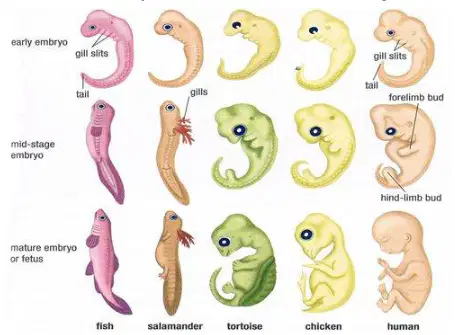
Many species have embryos with very similar features during early development. What does this tell us about these organisms? The embryos below are in chronological order from top to bottom.
It’s likely that they all share a common ancestor
They are all closely related to each other
There is only one template for embryos that all organisms have to use
All organisms have gills to breathe in the ocean
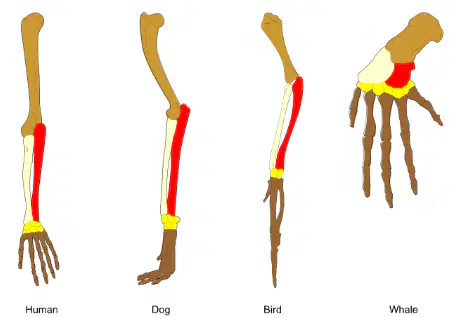
Some organisms that share a common ancestor have features that have different functions, but similar structures. These are known as ________
Fossil structures
Homologous structures
Analogous structures
Vestigial structures
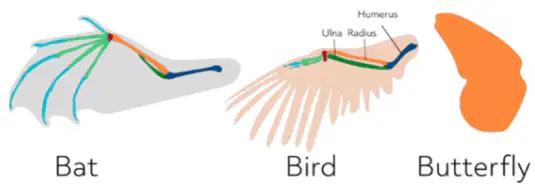
Some organisms have features that have different structures but similar functions. These are known as:
Fossil structures
Homologous structures
Analogous structures
Vestigial structures
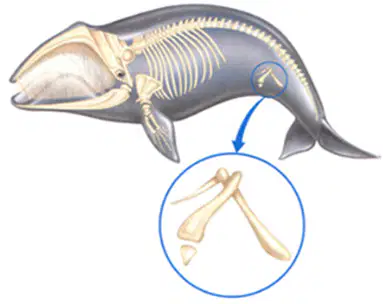
A structure that is present in an organism but no longer serves its original purpose:
Fossil structures
Homologous structures
Analogous structures
Vestigial structures
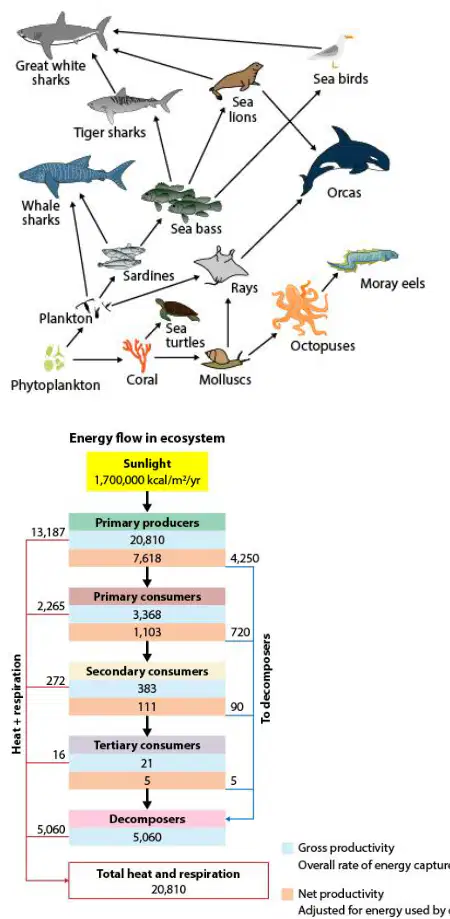
Based on the ocean food web diagram, which organism is a primary producer?
Sea bass
Phytoplankton
Orcas
Sea birds
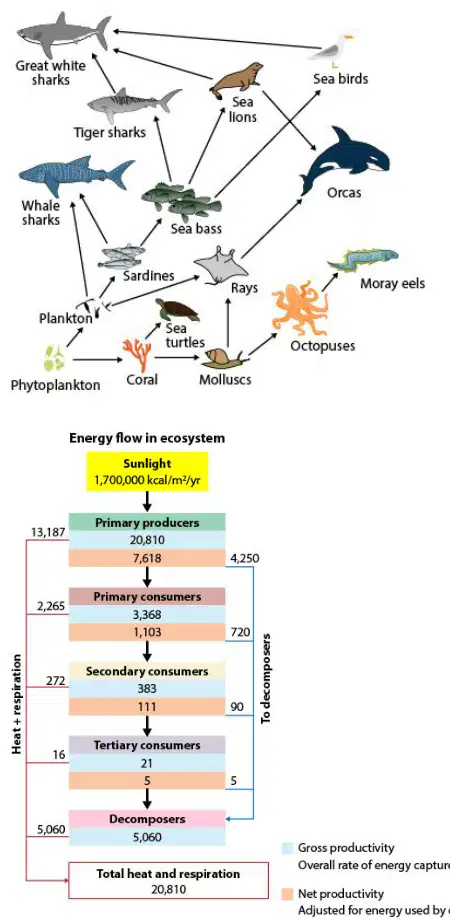
According to the energy flow diagram, what is the total amount of energy (in kcal/m^2/yr) captured by primary producers from sunlight?
13,187 kcal/m^2/yr
8,500 kcal/m^2/yr
20,000 kcal/m^2/yr
5,000 kcal/m^2/yr
Which best describes the MOST LIKELY effect on the Phytoplankton’s biomass if more Plankton moved into the ocean ecosystem?
The biomass would be higher because there would be fewer phytoplankton to store energy.
Biomass would be higher because there would be less energy lost as heat from the phytoplankton.
The Biomass would be lower for the phytoplankton since there are more consumers now.
Biomass would be lower because there would be more energy lost as heat from the phytoplankton.
Which best explains why less energy is passed from one trophic level to the next?
Energy is stored in the decomposers.
Energy is lost as heat during metabolic processes.
Tertiary consumers use up all the energy.
All the energy is used by the primary consumers.
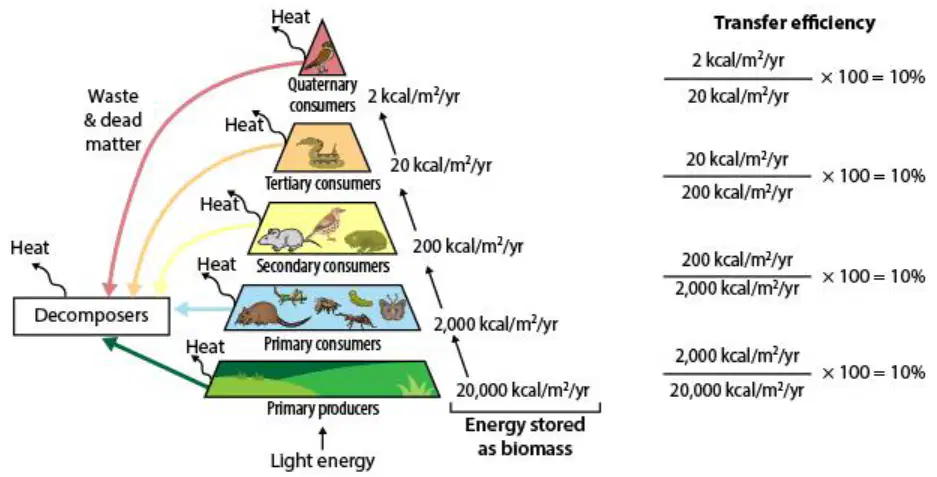
According to the passage and the diagram, what percentage of energy is typically transferred from one trophic level to the next in an energy pyramid?
1%
5%
10%
50%
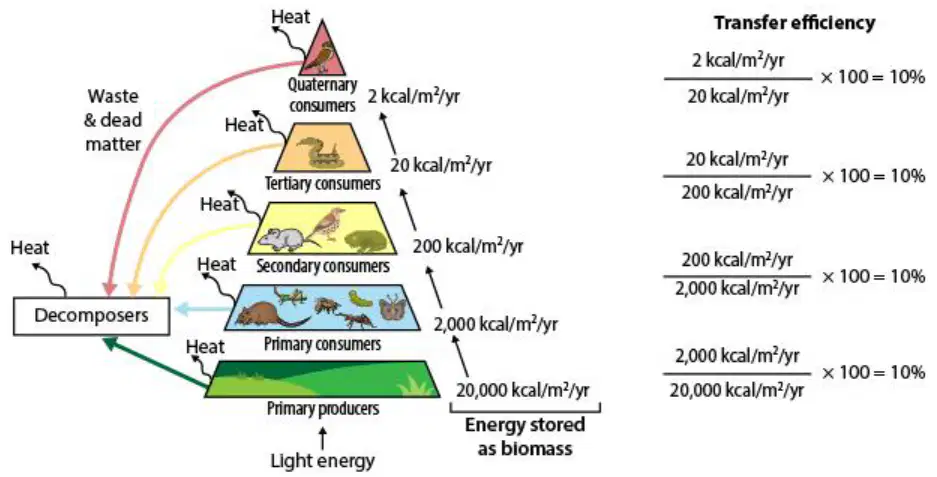
Which group is found at the base of the energy pyramid shown in the diagram?
Primary consumers
Secondary consumers
Tertiary consumers
Primary producers
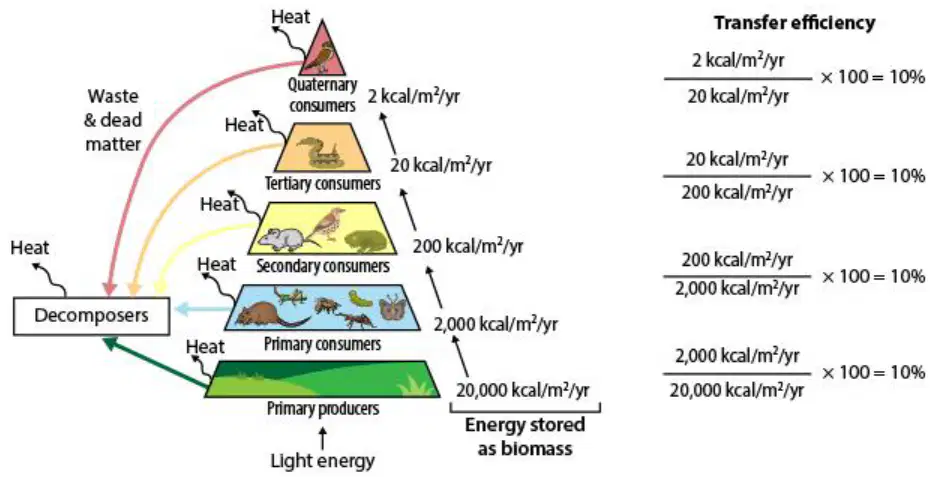
Only a small fraction of the energy stored in one trophic level is transferred to the next trophic level in an energy pyramid because:
Most energy is lost as heat due to metabolic processes.
All energy is efficiently transferred to the next level.
Energy is created at each trophic level.
Producers use all the energy for growth.
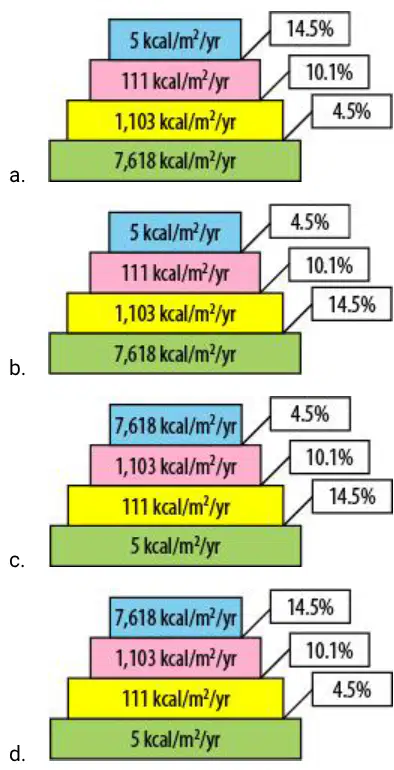
Which energy pyramid representing a small aquatic ecosystem shows the appropriate available biomass energy storage and transfer efficiency for each level?
Pyramid a: 5 kcal/m²/yr (14.5%), 111 kcal/m²/yr (10.1%), 1,103 kcal/m²/yr (4.5%), 7,618 kcal/m²/yr
Pyramid b: 5 kcal/m²/yr (4.5%), 111 kcal/m²/yr (10.1%), 1,103 kcal/m²/yr (14.5%), 7,618 kcal/m²/yr
Pyramid c: 7,618 kcal/m²/yr (4.5%), 1,103 kcal/m²/yr (10.1%), 111 kcal/m²/yr (14.5%), 5 kcal/m²/yr
Pyramid d: 7,618 kcal/m²/yr (14.5%), 1,103 kcal/m²/yr (10.1%), 111 kcal/m²/yr (4.5%), 5 kcal/m²/yr
Approximately how much energy would secondary consumers receive if producers in an ecosystem stored 10,000 kcal energy as biomass?
1 kcal
10 kcal
100 kcal
1,000 kcal
What percentage of producers' energy do tertiary consumers receive?
0.01%
0.1%
1%
10%

Which statement BEST compares how matter and energy move among organisms in the food chain?
Matter cycles among organisms and energy flows among organisms in the system, and both matter and energy are conserved.
Matter and energy both flow among all organisms in the system, but only energy is conserved.
Matter and energy both cycle among all organisms in the system, and both matter and energy are conserved.
Matter flows among organisms and energy cycles among organisms in the system, but only matter is conserved.
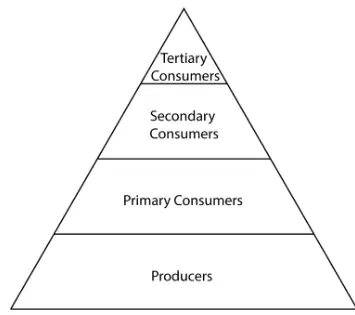
Which trophic level in the pyramid typically has the greatest biomass?
Producers
Primary consumers
Secondary consumers
Tertiary consumers

Match the image with the correct vocabulary word.

DNA
an organic chemical that carries all information of a living thing

Chromosome-
threadlike structures that carry information about the organism in units called genes

Cell-
the smallest unit with the basic properties of lifeand made of molecules

