
 Worksheets
Matter
Total questions: 95
Worksheet time: 48mins
Matter that has a definite volume and a definite shape is a _____________.
solid
liquid
gas
plasma
The amount of energy needed to change a material from a liquid to a gas is the heat of _________________
evaporation
fusion
vaporization
condensation
When two or more substances are physically combined, the result is a(n) ________________.
chemical change
element
compound
mixture
The air that you breathe is an example of a(n) ____________ solution.
solid
liquid
gaseous
plasma
As a sample of matter is heated, its particles _______________.
are unaffected
move more quickly
move more slowly
stop moving
The most common state of matter in the universe is ________________.
solid
liquid
gas
plasma
The color of ink is a ________________.
physical change
physical property
chemical change
chemical property
Three examples of physical changes are
sawing wood, crushing a can, and burning a marshmallow
burning of gasoline, rotting an egg, and exploding fireworks
freezing of water, evaporation of gasoline, and rusting of a nail
boiling of water, blowing up a balloon, and melting a candle
Which of the following is evidence that a physical change has occurred?
Broken glass
Rust
Bubbles
Formation of a solid precipitate
Which of the following is not a physical property?
Color
Odor
State
Reactivity with oxygen
Matter in which the particles are free to move in all directions until they have spread evenly throughout their container is a ________________.
solid
liquid
gas
plasma
______________ is another name for a homogeneous mixture.
Liquid
Substance
Suspension
Solution
The amount of energy needed to change a material from the solid state to the liquid state is the heat of ___
condensation
vaporization
fusion
evaporation
CaCO₃ is an example of which type of matter?
Element
Compound
Homogeneous mixture
Heterogeneous mixture
In which phase of matter are the molecules of the substance farthest apart from each other?
solid
liquid
gas
crystal
A flask containing molecules of gas A and a separate flask containing molecules of gas B are both at the same temperature. Gases A and B must have equal
volumes
masses
pressures
average kinetic energies
Hydrogen, gold, and iron are all examples of
homogeneous mixtures
heterogeneous mixtures
elements
compounds
A type of matter formed by chemically joining two or more elements is known as a
compound
solution
colloid
suspension
Which term best describes when particles escape from the surface of a liquid and become gaseous?
sublimation
evaporation
vaporization
deposition
Milk, paint, and mayonnaise are all examples of
Homogeneous mixtures
Heterogeneous mixtures
Compounds
Elements
The particles in a liquid are usually
closer together and lower energy than in a solid.
farther apart and lower in energy than in a solid.
farther apart and higher in energy than in a gas.
closer together and lower in energy than in a gas.
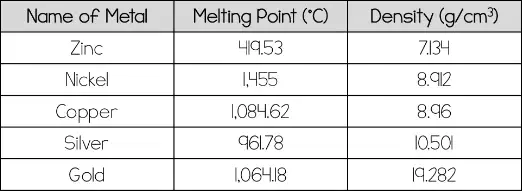
Using the data table to the right, determine the identity of a cube of metal that measures 1.2 cm on each side and has a mass of 18.15 grams.
Gold
Silver
Nickel
Zinc
Mrs. James blends lemons, sugar, and water in a pitcher. She has made a ________.
compound
substance
homogeneous mixture
heterogeneous mixture
The Law of Conservation of Mass states
Mass never stays constant.
Mass is always added during a chemical change.
Mass is always lost during a chemical change.
Mass is not lost or created during a chemical change.
Which of the following liquids would be the most viscous?
syrup
water
lemonade
soda
Atoms of elements in the same group of the periodic table share the same
number of energy levels
number of valence electrons
atomic numbers
atomic masses
What is an atom’s nucleus made of?
protons and electrons
protons only
protons and neutrons
neutrons only
How many electrons will a neutral atom of carbon have if its nucleus has 6 protons and 8 neutrons?
2
6
8
14
An element with 5 protons, 6 neutrons, and 8 electrons has an atomic number of
5
6
8
11
An element with 5 protons, 6 neutrons, and 8 electrons has a mass number of
5
6
8
11
The farther an electron is from the nucleus, the more __________ it has.
charge
energy
mass
size
Atoms of the same element that have different numbers of neutrons are called
molecules
ions
protons
isotopes
The total number of electrons in the outer shell of a sodium atom is
1
2
8
18
Which particles determine the atomic number of an element?
Protons only
Neutrons only
Neutrons and protons
Protons and electrons
The total number of neutrons in the nucleus of any atom is equal to the
mass number of the atom
atomic number of the atom
atomic number minus the mass number
mass number minus the atomic number
Two different isotopes of an element have different _________.
numbers of neutrons
numbers of protons
atomic numbers
nothing is different about them
Two different isotopes of an element have the same _________.
numbers of neutrons
numbers of protons
mass numbers
nothing is the same about them
The maximum number of electrons that can occupy the 2nd shell of an atom of magnesium is
1
2
8
18
The mass of the most common isotope of an element is known based on an element’s ________
Mass number
Average atomic mass
Atomic number
Number of electrons
What is the correct electron arrangement for sulfur? (Hint: think about electron shells/energy levels!)
2-8-6
2-8-8
4-6-2
2-8-4
Which of the following is a transition metal?
Calcium
Nickel
Aluminum
Tellurium
An atom is neutral because
neutrons balance the protons and electrons
nuclear forces stabilize the charges
the numbers of protons and electrons are equal
the numbers of protons and neutrons are equal
An unstable nucleus results from too many or too few ____________
neutrons
protons
electrons
radons
Which part of the periodic table indicates the number of energy levels in the electron cloud?
Periods (rows)
Groups (columns)
Atomic number
Element symbol
What is the correct symbol for an isotope of carbon with 6 protons and 6 neutrons?
¹²C
12C
⁶C
6C6
Which statement about the arrangement of the periodic table is not true?
Noble gases are in the group farthest to the right
Metals are found on the left side of the periodic table
Rare earth elements are in the first column on the left
Transition metals are in the center of the periodic table
Boron, carbon, nitrogen and oxygen are all members of the same _____________.
Period
Group
Block
Family
Which of the following elements would be the best conductor of electricity?
Iodine
Silicon
Silver
Argon
Which of the following elements would be the most reactive?
Iodine
Silicon
Silver
Argon
Which of the following elements would be the least reactive?
Iodine
Silicon
Silver
Argon
At room temperature, most metals are _____________?
A. Solids
B. Liquids
C. Gases
D. Plasmas
Hydrogen is in group 1 with lithium, sodium, potassium, rubidium, cesium, and francium because it ____________.
C. Has 1 valence electron
A. Is a metal
B. Has 2 valence electrons
D. Is a noble gas
The chemical bond formed when two atoms share electrons is called a(n)
Covalent bond
Ionic bond
Metallic bond
Electron bond
Which pair of atoms will combine with each other and form an ionic bond?
C and O
C and H
Ca and Mg
Ca and Br
Which element is most likely to gain electrons in a chemical reaction?
Kr
K
Br
Ca
What is the oxidation number of oxygen in most compounds?
6
-2
8
0
Which formula represents a substance that contains covalent bonds?
LiCl
CaCl₂
K₂O
CO₂
A regular, repeating arrangement of atoms, ions, or molecules is _____________.
B. A crystal
A. An alloy
C. A solution
D. A polymer
How does an atom of aluminum become an ion?
It gains 3 electrons
It gains 3 protons
It loses 3 electrons
It loses 3 neutrons
How many electrons are shared within a single bond?
2
1
4
6
Which atoms are most likely to form covalent bonds?
metal atoms that share electrons
metal atoms that share protons
nonmetal atoms that share electrons
nonmetal atoms that share protons
The electrons that are lost, gained, or shared in chemical bonds are called _____________.
A. valence electrons
B. core electrons
C. isotopic electrons
D. conduction electrons
Which of the following is NOT an example of covalent bonding?
H2O
NaF
NH3
O2
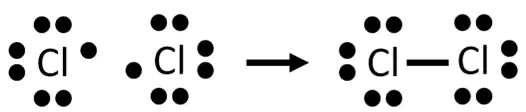
Which process is taking place in the diagram below?
Electron transfer
Electron sharing
Electron gain
Electron loss
How many electrons are needed in the outer energy levels of most atoms for the atom to be chemically stable?
2
4
6
8
14. The properties of a compound are __________ the properties of the elements that form it.
B. Different from
A. The same as
C. More similar to
D. Identical to
Which of the following is an example of a molecule?
H2O
NaF
Mg3N2
all of the above are molecules
How many electrons are being shared in a triple bond?
3
6
8
12
Which of the following is the reason why atoms of sodium and chlorine attract each other in a salt crystal?
Sodium has a negative charge and chlorine has a positive charge
Sodium has a positive charge and chlorine has a positive charge
Sodium has a positive charge and chlorine has a negative charge
Both have a negative charge
Both have a positive charge
Which of the following is the correct name for a compound between Magnesium and Sulfur?
Magnesium sulfur
Magnesium sulfide
Magnesium (II) sulfide
Dimagnesium disulfide
Which of the following is the correct name for a compound between Phosphorous and Chlorine?
Phosphorous chlorine
Phosphorous chloride
Phosphorous (III) chloride
Phosphorous trichloride
Which of the following is a similarity between ionic and covalent bonds?
Both include the gaining and losing of electrons
Both include the sharing of electrons
Both make the elements more stable
Both are typically found as solids at room temperature.
Each substance to the right of the arrow in a chemical equation is a(n) ___________.
B. Product
A. Reactant
C. Catalyst
D. Solvent
The numbers that go before symbols and formulas in a chemical equation are ___________.
Superscripts
Subscripts
Catalysts
Coefficients
Substances that speed up chemical reactions are called _________.
Inhibitors
Products
Reactants
Catalysts
A(n) ________ chemical equation has the same number of atoms of each element on each side of the equation.
unbalanced
balanced
simple
complex
If something is burned, a __________ reaction has occurred.
double displacement
single displacement
combustion
synthesis
Why does an increase in temperature result in an increase in reaction rate?
It raises the activation energy
It causes the molecules to increase in size
It decreases the concentration of reactants
It causes an increase in the number of particle collisions
If energy must be added to a chemical reaction for the reaction to take place, the reaction is ____________.
exergonic
endergonic
exothermic
endothermic
In a chemical equation, the symbol that means dissolved in water is _____
(s)
(l)
(g)
(aq)
What type of reaction is the following chemical reaction? CH3CH2OH + 3O2 → 2CO2 + 3H2O
double-displacement
single-displacement
combustion
synthesis
Which chemical reaction represents a double displacement reaction?
2Na + Cl2 → 2NaCl
2KClO3 → 2KCl + 3O2
Zn + 2HCl → ZnCl2 + H2
NaOH + HCl → NaCl + H2O
A teacher wants to demonstrate a chemical reaction for her students. Which activity below would best demonstrate a chemical reaction?
Placing metal in an acid to create gas
Measuring the densities of water and ice
Melting a solid piece of aluminum
Filling a balloon with helium gas
When a wood fire burns, it releases heat into the environment. This type of reaction is ________.
endothermic
exothermic
endergonic
exergonic
The Law of Conservation of Mass states
Mass never stays constant
Mass is always added during a chemical change
Mass is always lost during a chemical change
Mass is not lost or created during a chemical change
Which of the following observations does NOT indicate that a chemical reaction has occurred?
formation of a precipitate
production of a gas
state of matter change
heat and light released
Which of the following is a correctly balanced chemical equation?
Cl2 + 2NaI → 2NaCl + I2
Cl2 + NaI → NaCl + 2I2
Cl2 + NaI → NaCl + I2
2Cl2 + NaI → 2NaCl + I2
Which situation provides the best evidence that a chemical reaction is taking place?
A metal strip bends when heated
A solution freezes in the freezer
Two solutions mixed in a beaker produce a solid
A chemical is dissolved in water
A substance that is an ingredient in a chemical reaction is called a(n) ____________.
Catalyst
Product
Reactant
Inhibitor
In a reaction in which hydrogen reacts with oxygen to produce water, which substances are the reactants?
Hydrogen only
Water only
Oxygen only
Both hydrogen and oxygen
Which of the following is NOT an example of a chemical change?
Iron rusting
An apple ripening
Cutting paper
A piece of wood burning
Which of the following equations best represents “magnesium reacting with chlorine to produce magnesium chloride?”
Mg + Cl2 → MgCl2
MgCl2 + Mg → Cl2
MgCl2 + Mg → Cl2
Mg + Cl2 → MgCl2
How many atoms of oxygen are represented in 2Ca(NO3)2?
3
6
10
12
The symbol (s) written after a formula in a chemical equation stands for ____________.
solid
soluble
solution
synthesis
To balance a chemical equation, it may be necessary to adjust the ____________.
coefficients
subscripts
superscripts
formulas of the compounds

