
 Worksheets
8417100- Make-up
Total questions: 36
Worksheet time: 18mins
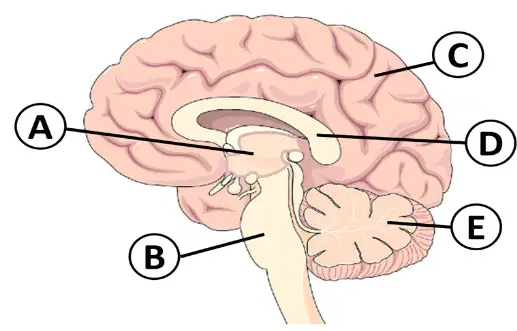
Locate the Brain Stem. Circle your answer.
D
A
E
B
C
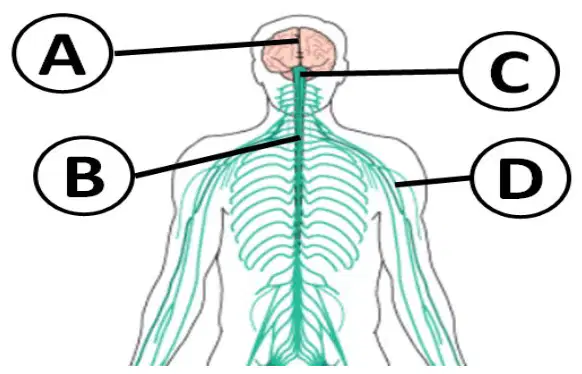
All the letters point to part of the Central Nervous System (CNS) structures, except? Circle your answer.
C
D
A
Which of the following senses is a special sense?
Autonomic
Pain
Temperature
Hearing
What type of hearing loss affects the middle ear?
Conductive
Sensorineural
Pain
Hearing
What type of hearing loss is the result of damage to the inner ear?
Sight
Pain
Conductive
Sensorineural
What is the condition where the lens of the eye gradually becomes cloudy and causes blurred or partial vision?
Otitis media
Conjunctivitis
Common cold
Cataract
What type of receptors are located in taste buds?
Chemoreceptors
Photoreceptors
Nociceptors
Thermoreceptors
What type of nerve cell receives stimuli for the sense of smell?
Papillae
Olfactory
Cilia
Cones
Which layer of the eye is the middle layer?
Fibrous
Retina
Vascular
Which of the following structures is associated with hearing in the inner ear?
Organ of Corti
Semicircular canals
Vestibular labyrinth
Eustachian tube
It's bedtime and you turn off your desk light. Which one of these senses allows you to walk over to your bed in the dark?
Touch
Temperature
Proprioception
Pain
If someone is color blind what part of the eye is likely damaged?
Cones
Rods
Cornea
Lens
You are running through your home and stub your toe. Which type of receptor reacts to the stimuli in your toe?
receptor
Nociceptor
Thermoreceptor
Photoreceptor
A region of the cerebral cortex that processes visual information.
Occipital lobe
Eye
Parietal Lobe
Frontal Lobe
What are the two divisions of the Peripheral Nervous System (PNS)?
Fibrous and Scalera
Somatic (Sensory and motor) and Autonomic (involuntary)
Frontal and Temporal
Axons and Dendrites
What is an early symptom of Alzheimer's?
Inability to do daily tasks
Moody behavior
Easily fatigued doing activities
Forgetting recent events
Which of these disorders occurs when there is a loss of blood flow, and in turn oxygen, to the brain?
Cerebrovascular accident
Myasthenia gravis
Autism spectrum disorder
Multiple sclerosis
Alzheimer's refers to a broad range of conditions characterized by challenges with social skills, repetitive behaviors, and speech and nonverbal communication.
True
False
Which activities of the body are controlled by the autonomic nervous system?
Voluntary
Unconscious
Conscious
Involuntary
Paul was in a car accident and suffered a head injury. Now he is having trouble organizing tasks and problem solving. Which lobe of the cerebral cortex is most likely damaged?
Temporal
Frontal
Occipital
Mechanical
Which of the following cranial nerves is considered to be part of the central nervous system?
Optic
Facial
Olfactory
Accessory
Which of the following is the main function of the nervous system?
Allows the body to recognize and respond to changes.
Protects the other body systems from external harm.
Provides the body with the proper energy to survive.
The nervous system enables the body to respond and adapt to changes that occur both inside and outside the body.
True
False
The synapse is a space between the axon of one neuron and the dendrites of other neurons.
True
False
The sympathetic nervous system slows heart rate, decreases respiration, and increases activity in the digestive tract.
True
False
The basic structural unit of the nervous system is the ____.
b) neuron
a) axon
c) glia
d) dendrite
A nerve fiber that carries impulses toward the cell body is a/an ____.
a) dendrite
b) Soma
c) synapse
d) myelin sheath
The division of the autonomic nervous system that acts in times of emergency is the ____.
parasympathetic (ex. Calm and balance)
somatic
peripheral
sympathetic (ex. Fight or Flight)
The sympathetic and parasympathetic nervous systems work together to maintain a balanced state called ____.
special senses
homeostasis
voluntary movement
involuntary movement
A chronic, progressive, disabling condition resulting from a degeneration of the myelin sheath is ____.
Cerebral palsy
Epilepsy
Autism
Multiple sclerosis
A patient comes to the emergency department after receiving a blow to the head. The patient’s spouse verifies that the patient speaks English as a first language. However, the healthcare team discovers that the patient is unable to understand anything they say or write down for him to read. Which of the patient’s cerebral lobes has been injured by the blow to the head?
Frontal
Eyes
Temporal
Occipital
LaTanya’s ability to tell if a bug is crawling on her skin is due to her:
special senses.
general senses.
sympathetic nervous system.
parasympathetic nervous system.
Which region of the ear has sensory neurons for hearing?
Ossicles
Cochlea
Tympanic membrane
Vestibular organs
Lydia has difficulty keeping her balance, sometimes to the point of feeling nauseated. Which region of her ear should be the focus for finding the cause?
Ossicles
Pinnae
Tympanic membrane
Vestibular organs
Where are photoreceptors (Cons and Rods) located in the eye?
cornea.
lens.
retina.
iris.
Henry has sensorineural hearing loss. Which reason is the most likely cause?
Buildup of earwax
Tumor in the ear canal
Fluid buildup in the middle ear
Prolonged ear exposure to loud noise

