
Font size
 Worksheets
Reversible and Equilibrium
Total questions: 99
Worksheet time: 2hrs 35mins
Which of the following is a characteristic of reversible reactions?
They can only proceed in one direction.
They can proceed to completion.
They can reach equilibrium.
None of the above
Which of the following is an example of an irreversible reaction?
The combustion of methane
The decomposition of calcium carbonate in a closed system
The formation of a metal oxide from a metal and oxygen
The breakdown of water into hydrogen and oxygen using electricity
Which of the following equations represents an irreversible reaction?
2SO2(g) + O2(g) ⇌ 2SO3(g)
C8H18(l) + 12 1/2 O2(g) → 8CO2(g) + 9H2O(l)
H2(g) + I2(g) ⇌ 2HI(g)
N2O4(g) ⇌ 2NO2(g)
Which of the following is not a measure of the extent of a reaction?
The change in concentration of reactants over time
The change in concentration of products over time
The change in mass of the reactants over time
The total number of reactant molecules
Which of the following statements is true regarding the relationship between rate and extent of a reaction?
The rate and extent of a reaction are independent of each other.
A slow reaction will always have a low extent.
A fast reaction will always have a high extent.
A fast reaction will always have a low extent.
Which of the following statements best describes the extent of a chemical reaction?
It is the amount of product obtained in a reaction.
It is the amount of reactant obtained in a reaction.
It is the proportion of products that have formed reactants.
It is the proportion of reactants that have formed products.
If a chemical reaction has a theoretical yield of 50 grams and an actual yield of 40 grams, what is the percentage yield?
40%
50%
80%
125%
The equilibrium constant, K, is a measure of what aspect of a chemical reaction?
The rate of the reaction
The yield of the reaction
The extent of the reaction
The activation energy of the reaction
In a dynamic equilibrium system, which of the following is true?
The forward reaction rate is faster than the reverse reaction rate.
The reverse reaction rate is faster than the forward reaction rate.
The forward reaction rate is equal to the reverse reaction rate.
The forward and reverse reactions have stopped completely.
Which of the following is not true for a system in dynamic equilibrium?
Reactants are constantly being formed.
The temperature steadily increases over time.
The total gas pressure of the system is constant.
The rate of the forward reaction is equal to the rate of the backward reaction.
In the decomposition of dinitrogen tetroxide (N2O4(g) ⇌ 2NO2(g)), what is the stoichiometric ratio of NO2 produced for each mole of N2O4 that decomposes?
1:1
2:1
1:2
1:3
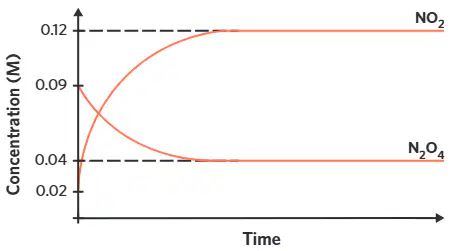
What are the initial concentrations of N2O4 and NO2?
(a)
Calculate the change in concentration (Δ[N2O4]) from initial to equilibrium as described in the passage.
(a)
Equilibrium can only be approached via the forward reaction.
True
False
According to the passage, what does it mean when the concentrations of all species present plateau in a concentration-time graph?
(a)
Consider the equation for the decomposition of phosphorus(V) chloride: PCl5(g) ⇌ PCl3(g) + Cl2(g). PCl5 is added to a reaction vessel at a concentration of 1.3 M and allowed to decompose. At equilibrium, the concentration of PCl5 in the reaction vessel is 1.0 M. What is the equilibrium concentration of PCl3?
(a)
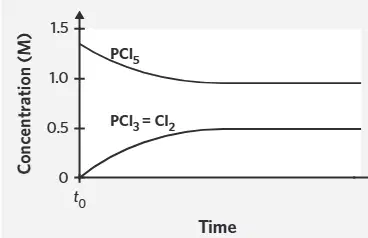
Based on the concentration-time graph for the decomposition of phosphorus(V) chloride, which of the following statements is correct?
The concentration of PCl5 increases over time.
The concentrations of PCl3 and Cl2 increase by the same amount that PCl5 decreases.
The concentration of Cl2 remains constant.
The concentration of PCl3 decreases over time.
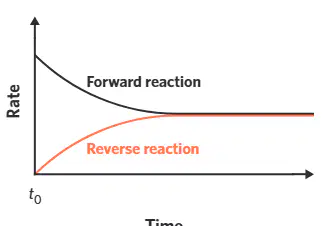
At equilibrium, what happens to the rates of the forward and reverse reactions?
(a)
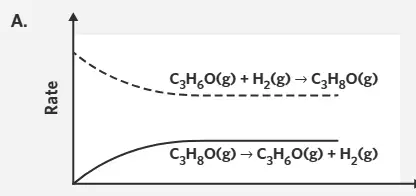
When 2-propanol (C3H8O) reacts to form an equilibrium mixture with propanone (C3H6O) and hydrogen (H2), which of the following graphs best represents how the rates of the forward and reverse reactions change over time?
A. [Graph showing C3H8O(g) + H2(g) → C3H6O(g) (dashed line) and C3H6O(g) → C3H8O(g) + H2(g) (solid line) with both lines approaching each other over time]
B. [Graph showing C3H6O(g) → C3H8O(g) + H2(g) (solid line) and C3H8O(g) + H2(g) → C3H6O(g) (dashed line) with both lines approaching each other over time]
C. [Graph showing C3H8O(g) + H2(g) → C3H6O(g) (solid line) and C3H6O(g) → C3H8O(g) + H2(g) (dashed line) with both lines diverging over time]
D. [Graph showing C3H6O(g) → C3H8O(g) + H2(g) (solid line) and C3H8O(g) + H2(g) → C3H6O(g) (dashed line) with both lines diverging over time]
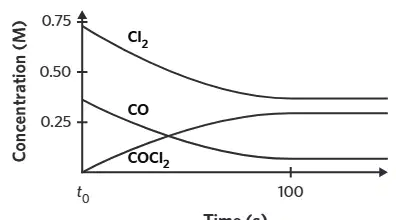
Use the following concentration-time graph to answer this question. The initial concentration of Cl₂ is closest to
0.00 M
0.10 M
0.40 M
0.75 M
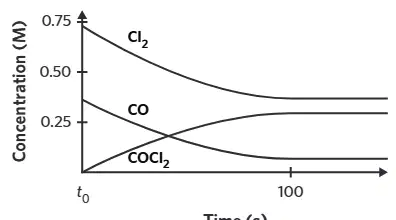
Use the following concentration-time graph to answer this question. Which of the following best describes what occurs at 100 seconds?
COCl₂ stops forming entirely.
The concentrations of CO and Cl₂ become equal.
The concentrations of COCl₂, CO, and Cl₂ become constant.
The rate of COCl₂ formation exceeds the rate of COCl₂ decomposition.
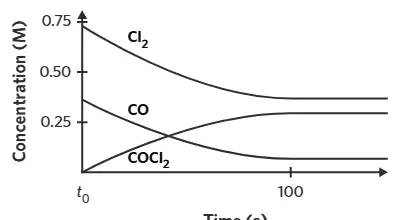
Use the following concentration-time graph to answer this question. Which of the following best represents the balanced equation for the decomposition of COCl₂?
COCl₂ ⇌ CO + Cl₂
COCl₂ ⇌ CO + 2Cl₂
2COCl₂ ⇌ CO + Cl₂
COCl₂ ⇌ 2CO + 3Cl₂
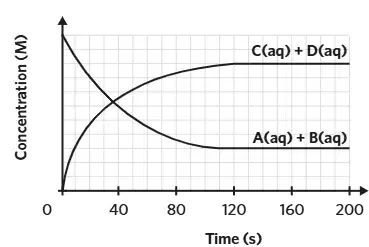
Which statement best describes the changes in concentration of A(aq) and B(aq) after equilibrium is reached?
The concentrations of A(aq) and B(aq) continue to decrease.
The concentrations of A(aq) and B(aq) remain constant.
The concentrations of A(aq) and B(aq) increase.
The concentrations of A(aq) and B(aq) fluctuate randomly.
At equilibrium, how do the rates of the forward and reverse reactions compare?
(a)
At equilibrium, the concentrations of reactants and products are always equal.
True
False
At what time is equilibrium first established?
10 seconds
45 seconds
120 seconds
160 seconds
Which of the following statements is true for this equilibrium system?
Only A(aq) and B(aq) were initially present in the system.
Only C(aq) and D(aq) were initially present in the system.
A(aq), B(aq), C(aq) and D(aq) were all initially present in the system.
None of the above are true for this equilibrium system.
Explain how the rates of the forward and reverse reactions change in this equilibrium system over time.
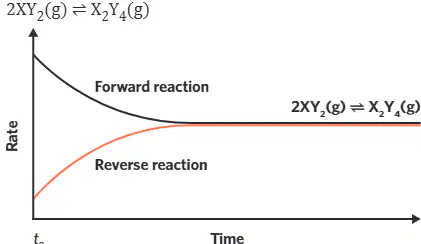
For the given equilibrium reaction, the rate-time graph shown would best represent which of the following scenarios?
The reaction vessel initially contained only XY₂(g).
The reaction vessel initially contained only X₂Y₄(g).
The reaction vessel initially contained both XY₂(g) and X₂Y₄(g).
The reaction vessel initially contained neither XY₂(g) nor X₂Y₄(g).
Some gaseous PCl₅ is added to an empty container, and the resulting closed system is allowed to reach equilibrium. At equilibrium, the mass of the gas mixture, compared to the initial mass of PCl₅, is
halved.
unchanged.
one and a half times greater.
doubled.
Consider the equilibrium reaction between the iron(III) ion and thiocyanate ion (SCN−). Fe3+(aq) + SCN−(aq) ⇌ FeSCN2+(aq) ΔH < 0 a. Give two features of this reaction at equilibrium.
Explain how the presence of a catalyst would affect the yield of the FeSCN2+ ion.
Consider the equilibrium reaction between the iron(III) ion and thiocyanate ion (SCN−). Fe3+(aq) + SCN−(aq) ⇌ FeSCN2+(aq) ΔH < 0 c. FeSCN2+(aq) is added to a vessel and allowed to react. Draw a rate-time graph showing the catalysed and uncatalysed equilibrium systems for this reaction.
Using the data in the table, which conditions provide the highest yield of ammonia?
(a)
Identify one disadvantage of using lower temperatures to produce ammonia.
Suggest how the disadvantage in part ii could be addressed.
Suggest two disadvantages of using a higher pressure.
Is the formation of nitrogen monoxide from nitrogen and oxygen a redox reaction? Justify your answer using oxidation states.
b. A sealed container is filled with 1.00 mol of NO(g) and equilibrium is established. The temperature is maintained at 1500°C. Explain why the rate of the reaction N2(g) + O2(g) ⇌ 2NO(g) will never be greater than the rate of the reaction 2NO(g) ⇌ N2(g) + O2(g) i. while the system is reaching equilibrium.
b. A sealed container is filled with 1.00 mol of NO(g) and equilibrium is established. The temperature is maintained at 1500°C. Explain why the rate of the reaction N2(g) + O2(g) ⇌ 2NO(g) will never be greater than the rate of the reaction 2NO(g) ⇌ N2(g) + O2(g) ii. once equilibrium is established.
Consider the following equilibrium expression. K = [L][M]4/[J]6[K] The equation of the forward reaction for this equilibrium expression is
6J + K ⇌ L + 4M
L + M4 ⇌ J6 + K
J6 + K ⇌ L + M4
L + 4M ⇌ 6J + K
What strategies do we need in order to answer the question?
A) 6J + K ⇌ L + 4M
B) L + 4M ⇌ 6J + K
C) J + 6K ⇌ 4L + M
D) 4L + M ⇌ J + 6K
Consider the equation shown: CO(g) + Cl2(g) ⇌ COCl2(g) A sealed 2.00 L reaction vessel contains 3.00 mol of CO(g), 2.00 mol of Cl2(g) and 2.50 mol of COCl2(g) when the system establishes equilibrium. Calculate the equilibrium constant for this reaction. (Give your answer to three significant figures and include the correct units.)
(a)
If the mole coefficients on each species in a reaction are doubled, for example: 2A + 2B ⇌ 2C + 2D, how must the equilibrium expression be written?
K = [C][D]/[A][B]
K = ([C][D]/[A][B])²
K = [C]²[D]²/[A]²[B]²
Both B and C are correct.
If a reaction is written in reverse, what is the relationship between the equilibrium constant for the reverse reaction (K_reverse) and the forward reaction (K_forward)?
K_reverse = K_forward
K_reverse = 1/K_forward
K_reverse = K_forward²
K_reverse = √K_forward
Calculate the value of K2 at 250 °C.
(a)
‘The value of K will not change if all the concentrations are halved.’ Is this statement True or False?
True
False
What is the change in concentration of N2(g) at equilibrium?
(a)
What is the equilibrium concentration of NH3(g)?
(a)
Hydrogen and iodine react together to form hydrogen iodide according to the following equilibrium reaction: H2(g) + I2(g) ⇌ 2HI(g) 0.40 mol of H2(g), 0.70 mol of I2(g) and 0.10 mol of HI(g) were initially present in a 5.0 L reaction vessel, and the system was allowed to reach equilibrium. At equilibrium, the concentration of HI(g) was 0.14 M. Calculate the amount of H2 in mol, present in the reaction vessel at equilibrium.
(a)

What is the change in the amount of HI present at equilibrium?
(a)

Based on the nICE table for the reaction H2(g) + I2(g) ⇌ 2HI(g), if the amount of HI increases by 0.60 mol, what is the change in the amount of H2?
(a)
How can the equilibrium constant (K) change with temperature?
Only pressure affects the value of K
Only temperature affects the value of K
Both pressure and temperature affect the value of K
Neither pressure nor temperature affect the value of K
For a reaction where the forward reaction is endothermic (ΔH > 0), what happens to the value of the equilibrium constant (K) when the temperature increases?
(a)
Consider the equation for the formation of hydrogen iodide from hydrogen and iodine. H₂(g) + I₂(g) ⇌ 2HI(g) ΔH = –10.4 kJ For this reaction, K = 160 at 500 K. Which of the following is closest to the value of K at 700 K?
A. 54
B. 160
C. 500
D. 700
Which of the following statements is true about the equilibrium constant, K?
K depends on the initial concentrations of reactants and products.
K is always greater than 1 for an exothermic reaction.
K is always expressed in units of M or mol L⁻¹.
K can only change with temperature.
Assume the concentration of all of the gases in the below equilibrium reactions is exactly 1.0 M. Reaction 1 CH₄(g) + 2H₂O(g) ⇌ CO₂(g) + 4H₂(g) Reaction 2 N₂(g) + 3H₂(g) ⇌ 2NH₃(g) Reaction 3 H₂(g) + I₂(g) ⇌ 2HI(g) Reaction 4 2NO₂(g) ⇌ N₂O₄(g) For which reaction is K = 1.0 M⁻²?
Reaction 1
Reaction 2
Reaction 3
Reaction 4
Ammonia can be synthesised by reacting nitrogen, N2 gas with hydrogen, H2 gas according to the following equation. N2(g) + 3H2(g) ⇌ 2NH3(g) ΔH = –92 kJ The expression for the equilibrium constant for this reaction is
[NH3]/[H2]3[N2]
2[NH3]/3[H2][N2]
[NH3]2/[H2]3[N2]3
[NH3]2/[H2]3[N2]
Consider the following reaction at 25 °C. 2A + B ⇌ C + D K = 2.5 × 10⁻³ M–1 If the concentration of A is doubled, what will happen to the value of K?
K will increase.
K will decrease.
K will remain the same.
The effect of the concentration of A on K cannot be determined without knowing the concentrations of B, C, and D.
An exothermic system at equilibrium subjected to an increase in temperature will have
an increased rate of reaction and an increase in K.
an increased rate of reaction and a decrease in K.
a decreased rate of reaction and an increase in K.
a decreased rate of reaction and a decrease in K.
The values of K and Q for a system are given. K = 3.0×10⁴M3 Q = 22M3 Based on these values, is the system at equilibrium? If not, is the forward or reverse reaction currently favoured? Explain your answer.
What information can be determined from the value of Q?
The extent to which the reaction has proceeded at a given point in time
Whether the reaction is exothermic or endothermic
The activation energy of the reaction
The rate of the reaction
If Q < K, the reaction
will proceed predominantly in the forward direction.
will proceed predominantly in the reverse direction.
is at equilibrium.
has stopped.
What is the relationship between Q and K at equilibrium?
Q > K
Q < K
Q = K
There is no relationship between Q and K at equilibrium.
Use the following information to answer questions 9-11. The oxidation of sulfur dioxide, SO₂, to sulfur trioxide, SO₃, can be represented by the following equation. 2SO₂(g) + O₂(g) ⇌ 2SO₃(g) K = 1.75 M⁻¹ at 1000 °C An equilibrium mixture has a concentration of 0.12 M SO₂ and 0.16 M oxygen gas, O₂. The temperature of the container is 1000 °C. What is the expression for the equilibrium constant for this reaction?
[SO₃] / [SO₂] + [O₂]
2[SO₃] / 2[SO₂][O₂]
[SO₃]² / [SO₂]²[O₂]
[SO₂]²[O₂] / [SO₃]²
Which of the following expressions can be used to calculate [SO3] at equilibrium?
[SO3] = K × [SO2][O2]
[SO3] = [SO2][O2]K
[SO3] = K×[SO2]2[O2]
[SO3] = [SO2]2[O2]K
The equilibrium concentration of SO3 at 1000 °C is
1.5 × 10^–4 M
4.0 × 10⁻³ M
1.2 × 10^–2 M
6.3 × 10^–2 M
The equilibrium constant (K) for the reaction A + B ⇌ C is 0.050 M^–1 at 25°C. What is the equilibrium constant (K) for the reaction 2A+2B⇌2C ?
0.0025 M^–2
0.025 M^–2
0.050 M^–2
0.10 M^–2
Given the information above, what is the value of K for the following reaction at 150 °C? 4IBr(g) ⇌ 2Br2(g) + 2I2(g)
1.6×10⁻²
4.1×10⁻³
6.9×10⁻⁵
8.03×10⁻⁵
The following reaction, in which dinitrogen tetroxide, N2O4 is converted to nitrogen dioxide, NO2 forms an equilibrium. N2O4(g) ⇌ 2NO2(g) At a given temperature, the equilibrium constant for this reaction is 3.15 M and the molar concentration of N2O4 at equilibrium is 0.350 M. At this temperature, the molar concentration of NO2 at equilibrium is
0.550 M
1.05 M
1.10 M
3.00 M
Carbon monoxide reacts with ammonia to form an equilibrium according to the following equation. 2CO(g) + NH3(g) ⇌ HCN(g) + CO2(g) + H2(g) At a temperature T1 the equilibrium constant for the reaction is K = 0.175. A 7000 L reaction vessel is maintained consistently at this temperature. a. Write an expression for the equilibrium constant, K.
(a)
Initially, the concentrations of reactants in the 7000 L vessel are as follows: [CO] = 0.163 M [NH3] = 4.00 M [HCN] = 13.40 M [CO2] = 15.30 M [H2] = 19.20 M i. At this temperature T1, in which direction will the reaction proceed in order to establish equilibrium? Justify your answer using a calculation.
Initially, the concentrations of reactants in the 7000 L vessel are as follows: [CO] = 0.163 M [NH3] = 4.00 M [HCN] = 13.40 M [CO2] = 15.30 M [H2] = 19.20 M ii. At equilibrium, [H2] = 13.60 M. Calculate the mass, in grams, of NH3 present at equilibrium.
A chemist lowers the temperature of the reaction vessel to a new temperature T2. At this new temperature, the equilibrium concentration of HCN is 0.00100 M. Calculate the value (including units) of the equilibrium constant for this reaction at the new temperature T2.
Is the production of HCN via this reaction endothermic or exothermic? Explain.
At the same temperature T1, it is observed that this second reaction results in a much higher rate of production of HCN compared with the process described by the first reaction. From this information alone, is it possible to determine anything about the relative magnitude of this second reaction’s equilibrium constant compared with that of the first reaction? Explain.
Consider the reaction shown in the following equation.
2NO(g) + Br2(g) ⇌ 2NOBr(g) ΔH = –16.1 kJ, K = 1.3 × 10⁻² M–1 at 1000 K
A chemist places 10.0 mol of NOBr; 10.0 mol of NO and 5.0 mol of Br2 in a 1.0 L container at 1000 K.
a. Write an expression for the equilibrium constant for this reaction.
(a)
Consider the reaction shown in the following equation. 2NO(g) + Br2(g) ⇌ 2NOBr(g) ΔH = –16.1 kJ, K = 1.3 × 10⁻² M–1 at 1000 K A chemist places 10.0 mol of NOBr; 10.0 mol of NO and 5.0 mol of Br2 in a 1.0 L container at 1000 K. b. Predict in which direction the reaction will proceed. Justify your answer.
Identify the hazard represented by this pictogram.
(a)
Identify one precautionary measure for this hazard.
(a)
The chemist performing the investigation fails to ensure that her reaction vessel is airtight, and reports feeling a 'shortness of breath'. A fellow chemist therefore asserts that nitrogen monoxide must cause respiratory problems. Evaluate the chemist’s assertion.
The magnitude of the equilibrium constant, K, at 25 °C for the following reaction is 640. For the reaction (1/3)N2(g) + H2(g) ⇌ (2/3)NH3(g), the magnitude of K at 25 °C is
A. 9 and ΔH = –30.8 kJ
B. 213 and ΔH = –30.8 kJ
C. 640 and ΔH = –30.8 kJ
D. 640 and ΔH = –92.3 kJ
Hydrogen and fluorine react according to the following equation. (1/2)H2(g) + (1/2)F2(g) ⇌ HF(g) ΔH = –271 kJ In an experiment, 0.250 mol of hydrogen and 0.340 mol of fluorine were placed in a reaction vessel that had a volume of V litres. Once equilibrium was established, there was 0.220 mol of HF present in the reaction vessel. Which one of the following expressions can be used to calculate the value of the equilibrium constant for this reaction?
[HF] / ( [H2](1/2) [F2](1/2) )
[HF] / ([H2][F2])
n(HF) / (n(H2) × n(F2))
n(HF)/(n(H2)(1/2)×n(F2)(1/2))
The reaction vessel is surrounded by a heat exchanger that keeps the reaction mixture at a constant temperature. The amount of heat energy absorbed by the heat exchanger in order to keep a constant temperature in the reaction vessel is
24.4 kJ
59.6 kJ
67.8 kJ
92.1 kJ
Fill in the blank: A(n) (a) is a chemical reaction that absorbs energy (in the form of heat) from the surrounding environment.
Fill in the blank: The (a) is the value of the concentration fraction for a system at equilibrium.
Fill in the blank: The K=[A]a[B]b[C]c[D]d is given by the formula K = [C]^c[D]^d / [A]^a[B]^b.
(a)
Fill in the blank: The (a) states that the value of K is the ratio of the concentrations of the products to the concentrations of the reactants, i.e., K = [products]/[reactants].
Fill in the blank: A(n) (a) is a chemical reaction accompanied by the release of energy (in the form of heat).
Fill in the blank: The (a) is the value of the concentration fraction for a system that is not at equilibrium.
Fill in the blank: A (a) is a graph of concentration versus time used to represent equilibrium reactions.
Fill in the blank: (a) is the point in a reversible chemical reaction when the rate of the forward reaction is equal to the rate of the reverse reaction, and the concentrations of products and reactants are constant.
Fill in the blank: An (a) is a reaction in which reactants and products are constantly being formed.
Fill in the blank: (a) is the proportion of reactants that have been converted into products.
Fill in the blank: An (a) is a reaction that can only proceed in one direction and cannot be reversed.
Fill in the blank: A (a) is a graph of rate of reaction versus time used to represent equilibrium reactions.
Fill in the blank: A (a) is a reaction that can proceed both forwards and backwards.
Fill in the blank: (a) is the expected amount of product formed based on stoichiometric ratios and the mass of limiting reactant used.
Fill in the blank: (a) is the mass of product obtained during a chemical reaction.

