
 Worksheets
Semester 2 Chemistry exam B
Total questions: 44
Worksheet time: 22mins
Name
Class
Date
1.
First name
4 lines
2.
Last name
4 lines
3.
Class period
a)
1
b)
2
c)
3
d)
4
4.
Day/date
4 lines
5.
Which of the following best describes the formation of an ionic bond?
a)
Electrons are shared between two nonmetals.
b)
Electrons are pooled together in a "sea of electrons.
c)
"One atom donates an electron to another atom, typically between a metal and a nonmetal.
d)
Electrons are transferred between two metals.
6.
What is a key property of ionic compounds?
a)
They are malleable and ductile.
b)
They have low melting and boiling points.
c)
They are good conductors of electricity in solid form.
d)
They are usually soluble in water and conduct electricity when dissolved.
7.
Which of the following statements is true about covalent bonds?
a)
They form between metals and nonmetals.
b)
They involve the transfer of electrons.
c)
They typically result in compounds with high melting points.
d)
They involve the sharing of electron pairs between atoms.
8.
Cations – positively charged ions
Anions – negatively charged ions
a)
True
b)
False
c)
Some times
d)
never
e)
Maybe
9.
In a water molecule (H₂O), what type of bond holds the hydrogen and oxygen atoms together?
a)
Ionic bond
b)
Covalent bond
c)
Metallic bond
d)
Hydrogen bond
10.
Which of the following is a characteristic property of metallic bonds?.
a)
They form between nonmetals
b)
They result in compounds that are poor conductors of electricity.
c)
They involve a "sea of electrons" that allows for malleability.
d)
They have low melting and boiling points.
11.
Which type of bond is most likely to form between two chlorine atoms?
a)
Ionic bond
b)
Covalent bond
c)
Metallic bond
d)
Hydrogen bond
12.
Which of the following compounds is most likely to have a covalent bond?
a)
NaCl
b)
MgO
c)
H₂O
d)
Fe
13.
What is a common property of covalent compounds?
a)
They conduct electricity when dissolved in water.
b)
They have high melting and boiling points.
c)
They may or may not dissolve in water.
d)
They are typically shiny in appearance.
14.
Which of the following best describes the electron behavior in metallic bonds?
a)
Electrons are transferred from one atom to another.
b)
Electrons are shared between specific pairs of atoms.
c)
Electrons are pooled and move freely among metal atoms.
d)
Electrons are tightly held by individual atoms.
15.
Which type of bond is responsible for the high electrical conductivity of metals?
a)
Ionic bond
b)
Covalent bond
c)
Metallic bond
d)
Hydrogen bond
16.
Which of the following best describes a
synthesis reaction?
a)
A single compound breaks down into two or more simpler products.
b)
Two or more reactants combine to form a single product.
c)
One element replaces another in a compound.
d)
The ions of two compounds exchange places in an aqueous solution.
17.
In a decomposition reaction, what is the primary characteristic of the products compared to the reactants?
a)
The products are more complex than the reactants.
b)
The products are simpler than the reactants.
c)
The products have the same complexity as the reactants.
d)
The products are always gases.
18.

a)
a
b)
b
c)
c
d)
d
19.
What is the main characteristic of a double replacement reaction?
a)
Two elements combine to form a single compound.
b)
A single compound breaks down into two or more products.
c)
The ions of two compounds exchange places in an aqueous solution.
d)
A substance combines with oxygen, releasing energy.
20.
Which of the following is a characteristic of combustion reactions?
a)
They always produce water and carbon dioxide.
b)
They involve the exchange of ions between two compounds.
c)
They release energy in the form of light and heat.
d)
They involve the replacement of one element by another.
21.

a)
a
b)
b
c)
c
d)
d
22.

a)
a
b)
b
c)
c
d)
d
23.

a)
a
b)
b
c)
c
d)
d
24.

a)
a
b)
b
c)
c
d)
d
25.
A balanced chemical equation has the same number of each type of atom on both sides of the equation.
a)
True
b)
False
26.
The law of conservation of mass states that mass is neither created nor destroyed in a chemical reaction, which is why chemical equations must be balanced.
a)
True
b)
False
27.
In a chemical equation, the coefficients indicate the number of molecules or moles of each substance involved in the reaction.
a)
True
b)
False
28.
In a chemical equation, the reactants are written on the right side and the products on the left side.
a)
True
b)
False
29.
The coefficients in a balanced chemical equation can be fractions.
a)
True
b)
False
30.
The (a) formula of a compound shows the simplest whole number ratio of atoms of each element in the compound.
31.
The (a) formula provides the actual number of atoms of each element in a molecule of the compound.
32.
The (a) formula represents the three-dimensional arrangement of atoms in a molecule.
33.
Which of the following elements are classified as noble gases?
a)
Helium (He)
b)
Oxygen (O)
c)
Neon (Ne)
d)
Argon (Ar)
34.
Which of the following elements are transition metals?
a)
Iron (Fe)
b)
Copper (Cu)
c)
Sodium (Na)
d)
Zinc (Zn)
35.
Which of the following elements have a full outer electron shell in their ground state?
a)
Helium (He)
b)
Neon (Ne)
c)
Argon (Ar)
d)
Krypton (Kr)
36.
In a balanced chemical equation, the coefficients represent the (a) of moles of each substance involved in the reaction.
37.
The molar mass of a compound is used to convert between grams and (a) in stoichiometric calculations.
38.
The _______ reactant is the substance that is completely consumed in a chemical reaction, limiting the amount of product formed.
a)
limiting
b)
moles
c)
number
d)
molecular mass
39.
The molar mass of water (H2 O) is approximately 18.02 g/mol.
a)
True
b)
False
40.
The molar mass of sodium chloride (NaCl) is the greater than the molar mass of potassium chloride (KCl).
a)
True
b)
False
41.
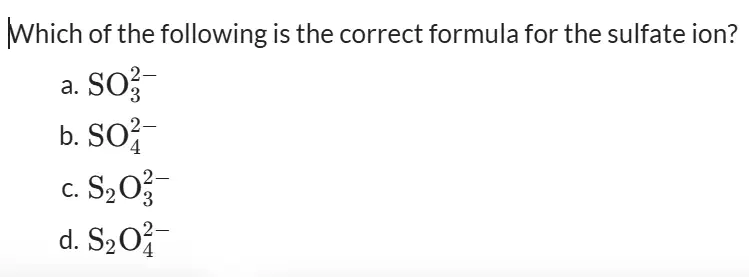
a)
a
b)
b
c)
c
d)
d
42.
What is the charge on the phosphate ion?
a)
1-
b)
2-
c)
3-
d)
4-
43.

a)
a
b)
b
c)
c
d)
d
44.

Which of the following is the electron configuration for
sodium?
a)
a
b)
b
c)
c
d)
d
100 %

