

wayground logo

Free Printable Worksheets

Font size

S
M
L
XL
Worksheets

ME-203 SP&SC Quiz

Total questions: 94

Worksheet time: 3hrs 8mins

Name
Class
Date
1.
Which are the main actors in our economy?
a)
Factories and consumers
b)
Government, business and finance
c)
Government and sustainability
d)
Only finance
e)
Consumers ,finance and sustainability
2.
Which of the following best defines sustainability?
a)
Maximising the use of natural resources to meet current demands
b)
Avoiding resource depletion to maintain ecological balance and meet present and future needs
c)
Focusing solely on economic growth without considering environmental impact
d)
Using resources without concern for future generations
e)
Reducing all human consumption to prevent any environmental impact
3.
What is the Lower and Upper goals for the Paris agreement?
a)
+0.5°C and +2°C
b)
+1°C and +2°C
c)
+1°C and +1.5°C
d)
+1.5°C and +2°C
e)
+1.5°C and +2.5°C
4.
Which continent has contributed the most to CO2 emissions from 1751 to 2017?
a)
North America
b)
Asia
c)
Continental Europe
d)
Africa
e)
None of the above
5.
Which of the following is NOT one of the United Nations' 2030 Sustainable Development Goals (SDGs)?
a)
Universal free healthcare
b)
Quality education
c)
Responsible consumption and production
d)
Life below water
e)
All of the above are SDGs
6.
Which of the following Sustainable Development Goals (SDGs) was highlighted in the lecture to be a challenge for materials,  products,  and supply chains?
a)
SDG 6 - Clean Water and Sanitation
b)
SDG 7 - Affordable and Clean Energy
c)
SDG 9 - Industry, Innovation, and infrastructure
d)
SDG 11 - Sustainable Cities and Communities
e)
SDG 12 - Responsible Consumption and Production
7.

We can expect different levels of Global Warming depending on the different Shared Socioeconomic Pathways (SSPs). Select the correct answer that is in the Paris Agreement:

- SSP1: about 1.5-2°C by 2100

- SSP2: about 2.6-3°C by 2100

- SSP3: about 3.5-4°C by 2100

- SSP4: about 2.6-3°C by 2100

- SSP5: about 4-5°C by 2100

a)

1.5 - 2

b)

2.6 - 3

c)

3.5 - 4

d)

4 - 5

e)
None of the above
8.
Toxic and long-lived substances that humans release into the environment affect which one of the following Planetary Boundaries (PBs):
a)
Biochemical flows
b)
Climate change
c)
Novel entities
d)
Stratospheric ozone depletion
e)
Ocean acidification
9.
What is the meaning of mitigation and adaptation in the context of climate change?
a)
Mitigation refers to reducing greenhouse gas emissions while adaptation refers to managing the risks of climate change.
b)
Adaptation refers to reducing greenhouse gas emissions while mitigation refers to managing the risks of climate change.
c)
Mitigation focuses on the effects while adaptation focuses on the causes.
d)
Both refer to reducing greenhouse gas emissions to slow the rate of climate change.
e)
Both refer to managing the effects of climate change in threatened areas.
10.
Scope 3 upstream emissions of a factory include:
a)
Emissions from the electricity purchased.
b)
Emissions from the company vehicles.
c)
Mining of the supplier for raw materials.
d)
In-house gas burning for heating the workplace.
e)
Emissions from the electricity purchased from an external supplier.
11.
Which of the following are the hardest to abate materials?
a)
Cooper, lithium and silicon
b)
Steel, aluminium and nickel
c)
Wood, lead and titanium
d)
Steel, plastic and cement
e)
Cooper, aluminium and plastic
12.
Emissions from end-of-life dismantling is:
a)
Scope 1 emissions
b)
Scope 2 emissions
c)
Scope 3 emissions upstream
d)
Scope 3 emissions downstream
e)
Not contemplated in the Scope classification
13.
What are critical materials?
a)
Materials with high CO2e emissions per kg.
b)
Hard to abate materials
c)
Materials susceptible to supply chain disruptions
d)
Materials available in very low quantities
e)
Materials without end-of-life recyclability available
14.
Out of the materials listed below which contributes the most to Global CO2 emissions?
a)
Plastic
b)
Aluminium
c)
Iron and steel
d)
Cement
e)
None of the above
15.
There are 2 types of actions to build climate resilience: Mitigation and Adaptation. Out of the listed actions below,  which would fall under BOTH Mitigation AND Adaptation?
a)
Sustainable transport
b)
Clean energy
c)
Flood protection
d)
Water conservation
e)
None of the above
16.
Which 3 of the following actions to build climate resilience below would be considered as Mitigation?
a)
Sustainable transport
b)
Clean energy
c)
Energy efficiency
d)
Flood protection
e)
Disaster management
17.
Which of the actions to build climate resilience below would be considered as Adaptation?
a)
Sustainable transport
b)
Clean energy
c)
Flood protection
d)
Disaster management
e)
Infrastructural upgrades
18.
Which of three of these activities would be considered scope 3 Downstream activities?
a)
Processing of sold products
b)
Use of sold products
c)
Waste generated in operations
d)
End of of life treatment of sold products
e)
Employee commuting
19.
Which of these activities would be considered scope 3 Up-stream activities?
a)
Capital goods
b)
Use of sold products
c)
Waste generated in operations
d)
Processing of sold products
e)
Business travel
20.
Which of the following materials are Hard to Abate Materials mentioned in the lectures:
a)
Aluminium
b)
Cobalt
c)
Concrete
d)
Lithium
e)
Petrochemicals
21.
What does the concept economics mean?
a)
Maximization of monetary profit
b)
Efficient usage of exclusively time and money
c)
Efficient allocation of scarce resources
d)
Allocation of resources to trade in for other scarce resources
e)
Monetarization of goods and services
22.
In which stage are most of a product's emissions determined?
a)
In the design and material selection phase
b)
During manufacturing
c)
During transportation
d)
Owners intended usage
e)
During the end-of-life processing
23.
Which are the THREE key elements of a circular economy?
a)
Design out waste and pollution
b)
Efficient supply chain
c)
Keep products and materials in use
d)
Fast production
e)
Regenerate natural systems
24.
Take-Make-Dispose is an example of which type of system:
a)
Circular economy for products with infinite resources of raw materials
b)
Linear supply chain with hidden environmental costs.
c)
Customer-configured supply chain model.
d)
Closed loop supply chain model with hidden environmental costs.
e)
None of the above
25.
Which of the following is the most favourable R of the circular economy?
a)
Remanufacture
b)
Recycle
c)
Reduce
d)
Recover
e)
Relocate
26.
Which of the following are key elements of the Circular Economy?
a)
Design out waste and pollution
b)
Keep products and materials in use
c)
Regenerate natural systems
d)
Sharing
e)
Material recirculation
27.
Which is NOT one of the R's of a Circular Economy?
a)
Refurbish
b)
Remanufacture
c)
Relocate
d)
Repurpose
e)
Recover
28.
Which of these are NOT barriers to a Circular Economy?
a)
regulatory and access barriers
b)
technological barriers
c)
financial barriers
d)
collection barriers
e)
None of the above
29.

Which of the following statements is correct regarding value and its components in the context of Tesla's production and supply chain? Definition: A value is a conscious choice to act in a certain manner to meet your own needs.

1. Value Creation for Tesla involves designing and engineering high-performance electric vehicles (EVs), developing battery technology, and refining autonomous driving software to meet customer needs.

2. Value Capture in Tesla’s case refers to efficiently managing its Gigafactories and global supply chain to ensure timely production and distribution of vehicles. 3. Value Capture for Tesla includes selling vehicles through its direct-to-consumer model, online sales, and retail showrooms instead of relying on traditional dealership networks. 4. Tesla’s Value Capture strategy includes premium pricing for its cars, energy solutions, and software features like Full Self-Driving (FSD), ensuring profitability. 5. Tesla’s Value Delivery ensures that cars reach customers efficiently through optimized logistics, factory-to-consumer shipping, and service networks.
a)
1, 3 and 5
b)
1, 2, and 4
c)
1, 4 and 5
d)
2, 3 and 4
e)
21, 2, 3 and 5
30.
Which of the following statements about the Bill of Materials (BoM) is correct? 1. A BoM always consists of a single-level structure, listing only the immediate components of the final product. 2. The BoM provides a hierarchical breakdown of the product, listing the finished product at the top and the required components at multiple levels. 3. In a BoM, all components must be assembled in the same sequence as they are listed, without flexibility in manufacturing. 4. The BoM is essential for both product design and manufacturing, helping in cost estimation, material procurement, and production planning. 5. The BoM only includes materials and components but does not account for instructions required in the assembly process.
a)
1 and 3
b)
2 and 4
c)
3 and 5
d)
1, 3 and 5
e)
2, 4 and 5
31.
Which of the following statements about supply chains is correct?1. A supply chain includes only the manufacturing process and does not involve logistics or delivery to customers. 2. Vertical integration in a supply chain means a company owns multiple stages of production, from raw materials to final product distribution. 3. A value-adding network involves multiple independent companies working together in different parts of the supply chain to create value. 4. Mismatch between demand and supply occurs only when demand exceeds supply and never due to supply chain disruptions. 5. Supply chain efficiency depends on matching demand with supply, ensuring timely production and delivery to avoid shortages or excess inventory.
a)
2, 3 and 5
b)
1, 2 and 4
c)
3 and 4
d)
2, 4 and 5
e)
1, 3 and 5
32.
Which of the following statements about the Bullwhip Effect is correct?1. The Bullwhip Effect is primarily caused by operational issues like demand forecasting errors, lead time variability, and order batching. 2. Behavioral factors, such as trust issues, panic ordering, and misperceptions of feedback, contribute significantly to the Bullwhip Effect. 3. The Reverse Bullwhip Effect occurs when supply disruptions, such as a pandemic or natural disaster, amplify distortions as they move downstream in the supply chain. 4. Avoiding price games, such as temporary promotions and forward buying, can help mitigate the Bullwhip Effect by ensuring stable demand patterns. 5. The Bullwhip Effect can be eliminated entirely by using Vendor Managed Inventory (VMI) and Just-in-Time (JIT) practices.
a)
1, 3 and 5
b)
2, 3 and 4
c)
1, 2 and 4
d)
2, 4 and 5
e)
3, 4 and 5
33.
Which of the following statements is incorrect about the key challenges in supply chain management?1. Demand and Supply Variability is a major challenge as fluctuations in demand and supply chain disruptions impact inventory levels and production planning. 2. Efficiency involves using minimal resources to maximize productivity and streamline supply chain operations. 3. Resilience refers to the ability to recover quickly from disruptions, such as supply chain shocks and unforeseen risks. 4. Sustainability in supply chains is only about reducing costs and improving financial performance. 5. Supply Chain Visibility is crucial for tracking shipments, monitoring supplier performance, and managing risks in real time.
a)
1
b)
2
c)
3
d)
4
e)
5
34.
Which of the following statements is correct regarding supply chain models and circular supply chains?1. A linear supply chain follows a one-way path where products are discarded as waste after use, leading to high landfill generation. 2. A sustainable (closed-loop) supply chain focuses on recycling and repair but does not fully eliminate waste. 3. A circular supply chain aims to restore, regenerate, and reuse materials to minimize waste and achieve a zero-landfill system. 4. The Dutch Army (KPU) circular supply chain demonstrates how a military organization can adopt sustainable textile recovery to reduce costs and environmental impact. 5. In a circular supply chain, recycling alone is enough to achieve zero landfill without the need for refurbishment or reuse.
a)
1, 2 and 3
b)
2, 3 and 4
c)
1, 3 and 5
d)
1, 2, 3 and 4
e)
3, 4 and 5
35.
Which of the following is not a key approach to redesigning supply chains to enhance efficiency, resilience and sustainaility ?A) Establishing long-term sustainability goals & including lower-tier suppliers – Engaging all tiers of suppliers in sustainability initiatives and aligning them with long-term environmental and social responsibility goals. B) Improving supply chain network visibility – Enhancing transparency across the supply chain using digital tools and real-time monitoring to manage disruptions and optimize operations. C) Expanding offshoring for cost savings – Increasing reliance on global suppliers in low-cost countries to minimize production expenses, even if it increases lead times and supply chain risks. D) Near-shoring & friend-shoring – Reducing dependency on distant suppliers by relocating production closer to the market (near-shoring) or shifting to politically aligned trade partners (friend-shoring) for resilience. E) Using technology & AI – Leveraging AI, automation, and advanced analytics to optimize operations, improve forecasting, and minimize waste in supply chain processes.
a)
A
b)
B
c)
C
d)
D
e)
E
36.
What does EU policy R.E.A.C.H. regulate?
a)
Greenhouse emissions for factories (Scope 1)
b)
Products end-of-life disposal
c)
Restricted chemical substances
d)
Scope 3 emissions for raw materials
e)
Emissions for land, sea and air transport
37.
The EU Waste Framework Directive introduces for the first time, which TWO of the following concepts:
a)
Polluter pays principle
b)
End-user pays principle
c)
Extended producer responsibility
d)
Extended consumer responsibility
e)
Extended government responsibility
38.
Which of the following is NOT an end-of-life treatment?
a)
Incineration
b)
Landfilling
c)
Storage
d)
Recycling
e)
Repurpose
39.
Which of the following concepts is NOT essential to mitigating materials and products impacts:
a)
Circular economy
b)
Cleaner technologies by design
c)
Recycling rates
d)
Collaborative efforts
e)
Wealth growth
40.
What Environmental/Social issues are there when it comes to mining Cobalt?
a)
Requires Cyanide to extract
b)
Unethical labour practices
c)
Radioactive emissions
d)
Requires highly skilled workers
e)
Cobalt has no significant Environmental/Social issues
41.
How did we define Green Chemistry in the context of sustainable mining?
a)
Maximising atom economy,  meaning reactions are designed to use all materials efficiently
b)
Using renewable feedstocks instead of non-renewable ones.
c)
Minimising toxic waste production and reducing the environmental impact of chemical processes
d)
Reducing energy consumption by conducting reactions at ambient temperature and pressure
e)
None of the above
42.
What is a suggested solution presented in the lecture to reduce the environmental impact of Aluminium mining?
a)
Recycling aluminium
b)
Increasing bauxite mining
c)
Using less water in the extraction process
d)
Switching to alternative materials
e)
None of the above
43.
What are some of the benefits of DLE (direct lithium extraction)
a)
Benefit of extract other rare earth materials along with lithium
b)
Bypasses the need to evaporate a pond
c)
Faster extraction rates
d)
Eliminates the need for water when extracting lithium
e)
Lower extraction costs
44.
Micro-plastics and plastics contamination impact all the following EXCEPT:
a)
Biodiversity
b)
Animals' immune system
c)
Endocrine disruption
d)
Stratospheric ozone depletion
e)
Habitat destruction
45.
Plastic pollution directly affects which TWO of the following planetary boundaries (PBs):
a)
Biosphere integrity
b)
Climate change
c)
Novel entities
d)
Stratospheric ozone depletion
e)
Ocean acidification
46.
As of year 2023, we are over how many of the 9 Planetary Boundaries (PBs):
a)
9
b)
6
c)
3
d)
0
e)
None of the above
47.
The circularity rate in Switzerland is currently:
a)
Less than 5%
b)
More than 90%
c)
Between 7% and 14%
d)
Between 16% and 25%
e)
Between 26% and 39%
48.
How can NetZero be achieved with a contained increase in critical raw materials need?
a)
With technological changes only
b)
With behavioural changes only
c)
With both behavioural and technological changes
d)
With business as usual
e)
None of the above
49.
The current price of natural resources is:
a)
Above the value that would halt its depletion
b)
Below the value that would halt its depletion
c)
Above the extraction cost
d)
Below the legal requirement
e)
Below the extraction cost
50.
Which of the following is NOT part of the 4 principles for humanitarian work:
a)
Humanity
b)
Impartiality
c)
Independence
d)
Judgmentalism
e)
Neutrality
51.
The principle of Independence in humanitarian work refers to:
a)
Where they work
b)
Why they work
c)
Whom they help
d)
Prioritization
e)
Taking no sides
52.
The principle of Impartiality in humanitarian work refers to:
a)
Where they work
b)
Why they work
c)
Whom they help
d)
Prioritization
e)
Taking no sides
53.
Which of the following are MICRO stakeholders? Select 3 :
a)
Employee
b)
Investors
c)
Government
d)
Nature based services (land, water, bees, etc…)
e)
Customers
54.
Which of the following are MESO stakeholders? Select 1 :
a)
Customer
b)
NGOs
c)
Competition
d)
Nature based services (land, water, bees, etc…)
e)
Tier 1 supplier
55.
Which of the following are MACRO stakeholders? Select 2 :
a)
Trade bodies
b)
Employee
c)
NGOs
d)
Society & community
e)
Nature based services (land, water, bees, etc…)
56.
What is the definition of a NET POSITIVE company?
a)
A company that only focuses on maximising shareholder profits while minimising costs.
b)
A company that aims to eliminate all negative environmental and social impacts,  regardless of profitability.
c)
A company that operates with zero emissions and no resource consumption.
d)
A company that has an overall positive impact on its stakeholders, including employees, suppliers, customers, community, and society at large.
e)
A company that avoids any responsibility for social and environmental concers.
57.
What is the difference between NetZero and NetPositive?
a)
NetPositive is a necessary step towards NetZero
b)
NetZero refers to carbon neutrality whereas NetPositive refers to profit growth.
c)
In NetPositive stakeholders' impacts are mitigated without reaching neutrality,  while NetZero archives neutrality.
d)
NetZero and NetPositive are synonymous terms.
e)
NetPositive has an overall positive impact on all its stakeholders, while NetZero aims for just neutrality without regeneration.
58.
Which one of the following statements is FALSE:
a)
Influencing stakeholders is a key step towards NetPositive.
b)
When communicating with stakeholders effectively, focus on short-term results and keep ownership of the idea.
c)
The AIDA Model Hierarchy presents the steps towards effectively influencing stakeholders.
d)
In the AIDA Model Hierarchy, AIDA stands for Attention, Interest, Desire and Action.
e)
Optimizing the return for all the stakeholders in a company can result in a higher return for the shareholders.
59.
How was 'Weak sustainability' model based on Brundtland 1987 defined?
a)
Presents the 3 themes as nested and confers different sizes and weights to them.
b)
Presents the economic, societal, and environmental with equal weightings and seeks to balance them.
c)
Presents the weighting of economics as much greater than that of society and the environment.
d)
Presents societal and economic weight to be negligible compared to environmental.
e)
None of the above.
60.
How was 'Strong sustainability' model based on Giddings in 2002 defined?
a)
Presents the 3 themes as nested and confers different size and weights to them.
b)
Presents the economic, societal, and environmental with equal weightings and seeks to balance them.
c)
Presents the weighting of economics as much greater than that of society and the environment.
d)
Presents societal and economic weight to be negligible compared to environmental.
e)
None of the above.
61.
GDP is used to present the economic strength of a country. Which of these are NOT represented by GDP?
a)
Distribution of wealth.
b)
Unpaid activities.
c)
Goods produced.
d)
Negative externalities.
e)
Service provided.
62.
We have discussed the flaws with the GDP index to considers economic, social, and environmental factors. An alternative index to take all 3 aspects into account was GPI. What does GPI stand for?
a)
Global Peace Index
b)
Gross Product Index
c)
Gradient Performance Index
d)
GeoPolitical Index
e)
Genuine Progression Index
63.
How do you define externalities?
a)
An economic effect that only impacts the individuals directly involved in a transaction.
b)
A regulatory fee imposed by the government to control negative business practices.
c)
An economic effect that only impacts the individuals directly involved in a transaction.
d)
A cost or benefit caused by economic actor that is not suffered or not enjoyed by that same actor.
e)
None of the above.
64.
What does Social Cost of Carbon measure?
a)
The cost of implementing renewable energy to offset carbon emissions.
b)
Monetized damage to society from emitting a tonne of CO2.
c)
The price companies must pay per tonne of CO2 under carbon tax schemes.
d)
The cost per tonne on the amount of CO2 emitted from assets and projects.
e)
None of the above.
65.
What does Internal Cost of Carbon measure?
a)
The cost of implementing renewable energy to offset carbon emissions.
b)
Monetized damage to society from emitting a tonne of CO2.
c)
The price companies must pay per tonne of CO2 under carbon tax schemes.
d)
The cost per tonne on the amount of CO2 emitted from assets and projects.
e)
None of the above.
66.
Which one of the following statements regarding the world's wealth distribution is correct:
a)
1% of the wealth is owned by 50% of the population
b)
Richest 10% of the population owns 90% of the wealth
c)
50% of the wealth is owned by the richest 1% of the population
d)
90% of the population owns 10% of the wealth
e)
90% of the wealth is owned by the richest 1% of the population
67.
Delaying action on climate change:
a)
Decreases the cost of mitigation
b)
Increases the cost of mitigation
c)
Increases the cost of adaptation without altering the cost of mitigation
d)
Decreases the cost of adaptation without altering the cost of mitigation
e)
Has environmental effects but it is independent from cost
68.
Externalities:
a)
Are not included in the market price
b)
Are included in the market price
c)
Only positive externalities are not included in the market price
d)
Are included in the market price as long as they impact the environment
e)
Do not impact the environment,  only indicate the volatility of the market price.
69.
R&D cost is part of:
a)
Materials cost
b)
Production cost
c)
Operating cost
d)
Business cost
e)
Depreciation cost
70.
Corporate taxes are part of:
a)
Materials cost
b)
Production cost
c)
Operating cost
d)
Business cost
e)
Depreciation cost
71.
Tooling cost is part of:
a)
Materials cost
b)
Production cost
c)
Operating cost
d)
Business cost
e)
Corporate cost
72.
Setting the gross margin based on the benefits to the customer needs:
a)
Is a cost-plus approach.
b)
Is done in products with low value proposition
c)
Is a qualitative approach
d)
Generally decreases the headroom to invest in stakeholders
e)
Is a value-in-use pricing
73.
Select the TWO correct statements regarding financial definitions in a company:
a)
CAPEX are funds to acquire, upgrade and maintain physical assets
b)
OPEX are operating expenses without including R&D
c)
OPEX are operating expenses without energy costs
d)
The price is the cost of the product
e)
NPV is the value in today's money of a future investment
74.
What best defines an LCA?
a)
A method for estimating the financial costs of a product from manufacturing to disposal.
b)
The compilation and evaluation of the inputs and outputs and potential environmental impacts of a product system through its life cycle.
c)
A marketing analysis of how consumers interact with a product over time.
d)
A regulatory checklist used to ensure products meet environmental compliance.
e)
A process for determining the lifespan of a product based on material durability.
75.
Choose ONE limitation of an LCA:
a)
LCA is comparative not absolute
b)
LCA NEVER considers the End-of-Life process
c)
LCA ONLY considers direct impact
d)
LCA NEVER considers human health
e)
There is NO limitation to LCA
76.
What does "cradle-to-gate" refer to in a Life Cycle Assessment (LCA)?
a)
An LCA that evaluates only the manufacturing stage of a product.
b)
An LCA that evaluates the environmental impacts of manufacturing and distribution of a product.
c)
An LCA that covers manufacturing, distribution and the use-phase of a product.
d)
An LCA that includes the entire product life cycle: manufacturing, distribution, use and end-of-life.
e)
None of the above
77.
What does "cradle-to-grave" refer to in a Life Cycle Assessment (LCA)?
a)
An LCA that evaluates only the manufacturing stage of a product.
b)
An LCA that evaluates the environmental impacts of manufacturing and distribution of a product.
c)
An LCA that covers manufacturing, distribution and the use-phase of a product.
d)
An LCA that includes the entire product life cycle: manufacturing, distribution, use and end-of-life.
e)
None of the above
78.
Which one of the following is NOT one of the four phases in an LCA analysis?
a)
Goal and scope definition
b)
Inventory analysis
c)
Impact assessment
d)
VAN optimization
e)
Interpretation
79.
An unfortunate accident at the sawmill generating pollution to the environment is accounted in which of the LCA analysis phase?
a)
Goal and scope definition
b)
Inventory analysis
c)
Impact assessment
d)
VAN optimization
e)
Interpretation
80.
Which two products are NOT suitable for direct comparison as a functional unit via a Life Cycle Assessment (LCA)?
a)
HOKA running shoe and Nike running shoe
b)
Brazilian coffee beans and Colombian coffee beans
c)
Tesla's electric car and BMW's hybrid car
d)
La-Z-Boy chair and IKEA cushion chair
e)
All are suitable for direct comparison
81.
Which TWO of the following statements is correct regarding LCA analysis?
a)
Mass and energy balances should be verified.
b)
Interpretation should be done after the design freeze
c)
System boundaries should cover the same functional unit
d)
Identical processes in different scenarios can never be excluded
e)
Product mass is generally independent from impacts
82.
Which one of the following statements is FALSE regarding LCA peer review?
a)
Peer review ensures that the study report is transparent and consistent
b)
External review is necessary for ISO-compatible studies involving a comparative assertation
c)
Peer review needs to be planned and budgeted from the start of the LCA
d)
It is preferable to not involve the reviewers until close to the end of the project
e)
Peer review is an analogy of paid independent review from a charted surveyor
83.
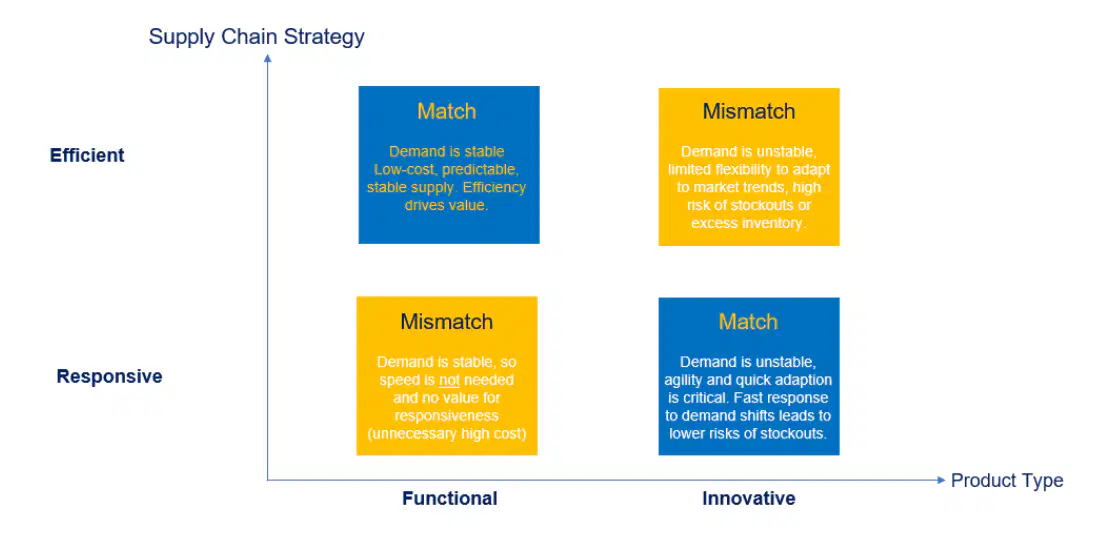
According to Fischer framework, select which kind of supply chain strategy is most adequate for the following product: milk.
a)
Responsive, since it is a functional product
b)
Responsive, since it is an innovative product
c)
Efficient, since it is a functional product
d)
Efficient, since it is an innovative product
e)
Both responsive and efficient at the same time
84.
Simulation is mainly which type of Supply Chain Analytics?
a)
Descriptive analytics: What happened? (e.g. last month's inventory levels)
b)
Diagnostic analytics: Why did it happen? (e.g. delay due to supplier issues)
c)
Predictive analytics: What will happen next? (e.g. forecast demand next quarter)
d)
Prescriptive analytics: What should we do? (e.g. optimize transport routes or reorder points)
e)
All of the above
85.
In a typical supply chain analytics project, which activity takes up the most time and effort?
a)
Running advanced analytics and machine learning models
b)
Integrating, cleaning and preparing data from various sources
c)
Designing dashboards and visualizations for stakeholders
d)
Building simulation models and testing scenarios
e)
Both the first and forth statements are correct
86.
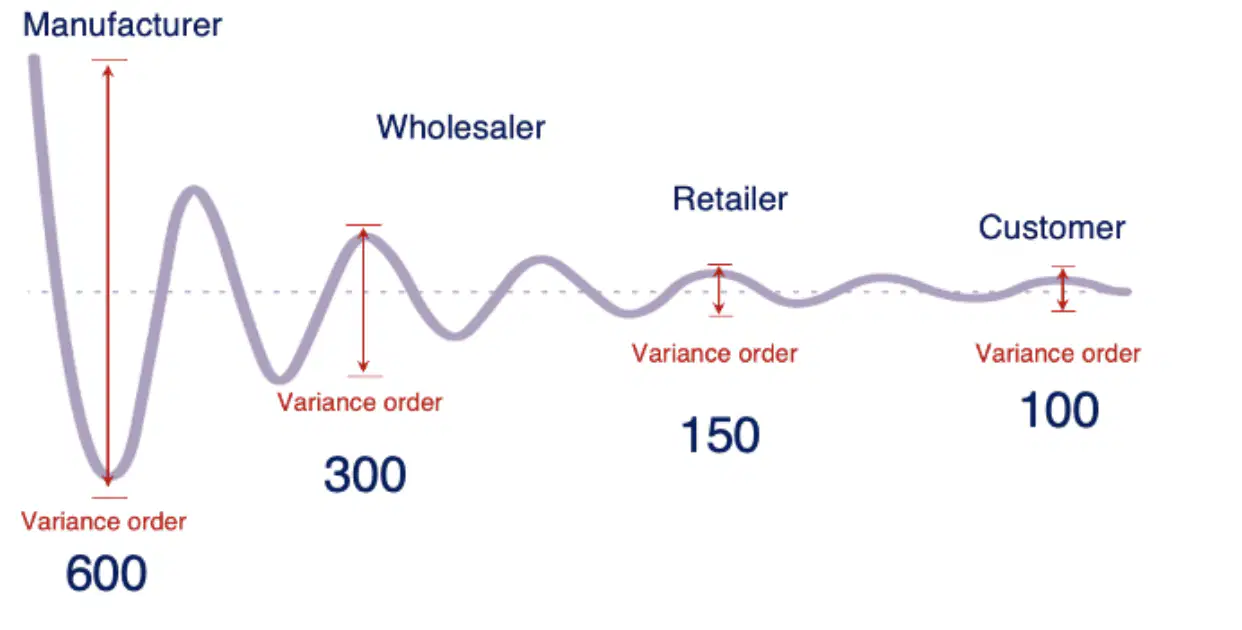
What is the Bullwhip effect of the whole supply chain (customer to manufacturer) and the Amplification from the wholesale to manufacturer?
a)
6x and 2x, respectively
b)
3x and 2x, respectively
c)
6x and 0.5x, respectively
d)
1.67x and 0.5x, respectively
e)
None of the above
87.
Demand forecasting is part of which one of the following Key Activities in Supply Chain?
a)
Sales and Operations Planning
b)
Sourcing
c)
Production
d)
Warehousing
e)
Point-of-scale
88.
Which one of the following Supply Chain Activities is paired with a less relevant Key Performance Indicator (KPI)?
a)
Activity: Recycle. KPI: Shelf availability.
b)
Activity: Sales and operations. KPI: Demand forecast accuracy (%).
c)
Activity: Sourcing. KPI: Supplier defect rate.
d)
Activity: Production. KPI: Overall Equipment Efficiency (OEE).
e)
Activity: Transportation. KPI: Carbon emissions per shipment.
89.
Which one of the following characteristics is correct for a Circular Supply Chain (and not for a Sustainable or Traditional Supply Chain)?
a)
Focus on collaborative value creation
b)
Global reach Scope
c)
Service-based outcomes Strategy
d)
Low-volume scale
e)
Structure with closed, short and cascaded loops
90.
Which one of the following supply chain activities is not directly involved in Scope 3 emissions?
a)
Purchased goods and services
b)
Waste generated in operations
c)
Transportation and distribution upstream
d)
Transportation and distribution downstream
e)
End-of-life treatment of sold products
91.
In this screenshot of an AnyLogistix simulation we can see a drop in Service Level below 100%. Which of the following strategies would not be suitable to increase back the Service Level?
a)
Increase Initial Stock
b)
Decrease Demand
c)
Decrease Production Cost
d)
Increase Inventory Level
e)
Increase Production
92.
What does SMART stand-for?
a)
Special, mass-based, accountable, relativistic, transitional
b)
Specific, monetary, accountable, relevant, time-based
c)
Super, measurable, achievable, relativistic, time-based
d)
Specific, measurable, attainable, relevant, time-based
e)
Special, measurable, achievable, realistic, trajectory
93.
Which answer is not part of Kotter's eight-step process for leading change within an organization include?
a)
Create urgency, Build a coalition, Form strategic vision
b)
Keep to inner core team, Adjust goals to suit progress
c)
Obtain buy-in across organization, Remove barriers
d)
Generate and celebrate short-term wins
e)
Success as a springboard, Institute change
94.
Which answer is not a definition of greenwashing given in the course?
a)
Statements not backed up by concrete action plans, $$$ investment on the ground, accountability, measurable outcomes, reported publicly.
b)
Making unsubstantiated claims to deceive stakeholders that a company’s products have a greater positive environmental impact than they actually do.
c)
The act or practice of making a product, policy, or activity appear to be more environmentally friendly or less environmentally damaging than it really is.
d)
Removing a publicly made declaration or promise from publicity materials or web pages and removing the sustainability target.
e)
Accurate reporting of double materiality of the company’s scope 1,2,3 emissions.
