

Wayground logo

Free Printable Worksheets

Font size

S
M
L
XL
Worksheets

Test 1 - US II

Total questions: 99

Worksheet time: 1hrs 9mins

Name
Class
Date
1.

This group opposed Lincoln's plan for reconstruction and felt the south should be punished.

a)

Democrats

b)

Radical Republicans

c)

Libertarians

d)

Socialists

2.

This gave all men regardless of race the right to vote.

a)

13th Amendment

b)

14th Amendment

c)

15th Amendment

d)

16th Amendment

3.

This secret society attempted to keep Freedmen from exercising their rights through threats and violence.

a)

the Freedmen's Bureau

b)

The Anti-Freedmen Group

c)

the Ku Klux Klan

d)

the NAACP

4.

The 13th Amendment

a)

gave former slaves citizenship

b)

gave former slaves the right to vote

c)

gave slaves their freedom

d)

gave women the right to vote

5.

This plan for reconstruction had few steps and was meant to be an easy way for the south to rejoin the Union. It included the 10% plan.

a)

Radical Reconstruction

b)

Military Reconstruction

c)

Congressional Reconstruction

d)

Presidential Reconstruction

6.

The 14th Amendment to the Constitution ...

a)

abolished slavery

b)

gave former slaves their citizenship

c)

gave former slaves the right to vote

d)

gave women the right to own property

7.

The intent of the KKK was to

a)

help former slaves vote in elections

b)

prevent former slaves from voting in elections

c)

help former soldiers adjust to life at home

d)

prevent women from voting

8.

After the Civil War there was an effort by whites to maintain

a)

slavery

b)

white supremacy

c)

the Confederacy

d)

women staying in the kitchen and taking care of the home

9.

Some of the goals of the Freedmen's Bureau included

a)

helping former slaves vote

b)

building and running schools

c)

providing food and clothing for former slaves

d)

all of the above

10.

Why did Sharecropping and tenant farming become the dominant form of agriculture after the Civil War?

a)

many former Confederate soldiers were available to work

b)

the government offered farmers incentives to practice sharecropping

c)

there were many former slaves who needed work and plantation owners who needed labor

d)

people flocked to the south after the war for jobs

11.

Who became president after Lincoln's assassination?

a)

U.S. Grant

b)

Andrew Johnson

c)

Andrew Jackson

d)

Robert E. Lee

12.

In what year did Reconstruction end? With the election of which president?

a)

1877, Rutherford B. Hayes

b)

1889, U.S. Grant

c)

1866, Andrew Johnson

d)

1890, Robert E. Lee

13.
What did the 13th Amendment do?
a)
made slavery illegal
b)
made former slaves citizens and gave them rights
c)
gave black men the right to vote
d)
gave former slaves land to begin farms
14.
What did the 14th Amendment do?
a)
made slavery illegal
b)
made former slaves citizens and gave them rights
c)
gave black men the right to vote
d)
gave former slaves land to begin farms
15.
What did the 15th Amendment do?
a)
made slavery illegal
b)
made former slaves citizens and gave them rights
c)
gave black men the right to vote
d)
gave former slaves land to begin farms
16.
What was segregation?
a)
equal treatment for all people
b)
the forced separation of races
c)
a farmer shares part of his crop to pay for land
d)
the period of time after the Civil War
17.
What was Reconstruction?
a)
equal treatment for all people
b)
the forced separation of races
c)
a farmer shares part of his crop to pay for land
d)
the period of time after the Civil War
18.
The US government created what organization to help former slaves and poor whites?
a)
Bureau of Parks and Recreation
b)
Free Food Bureau
c)
Jobs and Education Bureau
d)
Freedman's Bureau
19.
Laws that required the African-Americans be separated from white in public places are...
a)
Jim Crow Laws
b)
Black Codes
c)
Grandfather Codes
d)
Integration Laws
20.
System of farming where farmers gave part of their crop to pay for the land they rented
a)
Family-Farming
b)
Sharecropping
c)
Groupcropping
d)
Split-Farming
21.
Why did sharecroppers remain poor?
a)
The South flooded during Reconstrucion
b)
They owed money to the landowners, never getting out of debt
c)
The sun never shone on crops
d)
Animals ate all the crops
22.
How was President Lincoln killed?
a)
heart failure
b)
bit by a snake
c)
falling off a horse
d)
shot by John Wilkes Booth
23.
Southern states created the Black Codes to do what?
a)
limit African Americans rights
b)
expand Confederate rights
c)
give women voting rights
d)
jail Carpetbaggers
24.
Carpetbaggers were...
a)
Newly freed slaves
b)
Southern Republicans
c)
Confederate Soldiers
d)
Northerners who took advantage of southern economic hardships 
25.
Abraham Lincoln believed...
a)
African Americans needed Constitutional Amendments to guarantee voting rights
b)
in the southern cause
c)
southern states should have to prove their loyalty after the war
d)
preservation of the Union was more important than punishing the south
26.
Organizations like these worked for which of these goals? 
a)
To encourage southerners to fight against the Union 
b)
to legalize discrimination against African 
Americans
c)
To encourage African American education
d)
to promote Confederate rights
27.
The Presidential Election of 1876 resulted in...
a)
military supervision of the south
b)
the restoration of voting rights for white southerners
c)
the end of Reconstruction in the south
d)
equal rights for African Americans
28.
Scalawags were...
a)
Northerners who took advantage of southern economic hardships 
b)
Southern Republicans
c)
former Confederate Leaders
d)
African Americans
29.

Lincoln's "10 Percent Plan" dealt with

a)

his idea for instituting an income tax.

b)

how to draft more men into the Union Army.

c)

re-admitting Southern states into the Union.

d)

his quest to reconquer only 10% of the South

30.

Presidential Reconstruction following the American Civil War can BEST be described as

a)

a plan to fix the damage to the White House caused by the Civil War.

b)

a desire to rebuild the southern states quickly to help control the economy.

c)

a desire to rebuild the country quickly and without ill feelings following the war.

d)

a desire to punish those southerners responsible for causing and/or prolonging the war.

31.

What group was created in 1865 in Pulaski, Tennessee, for the purpose of preventing both the programs of Reconstruction and laws promoting racial equality?

a)

Freedman's Bureau

b)

Ku Klux Klan

c)

Know Nothing Party

d)

White Circle Council

32.

The period of rebuilding of The South after The Civil War was known as

a)

The Renaissance

b)

Reconstruction

c)

The Guilded Age

d)

The Industrial Revolution

33.

Which statement describes the attitude of the "Radical Republicans" following the Civil War?

a)

"Southern states should pass the 'Black Codes.' "

b)

"The Southern states have been conquered and should be punished for their actions."

c)

"Former Confederate leaders should be forgiven for their actions during the Civil War."

d)

"The country should follow President Lincoln's plans to reunite the country as quickly as possible."

34.

President Johnson was impeached for _________________.

a)

lying to the country

b)

violating the Tenure of Office Act

c)

holding elections in an off year

35.

A freedmen was required to have a labor contract in Mississippi after 1865. This is an example of ______________.

a)

Jim Crow Laws

b)

sharecropping

c)

the black codes

d)

Reconstruction

36.

Special Field Order 15 gave _____________ to families of freedmen.

a)

labor contracts

b)

40 acres of tillable land

c)

voting rights

d)

citizenship

37.
Northerners who migrated to the mostly destroyed post-war south to make large profits and/or help freedmen were known as
a)
Scalawags
b)
Ku Klux Klan
c)
Carpetbaggers
d)
Sharecroppers
38.
As sharecroppers former slaves were given a place to live, seeds, and equipment in order produce crops.  The land owner received a ________ of all crops grown
a)
Share
b)
Parcel
c)
Ownership
39.

Who was the first African-American U.S. Senator?

a)

Frederick Douglass

b)

Philip Bazaar

c)

William Carney

d)

Hiram Rhodes Revels

40.

The Homestead Act attempted to promote development of western lands by

a)

creating a system of dams for crop migration

b)

removing all restrictions on immigration

c)

placing Native Americans on reservations

d)

providing free land to settlers

41.
Skyscrapers were made mostly out of...
a)
Oil
b)
Coal
c)
Plastic
d)
Steel
42.
Gilded means...
a)
covered in coal
b)
poor but with the demand for money
c)
goods and services
d)
covered in a layer of gold
43.
When a single corporation or person owns nearly the entire supply of a good, it is a...
a)
Market Economy
b)
Monopoly
c)
Inferior Good
d)
Vertical Integration
44.
What affect do monopolies have on small businesses?
a)
Increase competition with them
b)
Reduce the need for government intervention
c)
Spread wealth with the smaller business
d)
Reduce the number of small businesses
45.
Negotiating through collective bargaining and going on strike if necessary, are methods of what group?
a)
Monopolies
b)
Trusts
c)
Economies
d)
Labor Unions
46.
Who founded the American Federation of Labor?
a)
Samuel Gompers
b)
Cornelius Vanderbilt
c)
Eugene Debs
d)
Upton Sinclair
47.

Politicians (like Boss Tweed) were taking what for favors?

a)

Hugs

b)

Pugs

c)

Bribes

d)

Food

48.

Elected leaders give government jobs and favors to supporters in exchange for loyalty and support

a)

Spoil System

b)

Money System

c)

Bribery System

d)

Government System

49.
This reform required people to pass a test and show skills in order to take federal jobs.
a)
Civil Service Commission
b)
Civil Municipal Commission
c)
Civil Liberty  Commission
d)
Civil Hydration Commission
50.
Where were immigrants coming from during the Gilded Age?
a)
West Europe
b)
East Europe
c)
Australia
51.
What is a push factor?
a)
Reason to leave
b)
Reason to come
c)
Reason to stay
52.
What is a pull factor?
a)
Reason to leave
b)
Reason to come
c)
Reason to stay
53.
What is the fear of immigrants? 
a)
Immigrantphobia
b)
Xenophobia
c)
Claustrophobia
54.
The Chinese Exclusion Act prevented Chinese immigrating to the U.S. for how many years?
a)
1 year
b)
5 years
c)
7 years
d)
10 years
55.
This period during the 1870s to 1900 is known for it's rise of railroads, big business, industrialization and social problems in the United States.
a)
World War I
b)
Progressive Era
c)
Gilded age
d)
Roaring Twenties
56.
During the 19th and early 20th century, These men helped immigrants with jobs and housing in order to control votes during election? 
a)
political parties
b)
El Chapo
c)
political bosses
d)
republican party
57.
Because of the rapid growth of Industrilization in the North people moved out of rural towns to?
a)
Rural farms
b)
Urbanzied cities
c)
Subrebs cities
d)
El rancho
58.
Many Immigrants faced issues once they arrived such as language barriers, but these group of people mostly restricted new immigrants from emtering the country.
a)
Democrats
b)
Republicans
c)
Donald Trump
d)
Nativists
59.
Described as a time marked by gross income inequality and corrupt practices by corporations and abuse of workers, the term "Gilded Age" was coined by what writer?
a)
Upton Sinclair
b)
Andrew Carnegie
c)
Mark Twian
d)
Henry George
60.
Samuel Gompers focused the American Federation of Labor on
a)
Skilled workers
b)
African Americans
c)
Unskilled workers
d)
Railroad workers
61.
Who were the Pinkertons?
a)
Private police force known for their ability to break strikes
b)
Union group who refused to work
c)
People who didn't in any form of government
d)
united Rialroad workers
62.
Between 1860 and 1910, the U.S. population tripled due to:
a)
The Baby Boom
b)
Immigration
c)
The Homestead Act
d)
Better Healthcare
63.
This term refers to the process of teaching immigrants about U.S. culture and our beliefs and customs, all the while assimilating into American society.
a)
Americanization
b)
Nativism
c)
American
d)
MexiCAN
64.
What is the name given to the belief that the United States had the right and duty to expand across the North American continent?
a)
Manifest destiny 
b)
 Monroe Doctrine 
c)
 Great Awakening 
d)
Louisiana Purchase
65.
During the 19th and early 20th century, These men helped immigrants with jobs and housing in order to control votes during election? 
a)
political parties
b)
El Chapo
c)
political bosses
d)
republican party
66.
How do monopolies harm consumers?
a)
They eliminate competition and allow for high prices
b)
They encourage competition, but increase prices
c)
They increase competition and lower prices
d)
They increase prices while increasing the quality of products
67.
He used the Bessemer Process in a factory in Pittsburgh Pennsylvania, to mass produce stronger steel
a)
John D. Rockefeller
b)
Andrew Carnegie
c)
Terrence Powderly
d)
Cornelius Vanderbilt
68.
What event led to the beginning of Imperialism, because factories needed so many resources to produce goods?
a)
French Revolution
b)
Scientific Revolution
c)
Industrial Revolution
d)
Cold War
69.

During the Gilded Age, there was an increase in ________________ and _________________ as people moved to U.S. cities looking for economic opportunities.

a)

Immigration / urbanization

b)

capitalism / imperialism

c)

communism / free enterprise

d)

reform movements / civil rights

70.

During the Gilded Age, the expansion of _________________________led to corruption in the government but also improvements in basic services and urban infrastructure.

a)

the railroad

b)

suffrage

c)

slavery

d)

political machines

71.

The government encourage Native Americans and immigrants to adopt white culture in a process called ____________.

a)

cultural diffusion / globalization

b)

acculturation / industrialization

c)

assimilation / americanization

d)

overspeculation / urbanization

72.

Americans who were anti-immigration due to fear of losing jobs to immigrants were called -

a)

muckrakers

b)

nativists

c)

imperialists

d)

industrialists

73.

This law was made to reduce competition for jobs on the West coast because it prohibited immigration from China?

a)

Sherman Anti-Trust Act

b)

Chinese Exclusion Act

c)

Interstate Commerce Act

d)

Homestead Act

74.

Which application of a new technology can attributed to an invention of Thomas Edison?

a)

Refrigerated railroad cars allowed food to be transported long distances

b)

Light bulbs made it efficient for factory workers to work at night

c)

Diesel engines were used in production of airplanes

d)

Sonar technology was used to track submarines

75.

The Knights of Labor and the American Federation of Labor developed in response to the:

a)

increased need to protect worker interests

b)

decreased power of political machines

c)

increased demand for skilled workers

d)

decreased profitability of the agricultural sector
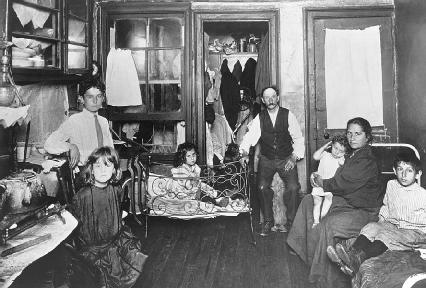
76.
The photo demonstrates one of the problems with
a)
overcrowding urban tenements.
b)
labor union activism in urban areas.
c)
the overproduction of consumer goods.
d)
the growth of political machines.
77.

The growth of cities is called . . .

a)

rural

b)

technology

c)

immigration

d)

urbanization

78.

Process which made steel more affordable and profitable.

a)

Laissez-faire

b)

Interstate Commerce

c)

Bessemer

d)

National Market

79.

This a an act of "charitable giving."

a)

Laissez-Faire

b)

Beneficiary

c)

Philanthropy

d)

Frugality

80.
_______ is when workers refuse to work in order to force an employer to meet their demands.
a)
labor unions
b)
party
c)
strike
d)
sweatshop
81.
Formation of national labor unions in the late 1800's was mainly because of
a)
passage of laws that supported workers
b)
laws restricting immigration
c)
poor working conditions and low wages
d)
economic depression that led to high unemployment
82.
a company tool to fight union demands by refusing to allow employees to enter its facilities to work
a)
lock out
b)
arbitration
c)
injunction
d)
closed shop
83.
an agreement in which a company agrees to hire only union members
a)
injunction
b)
closed shop
c)
industrial union
d)
arbitration
84.
orkers who tried to organize a union or strike were often fired and placed on a list of “troublemakers” called the
a)
union list
b)
blacklist
c)
lockout list
d)
strikebreaker list
85.
During The Great Migration, many southerners moved to big cities for what reason?
a)
to find more food
b)
because they didn't like growing cotton
c)
to find better jobs
d)
to get bigger homes
86.
Many of the people who moved away from the south were...
a)
old
b)
white
c)
black
d)
Asian
87.
Another term for monopoly during the period 1865-1900 was
a)
Big Business
b)
Trust
c)
Giant of Industry
d)
Forbes 500
88.

Which is NOT an accurate statement about child labor?

a)

Children missed out on an education

b)

Children worked in dangerous conditions

c)

Children made a lot of money by working

d)

Children were often injured or killed

89.

What part of the country did political machines control?

a)

Urban (city) governments

b)

Rural (country) governments

c)

The U.S. federal government

90.

What was the main reason for the rise of political machines?

a)

They bribed police officers to ignore crimes

b)

Nativists rigged elections in their favor

c)

Forced unions to keep factories open to low skilled workers

d)

Cities were overcrowded and couldn't get basic services needed for immigrants

91.

How did political machines get the support of immigrants?

a)

they promised to stop illegal immigration from Latin America

b)

They wasted money on military spending

c)

They helped them find homes and jobs in exchange for votes

d)

They developed a system to make becoming a citizen easier

92.

The most famous political machine was Tammany Hall in New York lead by-

a)

Bill the Butcher

b)

Andrew Carnegie

c)

William "Boss" Tweed

d)

John D Rockefeller

93.
What was the name of the organizations that often ran city, county, and state politics during the late 1800s?
a)
political machines
b)
monopolies
c)
power brokers
d)
the mafia
94.
What were the very top leaders of political machines called?
a)
precinct captains
b)
party bosses
c)
ward bosses
d)
lieutenants
95.

Where is Ellis Island located?

a)

Pacific Ocean

b)

Florida

c)

New York City Harbor

d)

Washington D.C.

96.

What was Ellis Island?

a)

An amusement park

b)

A vacation spot

c)

An immigration center in New York

d)

The first capital of the United States

97.
Where was Angel Island located?
a)
San Antonio, Texas
b)
New York, New York
c)
San Francisco, California
d)
Los Angeles, California
98.

Land out West could be 'fertile' -- What does fertile mean?

a)

Plants grow well there

b)

Soil was dry

c)

Lots of trees

d)

Many rivers and lakes

99.
The primary goal of manifest destiny was
a)
End slavery in the new territories
b)
removal of European influence from South America
c)
expansion westward to the Pacific Ocean
d)
secession of southern states from the nation
