
 Worksheets
T8L2&3: Climate Changes & Effects
Total questions: 40
Worksheet time: 20mins
If there was no CO₂ in the atmosphere, what would the Earth look like?
Volcanic Eruption
Snowball
Gaseous Haze
Glowing fireball
What is driving climate change right now?
Burning fossil fuels
Overuse of plastics
Deforestation
Tech usage
Which of the following best describes a positive feedback loop in climate change?
Ocean currents slow down, stabilizing temperatures
Warming leads to more cloud cover, which cools the Earth
Warming causes more ice to melt, which leads to further warming
Increased rainfall reduces atmospheric CO2

Which of the following are consequences of climate change?
Glaciers are shrinking and sea levels are rising
Heat waves are shorter but more intense
Animals are thriving in increased heat
Coral reefs are adding more species


The graph shows the increase in atmospheric CO₂ concentration over several decades.
What will this increase directly affect?
magnetic and gravitational fields.
weather and climate systems.
mantle convection.
rotation speed.
What is the GREENHOUSE EFFECT?
The trapping of heat in the Earth's atmosphere by greenhouse gases
The process of photosynthesis in plants
The movement of tectonic plates
The formation of clouds in the sky
Identify the four major GREENHOUSE GASSES.
Carbon dioxide, Methane, Nitrous oxide, Water vapor
Oxygen, Nitrogen, Argon, Neon
Hydrogen, Helium, Krypton, Xenon
Ozone, Carbon monoxide, Sulfur dioxide, Ammonia
Why is the GREENHOUSE EFFECT necessary?
Prevents harmful UV rays from reaching Earth
Maintains Earth's temperature suitable for life
Increases oxygen levels in the atmosphere
Causes global warming
Which method helps gather data about past conditions?
Tree rings
Modern weather stations
Satellite images of current weather
Weather forecasts
Rock deposits from glaciers help gather data about past conditions by indicating which of the following?
Past glacial activity and climate conditions
Current ocean temperatures
Volcanic eruptions
Earthquake frequency
What is climate change?
Long-term change in the Earth's average atmospheric temperature.
A short-term weather event like a thunderstorm.
A decrease in the Earth's city population's in due to shifting ideas.
A type of renewable energy that focuses on carbon dioxide waste
How does SHIFTING LAND MASSES affect the Earth’s climate?
Changes ocean currents and wind patterns
Increases volcanic eruptions
Decreases solar radiation
Causes more rainfall
How does SOLAR RATIATION affect climate?
Increases greenhouse gases
Changes the amount of energy Earth receives from the Sun
Causes more volcanic eruptions
Alters ocean currents and melts glaciers
How do VOLCANOES AFFECT CLIMATE?
Release gases (and particles) that can cool or warm the atmosphere
Increase salinity & density of oceans
Decrease Earth's gravity rate
Change Earth's orbit around sun and Moon's orbit around Earth
How much colder was the Earth during the Ice Ages? (°C)
5° to 15°
1° to 3°
10° to 20°
0° to 2°
What has been concluded about the Earth's climate patterns based on Milankovitch’s discovery?
Cycles of cooling summers
Movement of tectonic plates
Rise and fall of mountain ranges
Increase and decrease of volcanic eruptions
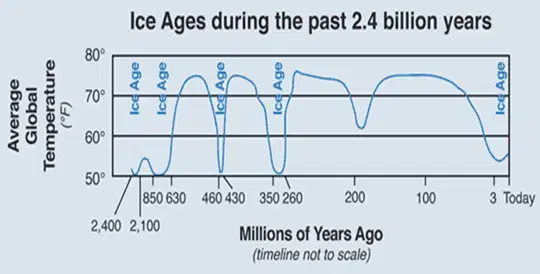
Which of the following statements best explains Earth's ICE AGES over the last 2.4 billion years?
Ice ages occur at regular intervals and last for long periods.
Ice ages occur randomly and last for short periods.
Ice ages only happened once in history.
Ice ages are not related to temperature changes.
What is GLOBAL WARMING?
An increase in Earth's average surface temperature (rising levels of greenhouse gases)
A decrease in Earth's average temperature due to ocean changes
The process of ozone layer depletion due to use of CFC materials.
A natural cooling of the planet.
How does agriculture contributes to climate change?
Producing greenhouse gases like methane and nitrous oxide
Reducing the amount of sunlight reaching the earth
Increasing rainfall worldwide
Decreasing global temperatures
Which of the following best explains how industry contributes to climate change?
Industries release greenhouse gases that trap heat in the atmosphere.
Industries help reduce carbon emissions by planting trees.
Industries have no impact on the climate.
Industries only use renewable energy sources.
How does DEFORESTATION contributes to climate change?
It increases CO₂ in the atmosphere by reducing the number of trees that absorb CO₂
It cools the Earth's surface by increasing shade.
It decreases greenhouse gases by planting more trees.
It has no impact on the climate.
What is the impact of CO₂ not in balance?
Global warming or enhanced greenhouse effect
Increased oxygen production
Decrease in atmospheric pressure
Reduction in sunlight reaching Earth
What absorbs a significant amount of carbon dioxide?
Oceans and plants
Deserts and rocks
Mountains and sand
Plastic and metal
In what substances does the biosphere "lock up" carbon dioxide?
Organic matter, fossil fuels, or plant biomass
Minerals like quartz and feldspar
Atmospheric nitrogen and oxygen
Liquid water and dissolved salts
Engineering New Solutions could help us deal with climate change by:
Developing renewable energy technologies
Increasing fossil fuel use
Reducing recycling efforts
Promoting deforestation
Warming temperatures have several impacts on rising sea levels.
Which of the following is NOT an effect of warming temperatures on sea levels?
Melting of polar ice caps
Thermal expansion of seawater
Increased frequency of volcanic eruptions
Melting of glaciers
Warming temperatures have several impacts on Polar Regions.
Which of the following lists three correct details?
Melting sea ice, rising sea levels, loss of habitat for polar bears
Increased rainfall, more earthquakes, higher volcanic activity
Expansion of forests, more desertification, increased hurricanes
Lower temperatures, more snowfall, thicker ice sheets
Warming temperatures can impact species in which of the following ways?
By forcing them to adapt, migrate, or face extinction
By increasing food supply for all species
By reducing competition among species
By making all habitats more suitable for all species
Warming temperatures have which of the following impacts on Extreme Weather Change?
Increase in frequency and intensity of heatwaves, more severe storms, and heavier rainfall events
Decrease in frequency of extreme weather events, milder storms, and less rainfall
No impact on extreme weather patterns
Reduction in both heatwaves and storm severity
How much has the planet increased in temperature in the last ~100 years?
No Change
1º C
3º C
5º C
How is climate change impacting our oceans?
More salinity
Slower currents
Ice sheets (Greenland) melting
More sand
Which animals are projected to become extinct in the oceans if global temperatures continue to rise?
Blue whales
Coral Reef fish
Sharks
Marlins
What is the affect of more gasses in the atmosphere?
Temperature drops
Pressures drop
Temperature rises
More UV radiation
What are fossil fuels?
Coal, gas and oil
Solar emissions
Biofuel (ethanol)
Wind Turbine fuels
What is the waste product of burning fossil fuels?
Methane
Nitrous oxide
Water vapor
Carbon dioxide
What is happening to the 'Greenhouse blanket'?
Thinning
Mutating
Thickening
Rising
The carbon footprint is a result of:
Too many humans building in rural (farm) areas
Added CO2 in atmosphere from burning fuels (human actiivty)
Melting glaciers at the poles
Animals migrating to areas they didn't use to

Which statement accurately analyzes this energy usage graph (2021)
We are most dependent on fossil fuels for energy
Biomass is not a renewable energy
Nuclear energy is renewable since they are next to each other
Hydroelectricity is nonrenewable since it is also green
What is the best title for the following: geothermal, solar, wind, biomass and hydroelectric.
Fossil fuels
Nonrenewable energy
Heat energy
Renewable energy

