
 Worksheets
EFB344
Total questions: 97
Worksheet time: 1hrs 14mins
What is the primary purpose of the daily settlement of futures contracts?
(a)
What is Forward Contract?
(a)
Why are both the buyer and the seller of the futures contract required to establish a margin account?
(a)
What does option contract represent for?
the right not obligation
the obligation
How can you “close” a futures position?
(a)
My portfolio has a beta of 1. Let VA be the value of the portfolio and VF is the notional (theory) value of a S&P200 futures contract (F0,T x $25). If I sell 𝑉A/𝑉F futures, discuss whether my portfolio is perfectly hedged.
𝛽a = 1
𝛽a = 0
𝛽a different 1
What is the difference between the over-the-counter and the exchange-traded market?
(a)
What are the bid and offer quotes of a market maker in the over-the-counter market?
(a)
Suppose you enter into a short futures contract to sell December fine wool for AUD 15.00 per kilogram on the ASX. The size of the contract is 2500 kilograms. The initial margin is $4000, equating to the maintenance margin. If the price of the fine wool futures increases to AUD 15.75 per kilogram, what will be the balance of the margin account? Determine the amount of the margin call, if appropriate.
Margin account balance = 2,125
Margin account balance = 1,875
Margin call = 2,125
Margin call = 1,875
Suppose that in September 2024 an American company takes a long position in a contract on May 2025 crude oil futures. It closes out its position in March 2025. The futures price (per barrel) is $68.30 when it enters into the contract, $70.50 when it closes out the position, and $69.10 at the end of December 2024. One contract is for delivery of 1,000 barrels. What is the company’s profit? When is it realised?
$800 is realised on a day-by-day basis between September 2024 and 31 December 2024
$1,400 is realised on a day-by-day basis between 1 January 2025 and March 2025.
$800 is realised on a day-by-day basis between 1 January 2025 and March 2025.
The total profit is $2,200
What is Cross Hedging?
(a)
What is Hedge ratio?
(a)

How many futures must be bought/sold?
18
20
19
24
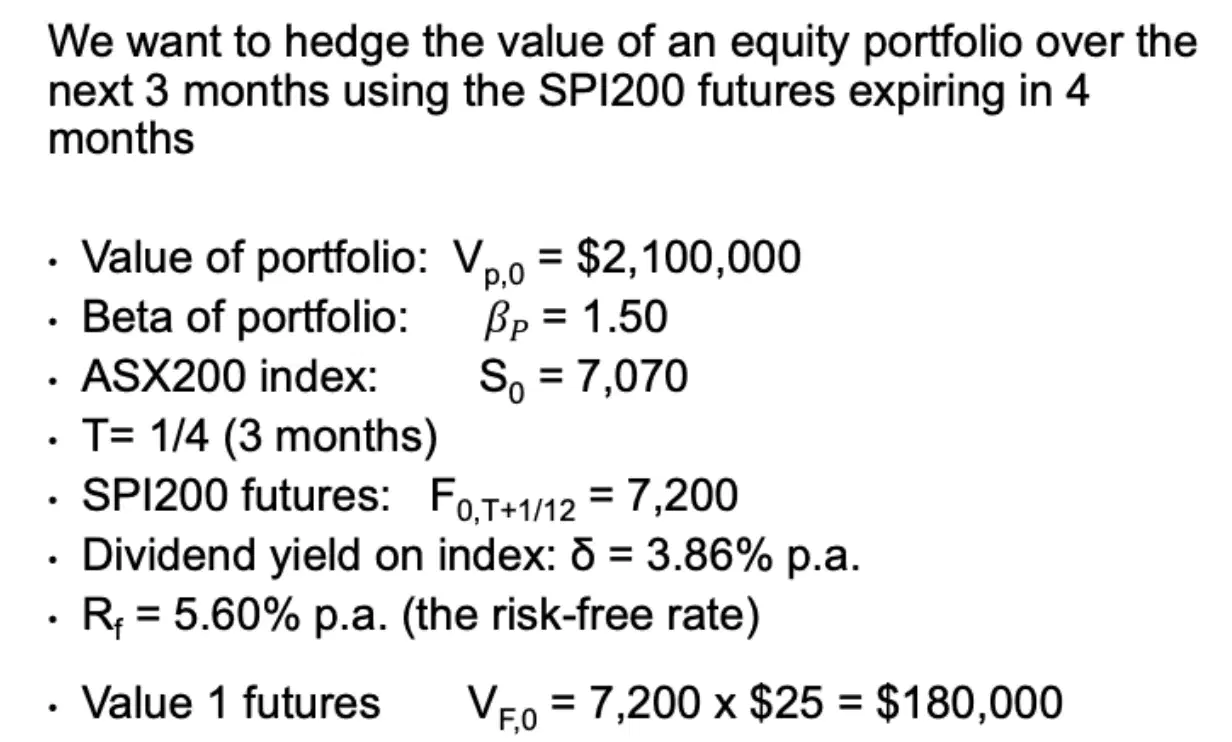
What is the result of the hedge in 3 months if ST = 7,400
and FT,T+1/12 = 7,509
$3,240,000
-$139,050
-$3,379,050
$180,000
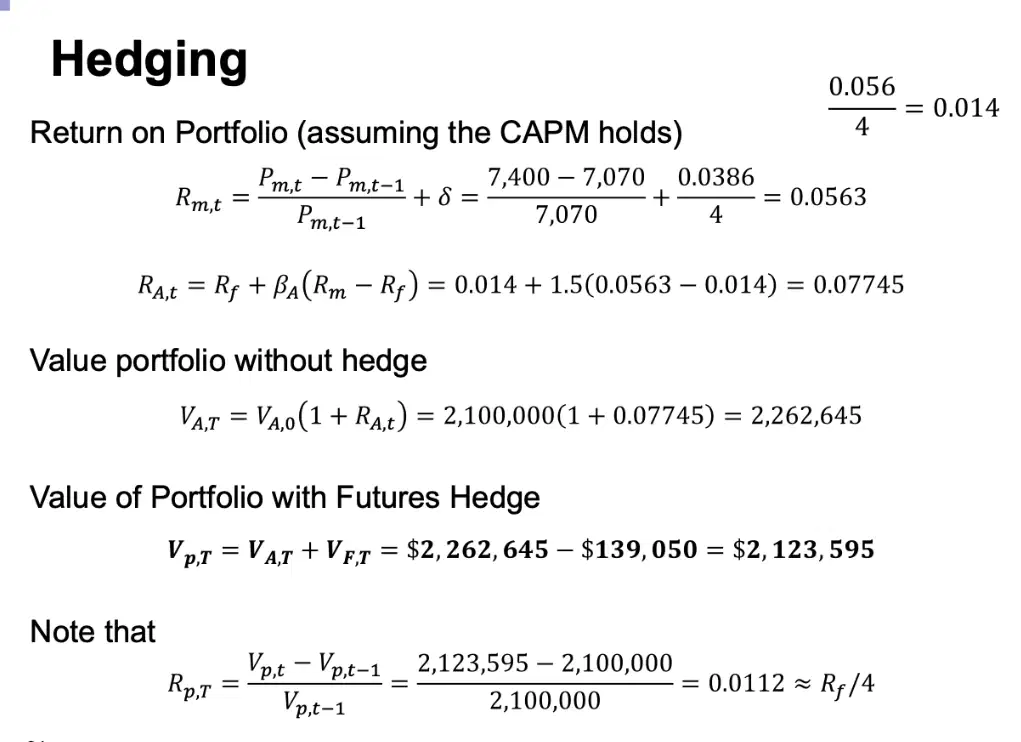
Proving the purpose of hedging. (4 months)
(a)
The beta of an ASX SPI200 futures contract is assumed to be equal to 1 and betas are linearly additive. If I have a portfolio beta of 1.5, why will the purchase of ASX SPI200 futures increase my portfolio beta above 1.5 when the two exposures being combined together have betas of 1 and 1.5?
(a)
$100 invested for 2 years at the continuously
compounded rate of 8% p.a. will be worth in year 2? and its present value.
117.35
100
66.4
152
Are forward and futures prices the same?
(a)
Which is more attractive between forward and future prices?
r constant -> forwards price = futures price
Corr(Futures Return, Interest Rate)>0 -> (futures price > forwards price) -> choose forwards
Corr < 0 -> (futures price < forwards price) -> choose forwards
Corr > 0 -> (futures price > forwards price) -> choose futures

101.058
100
2.5

Provide a numerical example of index arbitrage using futures contracts.
(a)

Compare and contrast the duration targeting formula and the beta targeting formula.
(a)
Why might a hedge based on duration targeting not work?
(a)
A stock index currently stands at 350. The risk-free interest rate is 8% p.a. (with continuous compounding) and the dividend yield on the index is 4% p.a. What should the futures price for a four- month contract be?
354.70
2714.3
1244
14234
It is 9 January 2023. The yield on a Treasury bond with a 12% coupon that matures in 12 October 2030 is quoted as 5.04%. Assume a face value of $100,000. What is the cash price? (Hint: There are 93 days until the next coupon payment on 12 April 2023 which will occur 182 days after the last payment).
$147,141
$144,741
A 90-day bank accepted bill futures price changes from 96.76 to 96.82. What is the gain or loss to an investor who is long two contracts? (assumed FV = 100,000,000)
$492
$291.23
A one-year long forward contract on a non-dividend-paying stock is entered into when the stock price is AUD 40 and the risk-free rate of interest is 10% pa with continuous compounding. (a) What are the (theoretical) forward price and the initial value of the contract? (b) Six months later, the price of the stock is AUD 45 and the risk-free interest rate is still 10%. What are the forward price and value of the forward contract?
F0,T = 44.21
f = 0
F0,T = 47.31
f = 2.95
F0,T = 44.21
f = 1105,1
F0,T = 47.31
f = 1182.07
Suppose that the risk free rate is 10% pa with continuous compounding and that the dividend yield on the stocks underlying an index is 4% pa. The index is standing at 400 and the futures price for a contract deliverable in four months is 405. What arbitrage opportunities does this create?
405
408.08
403
On 1 August, a portfolio manager has a bond portfolio worth $10 million. The duration of the portfolio is 7.1 years. The December 10-year Treasury bond futures price is currently 95.12, its value is $108,779, and its duration 7.8 years. How should the portfolio manager immunise the portfolio against changes in the interest rates (i.e. – remove market risk) over the next two months? (means Dt=0)
short 83 contracts
long 83 contracts
What is the discount rate Rt ?
(a)
Bond: FV = 100, T = 2, CS/A = 6%, where S/A stands for semi-annual
Zero-Coupon Rates: z0,0.5 = 5.0%, z0,1 = 5.8%, z0,1.5 = 6.4% and z0,2 = 6.8%. Calculate the bond price? yield?
6.672%
98.596
-1.27%
100
FRA to receive RK = 4%, L = $100m, T1 = 3 and T2 = 3.25. Note that the future period is 3 months, 3.25 – 3.00 = 0.25. If at T1: RM = 4.50%,
123,609.39
-123,609.39
What is motivation on transforming asset/liabilities?
View on future rates comparative advantage,
part of the risk management strategy
comparative advantage
Consider an Australian dollar FRA where a company will receive a rate of 6% with annual
compounding, on a principal of $100 million over 1 year. With this information and following the
Australian FRA conventions,
a. Explain whether an investor seeking to hedge a 1 year future investment would enter into the
‘receive’ or ‘pay’ side of the FRA.
pay
receive
A bank quotes an interest rate of 14% per annum with quarterly compounding. What is the equivalent rate with continuous compounding and annual compounding?
0.1475
0.1376
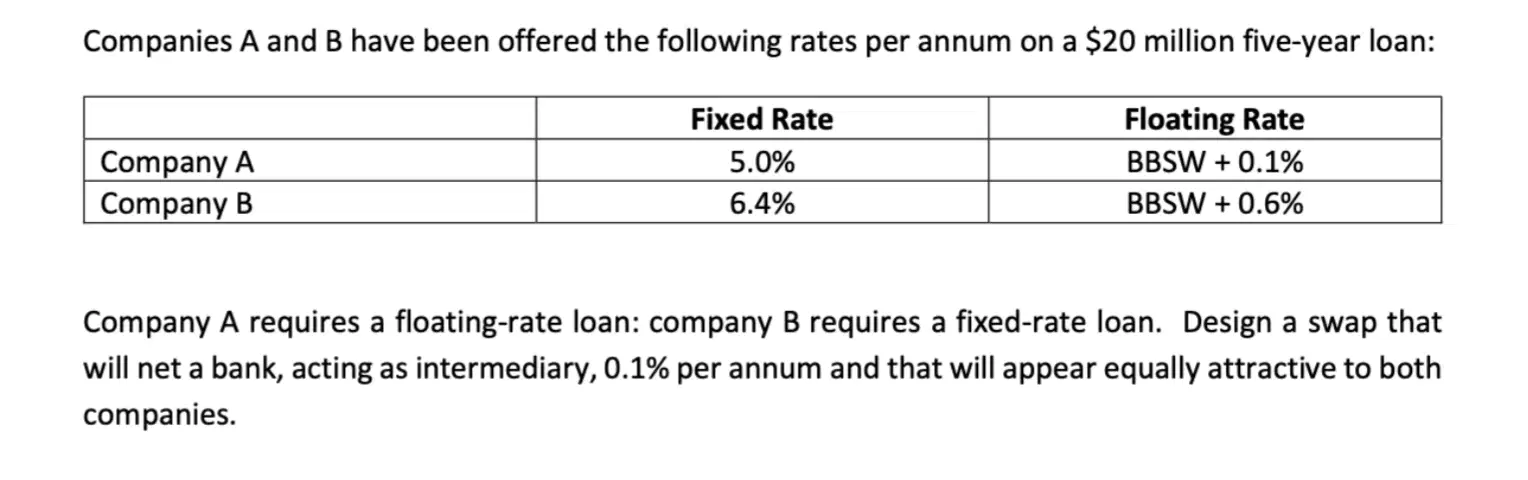
5.3%
5.4%
A $100 million interest rate swap has a remaining life of 10 months. Under the terms of the swap, the
six-month BBSW is exchanged for 7% per annum fixed (compounding semi-annually). The average of
the bid-offer rate being exchanged for six-month BBSW in swaps of all maturities is currently 5% per
annum with continuous compounding. The six-month BBSW rate was 4.6% per annum (semi-annual)
two months ago. What is the current value of the swap to the party paying floating? What is the value
to the party paying fixed?
100.609
102.718
2.109
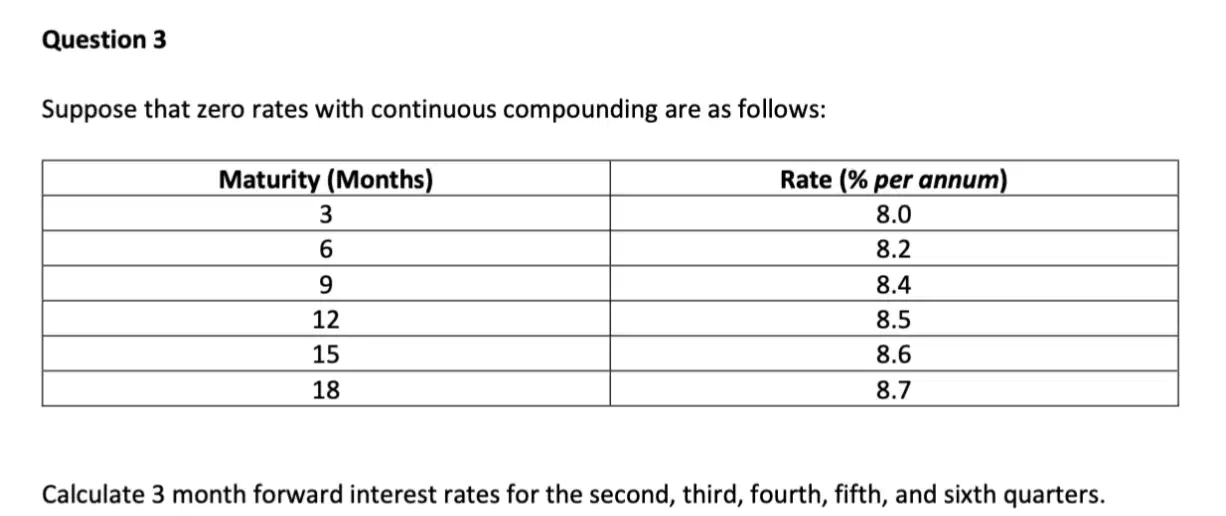
Second quarter (months 3–6). Third quarter (months 6–9)....
Qtr 3 = 8.8%
Qtr 2 = 8.4%
Qtr4 = 8.8%
Qtr5 = 9.0%
Qtr 6 = 9.2%
What is interest rate swaps?
(a)
What is an option?
(a)
An investor buys a European put on a BHP share for $3. The stock price is $42 and the strike price is $40. Under what circumstances does the investor make a profit? Under what circumstances will the option be exercised? Draw a diagram showing the variation of the investor’s profit with the stock price at maturity of the option
The option will be exercised if the stock price is less than $40 at the maturity of the option.
the price of the stock on the expiration date is less than $37
You have just shorted 100 CBA stocks at $75.52 and want to hedge your downside risk. How can you use an options contract to hedge your downside risk?
buy put option
buy call option
Explain why an American option is always worth at least as much as a European option on the same asset with the same strike price and exercise date
(a)
How are American options priced in the binomial tree?
(a)
A stock is currently trading at $40. It is known that at the end of one month it will be either $42 or
$38. The risk-free rate is 8% per annum continuously compounded. Use this replicating portfolio to
determine the value of a one-month European call option with a strike price of $39 (ie - use the
option and the underlying stock to construct a replicating portfolio for a risk free bond)
0.75
1.69
A stock is currently trading at $100. It is known that over each of the next two six-month periods, it will either go up by 10% or down by 10%. The risk-free rate is 8% per annum continuously compounded. What is the value of a one-year European call option with a strike price of $100?
14.21
0.7041
9.61
A stock currently trades for $50 and has an annual return volatility of 20%. Using a two-step binomial
lattice and a risk-free rate of 5.00% p.a., price a six-month American call that has an exercise price of $50
5.88
3.12
0
What is Black-Scholes-Merton Model
Alternative (and the first) model for pricing options on a non-dividend paying stock.
Offers a closed-form solution to price European
options
Can be altered to handle various other settings
What is Black-Scholes-Merton Model
(a)
how many assumption for BSM model?
2
4
5
7
What are Black Scholes Merton 's assumption?
(a)
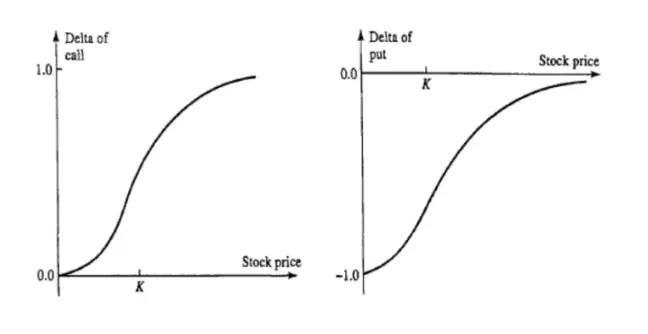
What does the option's delta measure?
(a)
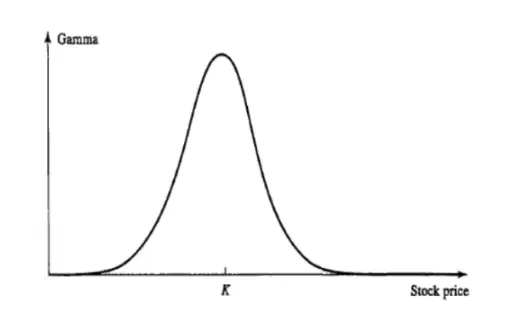
What does Gamma (Γ) measure?
(a)
What is Theta (Θ) tell you?
(a)
What does Vega (ʋ) tell you?
(a)
What does Rho measure?
(a)
Compare BSM Model and Binomial Option Pricing Model
(a)
You are interested in writing a European put option on a stock that is currently trading on $77.83, a strike price of $75, a risk-free rate of 2.647% p.a. (continuously compounded) and 3 months to maturity. The annual volatility (standard deviation) on the stock is 13.5% pa. Find the fair value for this option using the Black-Scholes-Merton model
f = 1.05
f =0.97
p = 0.86
You are interested in writing a European put option on a stock that is currently trading on $77.83, a strike price of $75, a risk-free rate of 2.647% p.a. (continuously compounded) and 3 months to maturity. The annual volatility (standard deviation) on the stock is 13.5% pa. Find the fair value for this option using A one-step binomial tree
f = 1.05
f =0.97
p = 0.86
You are interested in writing a European put option on a stock that is currently trading on $77.83, a strike price of $75, a risk-free rate of 2.647% p.a. (continuously compounded) and 3 months to maturity. The annual volatility (standard deviation) on the stock is 13.5% pa. Find the fair value for this option using two-step binomial tree
f = 1.05
f =0.97
p = 0.86
Calculate the price of a three-month European put option on a non-dividend paying stock with a strike price of $50 when the current stock price is $50, the risk free rate is 10% pa and the volatility (standard deviation of returns) is 30% pa
𝟐. 𝟑𝟕
𝟎. 𝟎𝟗
Calculate the price of a three-month European put option on a dividend of $1.50 paying stock with a strike price of $50 when the current stock price is $50, the risk free rate is 10% pa and the volatility (standard deviation of returns) is 30% pa
2.37
3.03
What is the price of a of a European call option on a non-dividend paying stock when the stock price
is $52, strike price of $50, the risk free rate is 12% pa, the volatility is 30%pa and the time to maturity
is three months?
5.06
0.5365
0.3865
What does it mean to assert that the delta of a call option is 0.7?
(a)
How can a short position in 1000 call options be made delta neutral (Delta =0) when the delta of each option is 0.7?
Buy 700 stocks
Sell 700 stocks
Calculate the delta of an at-the-money six-month European call option on a non-dividend paying
stock when the risk-free rate is 10%p.a. and the stock volatility is 25% p.a. (Delta = N(d1))
0.64
0.35
How to Bull Spread using calls? (market up)
Buying a call with K1
Selling a call with K2 (K2>K1) (C1>C2)
Selling a put with K2 (K2>K1)(P2>C1)
How to Bull Spread using puts? (market up)
Buying a Put with K1
Selling a Put with K2 (K2>K1) (p1<p2)
Selling a call with K2 (K2>K1) (p1<c2)
How to Bear Spread using puts (market down)
Buying a Put with K2 (K2>K1)
Selling a Put with K1 (p1<p2)
Buying a call with K2 (K2>K1)
How to use bear spread using calls? (market down)
Buying a Call with K2 (k2>K1)
Selling a Call with K1 (c1>c2)
Selling a Put with K1
How to guarantee loss if you want to long an asset?
Use Long collar
Use Bear spread
Use Bull spread
How to long collars?
Buy a put with strike K1 = F
Long an asset
Sell a call with strike K2 = C
Sell an asset
If you want to sell an asset with higher cap (C) while
removing the floor (F) after a certain point (D), what strategy will you use?
Seagull Strategy
Long Collars
Bear Spread using puts
Bull Spread using puts
how to apply seagull strategy?
Long the underlying asset
Buy a put with strike K2 = F
Sell a call with strike K3 = C
Sell a put with strike K1 = D
What is (long) Straddle (V) ?
Buying a Call with K
Buying a Put with K
Selling a Put with K
What is (long) butterfly spread (-^-) ?
Buying a Call with K1
Buying a Call with K3
Selling two Calls with K2
Selling a Put with K
What is (long) Strip (V phần < K lãi thấp hơn) ?
Buying two Call with K
Buying a Put with K
Selling two Put with K
What is (long) Strangle (siết cổ) ?
Buying a Call with K1
Buying a Put with K2
Buying a Put with K1
What is (long) Strip (trượt ngã chổng chân lên trời) ?
Buying a Call with K
Buying two Put with K
Buying a Put with K
What is Calendar Spread using calls (meaning buy/sell call at different maturity)? Draw diagram
Selling a Call with K and maturity T1
Buying a Call with K and maturity T2
Selling a Call with K and maturity T2
Profit/loss when short-term option expires –longer-term option is sold
What is Calendar Spread using put (meaning buy/sell put at different maturity)? Draw diagram
Selling a Put with K and maturity T1
Buying a Put with K and maturity T2
Selling a Put with K and maturity T2
Profit/loss when short-term option expires –longer-term option is sold
You own a stock. For values of the stock higher than $100 you would like to get three times the difference between the value of the stock and $100. Which options do you have to buy/sell in order to get this payoff?
Long share + 2 long calls
Long share + Long call + short put
A stock is currently trading on $77.83. There exists call and put options with a strike price of $75 and
3 months to maturity. The risk-free rate is 2.647% p.a. (continuously compounded). The annual
volatility (standard deviation) on the stock is 13.5% pa. Confirm that put-call parity holds for the
binomial option pricing model with a two-step binomial tree (put price = 0.97) (Do two methods to prove that they have same c)
c = 4.29
c=4.28
The price of a non-dividend paying stock is $19 and the price of a three-month European call option on the sock with a strike price of $20 is $1. The risk free rate is 4%pa. What should be the price of a three month European put option with a strike price of $20?
1.80
1
Explain two ways in which a bear spread can be created.
short put with K1 and long put with K2
long a call at K2 and shot a call at K1
short put with K2 and long put with K1
long a call at K1 and shot a call at K2
Call options on a stock are available with strike prices $15, $17.5, and $20, all with three months to maturity. Their prices are $4, $2, and $0.5 respectively. Show how to create a butterfly spread using these options. Construct a table showing how the payoff of the spread varies with the stock price. Choose initial investment?
0.5
2.5
4
What is the difference between a straddle and a strangle?
A straddle involves buying a call and a put with the same strike price and expiration
a strangle involves buying a call and a put with different strike prices but the same expiration
Straddle = higher cost, profits if the price moves a lot in either direction
Strangle = cheaper, but needs a bigger move to be profitable
A one-month European put option on a non-dividend paying stock is selling for $2.50. The strike price is $50. The stock price is $47 and the risk-free rate is 6% pa. What opportunities are there for arbitrage?
Borrow $49.50 at the risk-free rate (6% for one month).
Buy the stock at $47.
Buy the European put for $2.50.
If stock > $50 -> Profit ≥ $0.25; If stock < $50 -> Profit = $0.25 cuz c is negative -> impossible
What is meant by implied volatility? How would you calculate the volatility implied by a European put option price?
(a)
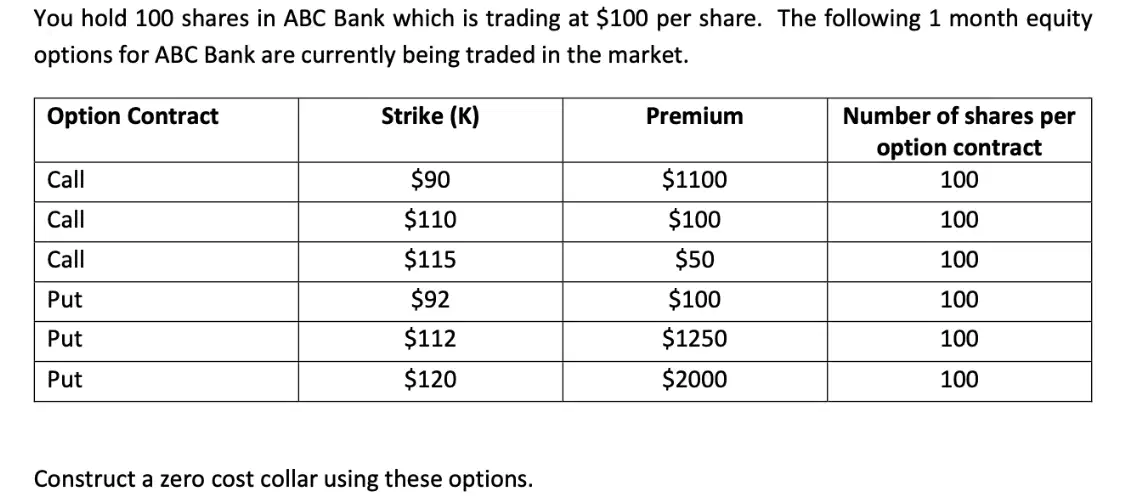
The goal is for the premium received from the call to equal the premium paid for the put, so net cost = $0.
Put = $92, Call = $115
Put = $92, Call = $110
Assuming that zero rates are as in question 3 above, what is the value of a FRA that enables the holder to earn 9.5% for a three-month period starting in one year on a principal of $1,000,000? The interest rate is expressed with quarterly compounding. T2 = 1.25, T1 = 1, R0,1.25 = 0.086
V0 =893.59
V0= 800
You want to hedge long-term fixed-price oil sales contracts using derivatives. What derivative did they use? What risk did it create?
Derivative used: Short-term futures contracts
- Risk created: Cash flow mismatch and liquidity risk due to rolling futures in a contango market
- Example: Metallgesellschaft
- Risk created: Interest rate risk and leverage amplification when rates rose
You want to gain large stock exposure without holding physical shares or disclosing your position. What derivative did they use? What risk did it create?
Derivative used: Total Return Swaps (TRS)
Risk created: Hidden leverage, counterparty risk, systemic losses
Example: Archegos Capital
Derivative used: Inverse floating rate notes and reverse repos
You want to earn more returns by exploiting the yield curve through borrowing short-term and investing long-term. What derivative did they use? What risk did it create?
Derivative used: Inverse floating rate notes and reverse repos
Risk created: Interest rate risk and leverage amplification when rates rose
Example: Orange County
Derivative used: Total Return Swaps (TRS)
You want to profit by selling insurance against credit default on AAA-rated products. What derivative did they use? What risk did it create?
Derivative used: Credit Default Swaps (CDS)
Risk created: Tail risk and massive exposure during systemic default
Example: Morgan Stanley (Hubler case)
Derivative used: Sold CDS on AAA CDO tranches while buying CDS on risky tranches
You want to reduce your funding cost when hedging risky mortgage bonds. What derivative did they use? What risk did it create?
Derivative used: Sold CDS on AAA CDO tranches while buying CDS on risky tranches
Risk created: Correlation risk, underestimation of joint defaults, and large unexpected losses
Example: Subprime Crisis (AIG, Lehman Brothers)
Derivative used: Credit Default Swaps (CDS)
You want to manage financial risk using derivatives but let emotions and mental biases influence your decisions. What derivative did they misuse? What risk did it create?
Derivatives used: Various (Futures, Swaps, CDS)
Risk created: Overconfidence, loss aversion, anchoring - led to ignoring red flags and oversizing position
Example: Present in multiple cases, especially Archegos and Orange County
Derivative used: Sold CDS on AAA CDO tranches while buying CDS on risky tranches

