
 Worksheets
Chapter 9 Test
Total questions: 47
Worksheet time: 24mins
Name
Class
Date
1.
In a chemical reaction, the products are found on the left side of the arrow.
a)
True
b)
False
2.
All chemical reactions release energy, although some release it in the form of light and others in the form of heat.
a)
True
b)
False
3.
The coefficient of each element should be the same on both sides of the equation.
a)
True
b)
False
4.
In an aqueous solution, the solute is the part of the solution that is being dissolved in water.
a)
True
b)
False
5.
A precipitate forms when two aqueous solutions react to form a solid product .
a)
True
b)
False
6.
The ions that can be observed forming a precipitate are known as spectator ions.
a)
True
b)
False
7.
Some single replacement reactions are not possible depending on the reactivity (activity series) of the different elements participating in the reaction.
a)
True
b)
False
8.
An ionic equation that includes only the particles that participate in the reaction is called a complete ionic equation.
a)
True
b)
False
9.
Word equations use words to indicate reactants and products of chemical reactions.
a)
True
b)
False
10.

In this equation, which are the reactant(s)?
a)
Option 1
b)
Option 2
c)
Option 3
d)
Option 4
11.

In this equation, which are the product (s)?
a)
Option 1
b)
Option 2
c)
Option 3
d)
Option 4
12.

Which is the name of the kind of solid substance formed in this figure?
a)
aqueous
b)
precipitate
c)
coordinate complex
d)
synthesis
13.

Which type of chemical reaction is shown?
a)
double replacement
b)
combustion
c)
synthesis
d)
decomposition
14.
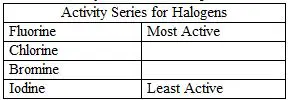
Use the activity series shown to predict which reaction will occur.
a)
Option 1
b)
Option 2
c)
Option 3
d)
Option 4
15.

Which are the spectator ions in the reaction shown?
a)
Option 1
b)
Option 2
c)
Option 3
d)
Option 4
16.
In a chemical equation, (aq) after one of the substances means that it is which of these?
a)
a solid formed from two ionic substances
b)
released as gas
c)
water solution
d)
produced from nothing
17.

How many total atoms are in
a)
21
b)
10
c)
24
d)
18
18.

How many total atoms are in
a)
20
b)
52
c)
36
d)
40
19.
Which type of reaction can be recognized by the general pattern? A + BX -> AX + B
a)
combustion
b)
synthesis
c)
single replacement
d)
decomposition
20.
Which type of reaction involves one element and one compound reacting and forming one element and one compound?
a)
decomposition
b)
double replacement
c)
single replacement
d)
synthesis
21.
Which type of reaction takes place in the presence of oxygen and produces carbon dioxide and water?
a)
decomposition
b)
double replacement
c)
synthesis
d)
combustion
22.

Which type of reaction is
a)
synthesis
b)
decomposition
c)
single replacement
d)
combustion
23.

Which type of reaction is
a)
synthesis
b)
double replacement
c)
single replacement
d)
combustion
24.
Which types of reactions are essentially opposites of one another?
a)
combustion and synthesis
b)
single replacement and double replacement
c)
synthesis and single replacement
d)
synthesis and decomposition
25.

What are the correct coefficients when this equation is balanced?
a)
1, 2, 10
b)
4, 6, 1
c)
4, 3, 1
d)
10, 5, 1
26.

Which are the product(s) of this reaction?
a)
Option 1
b)
Option 2
c)
Option 3
d)
Option 4
27.

What are the correct coefficients when this equation is balanced?
a)
1, 1, 1
b)
1, 2, 1
c)
2, 1, 2
d)
2, 1, 1
28.

What are the correct coefficients when this chemical equation is balanced?
a)
4, 2, 7
b)
1, 1, 1
c)
2, 5, 4
d)
2, 5, 2
29.

Which type of chemical reaction would this be classified as:
a)
synthesis
b)
double replacement
c)
combustion
d)
decomposition
30.

Identify the type of reaction shown by this chemical equation:
a)
single replacement
b)
synthesis
c)
double replacement
d)
decomposition
31.

Which type of chemical reaction is this an example of?
a)
synthesis
b)
double replacement
c)
single replacement
d)
combustion
32.

Identify the type of chemical reaction demonstrated by this equation:
a)
decomposition
b)
synthesis
c)
combustion
d)
single replacement
33.
Which is NOT a sign that a double displacement reaction has occurred?
a)
gas may be formed
b)
water may be produced
c)
a precipitate is formed
d)
the coefficients are equal
34.
What is the probable product of a double-replacement reaction?
a)
A new compound and the replaced metal
b)
A new compound and the replaced nonmetal
c)
Two different compounds
d)
A single compound
35.
What term is given to the ions that do not participate in the chemical reaction?
a)
Inactive ions
b)
Spectator ions
c)
Sideline ions
d)
Lazy ions
36.
What does (s) mean when written after a compound in a chemical equation.
a)
solid
b)
soft
c)
liquid
d)
gas
e)
slippery
37.
What does (aq) mean when written after a compound in a chemical equation.
a)
aqueous
b)
liquid
c)
gas
d)
Aquonis College
e)
aquadecent
38.
What does (l) mean when written after a compound in a chemical equation.
a)
library
b)
solid
c)
liquid
d)
gas
e)
loquacious
39.
Describes the number of atoms in a compound of each element.
a)
coefficient
b)
subscript
c)
superscript
d)
SI unit
40.
Describes the number of molecules in a compound and is used to balance a chemical reaction.
a)
coefficient
b)
superscript
c)
subscript
d)
SI unit
41.
What is the net ionic equation between an acid and a base? Such as HCl + NaOH
a)
Option 1
b)
Option 2
c)
Option 3
d)
Option 4
42.

Select all of the spectator ions from the reaction.
a)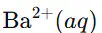
Option 1
b)
Option 2
c)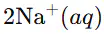
Option 3
d)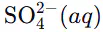
Option 4
43.
What is the net ionic equation for the precipitation of Fe(OH)₃ from FeCl₃ (aq) and NaOH (aq)?
a)
Fe³⁺ (aq) + 3OH⁻ (aq) → Fe(OH)₃ (s)
b)
FeCl₃ (aq) + NaOH (aq) → Fe(OH)₃ (s) + NaCl (aq)
c)
Fe³⁺ (aq) + Na⁺ (aq) → FeNa₃ (s)
d)
3Cl⁻ (aq) + OH⁻ (aq) → ClOH₃ (aq)
44.
Which of the following is NOT an essential part of a net ionic equation?
a)
States of matter (s, l, g, aq)
b)
Charges on ions
c)
Spectator ions
d)
Balanced atoms and charges
45.

The following is an example of a...
a)
complete ionic equation
b)
net ionic equation
c)
balanced molecular formula
d)
spectator equation
46.
What is the net ionic equation for the reaction of Pb(NO₃)₂ (aq) and KI (aq) that creates solid lead (II) iodide
a)
Pb²⁺ (aq) + 2I⁻ (aq) → PbI₂ (s)
b)
Pb(NO₃)₂ (aq) + 2KI (aq) → PbI₂ (s) + 2KNO₃ (aq)
c)
Pb²⁺ (aq) + NO₃⁻ (aq) → PbNO₃ (s)
d)
K⁺ (aq) + I⁻ (aq) → KI (aq)
47.
Which part(s) of a molecular formula do you break apart to write the complete ionic equation?
a)
solid
b)
liquid
c)
gas
d)
aqueous
100 %

