
NEW
Font size
 Worksheets
Oral Language Development Quiz
Total questions: 72
Worksheet time: 36mins
What factors influence oral language development according to the theoretical background?
Biological, social, and environmental factors
Economic, political, and technological factors
Historical, cultural, and geographical factors
Psychological, philosophical, and ethical factors
Which theory supports the understanding of how verbal and nonverbal systems enhance language comprehension?
Dual Coding Theory
Social Learning Theory
Cognitive Dissonance Theory
Behavioral Theory
How do environmental, cultural, and linguistic factors affect oral language development?
They shape the developmental trajectory and require inclusive approaches
They have no significant impact on language development
They only influence written language skills
They are irrelevant to language comprehension
Which of the following is a component of language that focuses on word structure?
Phonology
Morphology
Syntax
Pragmatics
What does syntax refer to in the components of language?
Sounds
Word structure
Sentence structure
Social language use
Which component of language is concerned with social language use?
Phonology
Morphology
Semantics
Pragmatics
What is the role of semantics in language?
Sounds
Meanings
Word structure
Sentence structure
What does phonology examine in a language?
The smallest units of meaning
The sound system
Sentence structure
Word origins
Which of the following is an example of a morpheme?
/c/
/a/
"re-"
/t/
How is the word "cat" phonetically composed in English?
/k/, /a/, /t/
/c/, /a/, /t/
/k/, /e/, /t/
/c/, /e/, /t/
What is the primary focus of morphology in language studies?
Sound patterns
Sentence structure
Smallest units of meaning
Word pronunciation
What does morphology help students understand?
The structure of sentences
The meanings of words
Variations in word forms
Social aspects of language use
Which of the following is an example of syntax in English?
Using "blue" to describe emotion
Placing adjectives before nouns
Adding "ing" to a verb
Using formal language in a classroom
What does semantics deal with?
Sentence structure
Word meanings and relationships
Social language use
Phonological rules
How does pragmatics influence language use?
By altering word forms
By structuring sentences
By adapting communication to context
By defining word meanings
What is the role of oral language in literacy learning?
It is unrelated to literacy
It only supports vocabulary development
It provides foundational skills for reading and writing
It focuses solely on grammar
According to ASHA (2022), what risk do children with underdeveloped oral language face?
Higher risk for reading difficulties
Increased mathematical challenges
Difficulty in physical education
Problems with social interactions
What is a key predictor of early reading success mentioned in the text?
Mathematical skills
Phonological awareness
Physical coordination
Artistic ability
Why is oral language proficiency critical for students, according to the text?
It helps in physical development
It influences the ability to infer meaning and integrate new information
It enhances musical skills
It improves athletic performance
What role does oral language play in the foundation of reading and writing?
It is unrelated to reading and writing
It is the basis for decoding, fluency, vocabulary, and comprehension
It only helps in vocabulary development
It is only important for writing skills
How can teachers help close equity gaps in language exposure?
By focusing solely on written language
By emphasizing oral language to create rich, language-focused environments
By ignoring language disparities
By teaching only advanced students
What are the key principles of effective oral language instruction?
Explicit, intentional, and interactive
Passive, indirect, and observational
Implicit, random, and solitary
Silent, unplanned, and individual
Which approach is most effective for oral language instruction?
Multimodal approaches using listening, speaking, visual aids, and kinesthetic activities
Single-mode approaches focusing only on reading
Visual-only approaches without interaction
Kinesthetic-only approaches without listening
What does the "Gradual Release of Responsibility" model include?
Teacher modeling, guided practice, and independent practice
Student-led discussions, peer review, and group projects
Independent study, silent reading, and self-assessment
Lecture, note-taking, and memorization
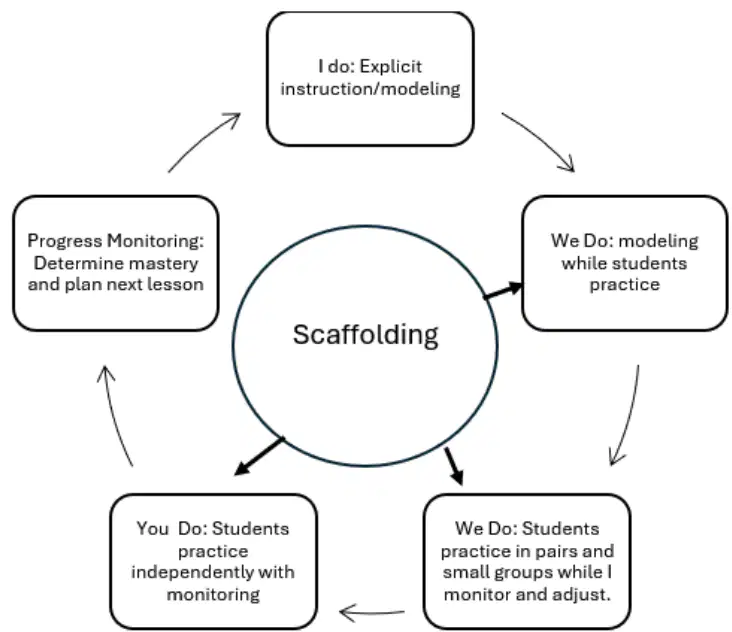
What is the purpose of the "I Do" stage in the scaffolding process?
Students practice independently
Teacher explicitly demonstrates tasks
Students practice in pairs
Teacher monitors progress
During the "We Do" stage, what is the primary activity students engage in?
Observing the teacher
Practicing independently
Engaging in activities that mimic modeled behavior
Receiving corrective feedback
What is the role of immediate corrective feedback in the scaffolding process?
To ensure students develop accurate oral language skills
To allow students to practice independently
To demonstrate tasks explicitly
To monitor student progress
What does the word "enormous" mean as explained in the learning material?
Very small
Very large
Very fast
Very slow
In the Four-Part Processing Model for Word Recognition, what plays a foundational role in each component?
Written language
Oral language
Visual aids
Mathematical skills

What is the primary function of the Context Processor in the Four-Part Processing Model for Word Recognition?
To interpret the meaning of words
To process the sounds of language
To recognize written language patterns
To provide contextual understanding of words
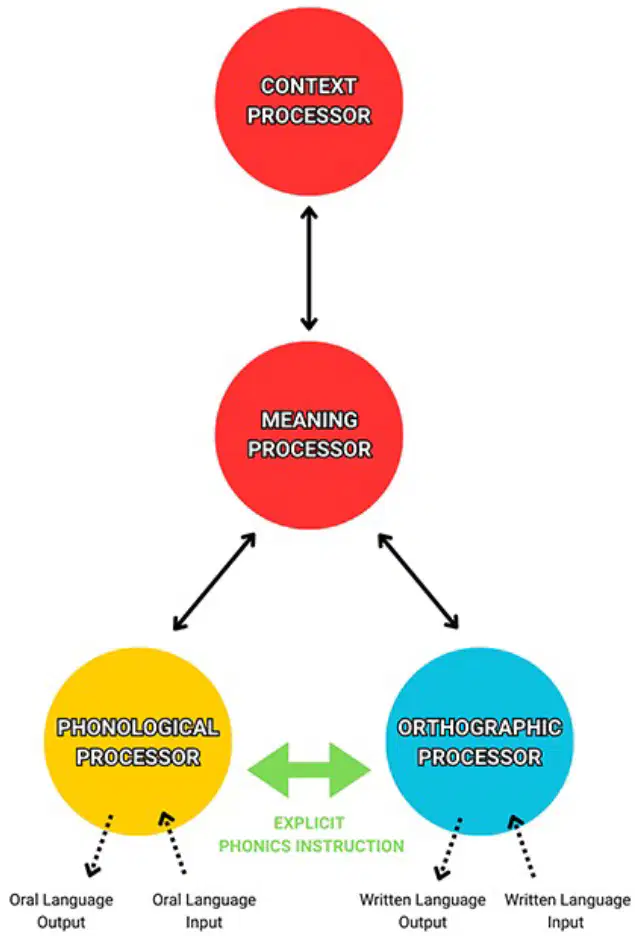
Which processor in the Four-Part Processing Model is directly involved in phonics instruction?
Context Processor
Meaning Processor
Phonological Processor
Orthographic Processor
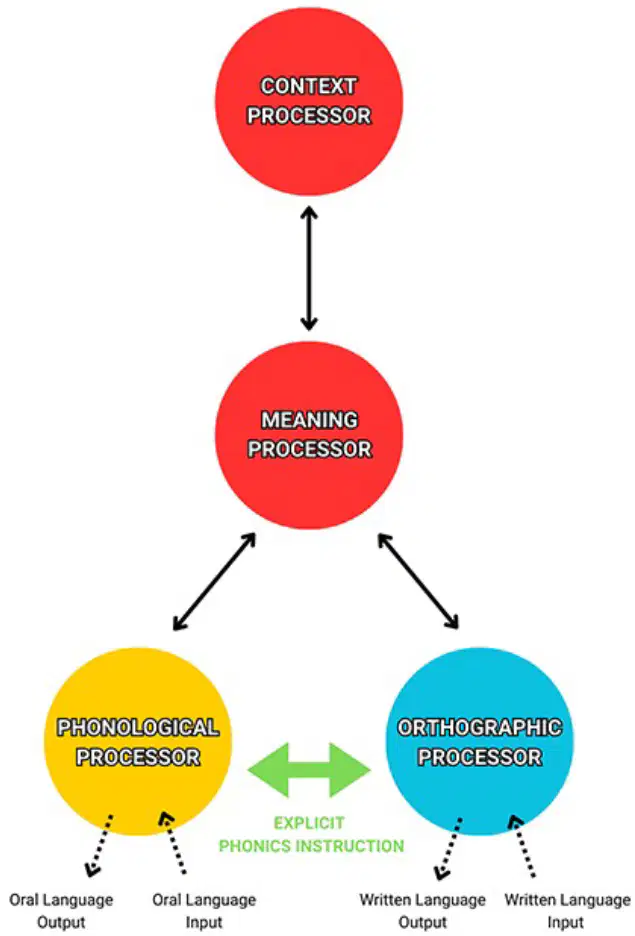
In the Four-Part Processing Model, which processor is responsible for handling written language input and output?
Context Processor
Meaning Processor
Phonological Processor
Orthographic Processor
What is the role of oral language in the context processor?
It helps in decoding sounds and mapping them to symbols.
It supports understanding of word meanings and larger discourse.
It deals with the visual representation of words.
It helps in recognizing and manipulating sounds in words.
How does oral language support the meaning processor?
By enabling comprehension of word meanings.
By exposing students to a variety of words and concepts.
By decoding sounds and mapping them to symbols.
By dealing with the visual representation of words.
Which processor relies on oral language skills to decode sounds?
Context Processor
Meaning Processor
Phonological Processor
Orthographic Processor
What is the role of oral language in the orthographic processor?
It helps in decoding sounds and mapping them to symbols.
It supports understanding of word meanings and larger discourse.
It works in tandem with oral language for visual representation.
It helps readers infer meaning based on text clues.
What is one of the roles of oral language in the Four-Part Model?
It provides the foundation for mathematical processing.
It supports the orthographic processor by linking spoken language to written forms.
It enhances the ability to recognize colors.
It helps in memorizing historical dates.
According to the text, what does oral language help learners associate?
Numbers with their corresponding values.
Graphemes with their corresponding phonemes.
Colors with their corresponding emotions.
Shapes with their corresponding names.
What is the primary focus of Scarborough's Reading Rope model?
The mechanics of writing.
Oral language development.
The interplay of language comprehension and word recognition.
The history of language development.
How does oral language development impact the Four-Part Model?
It is an isolated component with no impact.
It makes the model less efficient.
It is integral to processing reading and making meaning from text.
It only affects vocabulary skills.
What is the role of background knowledge in language comprehension?
It helps in decoding unfamiliar words.
It provides knowledge necessary to understand and make connections with new information.
It is used for understanding abstract ideas.
It involves understanding sentence structures.
Which component of language comprehension is critical for both oral language development and reading comprehension?
Background Knowledge
Verbal Reasoning
Vocabulary
Language Structures
How does verbal reasoning contribute to language comprehension?
By providing knowledge necessary to understand new information.
By helping in decoding unfamiliar words.
By developing skills such as making inferences and understanding abstract ideas.
By understanding and using sentence structures.
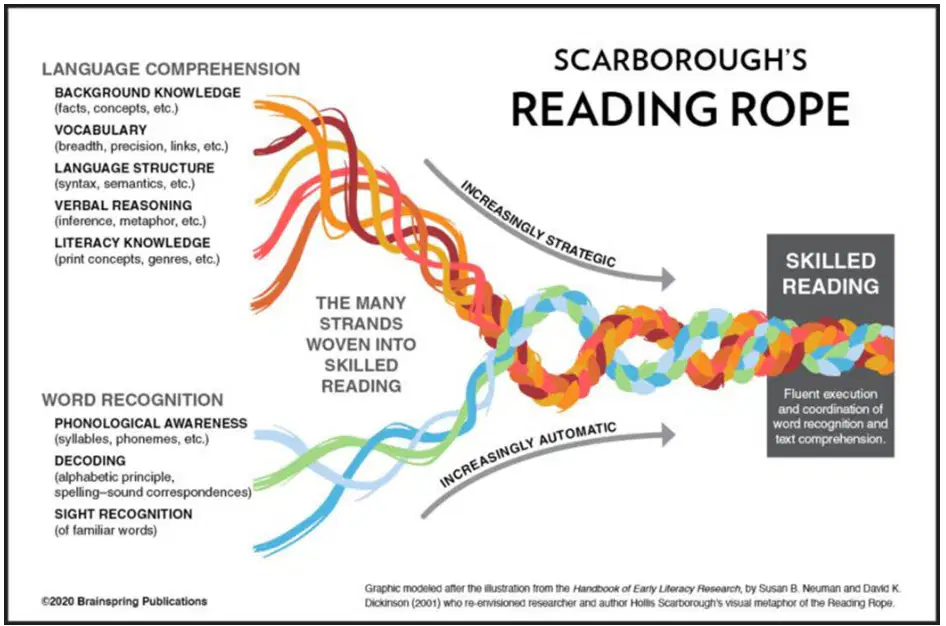
What does language structure proficiency include?
Understanding abstract ideas.
Using sentence structures and word meanings.
Making connections with new information.
Decoding unfamiliar words.
What is the role of literacy knowledge in language development?
It focuses solely on written language skills.
It involves exposure to oral language activities like dialogic reading.
It is unrelated to language functions in literacy contexts.
It only emphasizes grammar and syntax.
Which of the following is a component of phonological awareness?
Understanding grammar rules
Identifying and manipulating sounds in spoken language
Writing essays
Reading comprehension
How does oral language instruction aid in decoding?
By teaching complex sentence structures
By connecting sounds (phonemes) with their written counterparts (graphemes)
By focusing on silent reading
By emphasizing vocabulary memorization
What is the significance of oral language in Scarborough's Reading Rope?
It is not part of the Reading Rope.
It serves as the base for building language comprehension and phonological awareness.
It only focuses on vocabulary development.
It is only important for early childhood education.
What is one of the foundational skills necessary for word recognition and comprehension?
Phonological awareness
Mathematical skills
Historical knowledge
Artistic ability
Which instructional approach is recognized by the Kansas State Department of Education as effective for all students, including those with reading difficulties?
Structured Literacy (SL)
Creative Writing
Visual Arts
Physical Education
According to the National Reading Panel, what does rich oral language instruction support?
Reading comprehension and written expression
Mathematical problem-solving
Scientific experimentation
Historical analysis
What is one benefit of integrating oral language instruction into literacy lessons?
Strengthening foundational skills for reading fluency
Improving athletic performance
Enhancing musical talent
Developing culinary skills
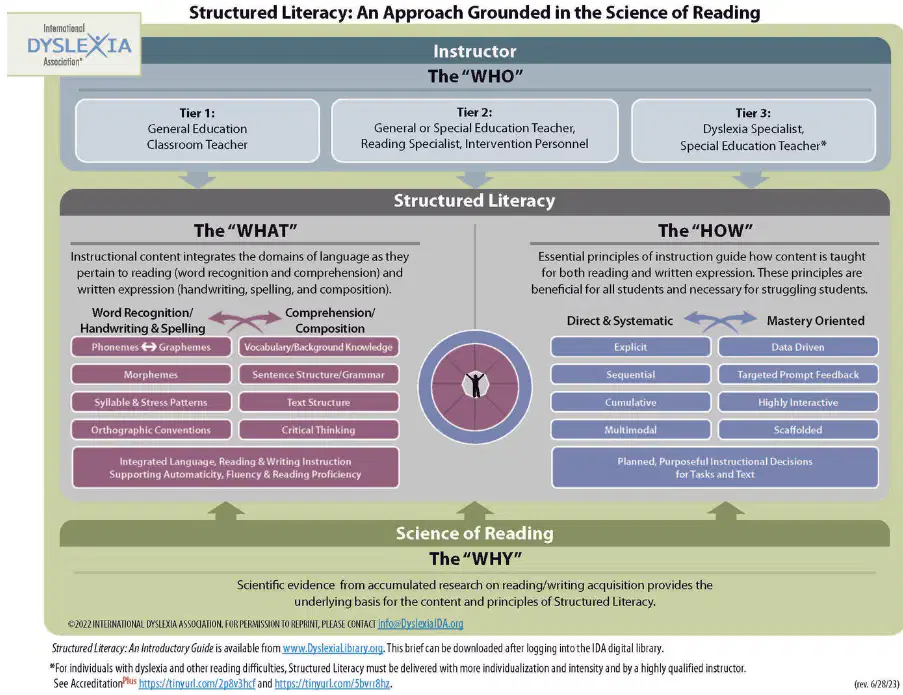
What is the primary focus of Structured Literacy according to the infographic?
To teach advanced literary analysis
To integrate domains of language for reading and writing
To focus solely on vocabulary development
To provide entertainment through reading
Who is included in Tier 3 of the instructors for Structured Literacy?
General Education Classroom Teacher
Reading Specialist
Dyslexia Specialist
Intervention Personnel
According to the Kansas State Department of Education, what is dyslexia characterized by?
Advanced reading skills
Poor spelling and decoding abilities
Excellent comprehension skills
Fast reading speed
What does the "HOW" section of Structured Literacy emphasize?
Randomized teaching methods
Direct and systematic instruction
Unstructured learning environments
Independent study
What are some key characteristics of dyslexia related to phonics?
Accurate and fluent word recognition
Excellent spelling skills
Strong phonemic awareness
Fast reading comprehension
Which of the following is a component of effective multisensory oral language instruction?
Using only visual aids
Engaging multiple senses
Focusing solely on auditory learning
Relying on written text
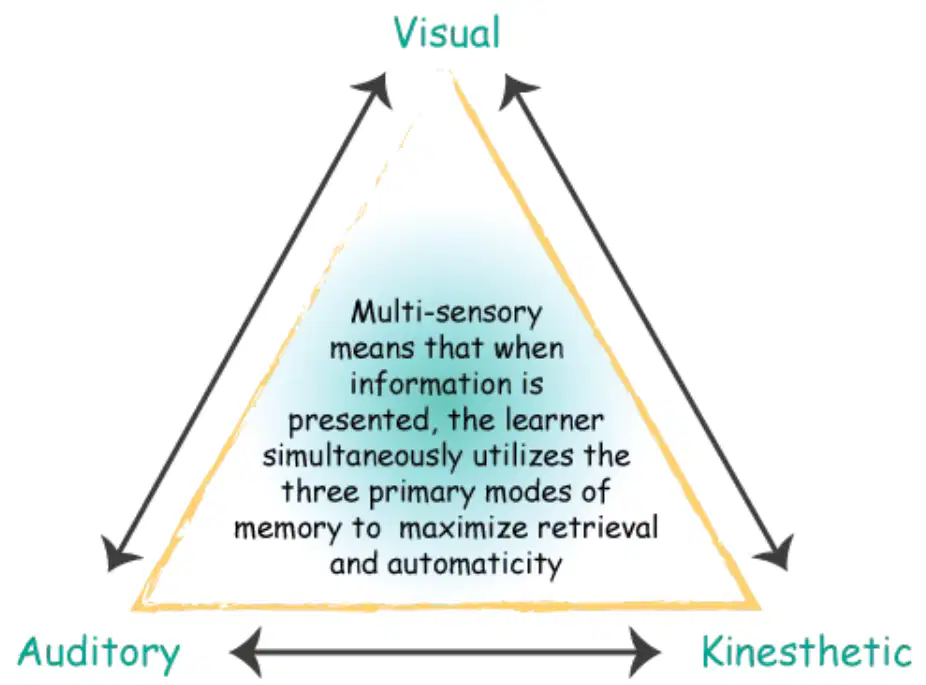
What are the three primary modes of memory utilized in multisensory learning?
Visual, Auditory, Kinesthetic
Visual, Tactile, Olfactory
Auditory, Tactile, Olfactory
Visual, Kinesthetic, Olfactory
Which of the following is an example of a visual instructional practice?
Listening to stories
Using picture cards
Engaging in conversations
Acting out vocabulary words
What is a kinesthetic-tactile activity that supports oral language learning?
Listening to stories
Using picture cards
Engaging in role-playing
Answering questions
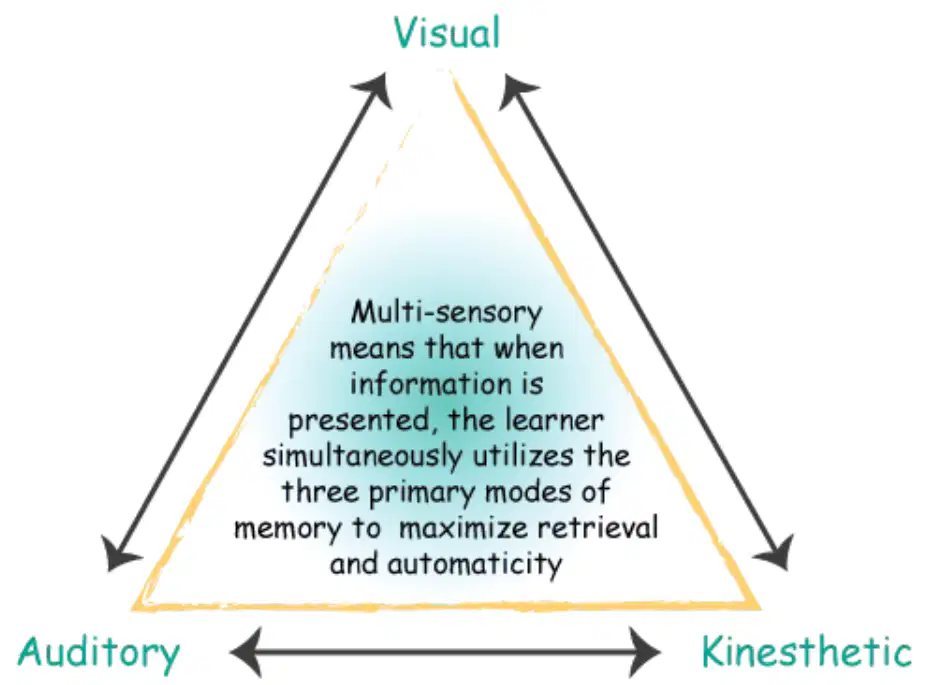
According to the diagram, what is the purpose of utilizing multisensory learning?
To increase the complexity of tasks
To maximize retrieval and automaticity
To focus on visual learning only
To reduce the use of auditory methods
What is expressive language primarily concerned with?
Understanding spoken language
Producing spoken language
Reading written language
Writing written language
Which of the following is an example of using expressive language?
Following directions
Answering comprehension questions
Using vocabulary words to make requests
Understanding vocabulary words
What does receptive language refer to?
Producing written language
Understanding spoken language
Creating complex sentences
Using past tense correctly
Which skill is NOT associated with receptive language?
Following multistep directions
Answering comprehension questions
Understanding vocabulary words
Using past tense to reflect past events
What is one approach mentioned for supporting the growth of receptive and expressive vocabularies?
Dialogic reading
Silent reading
Independent study
Group projects
Who discusses dialogic reading in the video mentioned in the text?
Christopher Lonigan
John Smith
Sarah Johnson
Emily Brown
What is a key component of traditional dialogic reading?
Repeatedly reading the same book
Reading multiple books at once
Writing essays about the book
Watching a movie adaptation
What type of questions are focused on "wh" type questions and introducing new vocabulary?
Level 1 questions
Level 2 questions
Level 3 questions
Level 4 questions
Which level of questions encourages children to share their thinking and make meaning from the text?
Level 1
Level 2
Level 3
Level 4
What is the focus of Level 3 questions?
Introducing new vocabulary
Soliciting feedback
Introducing advanced concepts like text features and story components
Asking "wh" type questions

