
 Worksheets
Exam 2 physics
Total questions: 108
Worksheet time: 1hrs 10mins
Which of the following is NOT a characteristic of an artifact?
Not real
Not in the correct position
Correct brightness
Incorrect shape or size
Which assumption is violated in a reverberation artifact?
Sound travels in soft tissue at 1540 m/s
Reflections only arise from structures within the beams axis
Sound travels directly to a reflector and back
The strength of a reflection is based on the reflectors angle
Which artifact appears as a solid hyperechoic line extending downward?
Mirror image
Comet tail
Shadowing
Enhancement
Which of the following is an assumption of imaging systems?
All echoes are hypoechoic
Sound reflects in curves
Image plane is very thick
Sound travels in a straight line
Which artifact results from too much attenuation?
Comet tail
Enhancement
Shadow
Reverberation
What is the cause of edge shadowing?
Beam striking a flat surface
Refraction and divergence at a curved edge
High attenuation
Gas bubbles
Which artifact is the opposite of shadowing?
Reverberation
Enhancement
Comet tail
Slice thickness
Which artifact mimics incorrect TGC
Mirror image
Enhancement
Focal enhancement
Refraction
Mirror image artifact results from:
grating lobes
weak attenuation
sound reflecting off a strong reflector
oblique angle refraction
Which artifact causes a structure to appear shallower than it actually is?
Reverberation
Enhancement
Speed eror
Range ambiguity
What are lobes caused by a single crystal transducer called?
Refractions
Side lobes
Grating lobes
Shadowing
Apodization is used to:
increase depth
improve frame rate
reduce grating lobes
correct mirror image artifacts
What happens when the beam encounters different propagation speeds at an oblique angle?
Enhancement
Refraction
Shadowing
Axial resolution error
Which artifact results from the thickness of the imaging plane being too large?
Enhancement
Reverberation
Slice thickness
Comet tail
Which artifact results in two side-by-side structures appearing as one?
Axial resolution
Lateral resolution
Shadow
Range ambiguity
Which artifact causes a structure in front of another to mask the second one due to long pulse length?
Comet tail
Axial resolution
Enhancement
Refraction
What causes multipath artifact?
Fast propagation
Wide beam width
Reflection path differs from the return path
Large reflector
Which artifact is worsened by low frame rates?
Temporal resolution
Axial resolution
Spatial resolution
Refraction
Which artifact results from low line density?
Mirror image
reverberation
spatial resolution
comet tail
What is a form of noise caused by interface of a small wavelets?
Speckle
Shadow
Refraction
Lateral resolution
Which artifact is caused by signals from outside the main beam?
Comet tail
Shadow
Refraction
Lateral resolution
What does harmonic imaging primarily help reduce?
Reverberation
Lobe artifact
Mirror images
Noise
Describes tissue that appears brighter than surrounding tissue
(a)
Describes tissue that has no internal echoes
(a)
Describes structure with equal echo brightness
(a)
This artifact causes a second copy of a structure deeper than the original
(a)
With this artifact, reflectors appear too shallow when sound travels faster than 1,540 m/s
(a)
In this artifact, reflectors appear too deep when sound travels slower than 1,540 m/s
(a)
The process of breaking PZT elements into smaller ones to reduce lobes is called:
(a)
In this artifact, a hollow structure like a cyst may appear falsely filled in
(a)
This artifact occurs when the system misinterprets a late echo as a shallow structure
(a)
The presence of false echo signals from outside the main sound beam
(a)
Artifact that occurs when two side-by- side reflectors are displayed as one
(a)
The ability to precisely position moving reflectors is known as _ resolution
(a)
Noise resembling grainy tissue texture in an image is called
(a)
(a) artifact appears as a bright horizontal band at the focal zone
Sound travels at exactly what speed in soft tissue?
(a)
_ resolution improves with thinner imaging planes
(a)
The effect of a long pulse length that prevents two reflectors from being resolved is called (a) artifact
(a) occurs when the echo does not return before the next pulse is sent out

Describe the portion of tissue by the arrows
Hypoechoic
Anechoic
Isoechoic
Hyperechoic

Describe the tissue in the image by the arrow
Hyperechoic
Anechoic
Hypoechoic
Isoechoic

Describe the tissue in the image
Anechoic
Hypoechoic
Hyperechoic
Isoechoic

Describe the tissue in the image
Anechoic
Isoechoic
Hyperechoic
Hypoechoic

How would this tissue be described?
Homogenous
Heterogenous

How would this tissue be described?
Homogenous
Heterogenous
Multiple, equally spaced reflections that appear on the display.
Mirror Image
Shadow
Comet Tail
Reverberation
What is reverberation caused by?
Resonance of small structures such as gas bubbles after they have been bombarded by a sound pulse
Bouncing of the sound wave between 2 strong reflectors positioned parallel to the beam
Too much attenuation
Increased intensity at the focus
Which are not a characteristic of reverberation?
Appear in multiples
Appear unequally spaced
Appear equally spaced
Are located perpendicular to the sound beams main axis
Are located at ever-increasing depths
Artifact that is created when closely spaced reverberations merge together
Reverberation
Comet Tail
Shadow
Speed Error
Which is not a characteristic of Comet Tail artifact
Located parallel to the sound beams main axis
Located in a medium with a very low propagation speed
Appears as multiple long hyperechoic echoes
Can arise from resonance of small structures like a gas bubble
Located in a medium with a very high propagation speed

Which artifact is present in this image?
Reverberation
Comet Tail
Shadowing
Speed Error
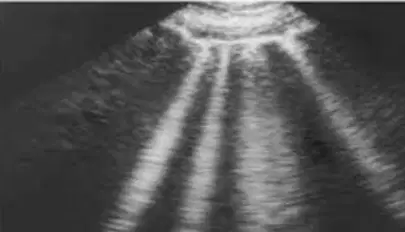
Which artifact is present in this image?
Shadow
Reverberation
Comet Tail
Mirror

Which artifact is present in this image?
Refraction
Shadow
Reverberation
Comet Tail
Which are characteristics of Shadow artifact?
Hypo- or anechoic background
The result of too little attenuation
Located above the structure with abnormal attenuation
Prevents visualization of true anatomy
The result of too much attenuation

Which artifact is present in this image?
Edge shadow
Refraction
Noise
Shadow

Which artifact is present in this image?
Shadow
Edge shadow
Range error
Lobes

Which artifact is present in this image?
Speed Error
Reverberation
Lobes
Enhancement

Which artifact is present in this image?
Edge shadow
Focal Enhancement
Speed Error
Refraction

Which artifact is present in this image?
Reverberation
Speed Error
Mirror
Lobes

Which artifact is present in this image?
Shadow
Mirror
Lobe
Refraction

Which artifact is present in this image?
Slice Thickness
Lobes
Mirror
Refraction
Select the causes of:
Anatomic reflectors absent on image
Shadowing
Comet Tail
Shadowing by refraction
Lateral and Axial Resolution
Grating lobe
Select the causes of:
Anatomic reflector appears multiple times on image; artifact positioned deeper than the true anatomy.
Shadowing
Comet tail
Ring down
Reverberations
Mirror image
Select the causes of:
Anatomic reflector appear multiple times on image; artifact displaced to the side of the true anatomy
Refraction
Shadowing
Axial and Lateral Resolution
Side lobe
Grating lobe
Select the causes of:
Anatomic reflectors appear with abnormal brightness
Banding
Enhancement
Lobes
Shadowing
Reverberations
Select the causes of:
Anatomic structures appear at incorrect depth
Range Ambiguity
Mirror image
Reverberations
Shadowing
Speed Error
Select the causes of:
Anatomic structures appear in the incorrect imaging plane
Reverberation
Shadowing
Slice or section thickness
Speed errors
Select the causes of:
Anatomic structures do not correspond to echoes on the image
Lobes
Acoustic Speckle
Multipath
Shadowing
Which imaging mode typically uses the lowest transducer output?
Pulsed doppler
Color doppler
Gray scale
Power doppler
Which instrument measures acoustic pressure at specific locations in a sound beam?
Calorimeter
Hydrophone
Thermocouple
Which method allows the visualization of the sound beam shape using sound-light interaction?
Calorimetry
Acousto-optics
Radiation force
Empirical approach
Which device measures temperature rise at a particular location?
Liquid crystal
Hydrophone
Thermocouple
Which of the following is TRUE regarding diagnostic ultrasound?
It has caused confirmed tissue damage at normal intensities
It is banned during fetal exams
It has no known harmful effects at low intensities
It always causes thermal heating
Who regulates ultrasound system output?
AIUM
WHO
FDA
CDC
The organization responsible for compiling scientific ultrasound bioeffects data is:
CDC
WHO
FDA
AIUM
Which of the following is an "in vitro" study?
Animal study in a lab
Observing effects in a fetus
Patient-based hospital study
Cell cultures in a dish
Which intensity limit is correct for focused beams?
1 mW/cm²
10 mW/cm²
100 mW/cm²
1000 mW/cm²
Which approach analyzes cause-and-effect to predict potential bioeffects?
Retrospective
Empirical
Mechanistic
Epidemiologic
Which approach reviews data from actual patient or animal exposure?
Mechanistic
Empirical
Thermal
Theoretical
Which mechanism results from tissue heating?
Cavitation
Acoustic streaming
Thermal
Refraction
Which tissue absorbs the most acoustic energy and leads to the greatest heating?
Muscle
Liver
Blood
Bone
Which form of Thermal Index assumes the sound beam travels through soft tissue?
TIC
TIB
TIS
TIQ
What does a TI (Thermal Index) of 2 suggest?
Exposure exceeds safe limits
A temperature rise of 2 degrees C may occur
No heating is possible
The patient is at risk for shock
Which mechanism involves microbubble activity?
Thermal
Cavitation
Apodization
Rarefraction
What kind of cavitation involves bubble oscillation without bursting?
Inertial
Transient
Harmonic
Stable
Which type of cavitation results in shock waves and very high temperatures?
Stable
Pulsatile
Transient
Static
The Mechanical Index (MI) increases with:
Lower peak rarefaction pressure
Lower frequency and higher negative pressure
Higher frequency and low pressure
High peak rarefaction pressure
Which term describes the study of disease prevalence and population impact?
Dosimetry
Thermometry
Epidemiology
Radiography
Which study type is ideal for assessing ultrasound risk?
Randomized and retrospective
Prospective and randomized
Retrospective and observational
Randomized and observational
The most common risk in electrical safety from ultrasound is:
Power overload
Radiation leak
Cracker transducer housing
Noise pollution
What principle guides minimizing ultrasound exposure while maximizing benefit?
ALARA
FDA
MI Index
TI Standard
A (a) measures acoustic pressure at a specific location in the beam
(a) is the science of identifying and measuring the characteristics of an ultrasound beam relevant to biological effects
This approach is based on theoretical predictions of ultrasound bioeffects
(a)
This approach is based on actual observations in patients or animals
(a)
The 2 major mechanisms of bioeffects are:
(a)
The _ is used to estimate potential temperature rise in tissue
(a)
_ involves gas bubble expansion and collapse
(a)
The _ index estimates the likelihood of cavitation bioeffects
(a)
How is total power of the ultrasound beam calculated?
total heat gain + pressure / time
total heat gain - time it took to obtain the heat
total heat gain + time it took to obtain the heat
total heat gain / time
True or false:
A thermocouple measures the power of the entire beam
True
False
Results indicate very high intensities can cause genetic damage and cell death
In vitro
In vivo
What is the bioeffects intensity limits of a focused and unfocused beam
100 mW/cm2 focused
100 mW/cm2 unfocused
1000 mW/cm2 focused
1000 mW/cm2 unfocused
1 W/cm2 focused
Searches for a relationship between cause and effect
Empirical Approach
Mechanistic approach
Searches for a relationship between exposure and response
Mechanistic approach
Empirical approach
Select the characteristics associated with a lower MI:
Less cavitation
More pressure
Less pressure
Lower frequency
Higher frequency
Select the characteristics associated with a Higher MI:
Less cavitation
More cavitation
More pressure
Lower frequency
Less pressure

