
Font size
 Worksheets
ATLANTIS-HIGH COMMUNICATION SYSTEM DIAGNOSIS
Total questions: 20
Worksheet time: 10mins
What does network wiring architecture describe?
The method of organizing ECUs on a bus.
How separate networks interact with each other.
Networks that are built using parallel wiring.
Whether a single wire or twisted-pair is used.
Which network wiring architecture uses an internal parallel connection to pass the bus circuit to the next ECU?
Hub
Stub
Daisy Chain
All of the above
What is the term for a network that combines two or three styles of wiring architectures?
Combination Wiring Architecture
Daisy-Chain Wiring Architecture
Series-Parallel Network
Hybrid Wiring Architecture
Which network wiring architecture(s) uses separate branches off a main line to connect ECUs?
Stub
Daisy-chain
Both A and B
Neither A nor B
Which Vehicle Architectures use star connectors? Select all that apply.
Atlantis-High
Compact US Wide (CUSW)
FIAT 7209
PowerNet
Where are termination resistors located in PowerNet Vehicles?
Splice blocks
Star connectors
Inside modules
Anywhere in the bus
What does bias mean?
Creating a voltage differential on the bus
Grounding the bus to the frame
Connecting the bus wires with resistors
Supplying a specific voltage to a bus
What is the purpose of biasing the bus?
Establishing a reference level for bus operation before ECUs begin transmitting data
Terminating transmitted signals at the end of a bus wire
Forcing a voltage differential between CAN (+) and CAN (-)
Making the network more resistant to circuit faults
What happens to the bus voltage during data transmissions?
ECUs receiving the transmission ground the bus indicating the message was received.
The voltage switches rapidly between 0V and 5V.
Network hardware repeatedly creates a calibrated voltage differential on the bus.
Network hardware balances the circuit and the voltage does not change.
What does it mean when the bus is in a recessive state?
Network hardware is not affecting the bus.
ECUs are grounding the bus during a transmission.
The bias voltage is being pulled up from the reference.
Termination resistors are not active in the circuit.
What does it mean when the bus is in a dominant state?
The bias voltage is at the established reference level.
Network hardware is pulling the bias voltage away from the reference level.
The termination resistors are disengaged.
No ECUs are communicating on the bus.
What is serial communication?
Transmitting data through a switch to be serialized
Transmitting data multiple bits at a time in parallel
Transmitting data sequentially one bit at a time
Transmitting data using a checksum serial algorithm
What is binary code?
An updated version of Morse code
A computer programming language
An algorithm used by computers
A two-symbol system used to create messages
In a string binary code, a single bit can either be a "1" or a "0." What happens to the possible combinations every time a bit is added to a string?
The number of combinations double.
The number of combinations quadruple.
The number combinations are reduced.
The number of combinations are not affected.
What is another term for the Data Field in a CAN Data Frame?
The cargo
The mother lode
The haul
The payload
Which type of ECU is capable of forwarding messages between two different networks?
Gateway Module
Dominant Node
Router ECU
Transceiver Module
How do ECUs settle disputes that occur when more than one ECU attempts to transmit a message?
Arbitration
Mediation
Nulification
Qualification
Which of the following best describes the two major differences of CAN-FD?
CAN-FD uses a flexible bit rate to transmit the Arbitration Field faster and has a "payload" that is up to 20X larger.
CAN-FD uses a flexible bit rate to transmit the Data Field faster and has a "payload" that is up to 8X larger.
CAN-FD uses a flexible bit rate to transmit the entire Data Frame faster and has a "payload" that is up to 20X larger.
CAN-FD uses a flexible bit rate to transmit the CRC Field faster and has a "payload" that is up to 8X larger.
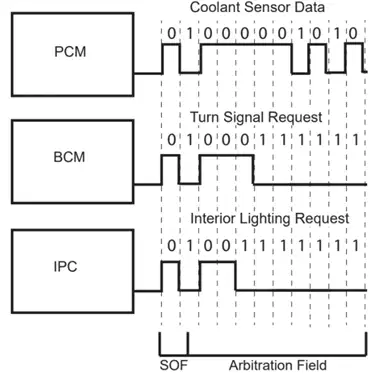
Based on the image, which ECU would win control to transmit on the bus?
PCM
BCM
IPC
NONE
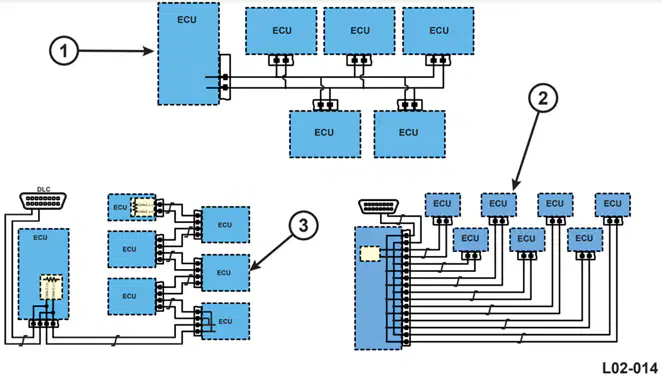
Using the following image, what type of wiring architecture is shown by Number 1?
Stub
Hub
Daisy Chain
Hybrid

