
 Worksheets
Regents Review Units 1 and 2
Total questions: 37
Worksheet time: 22mins
Which sample of matter has the greatest distance between molecules at STP?
N₂(g)
NH₃(aq)
C₆H₁₄(l)
C₆H₁₂O₆(s)
Which measurement has the greatest number of significant figures?
0.060 mg
60.6 mg
606 mg
66000 mg
Which unit is used to express the pressure of a gas?
mole
joule
kelvin
pascal
Which phase change at STP represents sublimation?
CO₂(s) → CO₂(g)
H₂O(s) → H₂O(l)
CO₂(l) → CO₂(g)
H₂O(l) → H₂O(s)
How many kiloJoules are equivalent to 10 Joules?
0.001 kJ
0.01 kJ
1000 kJ
10,000 kJ
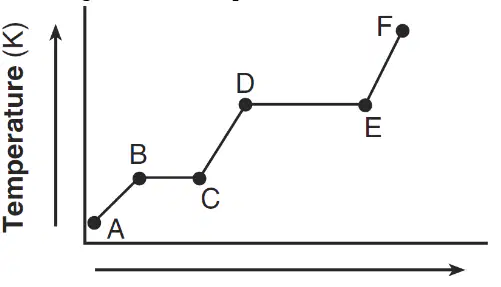
The heating curve below represents a sample of a substance starting as a solid below its melting point and being heated over a period of time. Which statement describes the energy of the particles in this sample during interval DE?
A) Both potential energy and average kinetic energy increase.
B) Both potential energy and average kinetic energy decrease.
C) Potential energy increases and average kinetic energy remains the same.
D) Potential energy remains the same and average kinetic energy increases.
At standard pressure, during which physical change does the potential energy decrease?
liquid to gas
liquid to solid
solid to gas
solid to liquid
What is the amount of heat required to completely melt a 250.-gram sample of H₂O(s) at STP?
334 J
1040 J
83500 J
565000 J
Which phase change is exothermic?
solid to liquid
solid to gas
liquid to solid
liquid to gas
What is the product of (2.324 cm × 1.11 cm) expressed to the correct number of significant figures?
2.58 cm²
2.5780 cm²
2.5796 cm²
2.57964 cm²
Which quantity of heat is equal to 200. joules?
20.0 kJ
2.00 kJ
0.200 kJ
0.0200 kJ
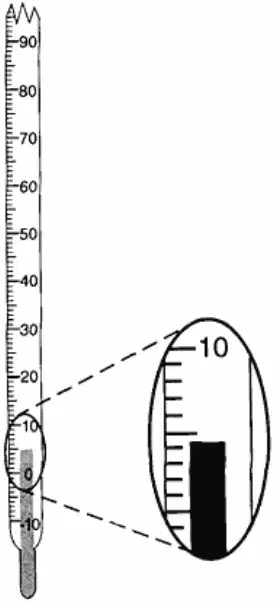
The diagram below represents a Celsius thermometer recording a certain temperature. What is the correct reading of the thermometer?
5°C
4.3°C
0.3°C
4°C
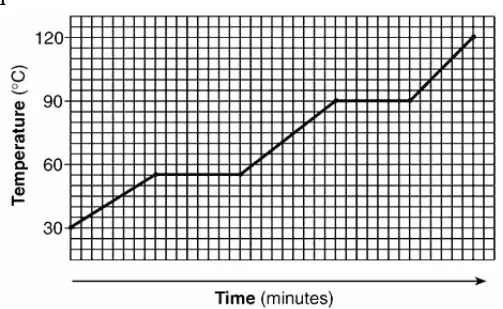
The graph below represents the heating curve of a substance that starts as a solid below its freezing point. What is the melting point of this substance?
30°C
55°C
90°C
120°C
What is the amount of heat required to melt 55 grams of solid magnesium oxide at its melting point? The heat of fusion is 1.9×10³J/g .
1.0 x 10^5 J
3.4 x 10^1 J
2.9 x 10^{-2} J
4.36 x 10^5 J
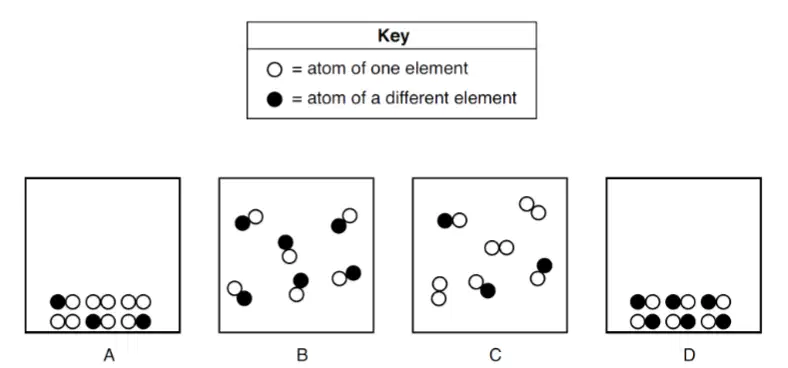
Which two particle diagrams represent two different phases of the same compound, only?
A and B
A and C
B and C
B and D
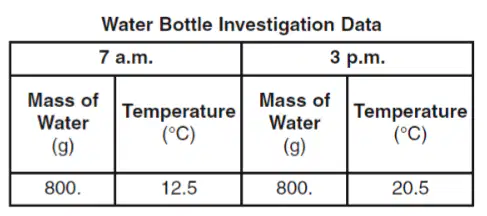
Compare the average kinetic energy of the water molecules in the bottle at 7 a.m. to the average kinetic energy of the water molecules in the bottle at 3 p.m.
The average kinetic energy is higher at 3 p.m. than at 7 a.m.
The average kinetic energy is higher at 7 a.m. than at 3 p.m.
The average kinetic energy is the same at both times.
There is not enough information to compare.
Determine the volume of a 75.0-gram sample of gold at STP. The density of gold is 19.3 g/cm3.
3.89 cm³
1450 cm³
75.0 cm³
0.0133 cm³
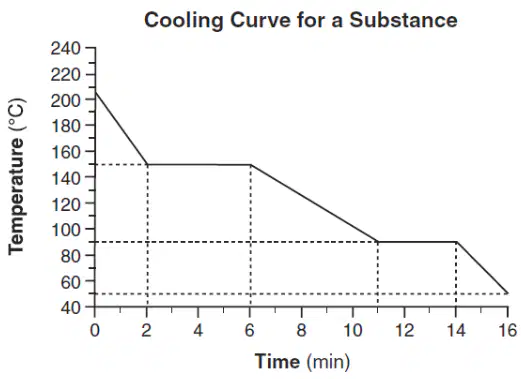
What is the melting point of this substance?
150°C
30°C
210°C
90°C
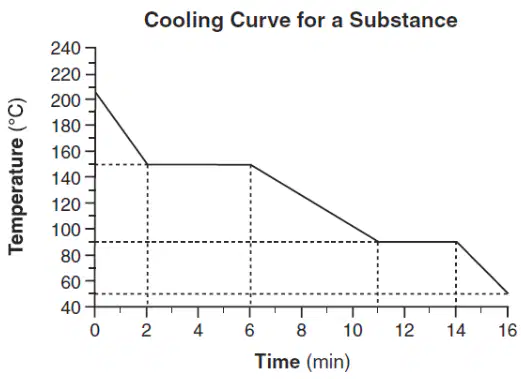
At what time do the particles of this sample have the lowest average kinetic energy?
16 minutes
4 minutes
8 minutes
20 minutes
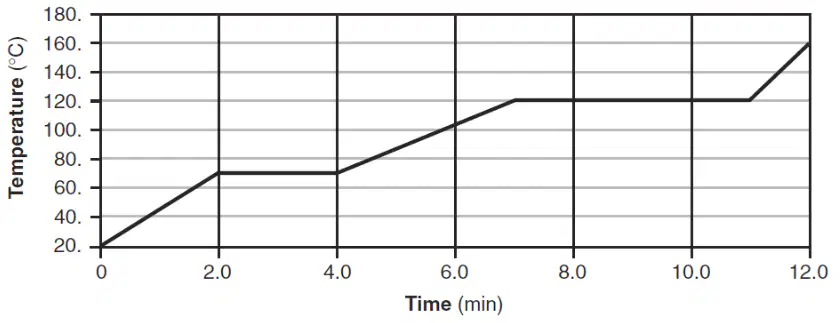
What is the total time this sample is in the liquid phase, only?
3 minutes
2 minutes
5 minutes
12 minutes
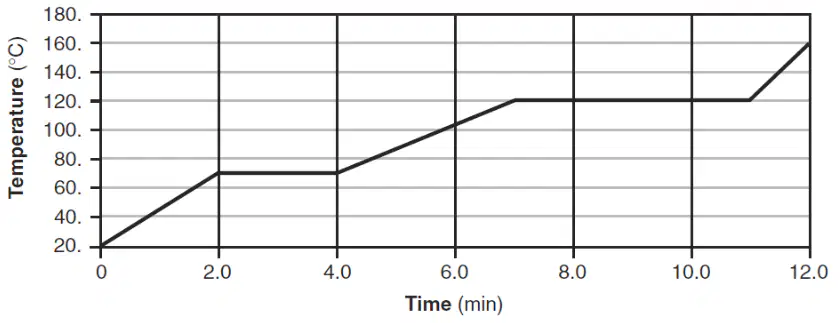
The boiling point of this sample is:
70°C
100°C
120°C
160°C
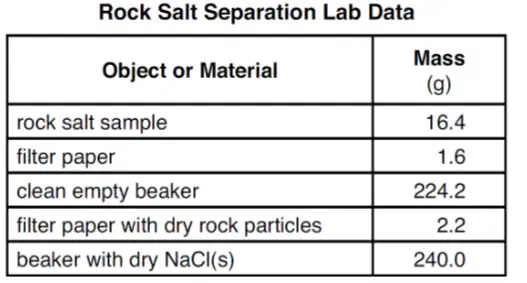
State the number of significant figures in the mass of the beaker with dry NaCl(s).
3
1
2
4
Calculate the density of a 129.5 gram sample of bronze that has a volume of 14.8 cubic centimeters.
8.75 g/cm³
0.11 g/cm³
1.15 g/cm³
19.2 g/cm³
Four statements about the development of the atomic model are shown below.
A: Electrons have wavelike properties.
B: Atoms have small, negatively charged particles.
C: The center of an atom is a small, dense nucleus.
D: Atoms are hard, indivisible spheres.
Which order of statements represents the historical development of the atomic model?
C → D → A → B
C → D → B → A
D → B → A → C
D → B → C → A
Which particles are isotopes of each other?
11X and 13X
21X and 34X
12X and 24X
13X and 32X
Which electron configuration represents an atom in an excited state?
2–7
2–6–2
2–8–1
2–8–2
Which electron configuration represents the electrons of a phosphorus atom (atomic #15) in an excited state?
2-8-5
2-8-6
2-7-6
2-7-4
The gold foil experiment led to the conclusion that each atom in the foil was composed mostly of empty space because most alpha particles directed at the foil
passed through the foil
remained trapped in the foil
were deflected by the nuclei in gold atoms
were deflected by the electrons in gold atoms
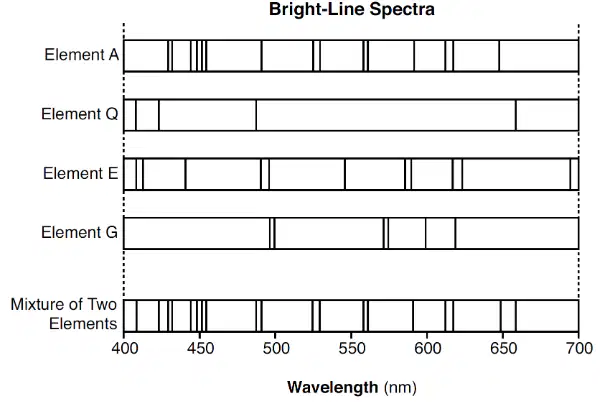
Given the bright-line spectra of four elements and the spectrum of a mixture formed from two of these elements: Which two elements are present in this mixture?
A) A and Q
B) A and E
C) G and Q
D) G and E
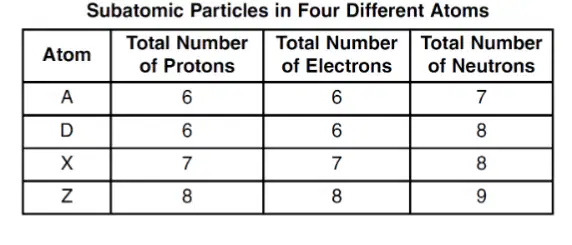
Which two atoms are isotopes of the same element?
A) A and D
B) A and Z
C) X and D
D) X and Z
According to the wave-mechanical model of the atom, electrons are located in
orbitals
circular paths
a small, dense nucleus
a hard, indivisible sphere
In which pair of elements do the nuclei of the atoms contain the same number of neutrons?
37 Li and 49 Be
714 N and 816 O
1123 Na and 1224 Mg
1632 S and 1735 Cl
What is the approximate mass of an atom that contains 26 protons, 26 electrons and 19 neutrons?
26 amu
45 amu
52 amu
71 amu
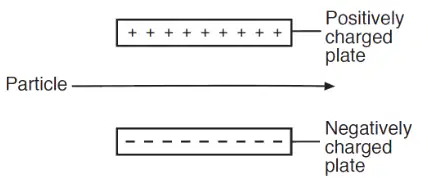
The diagram below represents a particle traveling through an electric field. Which particle remains undeflected when passing through this electric field?
proton
electron
neutron
positron
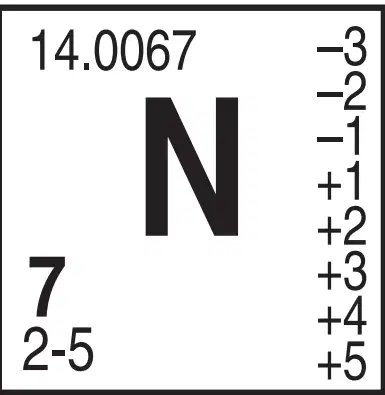
The only natural occurring isotopes of nitrogen are N-14 and N-15. Based on the atomic mass of the element nitrogen on the Periodic Table, the most abundant naturally occurring isotope of nitrogen is:
N-14
N-15
Both are equally abundant
Neither is abundant
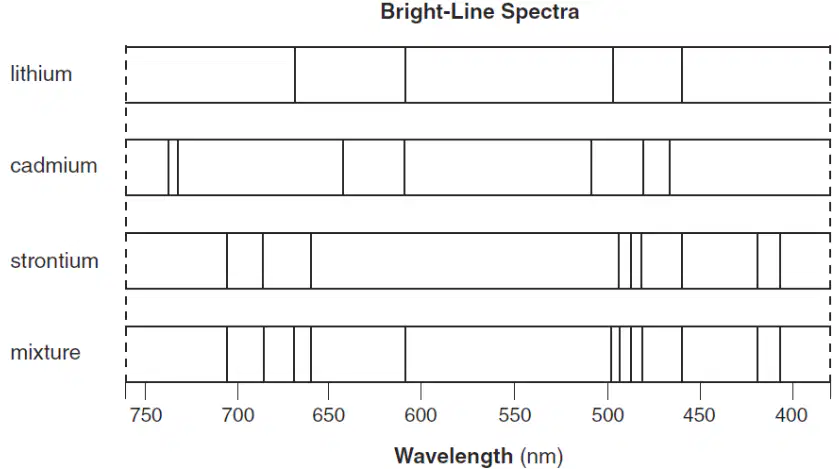
The bright-line spectrum of an element is produced when:
Electrons absorb energy and move to higher energy levels, then release energy as light when they return to lower levels.
Electrons lose energy and move to higher energy levels, emitting light in the process.
Electrons remain in their ground state and emit energy continuously.
Electrons gain energy and stay at higher energy levels without emitting light.
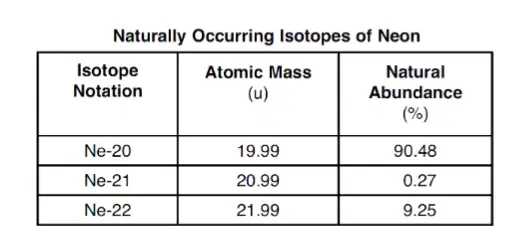
Show a numerical setup for calculating the atomic mass of neon.
(19.99*0.9048)+(20.99*0.0027)+(21.99*0.0925)
(19.99*90.48)+(20.99*0.27)+(21.99*9.25)
(19.99+20.99+21.99)/3
19.99+0.9048+20.99+0.0027+21.99+9.25

