
NEW
Font size
 Worksheets
Unit 4 Review
Total questions: 38
Worksheet time: 27mins
True or False: All meteors eventually become meteorites.
True
False
When meteoroids enter Earth's atmosphere at high speed, they burn up. Then they are called
meteors
asteroids
comets
moons
A satellite in elliptical orbit about Earth travels
fastest when it moves closer to Earth.
fastest when it moves farther from Earth.
slowest when it moves closer to Earth.
at the same rate for the entire orbit.
The orbit of planet Mars is elliptical. What can be said about the speed of Mars?
The speed of Mars increases as it orbits around the Sun
Mars travels at constant speed thru it's orbit
The speed of Mars deceases as it orbits around the Sun
The speed of Mars increases and deceases in cycles.

You discover a new planet in our solar system. You measure it's orbital period to be 246 years.
Where is this planet likely to be located based on this information?
Closer to the Sun than Mercury.
Located between Earth and Jupiter.
Located between Uranus and Neptune.
Located beyond Neptune.

To keep a satellite in orbit we must find the balance between _________ and _________.
Gravity and velocity
Speed and acceleration

If a satellite is closer to Earth, it must travel ______ than a satellite further from Earth.
The same speed
Slower
Faster
When a satellite travels at constant speed, its shape is a(n)
circle.
ellipse.
oval that is almost elliptical.
square.
What happens to meteors as they move through Earth's atmosphere?
What factors impact a meteor's ability to vaporize?
Size, speed, and composition (material).
Why might two objects collide in space?
Which of the following could happen when a meteor impacts the ground?
As the mass of a meteor increases, the size of its crater will...
As the velocity of a meteor increases, the size of the crater will..
Kepler's Third Law states that T2 is proportional to R3 . What does T stand for?
Speed of the planet
Radius (distance to the Sun)
Period (time to orbit)
Kepler's Third Law states that T2 is proportional to R3 . What does R stand for?
Speed of the planet
Radius (distance to the Sun)
Period (time to orbit)

Where is the planet moving faster?
around segment A
around segment B
around either segment - the speed doesn't change
impossible to know

The diagram below shows a moon revolving around a planet in an elliptical orbit. At which position is the moon traveling fastest?
location 1
location 2
location 3
location 4

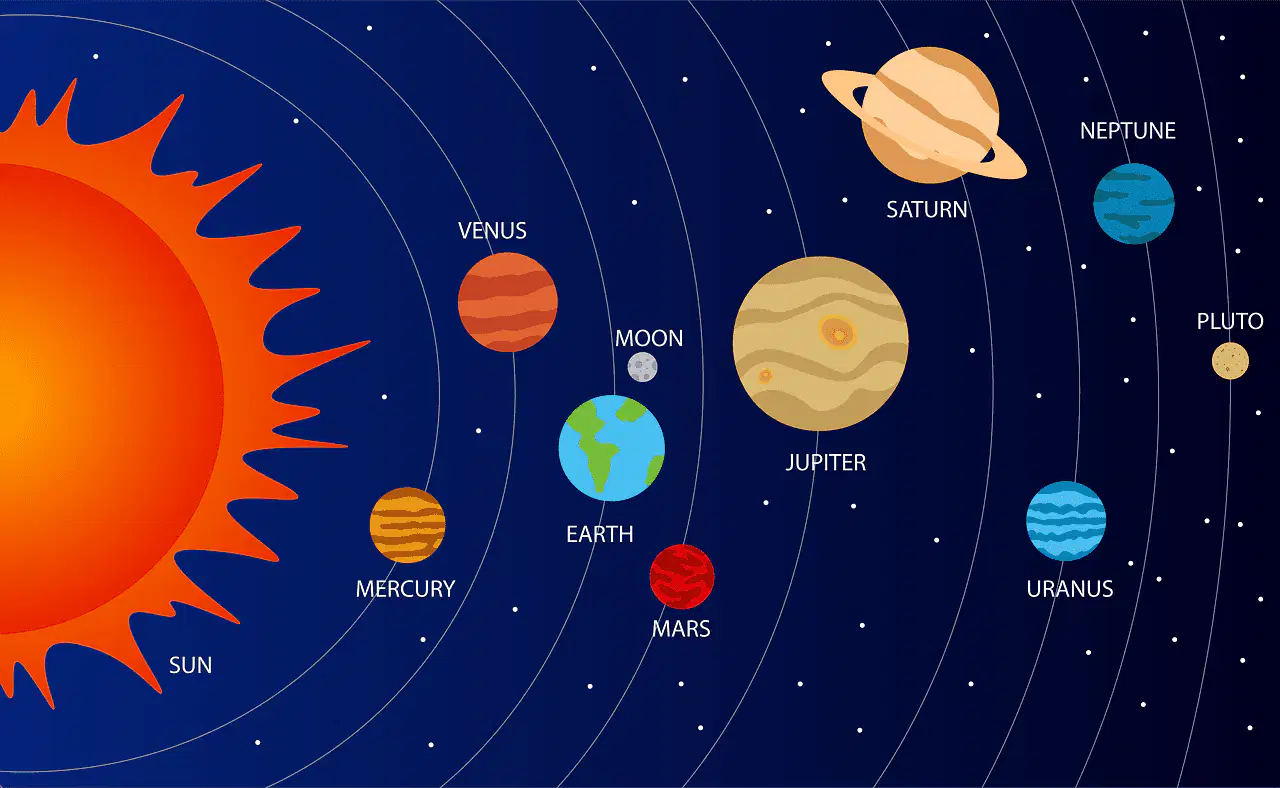
Which planet of those shown, because of its position, will take the least amount of time to revolve around the Sun?
Mercury
Venus
Earth
Mars

A comet moves much faster when it passes closer to the Sun than when it is further away. What is the primary cause in the change of the comet’s orbital speed?
Jupiter's gravitational field.
The sun's solar wind.
The sun's gravitational field.
Saturn's magnetic field.

Why is Earth’s year shorter than Jupiter’s year?
the gravitational pull of Jupiter’s moons
the shape of Earth’s orbit around the Sun
the smaller distance between Earth and the Sun
the mass and density of Jupiter
a former meteoroid that survives its fiery passage through the atmosphere to hit the Earth's surface
meteoroid
meteor
meteorite

A meteor when it burns in the atmosphere is also known as a ____.
rock
shooting star
ball of ice
Which is found in the belt between Mars and Jupiter
Comets
Asteroids
Meteors
Stars

Which of the following best explains why meteors often burn up before reaching Earth's surface?
They are repelled by Earth's magnetic field
They accelerate continuously due to gravity
They gain too much mass from the atmosphere
Drag force and vaporization reduce their mass and velocity significantly
How does the material impact the force in a collision?
Softer materials increase collision time and decrease force
Softer materials decrease collision time and decrease force
Softer materials decrease collision time and increase force
Softer materials increase collision time and increase force

