
NEW
Font size
 Worksheets
Ch 19 Free Energy and Thermodynamics
Total questions: 65
Worksheet time: 33mins
Which term describes how fast chemical changes occur?
Thermodynamics
Kinetics
Entropy
Equilibrium
Which concept is used to predict how far a reaction will go?
Kinetics
Entropy
Thermodynamics
Enthalpy
Which of the following is always increasing in our universe?
Enthalpy
Entropy
Kinetics
Free energy
Which law of thermodynamics states that energy cannot be created or destroyed, only transformed?
First law of thermodynamics
Second law of thermodynamics
Law of conservation of mass
Law of definite proportions
What does the second law of thermodynamics explain?
The speed of chemical reactions
The conservation of energy
The tendency of energy to spread out and increase entropy
The neutrality of acids and bases
What is "heat death" in the context of thermodynamics?
The point at which all matter freezes
The state where energy is evenly distributed and no work can be done
The destruction of energy
The rapid increase in temperature
Which of the following best defines a spontaneous process in chemistry?
A process that occurs without outside intervention
A process that requires continuous energy input
A process that always happens quickly
A process that never reaches equilibrium
Which factor dictates spontaneity in a chemical system?
Thermodynamics
Kinetics
Pressure
Volume
Which factor dictates the speed of a chemical reaction?
Kinetics
Thermodynamics
Temperature only
Equilibrium constant
How do catalysts affect the spontaneity of a reaction?
They do not affect spontaneity, only the speed of the reaction
They make nonspontaneous reactions spontaneous
They change the thermodynamic favorability
They increase the equilibrium constant
Which statement best differentiates between spontaneity and speed in chemical reactions?
Spontaneity is determined by thermodynamics, while speed is determined by kinetics
Spontaneity and speed are both determined by kinetics
Spontaneity is determined by pressure, speed by temperature
Spontaneity and speed are unrelated to chemical reactions
Is a nonspontaneous process impossible? Which of the following is the best explanation?
No, nonspontaneous processes can occur with the input of energy
Yes, nonspontaneous processes never occur
No, nonspontaneous processes occur faster than spontaneous ones
Yes, all nonspontaneous processes are irreversible
Which of the following best describes the role of an energy diagram in understanding chemical reactions?
It shows the energy changes and helps identify where kinetics and thermodynamics are involved
It only shows the speed of the reaction
It only shows the temperature changes
It is unrelated to chemical reactions
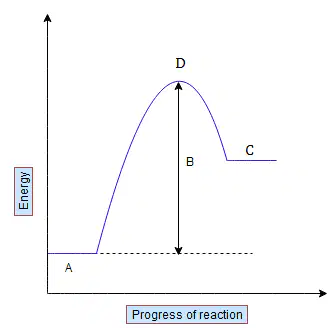
Which part of an energy diagram represents the activation energy of a reaction?
Distance between reactant energy and peak
The starting point of the reactants
The ending point of the products
The distance between reactant energy and product energy
Which of the following best defines enthalpy?
The total heat content of a system at constant pressure
The measure of disorder in a system
The energy required to break a chemical bond
The amount of energy stored in the nucleus of an atom
A process need not be __________ to be spontaneous.
Exothermic
Endothermic
Isothermal
Adiabatic
Which of the following is the best definition of entropy?
A measure of the disorder or randomness in a system
The energy required to start a reaction
The amount of heat transferred at constant pressure
The number of protons in an atom
What is Boltzmann’s equation for entropy, and what does each variable represent?
S = k ln W; S = entropy, k = Boltzmann constant, W = number of microstates
S = mCΔT; S = entropy, m = mass, C = specific heat, ΔT = temperature change
S = Q/T; S = entropy, Q = heat, T = temperature
S = PV/nR; S = entropy, P = pressure, V = volume, n = moles, R = gas constant
Which statement best differentiates a macrostate from a microstate?
A macrostate describes the overall properties of a system, while a microstate describes the specific arrangement of particles.
A macrostate is a single arrangement of particles, while a microstate is the average of all arrangements.
A macrostate is only found in solids, while a microstate is found in gases.
A macrostate is a chemical property, while a microstate is a physical property.
Which of the following is an example of an endothermic and spontaneous process?
The melting of ice at room temperature
The combustion of gasoline
The freezing of water
The condensation of steam
Define the second law of thermodynamics.
The total entropy of an isolated system always increases over time.
Energy cannot be created or destroyed.
The entropy of a perfect crystal at absolute zero is zero.
The enthalpy of a system is always constant.
What is the criterion for spontaneity in a chemical process?
The process must increase the entropy of the universe.
The process must decrease the temperature.
The process must increase the pressure.
The process must decrease the volume.
Describe what it means for entropy to be a state function.
It depends only on the initial and final states, not the path taken.
It depends on the path taken between states.
It is only defined for gases.
It is only defined for solids.
How is spontaneity determined in a chemical system?
By evaluating the change in Gibbs free energy.
By measuring the color of the reactants.
By checking the boiling point.
By observing the density.
How does entropy change relate to a phase change?
Entropy increases when a substance changes from solid to liquid or liquid to gas.
Entropy decreases when a substance changes from solid to liquid.
Entropy remains constant during a phase change.
Entropy is not affected by phase changes.
Describe the “order” of the different states of matter.
Solids are most ordered, liquids are less ordered, gases are least ordered.
Gases are most ordered, liquids are less ordered, solids are least ordered.
Liquids are most ordered, solids are less ordered, gases are least ordered.
All states have the same order.
How can you predict the sign of entropy change?
By considering whether the disorder of the system increases or decreases
By measuring the temperature only
By checking the color of the substances involved
By looking at the pressure only
How do we calculate the entropy change for a change of state? Give a formula and identify each variable and its units.
ΔS = q_rev/T, where ΔS is entropy change (J/K), q_rev is reversible heat (J), and T is temperature (K)
ΔS = m × c × ΔT, where m is mass, c is specific heat, ΔT is temperature change
ΔS = P × V, where P is pressure and V is volume
ΔS = nRT, where n is moles, R is gas constant, T is temperature
What are the units of entropy?
Joules per Kelvin (J/K)
Watts (W)
Moles per liter (mol/L)
Coulombs (C)
Describe a reversible process.
A process that can be reversed by a change in a variable, leaving the system and surroundings unchanged
A process that happens very quickly, eaving the system and surroundings unchanged
A process that cannot be undone, eaving the system and surroundings unchanged
A process that only occurs at high temperatures, eaving the system and surroundings unchanged
How can you defend the fact that ΔS_surroundings increases for systems where entropy is decreasing?
Because the total entropy of the universe must always decrease.
Because the decrease in system entropy is always larger than the increase in surroundings entropy.
Because the increase in surroundings entropy can compensate for the decrease in system entropy, maintaining the second law of thermodynamics.
Because entropy changes are not related between system and surroundings.
How can a process in which the system's entropy decreases still be spontaneous?
If the surroundings' entropy increases by a greater amount.
If the system is isolated from the surroundings.
If the temperature is extremely high.
If the process is endothermic.
How do an exothermic and an endothermic process affect the entropy of the surroundings?
Exothermic increases surroundings' entropy, endothermic decreases it.
Both increase the surroundings' entropy.
Exothermic decreases surroundings' entropy, endothermic increases it.
Both decrease the surroundings' entropy.
What is the dependence relationship of temperature (T) and entropy change (ΔS) in the surroundings?
ΔS_surroundings is independent of temperature.
ΔS_surroundings is directly proportional to temperature.
ΔS_surroundings is inversely proportional to temperature.
ΔS_surroundings is equal to temperature squared.
What are the units of entropy?
Joules (J)
Joules per Kelvin (J/K)
Kelvin (K)
Watts (W)
What is the equation for ΔS_surroundings and what are the conditions of spontaneity associated with it?
ΔS_surroundings = q/T; spontaneous if ΔS_surroundings > 0
ΔS_surroundings = T/q; spontaneous if ΔS_surroundings < 0
ΔS_surroundings = -q/T; spontaneous if ΔS_surroundings < 0
ΔS_surroundings = qT; spontaneous if ΔS_surroundings > 0
How is enthalpy related to entropy in the surroundings? (Give both an explanation and a formula.)
The change in entropy of the surroundings is equal to the enthalpy change divided by temperature: ΔS_surroundings = -ΔH/T.
The change in entropy of the surroundings is equal to the enthalpy change multiplied by temperature: ΔS_surroundings = ΔH × T.
The change in entropy of the surroundings is equal to the enthalpy change: ΔS_surroundings = ΔH.
The change in entropy of the surroundings is equal to the enthalpy change squared: ΔSsurroundings=(ΔH)2 .
What is Gibbs free energy?
The energy available to do work at constant temperature and pressure
The total energy of a system
The energy required to break a chemical bond
The energy lost as heat in a reaction
At what conditions is Gibbs free energy most relevant?
Constant temperature and pressure
Constant volume and temperature
Constant pressure and volume
Constant entropy and enthalpy
What does the term "standard conditions" refer to in the context of chemical reactions?
The specific temperature and pressure at which measurements are made for substances in their standard state
The conditions under which a reaction is fastest
The conditions where only gases are present
The conditions where only solids are present
Which of the following is most likely to be required when calculating entropy changes (ΔS_rxn) in chemical reactions?
Knowledge of standard conditions for each state of matter and substances in solution
The boiling point of the solvent
The color of the reactants
The taste of the products
Suppose you are asked to define standard conditions for a chemical reaction involving a gas, a liquid, and a solute in solution. What information would you need to provide?
The temperature, pressure, and concentration relevant to each state of matter
The melting point of the gas
The density of the liquid only
The color of the solute
What does ΔS°_rxn represent in thermodynamics?
The standard entropy change for a chemical reaction
The standard enthalpy change for a chemical reaction
The standard free energy change for a chemical reaction
The standard temperature change for a chemical reaction
How can standard molar entropies (S°) be used in thermodynamics?
To calculate the standard entropy change for a chemical reaction or physical process
To measure the temperature of a reaction
To determine the pressure of a gas
To find the boiling point of a liquid
Which statement best describes the third law of thermodynamics?
The entropy of a perfect crystal at absolute zero is zero
Energy cannot be created or destroyed
The entropy of the universe is always increasing
The enthalpy of a reaction is always positive
Arrange the following in order of increasing standard entropy: solids, liquids, gases.
Solids < Liquids < Gases
Gases < Liquids < Solids
Liquids < Solids < Gases
Solids < Gases < Liquids
How does molar mass generally affect the standard molar entropy of a substance?
Higher molar mass usually leads to higher standard molar entropy
Lower molar mass always leads to higher standard molar entropy
Molar mass has no effect on standard molar entropy
Higher molar mass always leads to lower standard molar entropy
Which of the following best describes the effect of allotropes on standard molar entropy?
Different allotropes of the same element can have different standard molar entropies
All allotropes of the same element have the same standard molar entropy
Allotropes only affect enthalpy, not entropy
Allotropes only exist for gases
How is the standard free energy change of a reaction (ΔG°rxn) typically calculated using tabulated values?
By using the standard free energies of formation of reactants and products
By measuring the temperature and pressure of the system
By calculating the entropy change only
By using the molar masses of the substances involved
Which of the following best describes the equation for calculating ΔG°rxn?
ΔG°rxn = ΣΔG°f(products) - ΣΔG°f(reactants)
ΔG°rxn = ΣΔH°f(products) + ΣΔH°f(reactants)
ΔG°rxn = ΣΔS°f(products) × ΣΔS°f(reactants)
ΔG°rxn = ΣΔE°f(products) / ΣΔE°f(reactants)
Identify the correct units for each variable in the equation ΔG°rxn = ΣΔG°f(products) - ΣΔG°f(reactants).
ΔG°rxn and ΔG°f are measured in kJ/mol
ΔG°rxn is measured in L, ΔG°f in mol
ΔG°rxn is measured in atm, ΔG°f in J
ΔG°rxn and ΔG°f are measured in g/mol
How can a nonspontaneous process be made spontaneous?
By coupling it with a spontaneous process
By increasing the pressure only
By decreasing the temperature only
By removing all reactants
What does the change in free energy (ΔG) represent in a chemical reaction?
The total energy of the system
The amount of energy available to do work
The mass of the reactants
The temperature of the reaction
Which of the following best defines a reversible reaction?
A reaction that only proceeds in one direction
A reaction that can proceed in both forward and reverse directions under certain conditions
A reaction that releases heat
A reaction that forms a precipitate
Why is free energy referred to as "free"?
Because it is not associated with any cost
Because it is the energy available to do work
Because it is always positive
Because it is not measurable
When calculating ΔG°rxn for a stepwise reaction, what relationship can be considered?
The sum of the free energy changes for each step equals the total ΔG°rxn
The product of the free energy changes for each step equals the total ΔG°rxn
Only the largest free energy change is considered
The free energy change is always zero
Which of the following best describes an irreversible reaction?
A reaction that can reach equilibrium
A reaction that can proceed in both directions
A reaction that proceeds only in one direction and cannot be reversed under normal conditions
A reaction that absorbs energy
What is the difference between standard and nonstandard states?
Standard states refer to conditions at 1 atm pressure and 25°C, while nonstandard states refer to any other conditions.
Standard states refer to conditions at 0°C and 1 atm, while nonstandard states refer to conditions at 100°C and 2 atm.
Standard states refer to conditions at 1 atm and 0 K, while nonstandard states refer to conditions at 1 atm and 273 K.
Standard states refer to conditions at 2 atm and 50°C, while nonstandard states refer to conditions at 1 atm and 25°C.
Which equation is used to calculate the free energy change for a reaction or process under nonstandard conditions?
ΔG = ΔG° + RT ln Q
ΔG = ΔH - TΔS
ΔG = ΔG° - RT ln K
ΔG = ΔH + TΔS
What equation is used to calculate the free energy change for a reaction or process under standard conditions?
ΔG° = ΔH° - TΔS°
ΔG° = ΔG + RT ln Q
ΔG° = ΔH + TΔS
ΔG° = ΔH° + TΔS°
How do we treat the calculation of free energy change for a reaction or process at equilibrium?
ΔG = 0 at equilibrium
ΔG = ΔG° at equilibrium
ΔG = ΔH at equilibrium
ΔG = TΔS at equilibrium
Which of the following is an example of a nonstandard condition that must be considered in free energy calculations?
Pressure different from 1 atm
Temperature at 25°C
Concentration at 1 M
All reactants and products in their standard states
Which of the following best describes the relationship between the standard free energy change (ΔG°) and the equilibrium constant (K)?
ΔG° is unrelated to K.
ΔG° can be calculated from K using a specific equation.
K is always greater than ΔG°.
ΔG° and K are both always negative.
How are the reaction quotient (Q), equilibrium constant (K), and free energy change (G) related in a chemical reaction?
G is only related to Q, not K.
Q and K are unrelated to G.
G depends on both Q and K.
K is always equal to Q.
How can we use a two-point equation to calculate the equilibrium constant for a reaction or process at two different temperatures?
By using the van't Hoff equation to relate the equilibrium constants at two temperatures.
By measuring the pressure at two different points.
By using the ideal gas law to find the equilibrium constant.
By calculating the average temperature and using it directly.

