
 Worksheets
Special Tractions Lower Limb
Total questions: 85
Worksheet time: 43mins
What is Bryant’s Traction primarily used for in pediatric patients?
Fractures of the femur in children up to two years old or weighing less than 30 lbs (14kg)
Fractures of the humerus in adults
Dislocations of the shoulder in teenagers
Sprains of the ankle in children over five years old
Which of the following is NOT an indication for using Bryant’s Traction?
Fractures of the femur in children under two years old
Stabilization of the hip joint where use of the cast is not indicated
Fractures of the femur in adults
Fractures of the femur in children weighing less than 30 lbs (14kg)
Why might Bryant’s Traction be chosen over a cast for a child with a hip joint injury?
When stabilization is needed but use of the cast is not indicated
When the child is over five years old
When the injury is to the upper limb
When the child weighs more than 30 lbs (14kg)
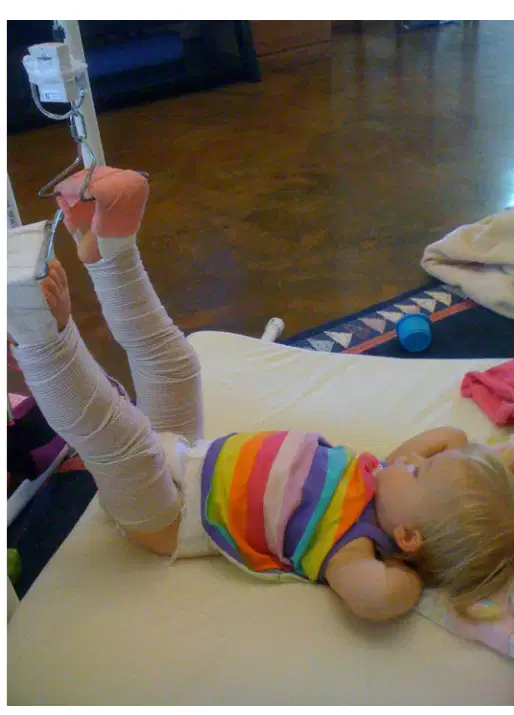
What is a key feature of Bryant’s Traction as shown in the treatment of a child?
Both legs are elevated and suspended vertically
Only one arm is in traction
The child is sitting upright
The legs are immobilized with a cast
What is the primary reason for using bilateral traction in Bryant’s Traction, even if the pathology is unilateral?
To prevent rotation and facilitate better stabilization of the patient.
To increase the speed of recovery.
To reduce the need for medication.
To allow the patient to move freely.
According to the guidelines for Bryant’s Traction, how should the hips be positioned when setting up vertical suspension traction of the legs?
The hips should be flexed at right angles.
The hips should be extended straight.
The hips should be rotated outward.
The hips should be elevated above the chest.
When Bryant’s Traction is correctly in place, what should be the position of the buttocks relative to the mattress?
The buttocks should just clear the mattress.
The buttocks should be pressed firmly into the mattress.
The buttocks should be elevated several inches above the mattress.
The buttocks should rest flat on the mattress.
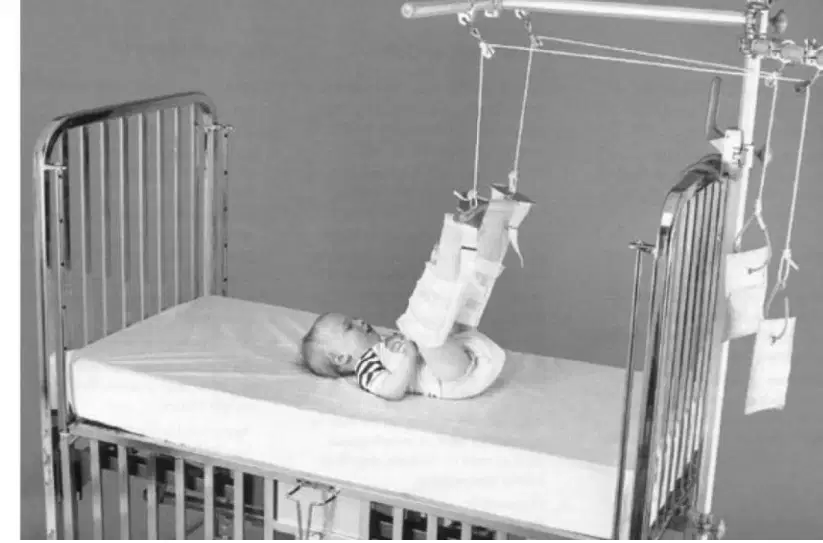
What should you do if, after lifting and releasing the buttocks in Bryant’s Traction, the child does not return to the “just clear” position?
Adjust the weights yourself until the child returns to the correct position.
Check with the attending physician regarding a possible change in the amount of weight.
Ignore the position and continue monitoring.
Remove the traction system immediately.
Which of the following is a dangerous complication that can occur with Bryant’s Traction?
Ischemic contractures
Bone fractures
Muscle sprain
Skin rash
How often should both feet be checked for color, pulse, motion, temperature, and sensation in a patient with Bryant’s Traction?
Every two hours
Every four hours
Once a day
Every thirty minutes
Where should you check for undue pressure when caring for a patient in Bryant’s Traction?
Over the outer head and neck of the fibula, on the dorsum of the foot, and on the Achilles tendon
Only on the heel
Only on the toes
Only on the knee
Why is it important to check both feet regularly in a patient with Bryant’s Traction?
To monitor for signs of compromised circulation and nerve function
To ensure the patient is comfortable
To keep the feet clean
To prevent muscle cramps
A nurse notices redness and swelling over the Achilles tendon in a child with Bryant’s Traction. What should the nurse do next?
Report the finding and adjust the traction to relieve pressure
Ignore it as it is a normal finding
Apply ice directly to the area
Remove the traction immediately
Which of the following is an important step when caring for a child in Bryant’s Traction?
Ensure that bandages, boots, etc., have not slipped and become bunched around the toes or ankles.
Change the traction weights daily.
Allow the child to walk with assistance.
Remove the traction device every hour.
Why are problems with Bryant’s Traction difficult to define in children?
Because the traction is always painful.
Due to the age of the child.
Because the equipment is too complex.
Due to frequent changes in traction type.
A nurse is planning care for a child in Bryant’s Traction. Which strategy best addresses the child’s inability to communicate wants and needs?
Regularly check for non-verbal cues indicating discomfort or needs.
Only provide care when the child cries.
Ignore the child’s behavior unless it is disruptive.
Wait for the child to verbally express their needs.
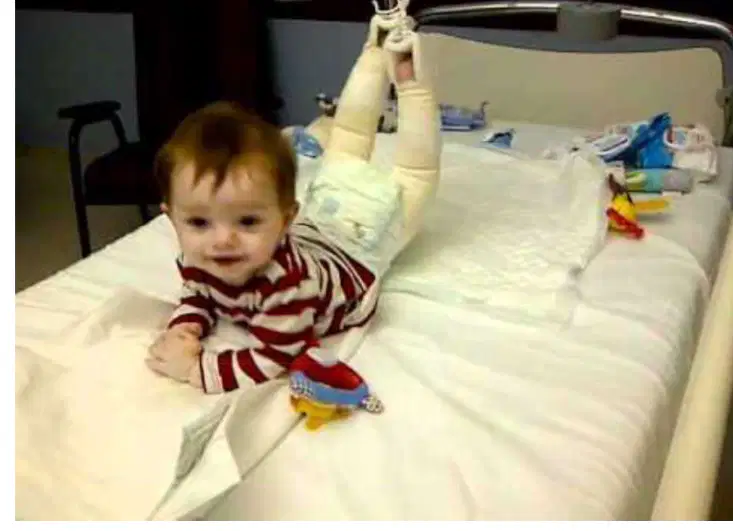
Why might it be necessary to use some form of jacket or restraint when a child is in Bryant’s traction?
To keep the child from rotating around the traction apparatus
To help the child sleep better
To prevent the child from eating
To make the child more comfortable
What is the primary purpose of using Modified Bryant's Traction in children?
To help reduce congenital hip dislocation
To treat broken arms
To improve lung function
To correct spinal curvature
How does Modified Bryant's Traction work when a child is lying on his back?
It holds the legs upright and gently stretches the child's leg using the weight on the traction
It bends the knees and supports the back
It immobilizes the arms and shoulders
It compresses the chest to aid breathing
Which structures are loosened by the use of Modified Bryant's Traction?
Ligaments, tendons, and muscles around the child's hip
Bones in the child's arm
Nerves in the child's spine
Blood vessels in the child's leg
A child is undergoing Modified Bryant's Traction. Explain why it is important for the traction to gently stretch the leg rather than apply excessive force.
Gentle stretching prevents injury to the ligaments, tendons, and muscles, allowing gradual loosening and reducing the risk of further damage.
Excessive force is needed to speed up the healing process.
Gentle stretching is only for comfort and has no medical benefit.
Excessive force helps to strengthen the bones faster.
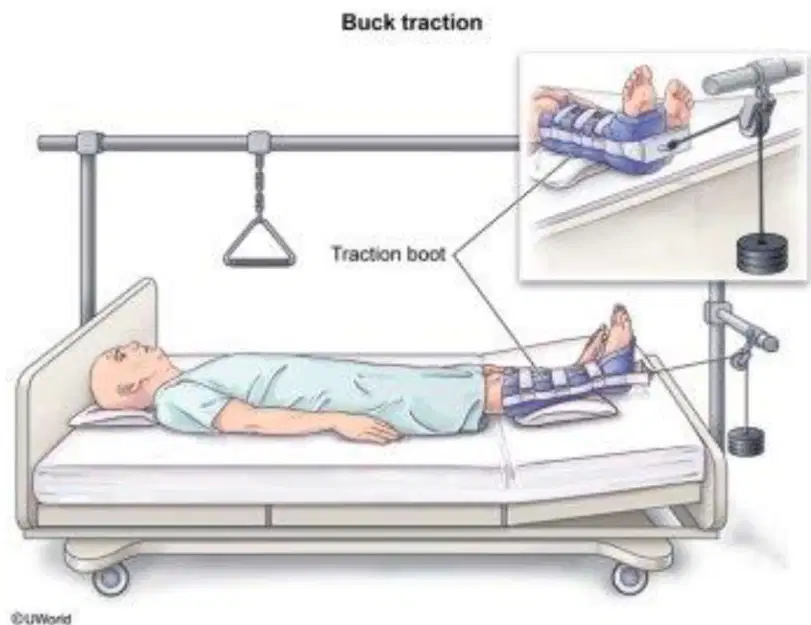
Which of the following best describes the correct position of a patient in Buck’s Traction?
The patient should be flat on their back with the foot of the bed elevated.
The patient should be sitting upright with the head of the bed elevated.
The patient should be lying on their stomach with the bed flat.
The patient should be in a side-lying position with the head of the bed lowered.
Which of the following is a key precaution when setting up Buck’s Traction?
Pulley bars must be placed so that the line of pull aligns distal to proximal.
The patient should be allowed to sit up as much as possible.
The traction boot should be removed every hour.
The weights should be placed on the bed.
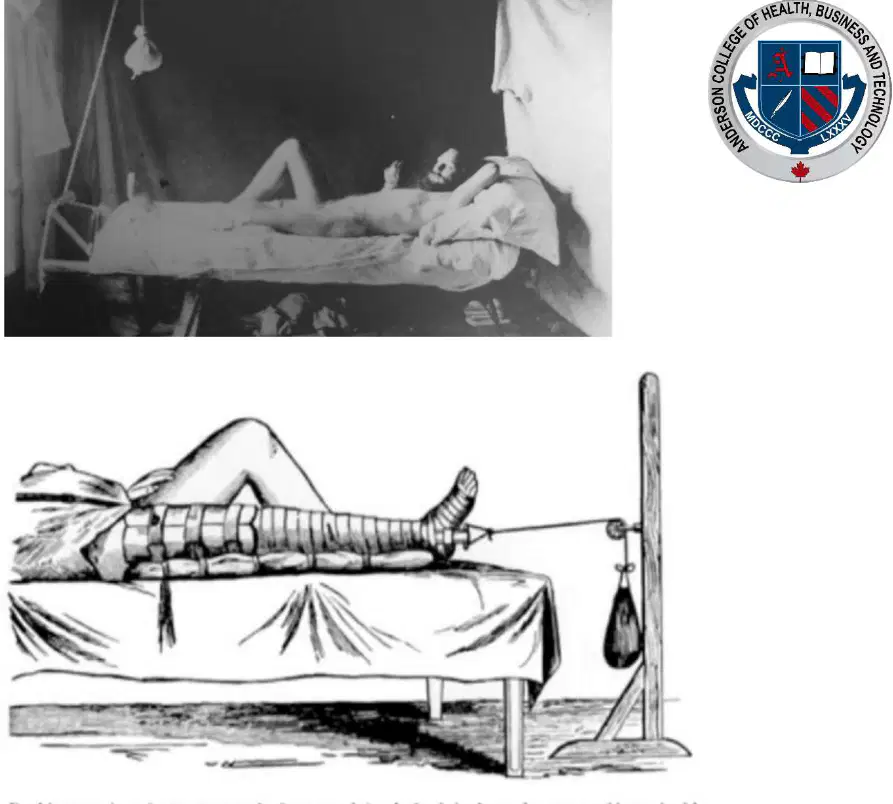
What is Buck’s traction primarily used for?
Bilateral arm traction
Unilateral leg traction (one leg)
Cervical spine traction
Pelvic traction
Explain why Buck’s traction might have been particularly useful during the American Civil War. Use reasoning and evidence from historical context.
It allowed for quick and easy amputation.
It provided a non-surgical method to stabilize leg fractures, which was crucial due to limited surgical resources and high rates of limb injuries.
It was used to treat head injuries.
It was primarily for spinal injuries.
Which of the following is NOT an indication for the use of Buck’s traction?
Trial treatment of nerve root disorders
Muscle spasms
Treatment of upper arm fractures
Minor fractures of the lower spine
What is the primary purpose of Buck’s unilateral leg traction?
To treat head injuries
To stabilize one leg, especially in cases of hip or femoral shaft fractures
To immobilize both arms
To treat abdominal pain
A patient with degenerative arthritis and knee injuries may benefit from which of the following treatments?
Buck’s traction
Cervical collar
Arm sling
Spinal fusion surgery
Explain why Buck’s traction might be chosen as a temporary stabilization method for fractured hips or femoral shaft fractures. Use evidence from the indications listed.
It provides permanent fixation of the bone.
It allows for temporary stabilization before definitive treatment.
It is only used for muscle spasms.
It is primarily for upper limb injuries.
What is the initial step in setting up Modified Bryant's Traction?
Bryant's traction is set up as usual.
Abduction of both hips is begun immediately.
The hips are fully abducted from the start.
Abduction is increased by 20 degrees daily.
After how many days is abduction of both hips begun in Modified Bryant's Traction?
Five days
One day
Ten days
Three weeks
By how many degrees is abduction increased on alternate days in Modified Bryant's Traction?
10 degrees
5 degrees
20 degrees
15 degrees
By what time frame should the hips be fully abducted in Modified Bryant's Traction?
Three weeks
One week
Five days
Ten days
Explain the rationale behind gradually increasing the abduction of both hips by about 10 degrees on alternate days in Modified Bryant's Traction.
To allow gradual adaptation and minimize complications.
To speed up the healing process as much as possible.
To avoid the need for any traction setup.
To ensure the hips remain immobile throughout.
What can happen if the wrappings are too tight across the dorsum of the foot when applying Buck’s Traction?
Excess pressure can cause severe complications.
The traction will be more effective.
The patient will feel less pain.
The adhesive will not stick properly.
Which material is suggested to be used near the ankles to cover the adhesive side of Skin-Trac Traction Strips?
Strips of felt or sheet wadding
Plastic wrap
Cotton balls
Band-aids
When planning to apply Buck’s Traction, what should you consider to avoid complications related to pressure?
Ensure wrappings are not too tight across the dorsum of the foot.
Use extra adhesive for better grip.
Apply heat to the area before wrapping.
Wrap the foot as tightly as possible.
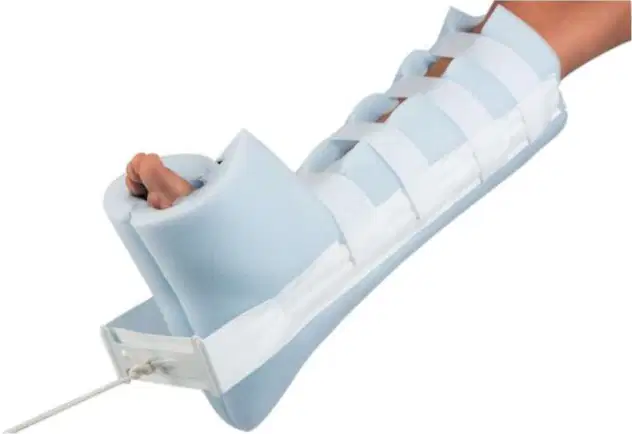
Why is it important to ensure that the heels are not digging into the mattress when a patient is in Buck’s Traction?
To prevent irritation and skin breakdown
To increase blood flow to the toes
To reduce swelling in the knee
To strengthen the calf muscles
What can be placed under the full length of the calf to keep the heels off the bed in Buck’s Traction?
Small foam pads or folded blankets
Ice packs
Heating pads
Wooden boards
What complication may occur if pressure is not kept off the peroneal nerve during Buck’s Traction?
Foot drop
Skin rash
Muscle cramps
Swelling of the thigh
A patient in Buck’s Traction complains of numbness in their foot. Using your reasoning skills, what should you check for first?
Pressure on the peroneal nerve
The tightness of the bed sheets
The temperature of the room
The patient’s hydration status
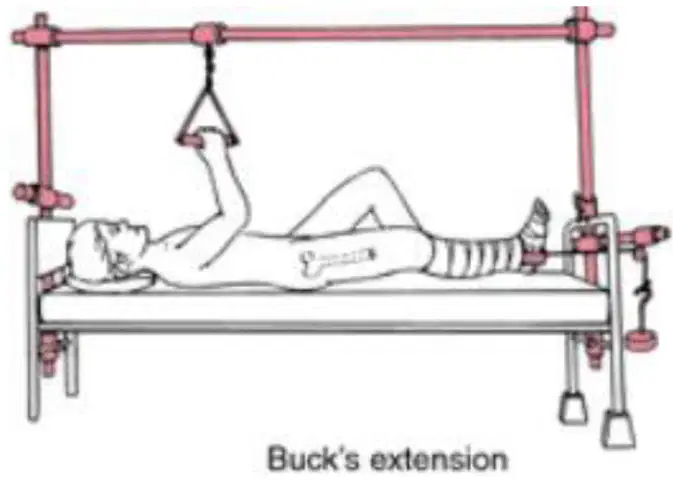
Which of the following is a purpose of using a bed cradle in Buck’s traction?
To keep bed covers from resting on the feet
To help the patient sit up in bed
To provide additional traction to the leg
To support the patient’s back
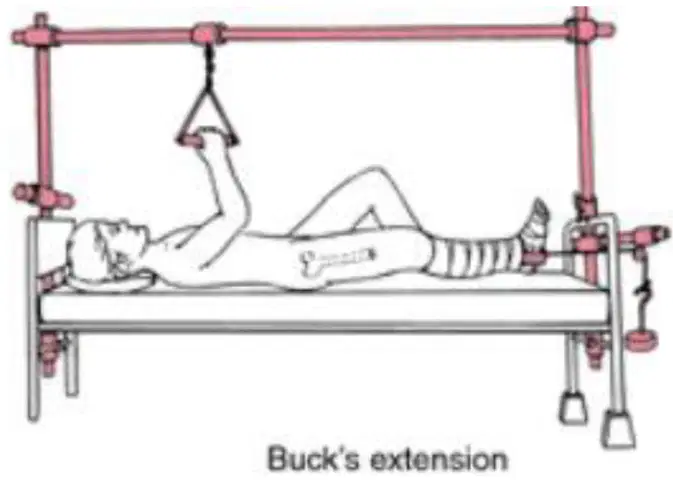
Why should a patient in Buck’s traction be encouraged to perform both active and passive exercises as tolerated?
To prevent muscle atrophy and promote circulation
To increase the weight of the traction
To reduce the need for a bed cradle
To allow the patient to remove the traction
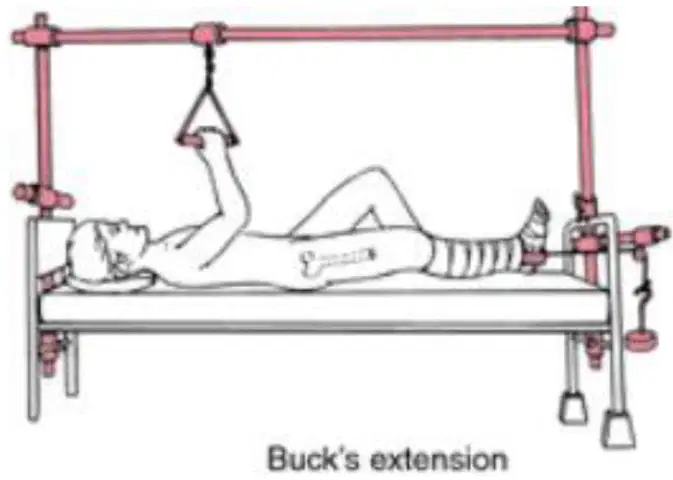
What is the recommended method for a patient in Buck’s traction to move about in bed?
By using the trapeze
By pulling on the bed covers
By pushing with their feet
By rolling to one side
What is the primary method by which skeletal traction applies force to the skeleton?
By using a cast around the limb
By attaching weights to the skin
By driving a metal pin or wire through the bone
By using elastic bands around the joint
In which situation is skeletal traction most frequently used?
Management of upper limb fractures
Management of lower limb fractures
Treatment of muscle strains
Correction of spinal deformities
Why should skeletal traction be reserved for cases where skin traction is contraindicated?
Because it is less effective than skin traction
Because it is more expensive than skin traction
Because it involves a higher risk of complications
Because it is easier to apply than skin traction
What is a serious complication associated with skeletal traction?
Muscle cramps
Osteomyelitis
Skin rash
Joint dislocation
A patient with a lower limb fracture cannot undergo skin traction due to a skin condition. What is the most appropriate alternative, and what risk should be considered?
Use skeletal traction; monitor for osteomyelitis
Use a cast; monitor for muscle atrophy
Use elastic bandages; monitor for swelling
Use physical therapy; monitor for pain
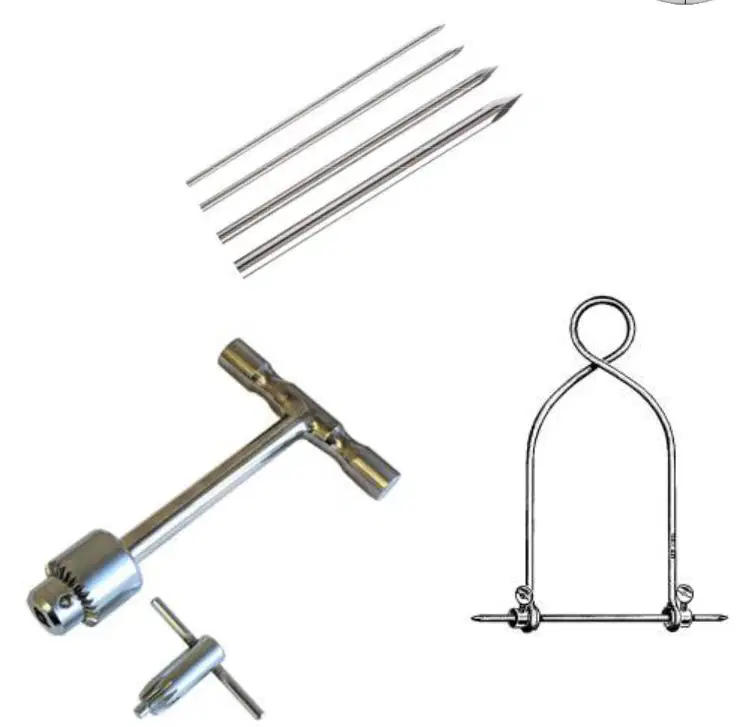
Which of the following best describes a Steinmann pin as used in skeletal traction?
A flexible plastic rod used for bone alignment
A rigid stainless-steel pin of varying lengths, 4 to 6 millimeters in diameter
A rubber band used to provide tension
A wooden dowel for external fixation
What is the primary function of the Bohler stirrup when attached to a Steinmann pin?
To increase the length of the pin
To allow the direction of traction to be varied without turning the pin in the bone
To secure the pin to the skin
To sterilize the pin after insertion
After the insertion of a Steinmann pin, what is the next step in the application of skeletal traction?
The pin is removed immediately
A special stirrup (Bohler, 1929) is attached to the pin
The pin is bent to fit the bone
The pin is covered with a cast
Explain why the Bohler stirrup is important in the application of skeletal traction, and discuss how it improves the procedure compared to simply turning the pin in the bone.
It prevents infection by covering the pin
It allows for adjustment of traction direction without rotating the pin, reducing bone damage
It increases the weight applied to the traction
It shortens the healing time by compressing the bone
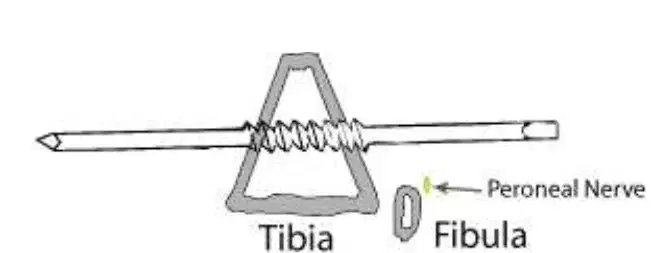
Which feature distinguishes a Denham pin from a Steinmann pin?
The Denham pin is longer than the Steinmann pin.
The Denham pin has a short raised threaded length near the end held in the introducer.
The Denham pin is made of a different metal than the Steinmann pin.
The Denham pin is only used in children.
What is the primary function of the threaded portion on a Denham pin?
To make the pin easier to remove
To engage the bony cortex and reduce the risk of the pin sliding
To increase the weight-bearing capacity of the pin
To allow for electrical stimulation
For which type of bone is the Denham pin particularly suitable?
Compact bone in the femur
Cancellous bone such as the calcaneus or osteoporotic bone
Cartilage in the knee joint
Dense bone in the skull
Explain why the Denham pin is preferred over other pins for use in osteoporotic bone. Use evidence from the description to support your answer.
Because it is less expensive than other pins
Because its threaded portion engages the bony cortex, reducing the risk of sliding, which is important in weaker, osteoporotic bone
Because it is easier to sterilize
Because it is shorter and causes less pain
Which of the following best describes the method to determine the site of insertion for a Steinmann pin at the distal femur?
Draw a line anteriorly at the level of the lower pole of patella and a second line from above downwards just posterior to the head of tibia.
Draw a line posteriorly at the level of the upper pole of patella and a second line from below upwards just anterior to the head of fibula.
Draw a line medially at the level of the upper pole of patella and a second line from below upwards just posterior to the head of fibula.
Draw a line laterally at the level of the lower pole of patella and a second line from above downwards just anterior to the head of tibia.
What is the significance of the intersection point of the two lines drawn as described in the application of skeletal traction for the distal femur?
It marks the location for incision of the skin.
It is the site of insertion of a Steinmann pin.
It indicates the end of the femur.
It is used to measure the length of the femur.
Which bone is specifically mentioned as a reference point for drawing the second line when determining the site of insertion at the distal femur?
Tibia
Patella
Fibula
Humerus
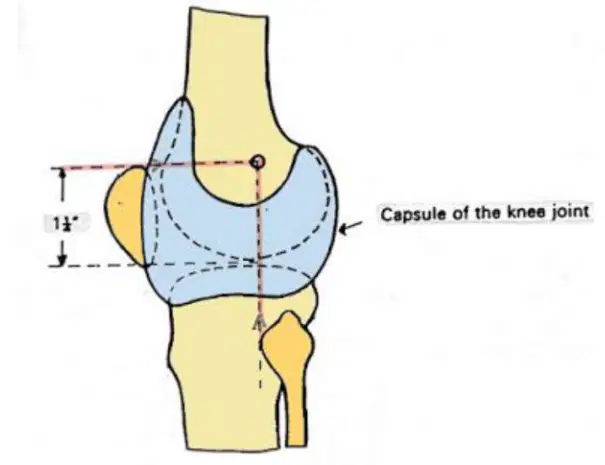
What anatomical structure is used as a reference for drawing the first line in determining the insertion site for skeletal traction at the distal femur?
Lower pole of patella
Upper pole of patella
Head of tibia
Shaft of femur
Which site is commonly used for the application of skeletal traction?
Proximal Tibia
Distal Femur
Proximal Humerus
Distal Radius
When applying skeletal traction to the distal femur, how far proximal to the articulation between the lateral femoral condyle and the lateral tibial plateau should the pin be inserted?
0.5 inches (1.25 cm)
2 inches (5 cm)
1.25 inches (3 cm)
3 inches (7.5 cm)
What is the correct direction for inserting the pin during skeletal traction of the distal femur?
Medial to lateral
Anterior to posterior
Lateral to medial
Superior to inferior
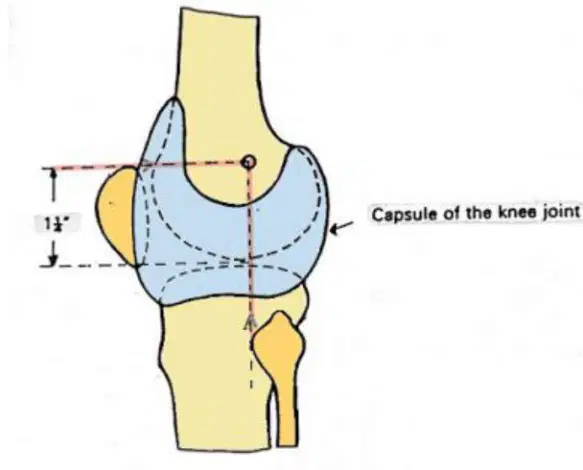
Explain the reasoning behind the recommendation to insert the pin lateral to medial and avoid the knee joint capsule during skeletal traction application to the distal femur.
To ensure the pin is more comfortable for the patient
To prevent damage to the joint and reduce the risk of complications
To make the procedure faster
To allow for easier removal of the pin
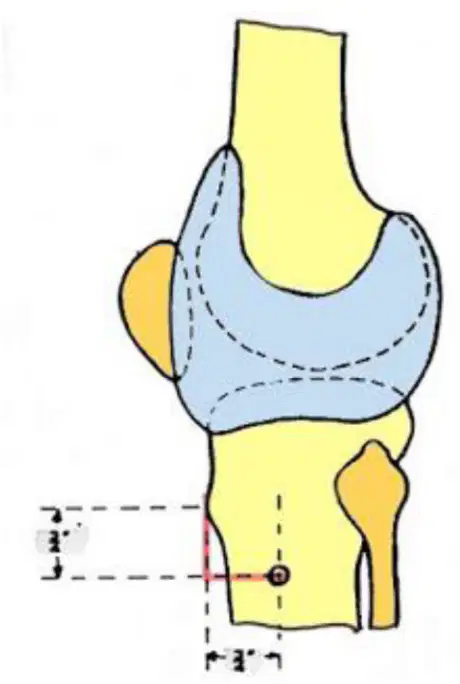
What is the correct site for the application of skeletal traction on the proximal tibia?
0.75 inch (2 cm) posterior and inferior to the tibial tuberosity
1 inch (2.5 cm) anterior to the tibial tuberosity
0.5 inch (1 cm) superior to the tibial tuberosity
2 inches (5 cm) lateral to the tibial tuberosity
In which direction should skeletal traction be applied to the proximal tibia to avoid nerve damage?
Medial to lateral
Lateral to medial
Superior to inferior
Inferior to superior
Why is it important to avoid damaging the common peroneal nerve during the application of skeletal traction to the proximal tibia?
It can cause severe bleeding
It can result in loss of knee stability
It can lead to nerve injury and possible foot drop
It can cause infection in the bone
A patient requires skeletal traction to the proximal tibia. As a healthcare provider, how would you plan the procedure to minimize complications?
Apply traction from medial to lateral and avoid the tibial tuberosity
Apply traction 0.75 inch (2 cm) posterior and inferior to the tibial tuberosity, from lateral to medial, and avoid the common peroneal nerve
Apply traction directly on the tibial tuberosity from superior to inferior
Apply traction 2 inches (5 cm) above the tibial tuberosity from medial to lateral
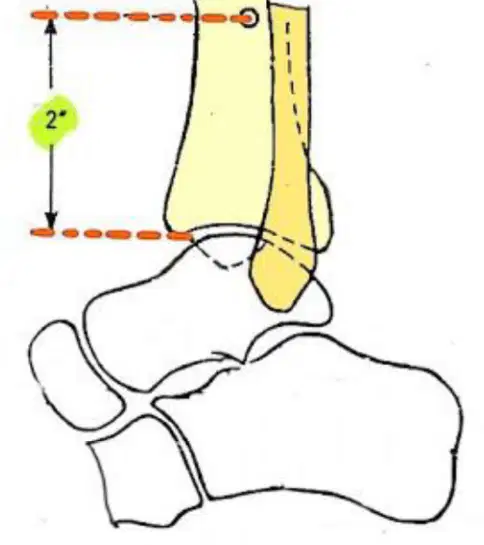
At what specific location is skeletal traction applied to the distal tibia?
2 inches above the level of the ankle joint, midway between anterior and posterior tibia
Directly on the ankle joint
5 inches below the knee joint
On the lateral side of the tibia only
What is the correct direction for applying skeletal traction to the distal tibia?
Medial to lateral
Lateral to medial
Anterior to posterior
Posterior to anterior
Why is it important to apply skeletal traction midway between the anterior and posterior tibia when treating the distal tibia?
To ensure even distribution of force and avoid injury to surrounding structures
To increase the speed of bone healing
To reduce the need for anesthesia
To prevent infection at the site
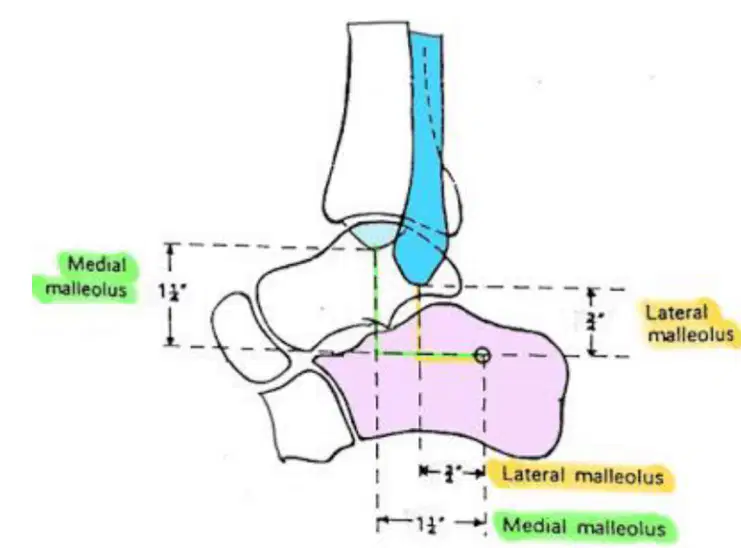
At what site should skeletal traction be applied to the calcaneum according to the provided guidelines?
0.75 inch (2 cm) below and behind the lateral malleolus
Directly on the lateral malleolus
2 inches above the medial malleolus
1 inch in front of the subtalar joint
Which anatomical structure should be avoided when applying skeletal traction to the calcaneum?
Subtalar joint
Lateral malleolus
Medial malleolus
Tibial shaft
If the site for skeletal traction is chosen as 0.75 inch (2 cm) below and behind the lateral malleolus, what is the corresponding point relative to the medial malleolus?
1.25 inches below and behind the medial malleolus
0.5 inch above the medial malleolus
2 inches in front of the medial malleolus
1.25 inches above the medial malleolus
Why is it important to avoid entering the subtalar joint during the application of skeletal traction to the calcaneum?
To prevent joint damage and complications
To increase the effectiveness of traction
To ensure the bone heals faster
To avoid unnecessary pain
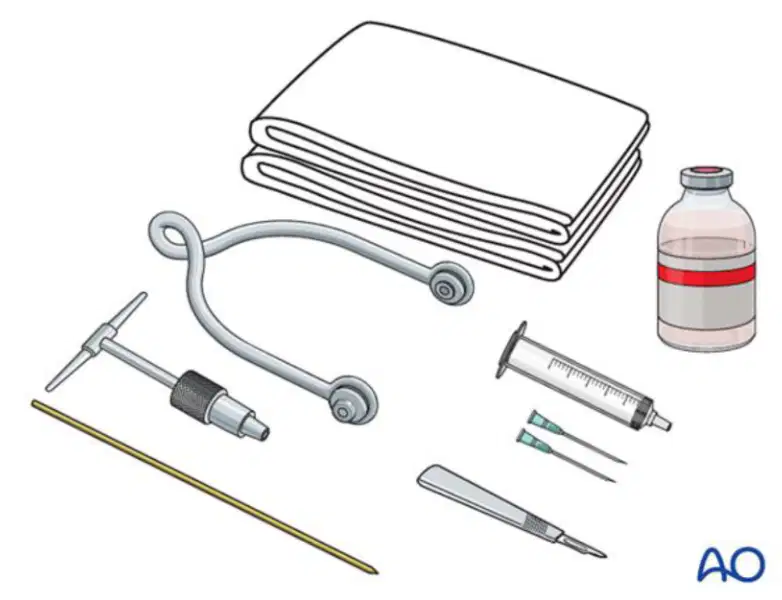
Which of the following items is NOT typically included in the preparation pack for the application of skeletal traction?
Sterile towels
Disinfectant
Bandages
Syringe
Which tool is specifically used to drive the Steinmann pin into the bone during skeletal traction?
Syringe
Jacobs chuck with T-handle
Scalpel with pointed blade
Stirrup
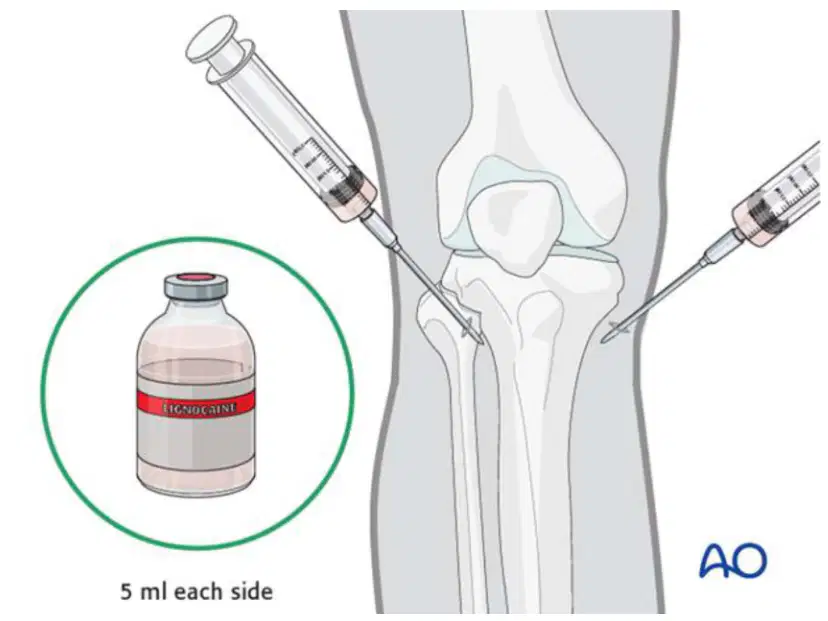
What is the concentration and volume of local anaesthesia typically injected on each side of the tibial tuberosity during the application of skeletal traction?
5 ml of 2% lignocaine
10 ml of 1% lignocaine
2 ml of 5% lignocaine
5 ml of 1% lignocaine
What is the purpose of infiltrating local anaesthesia down to the periosteum during the application of skeletal traction?
To numb the bone and surrounding tissues for pin insertion
To sterilize the skin before surgery
To reduce swelling in the joint
To increase blood flow to the area
Explain the reasoning behind injecting local anaesthesia both laterally and medially at the proposed site of pin insertion during skeletal traction.
To ensure complete anaesthesia at both the entry and exit points of the pin
To reduce the risk of infection
To increase the speed of the procedure
To avoid damaging the bone
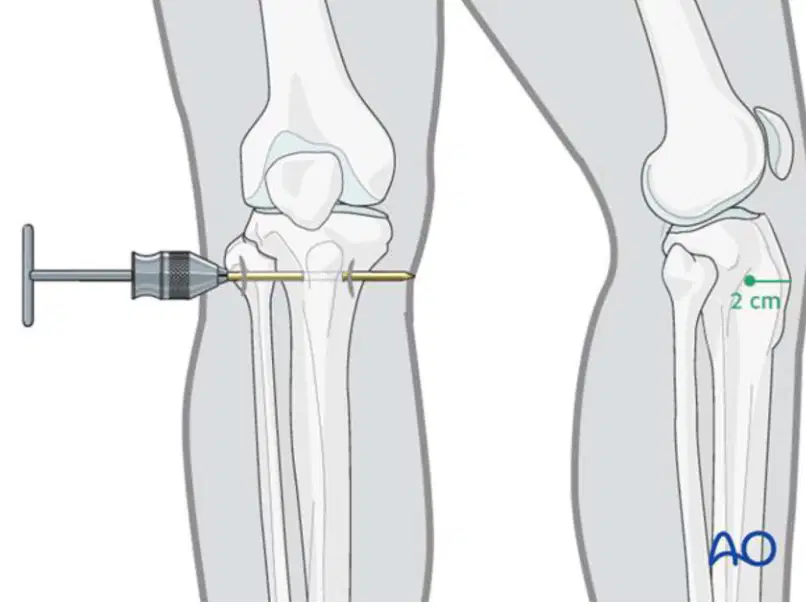
At what point is a Steinmann or Denham pin inserted during the application of skeletal traction?
About 2 cm dorsal to the tibial tuberosity
Directly on the tibial tuberosity
5 cm above the knee joint
At the midpoint of the femur
What is the purpose of checking the exit point of the pin during skeletal traction application?
To ensure it coincides with the area of local anesthetic infiltration
To avoid hitting the patella
To measure the length of the pin
To prevent infection
Which instrument is used to make the initial incision for pin insertion in skeletal traction?
Pointed scalpel
Bone saw
Surgical scissors
Needle holder
In Modified Bryant’s Traction, why is gradual abduction of the hips preferred over immediate full abduction?
To reduce the risk of vascular compromise and allow tissues to adapt
To prevent the need for any monitoring
To speed up the healing process
To make the setup easier for caregivers

