
 Worksheets
Geography and History of China Quiz
Total questions: 92
Worksheet time: 46mins
Where is the modern-day country of China located?
South America
East Asia
Europe
Africa
Which river in northern China is known for often flooding?
Amazon River
Nile River
Huang He River
Mississippi River
What is the Chang Jiang River known for?
Being the shortest river in Asia
Being the longest river in Asia
Being the widest river in Asia
Being the deepest river in Asia
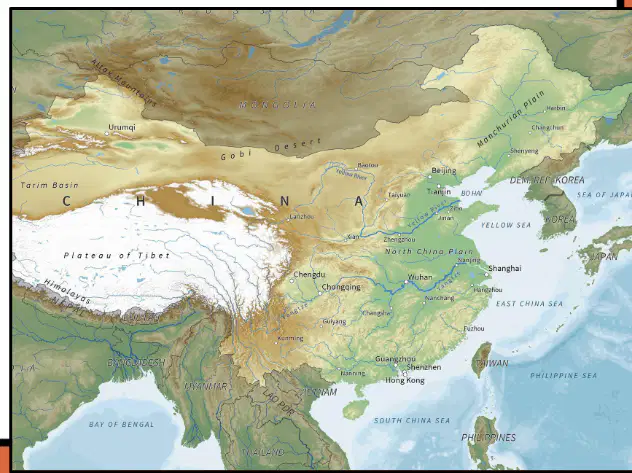
Around what year did the earliest settlements form along the Huang He and Chang Jiang Rivers?
3000 BCE
4000 BCE
5000 BCE
6000 BCE
Why is the Huang He River called the Yellow River?
Because of the loess that turns the water yellow
Due to the presence of gold in the river
Because of the yellow fish found in the river
Due to the yellow flowers along the banks
What is loess?
A type of fish
A dusty material that becomes soil
A kind of plant
A type of rock
Where does the loess in the Huang He River come from?
The Himalayas
The Gobi Desert
The Pacific Ocean
The Amazon Rainforest
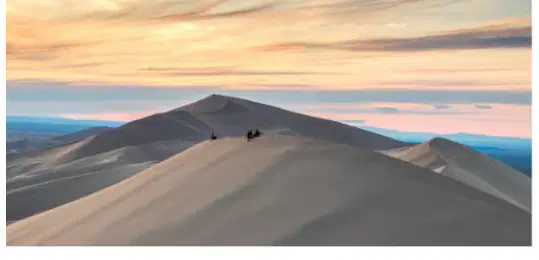
What is the Gobi Desert known for?
Being a tropical rainforest
Covering much of northern China
Having many rivers
Being a snowy region
Why is the Huang He River also called “China’s Sorrow”?
Because it is very long
Due to its destructive floods
Because it is very deep
Due to its beautiful scenery
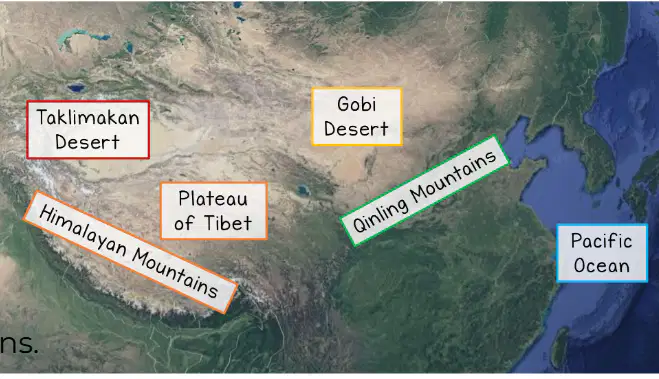
Which natural barrier is located to the north of China?
Qinling Mountains
Gobi Desert
Pacific Ocean
Taklimakan Desert
What effect did geography have on travel and communication in China?
Made it easier to travel and communicate
Had no effect on travel and communication
Made travel and communication difficult
Improved communication but not travel
Why was it challenging for governments to maintain control over Chinese territory?
Because of frequent invasions
Due to the expansion of regions
Because of lack of resources
Due to internal conflicts
What was the nature of early Chinese religion?
Monotheistic
Atheistic
Polytheistic
Agnostic
What role did dragons play in early Chinese culture?
They were feared as destructive creatures.
They were seen as powerful and kind, bringing rain.
They were worshipped as gods of war.
They were considered evil spirits.
Who was the supreme god that the Chinese focused on by 1600 BCE?
Zeus
Shangdi
Odin
Ra
What did the Chinese believe Shangdi controlled?
Only the weather
Success or failure in war, the harvest, the weather, and overall well-being
Only the harvest
Only family matters
Why did people pray to the spirits of their ancestors?
They believed ancestors could bring them wealth
They thought Shangdi was too busy to help them
They wanted to avoid bad luck
They were forced to by law
How did family members honor their ancestors?
By building large monuments
Through shrines, food offerings, and rituals
By writing poems
By singing songs
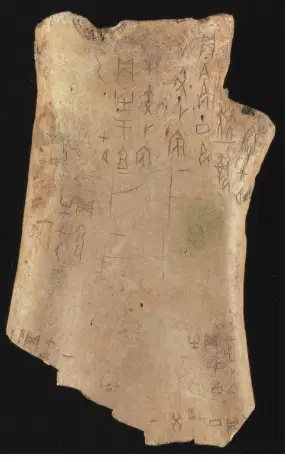
What were oracle bones used for in ancient China?
Cooking food
Communicating with ancestors
Building houses
Writing poetry
What materials were oracle bones typically made from?
Wood and stone
Oxen shoulder blades and turtle shells
Metal and clay
Silk and paper
How did priests interpret the answers from oracle bones?
By reading the stars
By listening to the wind
By interpreting the cracks formed by heating
By observing animal behavior
Who primarily used oracle bones in ancient China?
Farmers
Merchants
Rulers
Artists
What period did the civil wars in China occur according to the text?
600-500 BCE
475-221 BCE
300-200 BCE
700-600 BCE
Who were the philosophers that preached philosophies during the period of conflict in China?
Socrates and Plato
Confucius and Laozi
Aristotle and Pythagoras
Descartes and Kant
What was the main concern of many thinkers about the Chinese government during the period of conflict?
It was too powerful
It was corrupt and ineffective
It was too democratic
It was too small
What did Confucius focus on restoring through his set of beliefs?
Wealth and power
Decency and respect
Fear and control
Innovation and technology
What approach did Laozi encourage ?
Harmony with nature
Aggression and dominance
Isolation and solitude
Competition and rivalry
What does Confucianism focus on instead of religious ideas?
Morals and behavior
Prayers and gods
Afterlife and rituals
Supernatural beliefs
According to Confucius, what is necessary for an ethical and orderly society?
Wealth and power
Filial piety and strong family relationships
Military strength
Technological advancement
What is the meaning of filial piety in Confucianism?
Respect for one's parents and elders
Obedience to the government
Worship of ancestors
Loyalty to friends
What did Confucius believe rulers should be to inspire their people?
Wealthy and powerful
Honorable and lead by example
Fearful and strict
Charismatic and entertaining
What is an early version of the Golden Rule according to Confucius?
Do not impose on others what you do not desire.
Treat others as they treat you.
Always seek revenge for wrongs.
Help others only if they help you.
What is the Dao in Daoism?
A visible force that connects all living things
An invisible force that connects all living things
A symbol of power and strength
A type of meditation practice
What does the Yin and Yang symbol represent in Daoism?
Conflict between two forces
Harmony between two opposite forces
The power of light over darkness
The struggle between good and evil
According to Daoism, what is the benefit of being flexible and going with the flow?
It leads to more conflict
It results in more happiness
It causes more stress
It creates more challenges
In Daoism, what is the significance of balance in life?
It is only important in nature
It is important in all areas of life
It is not considered important
It is only important in relationships
Who founded Buddhism and when did it come to China?
Confucius, 1st century CE
Siddhartha Gautama, 530 BCE
Laozi, 500 BCE
Mahavira, 600 BCE
How did Buddhism come to China?
Through military conquest
Through trade routes
Through migration
Through sea voyages
Which religions are practiced in China and other parts of the world today?
Hinduism, Jainism, Sikhism
Christianity, Islam, Judaism
Confucianism, Daoism, Buddhism
Zoroastrianism, Shinto, Taoism
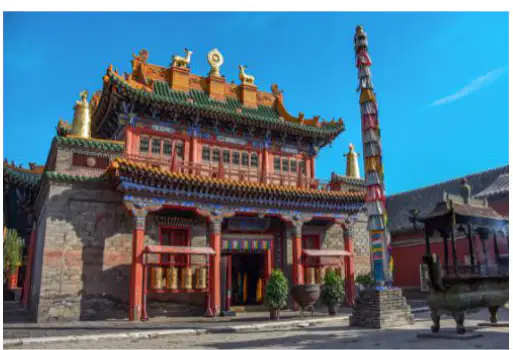
Where is the largest number of followers of Confucianism, Daoism, and Buddhism located?
South America
East Asia
North America
Europe
Who began the construction of the Great Wall of China?
Emperor Wu of Han
Qin Shi Huangdi
Emperor Gaozu of Han
Emperor Taizong of Tang
What was the original purpose of the Great Wall of China?
To serve as a trade route
To defend against the Xiongnu
To mark the southern border
To promote tourism
During which years was the Great Wall of China constructed under Qin Shi Huangdi?
300 BCE to 250 BCE
221 BCE to 206 BCE
200 BCE to 150 BCE
250 BCE to 200 BCE
Who were the Great Wall of China originally built to defend against?
The Mongols
The Xiongnu
The Huns
The Turks
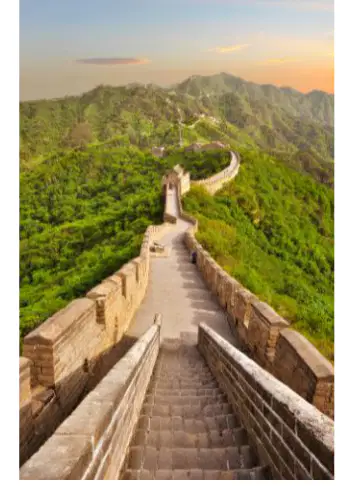
What role did the Great Wall of China play in trade?
It blocked all trade routes
It protected merchants along trade routes
It served as a marketplace
It was used to tax traders
Which dynasty built the Great Wall that exists today?
Han Dynasty
Ming Dynasty
Tang Dynasty
Qing Dynasty
What materials were used in the early version of the Great Wall?
Wood and straw
Steel and concrete
Clay, rocks, and soil
Bricks and mortar
How high was the early version of the Great Wall?
10 feet
20 feet
30 feet
40 feet
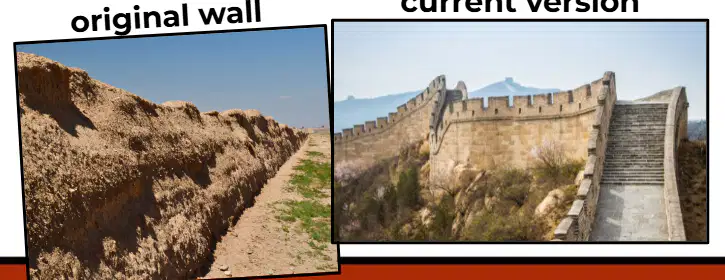
What is a common misconception about the Great Wall?
It is made of gold
It is a single continuous wall
It was built in one year
It is located in Europe
What was one of the main reasons the original Great Wall was not a source of pride for the people in ancient China?
It was built too quickly
It required an enormous human cost
It was not tall enough
It was made of weak materials
Who were some of the people forced to build the Great Wall under Qin Shi Huangdi?
Farmers and merchants
Artists and musicians
Prisoners and soldiers
Teachers and scholars
What were some of the dangerous conditions faced by workers building the Great Wall?
Lack of food and water
Hunger, sickness, and extreme temperatures
Attacks from wild animals
Frequent earthquakes
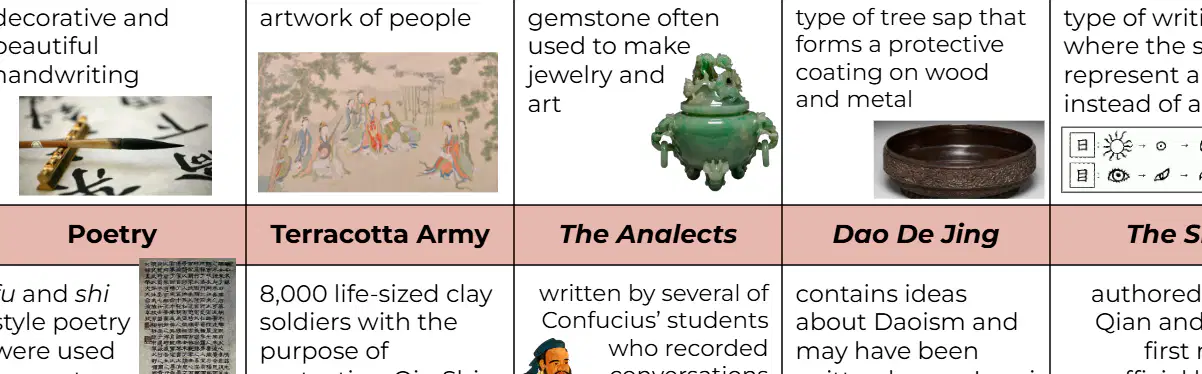
What is calligraphy known for?
Artwork of people
Decorative and beautiful handwriting
Type of tree sap
Life-sized clay soldiers
What is jade commonly used for?
Making jewelry and art
Writing symbols
Creating poetry
Coating wood and metal
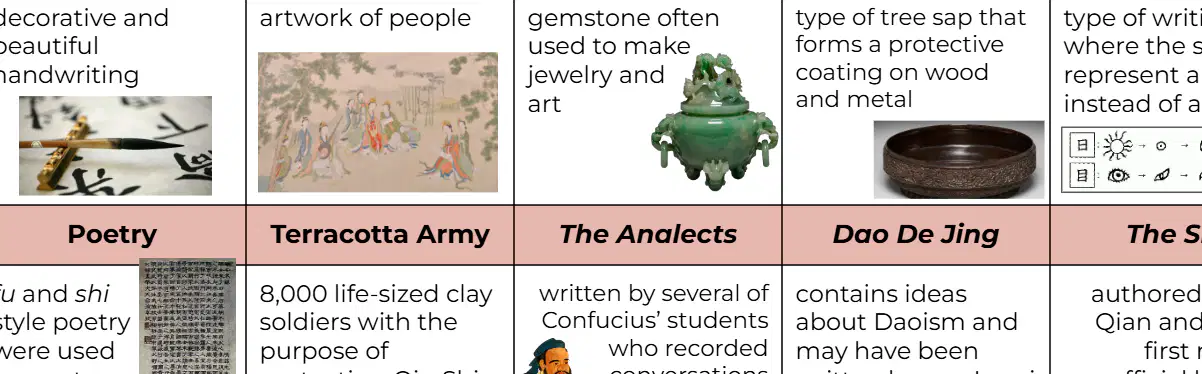
What is the purpose of lacquer?
To create life-sized soldiers
To form a protective coating on wood and metal
To write historical records
To paint figures
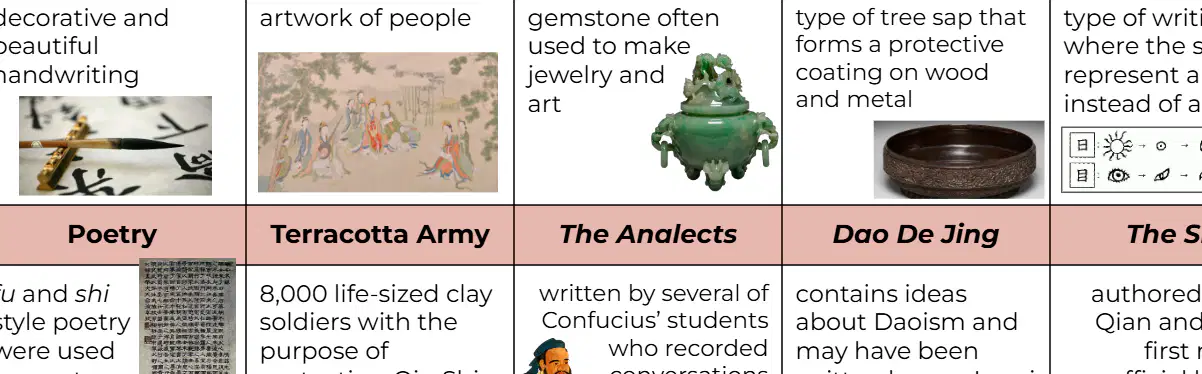
What are logographs?
Type of tree sap
Symbols representing a word instead of a sound
Style of poetry
Gemstone used in art
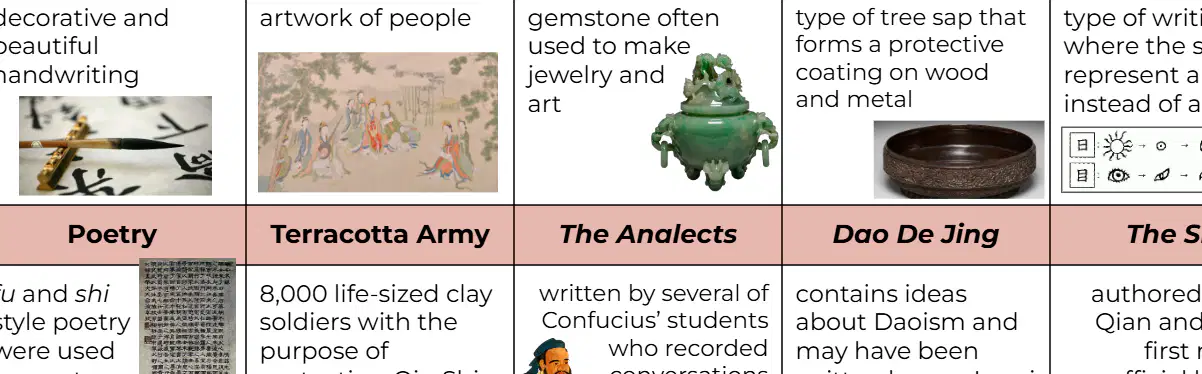
What was the purpose of the Terracotta Army?
To record conversations
To protect Qin Shi Huangdi in his afterlife
To spread Confucianism
To write about Daoism
What material, made from silkworms, became China’s main trading export?
Cotton
Wool
Silk
Linen
What is the purpose of a seismograph?
To measure temperature
To detect earthquakes
To track time
To plant seeds
Which invention was used for military communication and measuring distance?
Wheelbarrow
Kite
Crossbow
Sundial
What does a sundial use to tell time?
Water
Shadows from the sun
Plant fibers
Needles
What is the main ingredient in tea, according to legend?
Milk
Hot water
Sugar
Honey
What is the function of a seed drill?
To detect earthquakes
To plant seeds at precise measurements
To measure time
To produce silk
What is a crossbow an improvement of?
Sword
Bow and arrow
Spear
Shield
What is paper made from?
Metal fibers
Plant fibers
Animal fibers
Synthetic fibers
What does a wheelbarrow help to move?
Water
Large amounts of material
Air
Light
What method involves inserting needles into the skin to stop pain and cure disease?
Acupuncture
Surgery
Massage
Herbal therapy
What type of government was ancient China originally under?
Democracy
Monarchy
Republic
Oligarchy
Who usually inherited power in ancient Chinese dynasties?
Daughter
Cousin
Son
Friend
What is a dynasty?
A group of merchants
A group of rulers from the same family
A group of soldiers
A group of farmers
Which dynasty ruled China from 1600 to 1046 BCE?
Xia Dynasty
Shang Dynasty
Zhou Dynasty
Han Dynasty
How do historians organize the events of Chinese history?
By wars
By inventions
By the reigns of each dynasty
By trade routes
Why do historians debate the existence of the Xia Dynasty?
There are no written records and little archaeological evidence.
It was founded by Yu the Great.
It had a strong irrigation system.
It was the first dynasty in China.
What major project did Yu the Great undertake to control flooding?
Building the Great Wall
Creating an irrigation system
Constructing the Forbidden City
Developing a new calendar
Which river's flooding did Yu the Great aim to control?
Yangtze River
Mekong River
Yellow River
Ganges River
What did Shang rulers use to communicate with past ancestors and the supreme god Shangdi?
Oracle bones
Scrolls
Statues
Temples
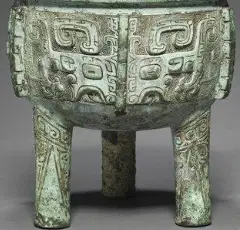
What was one of the responsibilities of Shang leaders?
Building walled cities
Writing poetry
Teaching philosophy
Painting murals
What concept did the Zhou Dynasty create to justify their rule?
Divine Right of Kings
Mandate of Heaven
Rule of Law
Heavenly Order
What would cause a dynasty to lose the Mandate of Heaven?
Becoming wealthy
Expanding territory
Becoming corrupt or abusive
Building monuments
What was one reason the Zhou Dynasty could not rule effectively?
The land was too small.
The people were not loyal.
China had grown larger after conquering new territory.
The kings were not powerful.
Who were the individuals that kings divided their land among during the Zhou Dynasty?
Farmers
Lords
Soldiers
Merchants
What did the lords provide to the Zhou Dynasty in exchange for land?
Money
Crops
Loyalty, taxes, and soldiers
Trade goods
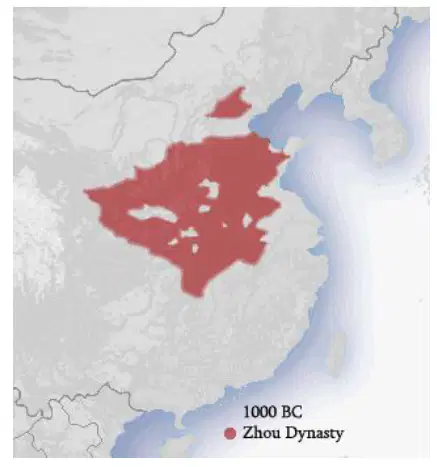
What is the social system called where lords give land to less wealthy farmers?
Capitalism
Socialism
Feudalism
Communism
What happened to the feudal system during the Warring States Period?
It became stronger
It fell apart as lords felt less allegiance to the Zhou
It expanded to new territories
It was replaced by a democratic system
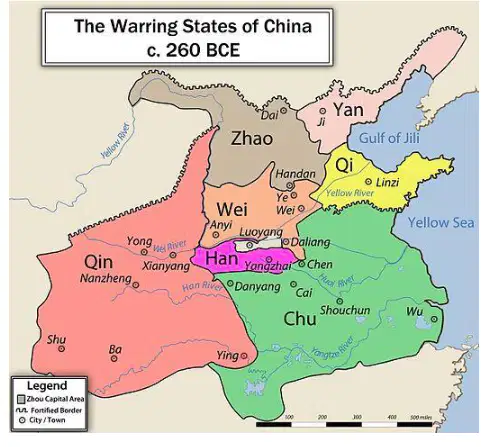
During the Warring States Period, what was the Zhou dynasty's role?
They had full control over the states
They continued to rule in theory but had little authority
They were completely overthrown
They expanded their territory significantly
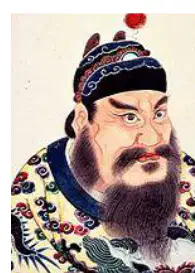
Who declared himself Qin Shi Huangdi, the first emperor of Qin?
King Ying Zheng
Emperor Wu
King Zhou
Emperor Gaozu
What does the name "Qin" (pronounced "chin") refer to in Chinese history?
A type of ancient Chinese music
A dynasty that unified China
A famous Chinese philosopher
A traditional Chinese festival
How did Shi Huangdi's government differ from the Zhou Dynasty's system?
It was based on a feudal system
It gave power to local lords
It centralized power under the emperor
It allowed for democratic elections
What was a significant change in government jobs under Shi Huangdi?
Jobs were inherited from family
Jobs were given by local lords
Jobs were assigned directly by the emperor
Jobs were chosen by public vote
What did Shi Huangdi standardize to make people's experiences the same in China?
Language and religion
Clothing and food
Parts of life such as laws and currency
Education and art
What was required to be uniform across all vehicles during the Qin Dynasty?
The color of the wheels
The length of axles
The type of fuel used
The height of the vehicles
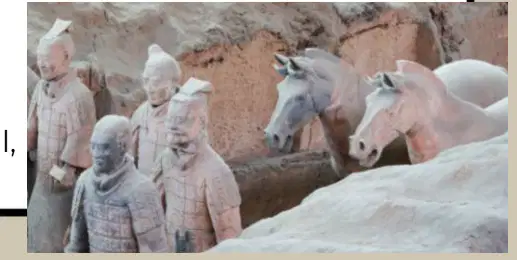
Which massive building projects were constructed under Shi Huangdi's rule?
The Eiffel Tower and the Statue of Liberty
The Great Wall, the Grand Canal, and the Terracotta Army
The Pyramids and the Sphinx
The Colosseum and the Parthenon

