
NEW
Font size
 Worksheets
Study Guide (1-5)
Total questions: 61
Worksheet time: 1hrs 1mins
Which of the following best describes metabolism? ________
the cycling of energy
the breakdown of water
the process of photosynthesis
the movement of muscles
Isotopes are ________
variant forms of atoms that have different numbers of neutrons and a different mass
atoms with the same number of protons and neutrons
elements that cannot combine with others
molecules formed by the combination of two atoms
Protein, lipid, nucleic acid, and carbohydrate are based on which one of the following elements?
Carbon
Oxygen
Nitrogen
Calcium
Which of the following molecules does not contain carbon?
Water
Glucose
Methane
Carbon dioxide
Which of the following is an example of genetic material?
DNA
Water
Glucose
Oxygen
Breakdown of complex carbohydrates begins in which organ in the human digestive system?
Mouth
Stomach
Small intestine
Esophagus
Most of the absorption of nutrients other than water, such as amino acids and nucleotides, takes place in which organ of the human digestive system?
Small Intestine
Stomach
Large Intestine
Esophagus
Breakdown of proteins begins in which organ of the human digestive system?
Stomach
Mouth
Large intestine
Esophagus
The majority of water absorption takes place in which organ of the human digestion system?
Large Intestines
Stomach
Esophagus
Mouth
Which one of the following in the human digestive helps neutralize stomach acid when it enters the small intestine?
Pancreatic Juices
Salivary Amylase
Gastric Juices
Bile
The ring-shaped muscle that prevents food from backtracking through the digestive system is which one of the following?
Sphincter
Villus
Alveolus
Nephron
What does the "12" in the chemical formula for glucose (C6H12O6) indicate?
there are 12 hydrogens in the atom
there are 12 carbons in the atom
there are 12 oxygens in the atom
there are 12 molecules of glucose
A molecule that dissolves easily in water is called which one of the following?
Hydrophilic
Hydrophobic
Lipophilic
Nonpolar
What type of macronutrient is fiber? ________
Carbohydrate
Protein
Fat
Vitamin
Which of the following is NOT a component of a nucleotide? ________
fatty acid
phosphate group
pentose sugar
nitrogenous base
Large numbers of ribosomes are present in cells that specialize in producing which of the following molecules?
proteins
lipids
carbohydrates
nucleic acids
Lysosomes are responsible for ________.
Destroying invading viruses and bacteria
Synthesizing proteins
Storing genetic information
Producing energy through photosynthesis
One of the major differences between eukaryotic and prokaryotic cells is: Eukaryotic cells are specific to human and animal cells, while prokaryotic cells are ________.
in bacteria
in plants
in fungi
in viruses
Without epithelial cells, we would have no ________ to protect your body from injury and would have no stomach to digest your food.
skin
bones
muscles
blood
Passive diffusion ________ require energy for particles to move from a high to low concentration.
does not
always
sometimes
must
Muscle cells require more energy to function, this is the reason why muscle cells would have more ________.
mitochondria
ribosomes
lysosomes
nuclei
The advantage of light microscopy over electron microscopy is that ________.
light microscopy allows one to view dynamic processes in living cells
light microscopy provides for higher resolving power than electron microscopy
electron microscopy allows for color imaging
electron microscopy can be used to view living cells
When biologists wish to study the internal ultrastructure of cells, they most likely would use a ________.
transmission electronic microscope
light microscope
scanning tunneling microscope
dissecting microscope
All of the following are part of a prokaryotic cell except ________.
an endoplasmic reticulum
ribosomes
plasma membrane
cell wall
Which of the following is a compartment that often takes up much of the volume of a plant cell?
Vacuole
Mitochondrion
Nucleus
Chloroplast
If an animal cell is placed in HYPERTONIC solution, what happens to the cell?
Shrinking from water loss
Swelling from water gain
No change in size
Cell divides rapidly
What term is used to describe when two solutions have reached a balanced state?
Equilibrium
Diffusion
Osmosis
Saturation
How are osmosis and diffusion similar processes?
Both move high to low concentrations
Both require energy from the cell
Both only occur in plant cells
Both involve movement against concentration gradients
Active transport goes against the concentration gradient. What does that mean? ________
Goes low to high
Goes high to low
Stays the same
Moves randomly
Plant cells will become turgid when placed in this type of solution: ________
Hypotonic
Hypertonic
Isotonic
Supersonic
Which is a difference between active and passive transport?
Active transport requires ATP (energy), passive does not
Passive transport requires ATP (energy), active does not
Both require the same amount of energy
Active transport only moves water molecules
In which situation would an egg shrink?
92% water in beaker, 99% water in egg
99% water in beaker, 92% water in egg
92% water in beaker, 92% water in egg
99% water in beaker, 99% water in egg
What is the term for metabolic pathways that release stored energy by breaking down complex molecules?
catabolic pathways
anabolic pathways
photosynthetic pathways
synthetic pathways
Where does glycolysis take place?
cytosol
mitochondria
nucleus
endoplasmic reticulum
The ATP made during glycolysis is generated by-
substrate-level phosphorylation
oxidative phosphorylation
photophosphorylation
chemiosmosis
The oxygen consumed during cellular respiration is involved directly in which process or event?
accepting electrons at the end of the electron transport chain
glycolysis
the citric acid cycle
the oxidation of pyruvate to acetyl CoA
the phosphorylation of ADP to form ATP
Which process in eukaryotic cells will proceed normally whether oxygen (O2) is present or absent?
glycolysis
electron transport
the citric acid cycle
oxidative phosphorylation
chemiosmosis
Why are carbohydrates and fats considered high energy foods?
They are easily reduced
They have a lot of oxygen atoms
They have no nitrogen in their makeup
They can have very long carbon skeletons
They have a lot of electrons associated with hydrogen
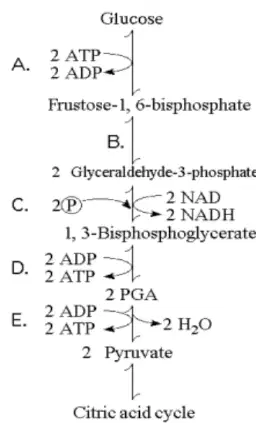
What step shows a split of one molecule into two smaller molecules?
D
C
A
B
E
From figure above: In which step is an inorganic phosphate added to the reactant?
D
C
A
E
F
From figure above: In which reaction does an intermediate pathway become oxidized?
C
E
F
D
A
From figure above: Which step consists of a phosphorylation reaction in which ATP is the phosphate source?
F
A
C
E
B
How does pyruvate enter the mitochondrion?
active transport
diffusion
facilitated diffusion
through a channel
through a pore
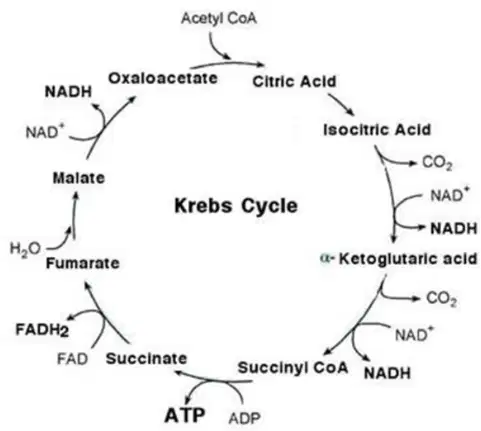
Starting with one molecule of isocitrate and ending with fumarate, what is the maximum number of ATP molecules that could be made through substrate-level phosphorylation?
1
2
11
12
24
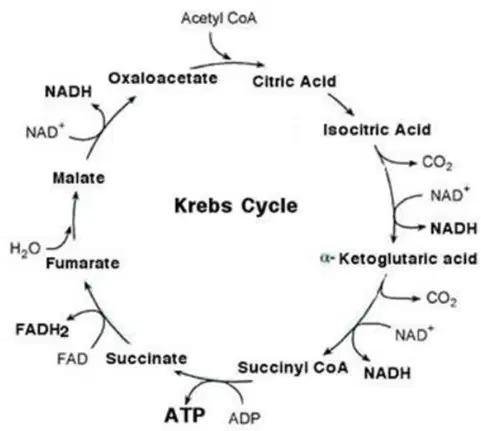
How many reduced dinucleotides would be produced with four turns of the citric acid cycle?
16
10
5
12
60
Using the figure above (Krebs' Cycle): How many molecules of carbon dioxide (CO2) would be produced by five turns of the citric acid cycle?
10
2
5
12
60
Using the figure above (Krebs' Cycle): Starting with citrate, which of the following combinations of products would result from three turns of the citric acid cycle?
3 ATP, 6 CO2, 9 NADH, and 3 FADH2
1 ATP, 2 CO2, 3 NADH, and 1 FADH2
2 ATP, 2 CO2, 1 NADH, and 3 FADH2
3 ATP, 3 CO2, 3 NADH, and 3 FADH2
38 ATP, 6 CO2, 3 NADH, and 12 FADH2
The process in which green plants synthesize organic food by utilizing carbon dioxide and water as raw materials, in the presence of sunlight, is known as:
Photosynthesis
Food synthesis
Light synthesis
Respiration
In which part of the cell does photosynthesis take place?
Cell wall
Chloroplast
Vacuole
Mitochondria
Which is correct regarding photosynthesis?
Water is absorbed from the soil through the stem system
Sunlight is trapped by pigments called xanthophyll
Chlorophyll absorbs green light
Carbon dioxide is obtained from the atmosphere
In which organism(s) does photosynthesis occur?
All of the above
Plants
Bacteria
Human
Which of the following is the correct equation for photosynthesis?
6CO2 + 12H2O → C6H12O6 + 6O2
6CO2 + 6O2 → C6H12O6 + 12H2O
12H2O → C6H12O6 + 6H2O + 6O2
6CO2 → C6H12O6 + 6H2O + 6O2
The following organelle performs photosynthesis
endoplasmic reticulum
mitochondria
nucleus
chloroplast
What is the main molecule that stores and releases energy?
NADP
Oxygen
PTP
ATP
Other than CO2 and light, which is used as the raw material for photosynthesis?
CO2
O2
MnO2
H2O
Why is light energy used in photosynthesis?
Reduction of H2O
Reduction of CO2
Activation of chlorophyll
Oxidation of C6H12O6
During photosynthesis, which light is least effective?
Greenlight
Blue light
Sunlight
Yellow light
Which equation shows Photosynthesis?
Which equation shows cellular respiration?
What elements make photosynthesis?
Sunlight + carbon dioxide + water = glucose + oxygen
What elements are used in cellular respiration?
Glucose + Oxygen = Water + Carbon Dioxide + ATP

