
 Worksheets
Chapter 9-10 Practice Exam
Total questions: 65
Worksheet time: 1hrs 5mins
What muscle tissue contains intercalated discs but is involuntary?
skeletal, smooth and cardiac muscle
skeletal muscle
cardiac muscle
smooth muscle
The time that elapses between the stimulation of a muscle and the contraction of that muscle is defined as the_
Latent period
Refractory period
Recruitment period
Depolarization period
This is an increase in the number of motor units.
synergist
threshold stimulus
activation energy
recruitment
Which is a fine or wispy sheath of connective tissue that surrounds each individual muscle fiber and consists of fine areolar connective tissue?
Epimysium
Perimysium
Endomysium
Sarcoplasm
Which type of muscle contraction occurs when the muscle neither shortens nor lengthens during contraction?
Concentric
Isotonic
Isometric
Eccentric
A partial but sustained contraction
twitch
muscle tone
cramp
atrophy
Where are vesicles with neurotransmitters stored?
motor end plate
mitochondria
axon
motor neuron endings
An action potential travels across the sarcolemma and into the muscle fiber (cell) by means of
endoplasmic reticulum
transverse tubules (t tubules)
mitochondria
motor end plate
In the sliding filament Model of Contraction at microscopic level 4 things happen to the sarcomere. Which of the following is true?
I-bands shorten
The h-zone appears
The distance between z-disc elongate or are pulled further the M-line
The amount of oxygen needed to convert lactic acid to glucose is
acidosis
oxygen debt
anaerobic respiration
aerobic respiration
A muscle contracts when the thin filaments of __ slide over the thick filaments of __
actin and myofibrils
myosin and actin
myosin and sarcomeres
myosin and myofilaments
Contraction elicited by a single brief stimulus is called
recruitment
myogram
a twitch
a threshold
What is a sarcomere?
a muscle cell
from Z line to M line
a functional unit of a muscle
a type of muscle
Actin has binding sites for...
ATP
Na
Ca
myosin
Which muscle is responsible for raising the eyebrows?
Zygomaticus
Frontal belly
Masseter
Orbicularis Oculi
Which characteristic of muscle tissue has the ability to shorten forcibly when adequately?
excitability or irritability
contractility
elasticity
extensibility
What is released at a synapse?
Motor end plate
Motor neuron
Motor unit
Neurotransmitter
What causes muscle fatigue?
build up of glycogen
build up of ascorbic acid
build up of lactase
build up of lactic acid
Synergist is a muscle that
assists a prime mover
carries out the main action
does that opposite action of a prime mover
An antagonist is a muscle that
does the opposite action of a prime mover
carries out the main action
assists a prime mover
The minimal stimulus needed to start a contraction
threshold stimulus
action stimulus
all or none stimulus
What attaches to immovable or less movable bone?
Origin
Sarcomeres
Action
Insertion
The period of time in which a muscle will not respond to a stimulus is called the _____.
Latent period
Threshold
Relaxation period
Refractory period
The arrangement of muscle fibers in which the fibers are arranged at an angle to a central longitudinal tendon
Longitudinal
Pennate
Parallel
Circular
Which muscle is striated and voluntary?
Cardiac
Skeletal
Smooth
Which muscle is responsible for closing the mouth and puckering the lips?
Platysma
Masseter
Orbicularis Oris
What is the end product of the anaerobic pathway?
Lactic acid and 2ATP per glucose
Carbon dioxide
Glucose
Water
Which of the following is a key difference between the anaerobic and aerobic pathways?
The presence of oxygen.
The location where they occur.
The type of fuel used.
The number of ATP produced.
Which molecule is the starting substrate for the anaerobic pathway?
Carbon dioxide
Glucose
ATP
Lactic acid
What is the difference between concentric and eccentric muscle contractions?
Concentric contractions involve the muscle lengthening while generating force, while eccentric contractions involve the muscle shortening while generating force.
Concentric contractions involve the muscle contracting without moving a body part, while eccentric contractions involve the muscle remaining the same length.
Concentric contractions involve the muscle relaxing completely, while eccentric contractions involve the muscle contracting without moving a body part.
Concentric contractions involve the muscle remaining the same length, while eccentric contractions involve the muscle changing length.
Concentric contractions involve the muscle shortening while generating force, while eccentric contractions involve the muscle lengthening while generating force.

What muscles are highlighted?
trapezium
latissimus dorsi
teres minor
deltoid
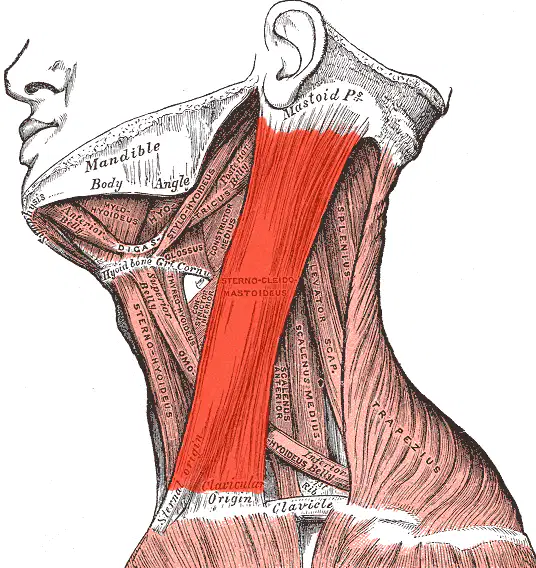
What muscle is highlighted?
sternocleidomastoid
masseter
platysma
Anterior scalene

What muscles are highlighted?
deltoid
rhomboid major
trapezius
latissimus dorsi
Which of the following muscles is named for its action?
biceps brachii
deltoid
adductor magnus
gluteus maximus
Acetylcholine is a
the movable attachment of a muscle
contractile organelles within muscle cells
neurotransmitter that is secreted by neurons to stimulate a muscle fiber to contract
a muscle that assists the action of a prime mover
The energy needed to perform a muscle contraction comes directly from
Glucose
Calcium
Oxygen
ATP
What is a crossbridge?
Where the calcium crosses into the cytoplasm
None of the answers are correct.
Where calcium binds with troponin
Where myosin heads binds to actin
Which statement describes a threshold stimulus
contractile organelles within muscle cells
the amount of oxygen required to convert lactic acid to glucose
the weakest stimulus that must be exceeded to elicit a nerve impulse or a muscle contraction
A synergist is a...
muscle responsible for a particular body movement
muscle that assists the action of a prime mover
muscle that acts in opposition to the prime mover
In a physiologically normal cell, the concentration gradient favors K+ flow out of the cell. Potassium is held in the cell, however, by the forces of the negative charge that builds up along the inside of the plasma membrane. This force is known as the _____
Electrical Gradient
Chemical Gradient
Osmotic Pressure
Hydrostatic Pressure
The function of the T-tubule in muscle contraction is to
make and store glycogen
release calcium into the cell
transmit the action potential deep into the muscle cells
form proteins
Recruitment is ...
Muscle responsible for a particular body movement.
Increase in number of motor units activated as stimulation intensity increases.
The amount of oxygen required to convert lactic acid to glucose.
Which describes aponeurosis
layers of fibrous tissue covering and separating muscles
indirect attachment that extends beyond the muscle in the form of a sheet
direct attachment of a muscle that remains relatively fixed during contractions
Muscles with a triangular shape, such as the pectoralis major muscle in the chest, typically have a:
unipenate fascicle arrangement
convergent fascicle arrangement
spiral fascicle arrangement
parallel fascicle arrangement
An antagonist is..
muscle that assists the action of a prime mover
muscle that acts in opposition to the prime mover
muscle responsible for a particular body movement
_____ plays the most important role in generating the membrane potential
Sodium
ATP
potassium
In relaxed muscle, the myosin-binding site on actin is blocked by ______.
titin
tropomyosin
troponin
An insertion is
attachment of a muscle that remains relatively fixed during contractions
muscle that assists the action of the prime mover
movable attachment of a muscle
Which describes a sarcomere
a protein that contracts muscle fibers
contractile organelle within muscle cells
contractile unit found within a myofibril
Myosin is
protein that contracts muscle fibers; is thicker
protein that contracts muscle fibers; is thinner
contractile unit of myofibril
A motor neuron...
chemical that is secreted by neurons to stimulate a muscle fiber to contract
transmits impulse form the central nervous system to a muscle
increase in number of motor units activated as stimulation intensity increases
The active transport responsible for maintaining the physiologically normal concentrations of sodium and potassium in the intracellular and extracellular fluids is the____
Voltage Gate
Chemical Gate
Sodium-Potassium Pump
A group of skeletal muscle fibers is called a/an ____.
fascicle
epimysium
perimysium
tendon
The correct order for the smallest to the largest unit of organization in muscle tissue is _______.
myofibril, muscle fiber, filament, fascicle
fascicle, filament, muscle fiber, myofibril
filament, myofibril, muscle fiber, fascicle
muscle fiber, fascicle, filament, myofibril
Which of the following best describes the composition of the structure known as a triad in a skeletal muscle fiber?
terminal cisterna, transverse tubule, and terminal cisterna
actin, troponin, and tropomyosin
ATP, CP, and glycogen
sarcolemma, sarcoplasm, and sarcoplasmic reticulum
The space between the axon terminus of the neuron and the sarcolemma of the muscle fiber is the ________.
synaptic cleft
motor unit
synaptic knob
motor end plate
Which results in the formation of lactic acid?
aerobic respiration
coupled reaction of creatine phosphate
anaerobic glycolysis
Characteristics of isometric contractions include all but
shortening
absence of shortening
used on resistance training
contraction phase
The ions that enter the skeletal muscle cell during the generation of an action potential are
calcium ions
potassium ions
sodium ions
chloride ions
A smoothed, sustained contraction resulting from very rapid stimulation of the muscle in which no evidence of relaxation is seen, is called
multiple motor unit summation
temporal summation
a twitch
fused tetanus
Several muscles act to move and/or stabilize the scapula. Which of the following are small rectangular muscles that square the shoulder as they act together to retract the scapula?
rhomboids
serratus anterior
levator scapulae
subscapularis
Intrinsic muscles of the back that promote extension of the spine (or head) include all but
semispinalis
scalene muscles
splenius muscles
erector spinae
The prime mover of inspiration is the
abdominal wall muscles
internal intercostals
external intercostals
diaphragm
What muscle is required to smile?
zygomaticus
frontal belly
orbicularis oculi
What muscle is used to squint the eyes?
Orbicularis oculi
Orbicularis oris

