
 Worksheets
UNIT 2 Exam Review
Total questions: 68
Worksheet time: 4hrs 21mins


This organelle is a rigid outer layer that protects plant cells.
Cell Membrane
Cell Wall
Nucleus
Chloroplast

This organelle controls what goes in and out of plant and animal cells.
Cell Wall
Cell Membrane
Cytoplasm
Cytoplasm

The _____________ stores food, water, wastes, and other materials in both plant and animal cells.
Vacuole
Mitochondria
Ribosomes
Chromatin

This fluid in the cell is where the organelles are found. It contains water and chemicals the cell needs.
Blood
Cytoplasm
Plasma
Vacuole

These organelles convert the energy in food molecules to a form the cell can use.
Chloroplasts
Mitochondria
Lysosomes
Ribosomes

These tiny cell structures assemble protein molecules from amino acids.
Carbohydrates
Lipids
Nucleic Acids
Ribosomes

Match the organelle with its correct function.

Stores and Protects DNA

Builds Proteins

Generates energy for the cell

Controls what enters and leaves the cell

Packages up proteins to be shipped out of the cell
Prediction: Circle the organelle that is involved in creating energy for the cell.


In cell signaling, how is the flow of specific ions
regulated?
Opening and closing of ligand-gated channels
Transduction
Cytoskeleton rearrangement
Endocytosis
Many signal transduction pathways use second messengers to:
transport a signal through the lipid bilayer portion of the plasma membrane.
relay a signal from the outside to the inside of the cell.
relay the message from the inside of the membrane throughout the cytoplasm.
amplify the message by phosphorylating proteins.
In cell signaling, how is the flow of specific ions
regulated?
Opening and closing of ligand-gated channels
Transduction
Cytoskeleton rearrangement
Endocytosis
Which of the following can activate a protein by transferring a phosphate group to it?
cAMP
G proteins
phosphodiesterase
protein kinase
What could happen to the target cells in an animal that lack receptors for local regulators?
They could compensate by receiving nutrients via an α factor.
They could develop normally in response to neurotransmitters instead.
They could divide but never reach full size.
They would not be able to multiply in response to growth factors from nearby cells.
Viruses are considered (a)
When a virus attaches to a host, what does it inject into the host?
Protein coat
DNA/genetic material
Capsid
Envelope
Antibiotics work to cure viruses?
True
False
A virus consists of:
RNA or DNA and a cell membrane
RNA or DNA and a protein coat
RNA and DNA and a protein coat
proteins, cell membrane, and RNA
What is the outside protective coating of a virus made of?
lipids
carbohydrates
protein
carbon
What reason do scientists give for saying that viruses are not living organisms?
they cannot reproduce without the aid of a host
they do not metabolize food into energy
they do not have organized cells
all of the above
none of the above
Why do viruses need a host cell?
because they aren't living
because they need to reproduce
because they can't live without a host cell
What does the lytic cycle result in?
destruction of the infected cell and the membrane
multiple new cells
people going in sane
True or False - Any virus can infect any cell
True
False
What happens if a cell is in a lysogenic cycle?
the virus will become part of your cells DNA but it hides
the virus causes your cell to make copies of itself
the virus will cause you cell to break open
all of the options listed
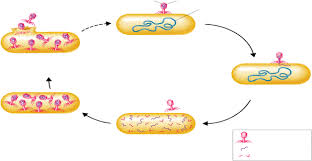
Which viral life cycle is shown?
Lysogenic Cycle
Lytic Cycle
Binary Fission
Conjugation


