wayground logo

Free Printable Worksheets

Font size

S
M
L
XL
Worksheets

BIO122 CHAPTER 4

Total questions: 60

Worksheet time: 51mins

Name
Class
Date
1.
A monosaccharide is a
a)
carbohydrate
b)
lipid
c)
nucleic acid
d)
protein
2.
What are the monomers of a polysaccharide?
a)
glycerol
b)
amino acid
c)
fatty acid
d)
glucose
3.
Which type of carbohydrate is this?
a)
monsaccharide
b)
disaccharide
c)
polysaccharide
d)
glyceride
4.
Which type of carbohydrate is this?
a)
monosaccharide
b)
disaccharide
c)
polysaccharide
d)
glyceride
5.
A monomer splits from a polymer through
a)
ATP synthesis
b)
monomerization
c)
hydrolysis
d)
condensation reaction
6.
This polysaccharide is important to the structure of plant cell walls, 
a)
Starch
b)
Glycogen
c)
Cellulose
d)
Chitin
7.
What type of carbohydrate is this?
a)
polysaccharide
b)
disaccharide
c)
monosaccharide
d)
it isn't a carbohydrate
8.
The 3 categories of carbohydrates are:
a)
Monosaccharide, disaccharide, polysaccharide
b)
glucose, fructose, galatose
c)
starch, cellulose, chitin
d)
There are no categories of carbohydrates
9.

What type of bond is formed between two monosaccharides?

a)

Ester bond

b)

Glycosidic bond

c)

Peptide bond

d)

Double bond

10.

What are processes P and Q?

a)

P - oxidation

Q - reduction

b)

P - reduction

Q - oxidation

c)

P - condensation

Q - hydrolysis

d)

P - hydrolysis

Q - condensation

11.
Which is not a chemical element needed to build sugars?
a)
Carbon
b)
Oxygen
c)
Nitrogen
d)
Hydrogen
12.
Which are examples of monosaccharides?
a)
Starch and glycogen
b)
Starch and glucose
c)
Glucose and fructose
d)
Glycogen and cellulose
13.
Which health problems is a consequence of eating too much added sugar? 
a)
overweight
b)
heart disease
c)
diabetes
d)
all of the above
14.
Important to the structural integrity of plant cells, this is the single most popular polysaccharide in the world.
a)
Starch
b)
Glycogen
c)
Cellulose
d)
Chitin
15.

The difference between tertiary and quartenary structure is:

a)

Tertiary structure has double bond whereas quartenary structure does not have double bond

b)

Tertiary structure consists of one polypeptide chain whereas quartenary structure consists of more than one polypeptide chains

c)

Tertiary structure is fibrous whereas quartenary structure is globular

d)

Tertiary structure is water-soluble whereas quartenary structure is lipid soluble

16.

The diagram shows the structure of collagen. Based on the diagram, what is the structural level of collagen?

a)

Primary

b)

Secondary

c)

Tertiary

d)

Quartenary

17.

Haemoglobin is a quartenary protein because;

a)

It has more than one peptide bonds

b)

Its shape is globular

c)

It consists of more than one polypeptide chains

d)

It has iron in each heme group

18.

Based on the diagram, the side chain of amino acid alanine is;

a)

NH2

b)

COOH

c)

H

d)

CH3

19.

How many amino acids does our body need in a day to function properly?

a)

11

b)

20

c)

9

d)

4

e)

36

20.

What is the role of protein in the body?

a)

Is the main source of energy for the body

b)

Helps to build and repair body tissue

c)

Provide warmth and cushioning to the body's organs

d)

Helps to transport vitamins through the body

e)

All of the above are roles of protein in the body

21.

What are the monomers that make up proteins?

a)

Monosaccharides

b)

Amino acids

c)

Nucleic acids

d)

Fatty acids

22.

What is the name for a chain of amino acids?

a)

Polypeptide chain

b)

Triglycerides

c)

Polysaccharides

d)

Nucleotides

23.

What is the name of the bond that joins two amino acids together?

a)

Ester bond

b)

Glycosidic bond

c)

Peptide bond

d)

Nucleic bond

24.

Which protein structure describes the sequence of amino acids?

a)

Primary

b)

Secondary

c)

Tertiary

d)

Quaternary

25.

Alpha helix and beta sheet are examples of what type of protein structure?

a)

Primary

b)

Secondary

c)

Tertiary

d)

Quaternary

26.

Which protein structure describes a protein's three-dimensional shape?

a)

Primary

b)

Secondary

c)

Tertiary

d)

Quaternary

27.

Which protein structure is only found in proteins with more than one polypeptide chain?

a)

Primary

b)

Secondary

c)

Tertiary

d)

Quaternary

28.

Which reaction is needed to break the bond between two amino acids?

a)

Dehydration

b)

Dehydrogenation

c)

Hydration

d)

Hydrolysis

29.

What is an example of protein denaturation?

a)

Inhaling oxygen and exhaling carbon dioxide

b)

Lifting weights

c)

Cooking an egg

d)

Injecting insulin

30.
What is the monomer of a lipid?
a)
monosaccharide
b)
nucleic acid
c)
fatty acid
d)
amino acid
31.
Steroids have what kind of structure?
a)
long chain of hydrogen/carbons with a glycerol group
b)
CHO in a hexagonal shape
c)
4 fused rings
d)
polar head and two fatty acid tails
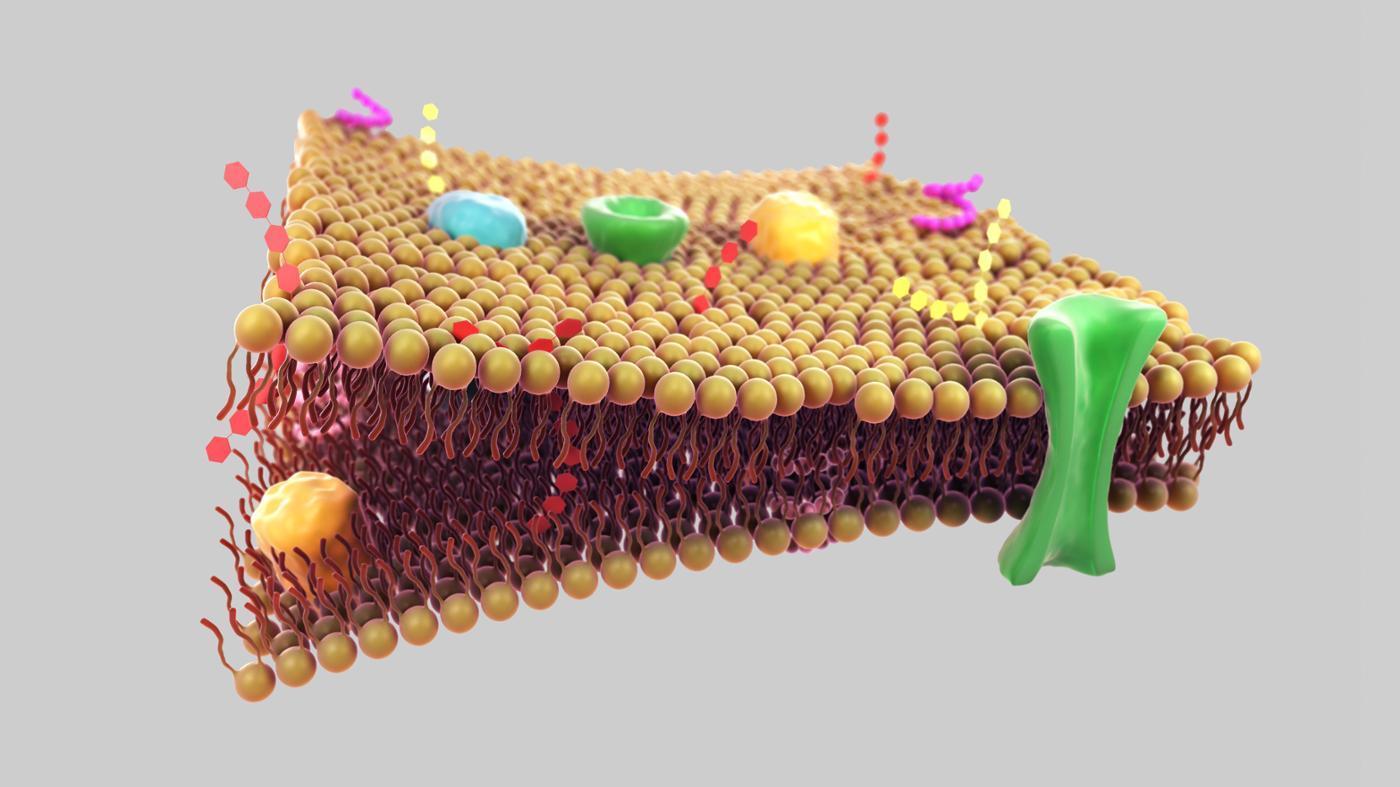
32.
The phospholipid bilayer comprises what part of the cell?
a)
cytoplasm
b)
cell membrane
c)
cytoskeleton
d)
nuclear membrane
33.
What type of fat is this?
a)
saturated fatty acid
b)
unsaturated fatty acid
c)
steroid
d)
wax
34.
What type of lipid is this?
a)
steroid
b)
cholesterol
c)
phospholipid
d)
triglyceride
35.
In the phospholipid, the polar head is considered what type of structure?
a)
hydrophobic
b)
insoluble
c)
hydrophilic
36.
Which of the following molecules is not a lipid? 
a)
testosterone
b)
triglycerides
c)
cellulose
d)
phospholipids
37.
The C-O-O-H on the end of a fatty acid structure is called a _______
a)
carboxyl group
b)
R group
c)
fatty acid
d)
amino acid
38.
Lipids do not dissolve in water because they are _______________
a)
polar
b)
water soluble
c)
non-polar
39.
Saturated fats have _______________
a)
straight structure
b)
single bonds
c)
solidity at room temperature
d)
all of the above
40.
An example of an unsaturated fat would be ________
a)
butter
b)
meat fat
c)
vegetable oil
d)
scrapple
41.
How do lipids function for cells?
a)
store information
b)
store energy
c)
breakdown wastes
d)
join with substrates
42.
Saturated fats are __________ at room temperature.
a)
liquid
b)
gases
c)
plasma
d)
solid
43.

Under basic conditions, lipid molecule hydrolysis produces

a)

Glycerol + Water

b)

Glycerol + Fatty acids

c)

Glycerol + Fatty acid salts

d)

Water + Fatty acids

44.

Which is not one of the three classes of lipids?

a)

Phospholipids

b)

Sterols

c)

Amino Acids

d)

Triglycerides

45.
What is the monomer of nucleic acids?
a)
Glycerol
b)
Monosaccharides
c)
Amino Acids
d)
Nucleotides
46.
What are the components of a nucleotide?
a)
nitrogen base, phosphate group, and pentose sugar
b)
pentose sugar, purine, and pyrimidine
c)
nitrogen base and a phosphate group
d)
DNA, phosphate group, monosaccharide
47.
RNA contains the sugar...
a)
Deoxyribose
b)
Glucose
c)
Ribose
d)
Lipids
48.
Which of the following elements does a Nucleic Acid have that a Carbohydrate and Lipid do not?
a)
Carbon
b)
Oxygen
c)
Hydrogen
d)
Nitrogen
49.
From the nucleotide on the right, which part is labeled 2?
a)
Sugar
b)
Phosphate
c)
Nitrogenous Base
d)
Phosphorous
50.
What pentose sugar does DNA use?
a)
Ribose
b)
Sucrose
c)
Amylose
d)
Deoxyribose
51.
Guanine is complementary to what other nitrogenous base?
a)
Cytosine
b)
Adenine
c)
Thymine
d)
Uracil
52.
Complementary Bases are held together by what type of bond?
a)
Covalent
b)
Hydrogen
c)
Ionic
d)
Mettalic
53.
If one series of bases reads: TTGACTAGG, then the complementary set of bases would read:
a)
TTGACTAGG
b)
AACTGATCC
c)
AATCGAACTT
d)
AAGTCATCC
54.
The backbone of DNA is made up of _______ & ________ units. 
a)
sugar & base
b)
sugar & phosphate
c)
base & phosphate
d)
phosphate & phosphate
55.

The repeating units in both DNA and RNA are called

a)

hydrogen bonds

b)

nucleic acids

c)

nucleotides

d)

amino acids

56.

What nucleotide base does RNA contain that DNA does not?

a)

adenine (A)

b)

cytosine (C)

c)

uracil (U)

d)

thymine (T)

57.
Adenine, Thymine, Guanine and Cytosine are what?
a)
Phosphates
b)
Sugars
c)
Nucleotides
d)
Bases
58.
Which nucleic acid only exists in the nucleus?
a)
mRNA
b)
DNA
c)
tRNA
d)
rRNA
59.

Which base is only found in RNA?

a)

Uracil

b)

Thymine

c)

Adenine

d)

Guanine

60.

What is A?

a)

Phosphate Group

b)

Pentose Sugar

c)

Nitrogenous Base

d)

Adenosine Triphosphate