
 Worksheets
Respiratory Therapy 1010 study
Total questions: 72
Worksheet time: 38mins
What are potential areas of risk common in respiratory therapy? Select all that apply.
Patient Movement
Patient Ambulation
Fire Hazard
Drowning
Chronic respiratory patients like sitting in a high fowler's position because it decreases their WOB.
True
False
Respiratory therapists move patients in order to:
Improve Gas Exchange
Properly performed therapies
Tramsport patients procedures
Help other colleagues
What is an autogenous infection?
An infection that is autoimmune
An infection a patient gets from themselves
An infection acquired from a health care worker
An infection acquired from equipment
What does PPE stand for?
Please Protect the Environment
Personal Protection Equipment
Personal Protection Environment
Patient Protection Equipment
What disease(s) spread infection by airborne transmission?
Bacterial pneumonia
Mycobacterium Tuberculosis
Varicella
Cholera
Measles
Which of the following are signs of diaphragmatic fatigue?
Respiratory alternans
Abdominal paradox
Apneustic respirations
Breath sounds that are described as having a musical quality and are produced as air flows through constricted airways are known as?
Wheezes
Rhonchi
Crackles
Diminished
A RT notes that a patient has a heart rate of 150/min prior to beginning a breathing treatment. The therapist should do?
Administer the treatment as prescribed
Record the patient's heart rate and return in 1 hour
Notify the patient's nurse and inform the physician
Recommend obtaining an arterial blood gas sample
What is the purpose of hyperbaric chambers in medical gas therapy?
Increased oxygen delivery to tissues
Enhanced carbon dioxide elimination
Administration of anesthetic gases
Prevention of aerosolized infections
The selective vasodilatory effect of nitric oxide is due to its action on:
Systemic arteries
Pulmonary arteries
Coronary arteries
Cerebral arteries
Fill in the blank: A symptom characterized by pain in the chest area is called _______.
Heart pain
Headache
Stomach ache
Back pain
Fill in the blank: The medical term for losing consciousness is _______.
Fainting
Sneezing
Coughing
Yawning
Fill in the blank: Difficulty in swallowing is referred to as _______.
Difficulty swallowing
Difficulty breathing
Difficulty speaking
Difficulty hearing
Fill in the blank: Difficulty breathing while lying down is called _______.
Difficulty breathing lying down
Tachypnea
Apnea
Bradypnea
Fill in the blank: A symptom where the patient has a rough or harsh-sounding voice is called _______.
Hoarseness
Dysphagia
Tinnitus
Diplopia
Fill in the blank: The act of expelling blood from the mouth due to bleeding in the respiratory tract is called _______.
Vomiting blood
Hematuria
Epistaxis
Hematemesis
Fill in the blank: An unpleasant smell detected from the patient is referred to as _______.
Odor
Fever
Rash
Pulse
Fill in the blank: A condition where there is insufficient blood supply to the tissues is called _______.
Low blood supply to the tissue
High oxygen saturation
Excessive bleeding
Increased heart rate
Fill in the blank: A symptom where the patient feels better when sitting up and worse when lying down is described as _______.
Orthopnea
Dyspnea
Platypnea
Tachypnea
Fill in the blank: The act of expelling blood from the lungs or airways is called _______.
Coughing up blood
Sneezing
Vomiting
Hiccups
Fill in the blank: Difficulty breathing when lying on one side is called _______.
Difficulty breathing lying on side
Orthopnea
Platypnea
Tachypnea
The use of Heliox will correct a severe asthma attack.
True
False
A patient complains of a "tingling" feeling in her lips during an IS treatment. The RT should instruct the patient to?
Breath more slowly
Take smaller breaths
Continue with the treatment as ordered
Exhaled through pursed lips after each breath
The primary indication for lung expansion therapy is?
Asthma
Atelectasis
Chronic bronchitis
Respiratory distress
On an IPPB machine, as you increase the flow what does it do to the inspiratory time?
Increases
Decreases
Which of the following increases the delivered tidal volume to a patient taking an IPPB treatment?
Increasing the flow rate
increasing the inspiratory pressure
Decreasing the sensitivity
Decreasing the flow rate
Which of the following situations is a contraindication for incentive spirometry?
A patient whose IC is <10 ml/kg
A patient whose IC is >10 ml/kg
A patient who cannot cooperate or follow instructions
An unconscious patient
Post OP from abdominal surgery
While evaluating a post-operative patient for whom incentive spirometry has been ordered, the RT obtains an inspiratory capacity of 6 ml/kg of body weight. The therapist should do which of the following?
Recommend IPPB in place of IS
Start the treatment as ordered
Measure the patient's tidal volume
Recommend a bronchodilator using a hand held nebulizer
As compliance decreases, what happens to tidal volume?
Increases
Decreases
As RAW increases, what happens to tidal volume?
Increases
Decreases
Which of the following is true in regard to DPIs?
Requires a rapid inhalation
Minimum flows of 30 L/min
Does not have a propellant
Can not be used if the patient has a breathing problem
Stability is defined as?
Medication spreading out within the lungs
Depth medication gets within the lungs
Tendency of aerosol particles to remain in suspension
Size of the aerosol particle
Increased viscosity of a medication requires increased flows.
True
False
As PaCO₂ increases, the pH______
Increases
Decreases
Remains the same
As HCO₃ decreases, the pH____________
Increases
Decreases
Remains the same
Standard blood gas analyzers do not measure actual SaO2.
True
False
A galvanic analyzer measures FiO2.
True
False
After changing electrodes or membranes, the RT should recalibrate the blood gas analyzer.
True
False
A pH >7.45 is known as?
Alkalosis
Acidosis
Alkalemia
Capnography measures:
Oxygen concentrations
Carbon dioxide concentrations
Nitric oxide concentrations
Helium concentrations
A cough assist device delivers positive pressure breaths at a pressure range of what?
10-20 cmH2O
15-25 cmH2O
30-50 cmH2O
55-65 cmH2O
Which of the following would facilitate clearance of pulmonary secretions in a patient with cystic fibrosis?
Flutter valve
Vest therapy
Autogenic drainage
room humidifier
Volara or IPV
Which of the following hand positions is used in chest percussion to loosen bronchial secretions?
Hands slightly cupped with fingers and thumbs closed
Hand flat with fingers and thumb closed
Fingers cupped thumb open
Fingers and thumb open
Which of the following areas should percussion not be performed over?
Spine
Female Breast
Surgical site
Skull
After CPT is performed, what should you instruct a patient to do?
Lay flat for 30 minutes
Stand on their head
Cough
All of the above
While reviewing the chart of a patient receiving postural drainage therapy, you notice the patient tends to undergo mild desaturation during therapy. Which of the following would you recommend to manage this problem?
Increase the patient's FiO2 during therapy
Discontinue the postural drainage therapy entirely
Discontinue the percussion and vibration only
Decrease the frequency of treatments
What happens during the exsufflation phase of mechanical insufflation-exsufflation?
Airway pressure is Abruptly decreased to -30 to -50 cmH20
Negative airway pressure is maintained for 2 to 3 seconds
Airway pressure is delivered 30 to 50 cmH20
Medication is delivered
An increase in which of the following can occur if condensation or water is allowed to accumulate in the large bore aerosol delivery tubing?
Gas flow to the patient
Absolute humidity delivered to the patient
FiO2
Total aerosol delivered
Secretions tend to become thicker if the inspired air has which of the following characteristics?
A relative humidity of 100% at body temperature
32 mg H2O per liter of gas
A water vapor pressure of 47 mmHg
48 mg H2O per liter of gas
After connecting a nasal cannula to the humidifier outlet, you kink the tubing and hear a whistling noise coming from the humidifier. Which of the following most likely has caused this?
The humidifier jar is cracked
The capillary tube in the humidifier is disconnected
The humidifier has no leaks
The top of the humidifier is not screwed on tightly
Which of the following are indications for cool, bland aerosol therapy?
A cough must be induced for sputum collection
Mobilization of secretions must be improved
post extubation of upper airway must be treated
Strider
The respiratory therapist is asked to recommend a humidifier that will be able to provide the highest water vapor content to the patient's airway.
Pass-over
Heat moisture exchanger
Heated wick
Bubble
What is the clinical indication for Heliox?
To make a patient sound like Mickey Mouse
To oxygenate a patient with an upper airway obstruction (ex. mass)
To oxygenate a patient in a severe asthma attack
The main function of white blood cells is to carry oxygen to the body
True
False
NO is a selective pulmonary vasodilator.
True
False
The physician wants a patient to have no more than 9 L/min of 80:20 Heliox. Where does the RT set the flow meter?
5 L/min
8 L/min
10 L/min
12 L/min
Which of the following are types of atelectasis?
Detached
Reabsorption
Passive
Adhesive
Crushing
What is the name of the test used to determine collateral circulation?
There is no test required
Modified Allens Test
Functional Arterial Test
Arterial Collateral Circulation Test
What is the #1 complication of arterial blood gas?
Embolism
Bruising
Arteriospasm
Shearing
A PaO2 of 50 mmHg will reveal what level of SaO2?
70%
80%
90%
100%
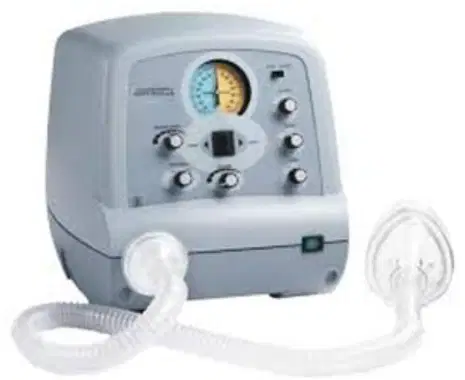
Look at the image of the medical device. What is the name of this device?
Defibrillator
Coughalator or Cough Assist
Metaneb
Bird Mark 7
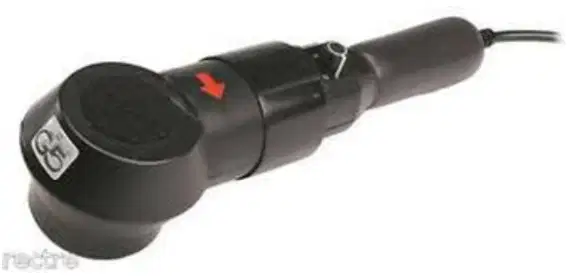
What is the name of the device shown in the image?
IPV device
EZPAP
Percussor
Incentive Spirometer
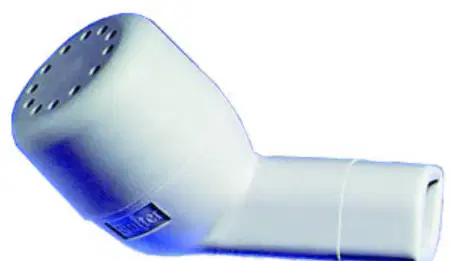
What is the name of the device shown in the image?
Flutter
PEP
Nebulizer
Aerogen

Look at the image of the medical device. What is the name of this device?
Acapella
Incentive Spirometer
Cough Assist
EZPAP
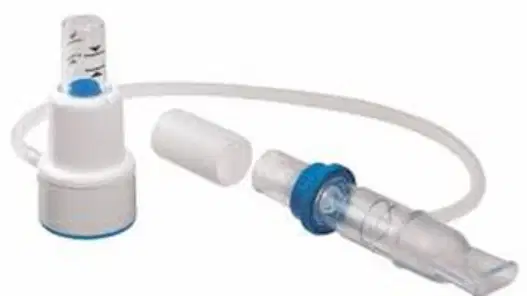
Look at the image of the medical device. What is the name of this device?
TheraPEP
Nebulizer
Aerogen
IPV
A patient is going out of town for a conference. Travel time by vehicle is 3 hours. Her home care company is ensuring she has a pick up once she gets to her destination. Currently her portable unit has 3 lbs remaining. Her nasal cannula runs at 3 L/min. How long will her oxygen last?
2.1 hours
5.7 hours
8 hours
10.3 hours
A full E cylinder is being used for an oxygen transport. They cylinder is being used for a patient on a 3 L/min nasal cannula. How long will the cylinder last?
1 hour
2.2 hours
3.4 hours
8.7 hours
Which of the following are considered forms of interstitial lung disease (ILD)?
I, III
I, II
II, IV
All of the above
A chest tube is placed for a pneumothorax. At what intercostal space does the physician place the tube?
1st-2nd intercostal space
2nd-3rd intercostal space
4th-5th intercostal space
5th-6th intercostal space
Interpret the following blood gas: pH 7.30 PaCO₂ 32 mmHg PaO₂ 75 mmHg HCO₃ 19 mEq/L
Partially compensated metabolic acidosis with mild hypoxemia
Combined acidosis with mild hypoxemia
Partially compensated respiratory acidosis with mild hypoxemia
Partially compensated respiratory alkalosis with mild hypoxemia
Interpret the following blood gas: pH 7.60 PaCO₂ 50 mmHg PaO₂ 82 mmHg HCO₃ 30 mEq/L
Combined alkalosis with normal oxygenation
Partially compensated metabolic alkalosis with mild hypoxemia
Partially compensated metabolic alkalosis with normal oxygenation
Combined acidosis with mild hypoxemia

