
 Worksheets
Introduction to Ecology
Total questions: 20
Worksheet time: 10mins
Complete the questions below. Ensure you check your spelling. 1. What is Ecology?
The study of how organisms interact with each other and their physical environment
The study of the importance of different ecosystems
The study of all known living organisms
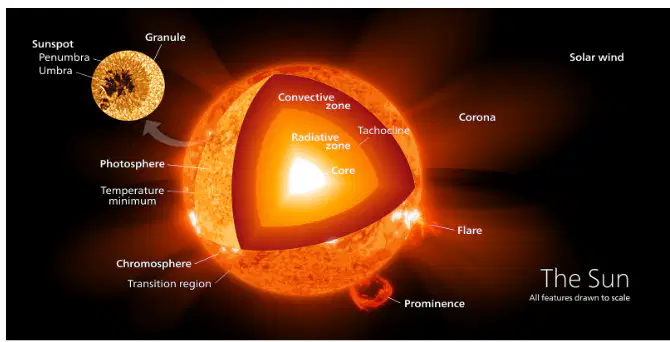
Is the sun an abiotic or biotic factor?
Abiotic
Biotic
A plant is an autotroph it is also called?
Heterotroph
Consumer
Producer
Which of these descriptions is for the term "community"?
All of the populations of different species in a given area at a given time.
All of the ecosystems in the world.
All of the populations in a given area, their physical environment and the influence of abiotic factors.
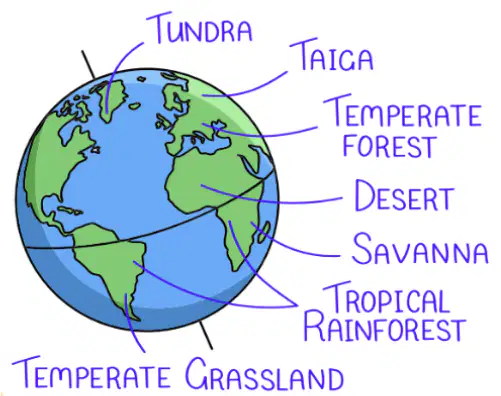
Which ecological level of organization is shown in the image above?
Biome
Community
Ecosystem
A lion that eats a zebra, that eats grass is a …
Producer
Secondary Consumer
Primary Consumer
As nutritional energy passes through (up) the food chain, energy is
Lost by 10%
Gained by 10%
Lost by 100%
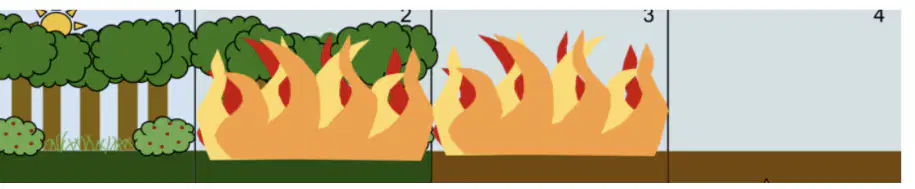
Identify scenario as primary or secondary succession A forest is established and a fire destroys acres of land. The soil still contains nutrients it needs to grow in 150 years.
Primary Succession
Secondary Succession
Please choose all the examples of limiting factors
Water
Food
Space
All of the above
Biodiversity is the variety of living organisms in an area. Where is the most biodiversity found?
Near the equator
Above the equator
Below the equator
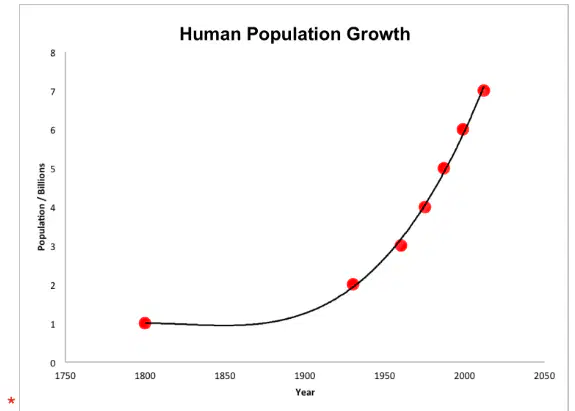
What type of population growth curve occurs in areas with unlimited resources (enough water, land, and food)?
Exponential
Logistic
A grasshopper is a herbivore that feeds mainly on grasses, weeds, shrubbery, and leaves. It is a
Primary Consumer
Secondary Consumer
Tertiary Consumer
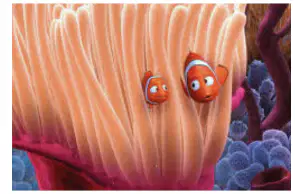
What is the type of relationship between a clownfish and an anemone?
Mutualism
Commensalism
Parasitism
One organism is benefited while the other is harmed is an example of what symbiotic relationship?
Parasitism
Mutualism
Commensalism
A buffalo walks around and mosquitos begin to encircle it. A egret bird then eats the mosquitos that the buffalo stirred up. What type of symbiotic relationship is being described?
Mutualism
Commensalism
Parasitism
Under which key process of the carbon cycle does dead organisms fossilize over thousands and millions of years and form fossil fuels?
Photosynthesis
Fossilization
Cellular respiration
What is the process that takes the Nitrogen gas in the air and fixes it (converts it) to ammonia?
Nitrogen Fixation
Denitrification
Assimilation
Storm water that picks up pollutants (such as fertilizer) and then flows it into our lakes, rivers, and streams is called?
Weathering
Runoff
Sedimentation
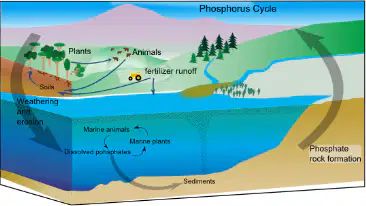
The biogeochemical process that lifts rock up from ocean floors onto land is called?
Runoff
Uplift
Weathering
Biodiversity is important for medicinal purposes because medicines are made from plants and animals found in nature.
True
False

