
 Worksheets
Biology Quiz
Total questions: 70
Worksheet time: 35mins
What defines a species?
Organisms with different characteristics
Organisms that cannot breed
Organisms with common characteristics that can breed to produce fertile offspring
Organisms that produce infertile offspring
What is the term used to describe a number of organisms of the same species?
Community
Ecosystem
Population
Habitat
What is the term for many different populations living together in a particular habitat?
Ecosystem
Community
Biome
Population
What is a habitat?
A place where an organism lives
A type of food for organisms
A method of reproduction
A form of protection
What does a habitat provide to an organism?
Shelter, food, water, and protection
Only food and water
Only shelter and reproduction
Only protection and food
Where do organisms reproduce?
In their habitat
In the sky
In the ocean only
In artificial environments only
What is an ecosystem?
A group of non-living components only
A community of organisms living in the same habitat, together with non-living environment
A single species living in isolation
A collection of abiotic components only
What are the components of an ecosystem?
Only biotic components
Only abiotic components
Biotic components (living organisms) and abiotic components (non-living organisms)
Only living organisms
What is the definition of "survival"?
The ability to stay alive
The ability to communicate
The ability to learn
The ability to travel
Which of the following is an abiotic component?
Trees
Animals
Soil
Birds
What is a balanced ecosystem?
A system where only food needs are met
A system where all needs (food, water, shelter, nutrients, gases, and mates) are met
A system that changes frequently over time
A system with no living organisms
How does a balanced ecosystem change over time?
It changes rapidly
It doesn't change much
It changes every day
It changes only during the night
What factors need to be maintained for a system to stay in balance?
The number of individuals in the different population
The number of populations in the different communities
The composition of gases in the air and its quality
The availability of uncontaminated water, soil and nutrients

What does the interaction between a bee and a sage flower exemplify?
Competition
Interdependence
Predation
Parasitism
Why is the bee dependent on the flower?
For shelter
For nectar
For pollination
For protection
Why is the flower dependent on the bee?
For nectar
For sunlight
For pollination
For water
What are producers in an ecosystem?
Organisms that rely on eating other organisms for energy
Organisms that create their own food
Organisms that decompose organic material
Organisms that are always animals
What is another name for producers?
Heterotrophs
Decomposers
Autotrophs
Carnivores
Which group do most plants belong to?
Consumers
Decomposers
Producers
Scavengers
What are organisms that feed primarily on producers called?
Carnivores
Herbivores
Omnivores
Decomposers
Which of the following statements is true about primary consumers?
They primarily eat meat.
They are also known as decomposers.
They primarily eat plants.
They are producers.
What is a common characteristic of animals in the primary consumer group?
They always eat meat.
They never eat plants.
They usually do not eat meat.
They are always carnivores.
What do secondary consumers primarily feed on?
Plants
Herbivores
Omnivores
Decomposers
What are organisms called that eat meat or mostly eat meat?
Herbivores
Omnivores
Carnivores
Decomposers
What do tertiary consumers primarily feed on?
Plants
Herbivores
Other carnivores
Decomposers
Which of the following is an example of a tertiary consumer?
Rabbit
Deer
Bear
Grasshopper
Can tertiary consumers feed on herbivores?
Yes
No
Only in winter
Only when food is scarce
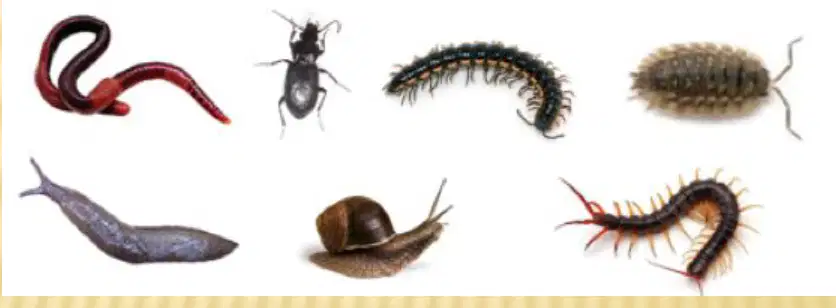
What are decomposers?
Organisms that produce their own food
Organisms that break down dead matter into simpler components
Organisms that consume only plants
Organisms that live in water
Which of the following is an example of a decomposer?
Lion
Oak tree
Fungi
Eagle

What are scavengers?
Organisms that feed off the dead remains of other animals
Organisms that produce their own food
Organisms that hunt live prey
Organisms that decompose organic material

What is the first step in the food chain shown in the diagram?
The kestrel eats the blue tit.
The blue tit eats the caterpillar.
The caterpillar eats the leaf.
The leaf eats the caterpillar.

In the food chain, what does the blue tit eat?
The kestrel
The leaf
The caterpillar
The grass

Which animal is at the top of the food chain in the diagram?
The caterpillar
The blue tit
The leaf
The kestrel
How is the sparrow hawk indirectly dependent on plants?
It eats plants directly.
It depends on thrushes, which eat snails, which eat cabbages.
It eats snails directly.
It depends on worms, which eat plants.
What does the text suggest about food chains?
They are always simple.
They are never as simple as they appear.
They only involve two species.
They do not include plants.
What is a more accurate representation of ecological relationships than a food chain?
A food pyramid
A food web
A food cycle
A food chart

What is the primary prey of the owl in the food web shown?
Fox
Stoat
Rat
Beetle

Which animal is at the top of the food chain in the diagram?
Beetle
Rabbit
Fox
Rat

Which animal is a predator of the rabbit in the food web?
Beetle
Stoat
Rat
Owl

What role does the beetle play in the food web?
Predator
Prey
Producer
Decomposer
What is the most likely outcome of a severe fall in the numbers of foxes?
Increase in rabbits, decrease in rats, increase in owls
Increase in rabbits, increase in stoats, increase in vegetation
Decrease in rabbits, increase in beetles, increase in vegetation
Increase in rabbits, increase in owls, decrease in vegetation
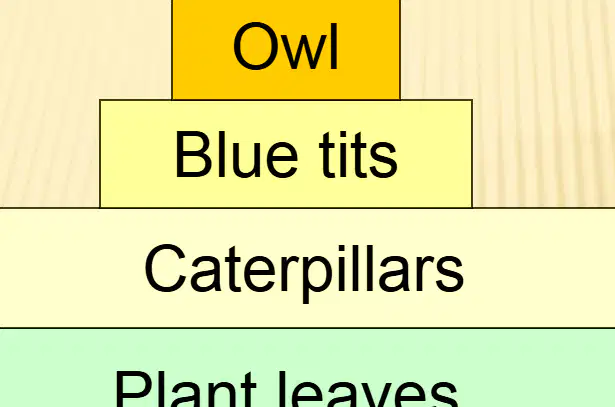
What does the width of each band in a pyramid of numbers represent?
The height of the organisms
The number of organisms
The weight of the organisms
The speed of the organisms
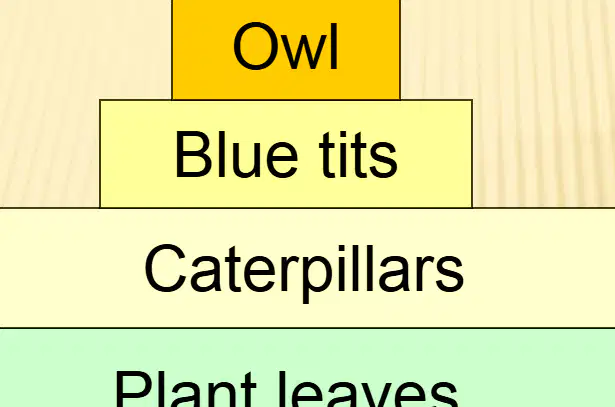
Which organism is at the top of the pyramid of numbers shown in the diagram?
Plant leaves
Caterpillars
Blue tits
Owl
What do animals need oxygen for?
Photosynthesis
Respiration
Decay
Carbon Cycle
What process do plants use to produce oxygen?
Respiration
Decay
Photosynthesis
Carbon Cycle
What do animals produce during respiration?
Oxygen
Nitrogen
Carbon Dioxide
Hydrogen
What do plants use up in photosynthesis?
Oxygen
Carbon Dioxide
Nitrogen
Hydrogen
What does the process of decay produce?
Oxygen
Nitrogen
Carbon Dioxide
Hydrogen
What is the interdependence of oxygen and carbon dioxide represented by?
Photosynthesis
Respiration
Carbon Cycle
Nitrogen Cycle
Which of the following processes is responsible for the production of carbon dioxide?
Photosynthesis in plants
Absorption by the oceans
Burning of fuel: wood, coal, oil, and gas
Uptake by soil
What is one way carbon dioxide is absorbed from the atmosphere?
Respiration in all organisms
Decay of organic matter
Photosynthesis in plants
Combustion of fossil fuels
Which of the following is not a method of carbon dioxide uptake?
Photosynthesis in plants
Absorption by the oceans
Respiration in all organisms
Uptake by soil
What process contributes to the production of carbon dioxide through the decay of organic matter?
Photosynthesis in plants
Absorption by the oceans
Respiration in all organisms
Decay of organic matter
Why is the interaction between living organisms important?
It increases the size of a population
It controls the size of a population
It decreases biodiversity
It creates an unstable environment
What is one of the main reasons for interactions between living organisms?
To create a chaotic environment
To create a balanced and stable environment
To increase competition
To eliminate predators
Which of the following is a type of interaction between living organisms?
Photosynthesis
Prey-Predator
Respiration
Metabolism
Which of the following is NOT a type of interaction mentioned in the document?
Symbiosis
Competition
Migration
Prey-Predator
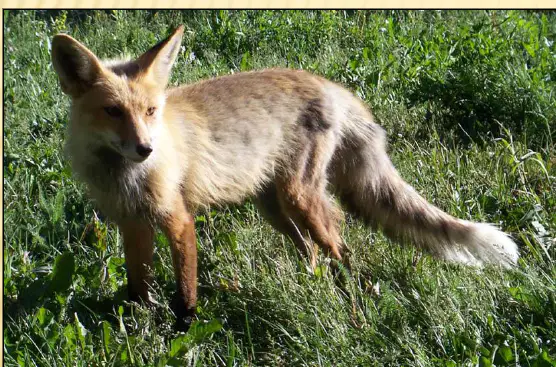
What is the relationship called where one organism hunts and consumes another?
Competition
Mutualism
Predator/Prey
Parasitism
In which type of relationship do two or more organisms compete for the same limited resources?
Predator/Prey
Competition
Symbiosis
Commensalism
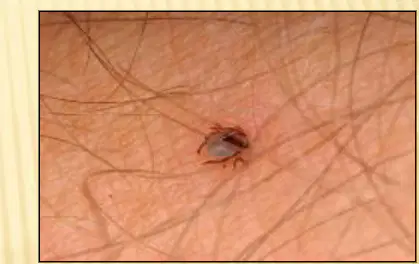
What is parasitism?
A relationship where both species benefit
An organism lives in or on another and feeds on it without immediately killing it
A relationship where one species benefits and the other is unaffected
A competitive relationship between two species
What is mutualism?
A relationship where one species benefits and the other is unaffected
An organism lives in or on another and feeds on it without immediately killing it
A cooperative partnership between two species where both benefit
A competitive relationship between two species
What is commensalism?
A relationship where both species benefit
An organism lives in or on another and feeds on it without immediately killing it
A relationship where one species benefits and the other remains unaffected
A competitive relationship between two species
What is competition in ecological terms?
Cooperation between organisms for resources
Two or more organisms competing for limited resources
Predation of one species by another
Symbiotic relationship between species
What is intra-specific competition?
Competition between different species
Cooperation between individuals of the same species
Competition between individuals of the same species
Predation within the same species
What is inter-specific competition?
Competition between individuals of the same species
Cooperation between different species
Competition between different species
Symbiosis between species
What is an example of biological control?
Using pesticides to kill insects
Raising fish in a pond to control mosquitos by eating their larva
Spraying chemicals to reduce weed growth
Using traps to catch rodents
What does biological control involve?
Using chemical fertilizers
Introducing another species such as a predator or parasite
Increasing the population of a species
Removing all predators from an ecosystem
What role do most bacteria play in the environment?
They are harmful to all living organisms.
They are beneficial and help break down dead organisms.
They only cause diseases in plants.
They are used solely in food production.
What do soil bacteria provide to plants?
Oxygen
Carbon dioxide
Mineral salts
Water
What are bacteria and fungi collectively known as?
Producers
Consumers
Decomposers
Predators

