wayground logo

Free Printable Worksheets

Font size

S
M
L
XL
Worksheets

Grade 11 - Earth Science First Monthly Exam

Total questions: 65

Worksheet time: 52mins

Name
Class
Date
1.

The most commonly accepted scientific theory of how the universe formed.

a)

The Big Bang Show

b)

The Big Bang Theory

c)

The Electromagnetic Theory

d)

The Steady State Theory

2.

A shift of light wavelengths towards the blue end of the electromagnetic spectrum that takes place when a light source is moving towards an observer (Earth).

a)

Rainbow

b)

Blue Shift

c)

Visible Light

3.

Weak radiation in space that is left over from the first stages of the Big Bang that theoretically created the universe.

a)

Cosmic Background Radiation

b)

Static

c)

Singularity

4.

Edwin Hubble discovered that the universe is expanding from his observation of __________

a)

Photons

b)

Red Shifts

c)

Conservation of Momentum

d)

Gravitational Pul

5.

States that the universe expands but did not change its density

a)

Multiverse Theory

b)

Steady State Theory

c)

Atomic Universe

d)

Primordial Universe

6.

The red-shift in the spectral lines of light, reaching us from other galaxies implies that these galaxies ____________.

a)

Are moving closer to one another

b)

Are moving farther apart from one another

c)

Redshift does not exist

d)

Are in rapid rotation

7.

A star is born when:

a)

nuclear fusion starts

b)

a nebula becomes a protostar

c)

gases in a nebula condense

d)

hydrogen is used up in fusion processes

8.
What fuel do stars use? 
a)
Oxygen
b)
Hydrogen
c)
Carbon
d)
Iron
9.

What were the original two elements in our universe?

a)

Hydrogen and Lithium

b)

Helium and Oxygen

c)

Helium and Hydrogen

d)

Hydrogen and Oxygen

10.

modification of the Big Bang theory, in which an expanding universe eventually reverses and collapses back to a Big Crunch before starting to expand again, forming one cycle of an endless series.

a)

Oscillating theory

b)

Steady State theory

c)

Bing Bang theory

d)

Big Crunch thoery

11.
What holds the planets in their orbits around the sun?
a)
gravity
b)
speed
c)
string
d)
air currents
12.
What is in the center of the Heliocentric Model?
a)
Sun
b)
Comet 
c)
Jupiter
d)
Earth
13.
Venus, Mercury, Earth, and Mars are what type of planet?
a)
Gas Giants
b)
Ice Giants
c)
Terrestrial Planets
d)
Exterior Planets
14.
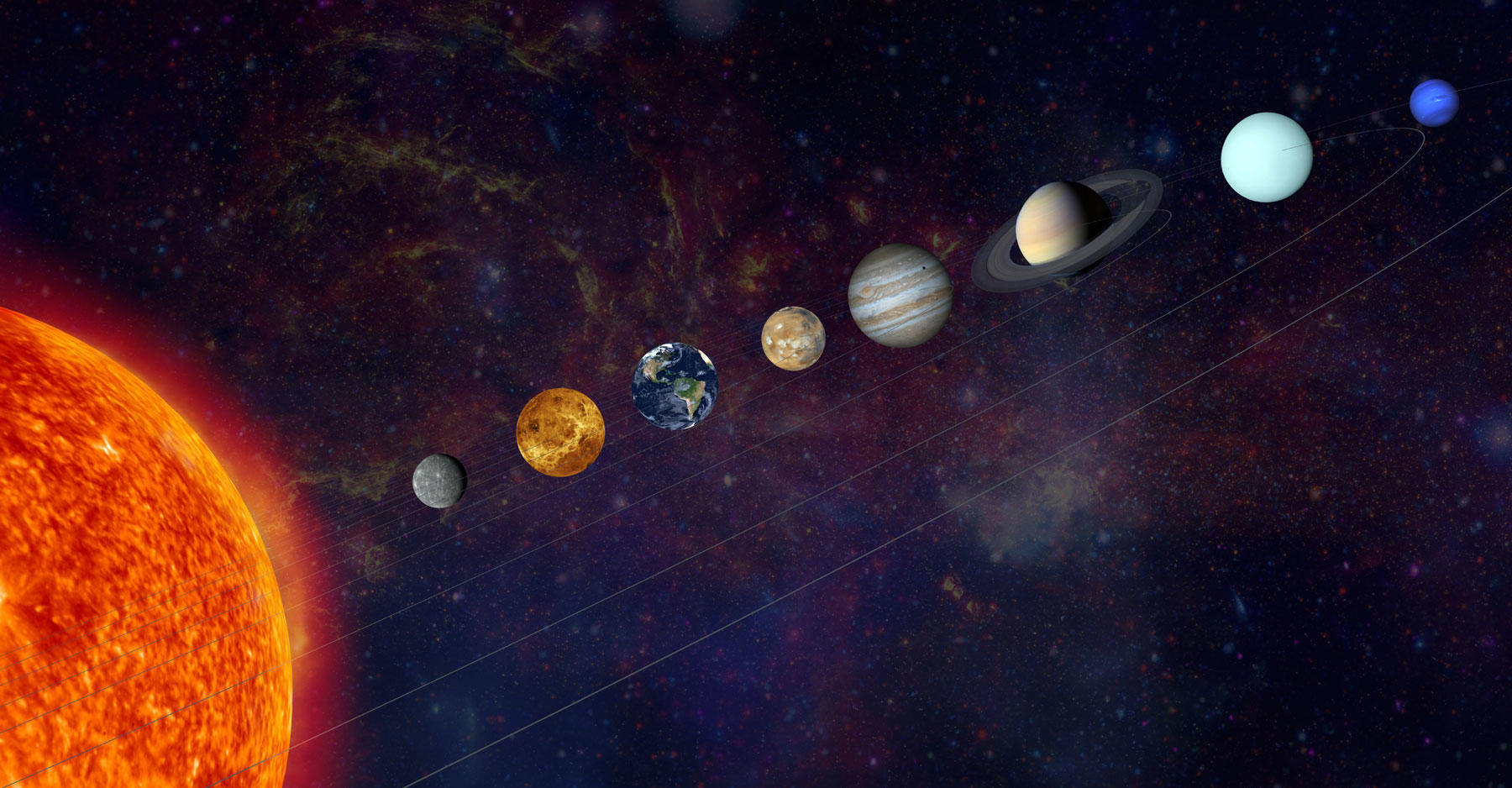
Which choice shows the correct order of the planets?
a)
Mars, Venus, Earth, Mercury, Jupiter, Saturn, Uranus, Neptune
b)
Earth, Venus, Mars, Mercury, Jupiter, Saturn, Uranus, Pluto
c)
Mercury, Venus, Earth, Mars, Jupiter, Saturn, Uranus, Neptune
d)
Saturn, Venus, Mars, Mercury, Jupiter, Neptune Mercury, Uranus
15.
What planet is it?
a)
Jupiter
b)
Saturn
c)
Uranus
d)
Venus
16.
The curved path in which a planet, satellite, or spacecraft moves in a circle around another object.  The path one object takes around another.
a)
rotate
b)
orbit
c)
moon
d)
revolve
17.
Planets that are closer to the sun
a)
take more time to orbit
b)
take less time to orbit
18.
What is true of all planets in our Solar System?
a)
They are large bodies in space that orbit the Sun
b)
Planets do not move, only stars move
c)
Planets make their own light
d)
Planets are larger than stars
19.
True or False
The planets are all equally distanced from each other.
a)
True
b)
False
20.
Planets form by a process called...
a)
accretion
b)
dark matter interactions
c)
electromagnetic radiation
d)
sun-dropping
21.
Which of the following is the strongest reason for Earth being habitable?
a)
The Earth is close enough to the Sun to have a night and day.
b)
The atmosphere of Earth has a favorable ratio of gases.
c)
The Earth is far enough from the Sun to be protected from radiation.
d)
The atmosphere is thin enough to allow energy to pass through it.
22.
Life forms on earth are _______ based. 
a)
oxygen 
b)
hydrogen 
c)
carbon 
d)
nitrogen
23.
What features make a planet habitable?
a)
Oxygen, Water, Proximity to the Sun and Food
b)
Carbon Dioxide, Proximity to the Sun, Habitat and artificial satelites
c)
Lots of radiation, extreme temperatures, no food, no shelter
d)
Extreme sunlight, dangerous predators, and salty water
24.
One of the conditions for life as we know it on Earth is a temperature range of 
a)
0 to 100 degrees Fahrenheit
b)
0 to 100 degrees Celsius
c)
0 to 100 degrees Kelvin
d)
32 to 100 degrees Fahrenheit
25.
Earth's tilt contributes to habitability 
a)
by moderating temperatures. 
b)
by creating hot and cold zones. 
c)
by promoting weather patterns to support the water cycle. 
d)
by keeping the earth the same distance from the sun. 
26.
Earth's ______________ provides protection from solar radiation. 
a)
atmosphere
b)
magnetic field 
c)
gravitational field 
d)
chemical composition 
27.
Earth, Mars and Venus have similarities, however earth's _________ has helped Earth maintain a life-sustaining temperature. 
a)
carbon cycle 
b)
water cycle 
c)
nitrogen cycle 
d)

phosphorous cycle

28.
Earth's magnetic field is due to 
a)
the iron core and the movement of molten iron that surrounds it. 
b)
the molten lava that escapes along the volcanic 'Ring of Fire' in the Pacific region. 
c)
the aurora borealis that absorbs magnetic energy from the Sun. 
d)
the Moon's pull on both water and land masses. 
29.
Which of the following statements about air pressure is true?
a)
Air pressure increases as altitude increases.
b)
Air pressure decreases as altitude increases.
c)
The atmosphere's air pressure does not vary
d)
Warm air tends to have higher air pressure than cold air
30.

Which correctly shows the 4 most abundant gasses in order from most abundant to least abundant?

a)

Nitrogen, Oxygen Argon, Carbon Dioxide, Ozone

b)

Oxygen, Nitrogen, Ozone, Carbon Dioxide, Argon

c)

Ozone, Nitrogen, Oxygen, Carbon Dioxide, Argon

d)

Oxygen, Ozone, Nitrogen, Argon, Carbon Dioxide

31.
The graph shows how temperature changes with altitude in the Earth's atmosphere. In the troposphere...
a)
Temperature decreases as altitude increases
b)
Temperature increases as altitude increases
c)
Temperature alternately increases and decreases as altitude increases
d)
Temperature stays the same as altitude increases
32.

Most of the mass in Earth's atmosphere is found:

a)

In the exosphere.

b)

In the stratosphere.

c)

In the thermosphere.

d)

In the troposphere.

33.
Which of the choices below is one of the primary gases found in the atmosphere?
a)
Oxygen
b)
Argon
c)
Carbon Dioxide
d)
Helium
34.
The hydrosphere is predominately made of
a)
liquid water
b)
frozen water
c)
solid rock
d)
gaseous air
35.
Earth's atmosphere is made up of four different layers. In which of the following layer does virtually all of Earth's weather take place?
a)
Stratosphere
b)
Mesosphere
c)
Thermosphere
d)
Troposphere
36.
Which of the following describes all of the types of water found in the hydrosphere?
a)
all frozen water on the Earth
b)
all of the water on the Earth
c)
all of the fresh water on the Earth
d)
all of the water found on the surface of the continents
37.
The rock, dust, soil, and minerals of the Earth's solid crust and outer mantle make up the ____
a)
Biosphere
b)
Geosphere
c)
Cryosphere
d)
Atmosphere
38.

What keeps the molecules of gases around Earth?

a)

Earth's size

b)

Earth's gravity

c)

Earth's inner core

d)

Earth's magnetic field

39.

If you climbed a mountain, how you you expect the temperature to change as you climbed higher?

a)

Temperature would increase

b)

Temperature would decrease

c)

Temperature would not change

40.
What is the correct order (starting from the surface) of Earth's layers?
a)
crust, mantle, inner core, outer core
b)
mantle, outer core, inner core, crust
c)
inner core, outer core, mantle, crust
d)
crust, mantle, outer core, inner core
41.
The soft layer of rock in the mantle that can act like a liquid and a solid is called the
a)
core
b)
asthenosphere
c)
lithosphere
d)
crust
42.
This is the outermost, rigid layer of the Earth, made up of two parts, is divided into pieces call tectonic plates.
a)
Inner Core
b)
Asthensophere
c)
Lithosphere
d)
Outer Core
43.

Oceanic crust is _____ than continental crust.

a)

denser

b)

less dense

44.
All living things on earth are part of the....
a)
Biosphere
b)
Geosphere
c)
Hydrosphere
d)
Cryosphere
45.
This volcano is an example of something you would find in the:
a)
Atmosphere
b)
Biosphere
c)
Hydrosphere
d)
Geosphere
46.
Which is NOT a process of the water cycle?
a)
precipitation
b)
freezing
c)
transpiration
d)
evaporation
47.
The process of plants losing water through their leaves is called ____.
a)
condensation
b)
evaporation
c)
transpiration
d)
exhaling
48.

Why do living things need nitrogen?

a)

To get energy

b)

To make amino acids

c)

To make proteins

d)

To make proteins AND amino acids

49.
What is the only process that removes carbon from the atmosphere?
a)
combustion
b)
cellular respiration
c)
photosynthesis
d)
decomposition
50.
Where is carbon stored in the environment?
a)
Fossil fuels
b)
Wood of trees
c)
Calcium carbonate (shells and bones)
d)
All of the above
51.
These gases, such as carbon dioxide, trap heat in the Earth's atmosphere causing global warming
a)
Global warming gases
b)
Hot House gases
c)
Green House gases
d)
Thermal pollution
52.
A particular golf course is using large amounts of nitrogen fertilizer. What process could move this nitrogen into a local stream?
a)
volatilization
b)
nitrogen fixation
c)
runoff
d)
ammonification
53.
What converts nitrogen into a useable form for plants and animals?
a)
bacteria
b)
fungi
c)
rain
54.
Which nutrient is not cycled through the atmosphere?
a)
carbon
b)
nitrogen
c)
phosphorous
d)
water
55.
This is released by the weathering of rocks.
a)
Carbon
b)
Oxygen
c)
Phosphorus
d)
Nitrogen
56.

What cycle are fossil fuels part of ?

a)

carbon

b)

oxygen

c)

nitrogen

d)

phosphorus

57.

What is the largest reservoir for water?

a)

the ocean

b)

rocks and minerals

c)

the atmosphere

d)

glaciers

58.

Where is the largest reservoir for the phosphorus cycle?

a)

rocks and minerals

b)

the ocean

c)

the atmopshere

d)

fossil fuels

59.

What is the largest reservoir for nitrogen?

a)

the ocean

b)

rocks and minerals

c)

the atmosphere

d)

bacteria

60.
Why do living things need nitrogen?
a)
To get energy
b)
To make amino acids
c)
To make proteins
d)
To make proteins AND amino acids
61.
Where are denitrifying bacteria found?
a)
In the soil
b)
Root nodules
c)
In dead things
d)
In the atmosphere
62.
What happens during the process of nitrogen-fixation?
a)
Nitrogen compounds turn into free nitrogen
b)
Free nitrogen turns into nitrogen compounds
63.
Which is NOT a way that nitrogen compounds are added to the soil?
a)
Decay of dead organisms
b)
Denitrification
c)
Animal waste
d)
Nitrogen-fixation
64.
What is the only process that removes carbon from the atmosphere?
a)
combustion
b)
cellular respiration
c)
photosynthesis
d)
decomposition
65.
What 2 things does a plant make during photosynthesis?
a)
oxygen, glucose
b)
glucose, carbon dioxide
c)
useable energy, glucose
d)
oxygen, carbon dioxide