
 Worksheets
Plant and Soil
Total questions: 61
Worksheet time: 43mins
What type of plant or weed completes its life cycle in one year or growing season?
Biennial plants
Annual Plants
Perennials
What are three important characteristics of a Monocot Seed?
One cotyledon, network of veins in the leaves and broad leaves
Two Cotyledon, network of veins in the leaves and broad leaves
One Cotyledon, Parallel veins in the leaves and Long, narrow leaf blades
Two cotyledos, paralled veins in the leaves and long, narrow leaf blades
A thick, rigid membrane that surrounds a plant cell
Gives the cell most of its support and structure.
cell wall
cell membrane
cytoplasm
nucleus
Small organelles that are sites of protein synthesis
cytoplasm
nucleus
ribosomes
smooth endoplasmic reticulum
Contains the DNA and controls most functions of the cell. It is also considered as the brain of the cell
nucleus
cytoplasm
cell membrane
rough endoplasmic reticulum

Where does photosynthesis takes place?
The flower
The leaf
The stem
The root

What is the vascular tissue that transports water up the plant?
Xylem
Phloem
Roots
Shoot

What is NOT a function of the root system?
Anchor the plant to the ground
Absorb water and nutrients
Store energy for example in potatoes or carrots
Create food for the plant through photosynthesis

What vascular tissue carries organic nutrients "sugar" throughout the plant?
Xylem
Phloem
Cones
Leafs

The part of the plant
that is generally above the ground including stems, leaves, buds and reproductive structures
Stem System
Leaf system
Shoot system
Xylem

Vascular tissue (tubes) responsible for the transportation of water and minerals up from the roots and around the plant.
Stomata
Transpiration
Phloem
Xylem

Vascular tissue (tubes) responsible for the transportation of glucose down and around in a plant.
Transpiration
Xylem
Phloem
Root Hairs

The process of water movement in plants
due to evaporation out the stomata
and absorption of water through the root hairs
Active Transport
Transpiration
Stomata
Guard Cells

Pores under leaves
that allow for transpiration
and gas exchange
Xylem
Stomata
Phloem
Transpiration

Two cells that regulate the size of the stomata depending on temperature and
water conditions
Phloem
Xylem
Stomata
Guard Cells

The plant hormone response to light
Transpiration
Thigmotropism
Geotropism
Phototropism

The plant hormone response to the
force of gravity
Phototropism
Geotropism
Thigmotropism
Transpiration

The plant hormone response to touch
Thigmotropism
Geotropism
Phototropism
Transpiration

Plants need ________ to conduct photosynthesis
Oxygen
Soil
Carbon dioxide
Sugar


Which of the following is NOT a scientific property of soil?
Color
Texture
Flavor (how it tastes)
Ability to retain water

Klepper is using the chart below to categorize soil. What property of soil is he finding?
ability to support plant growth
Spiritual energy of the soil (bio dynamics)
texture
color
Barb grabs a topsoil sample in her hand. She rolls it into a ball. The soil feels gritty and the ball falls apart. What property of soil is Barb testing?
color
texture
ability to support plant growth
water retention

If Sandra poured 500 mL of water into the soil and 400 mL can now be found in the jar, then the other 100 mL must have been-
retained
drained
lost in space
in the bathroom sink
Which soil would retain the most water?
loam
sand
silt
clay
Which soil would retain the least amount of water?
gravel
silt
sand
clay
The more water a soil retains, the less it -
stands still
drains
What is the process of changing once living material into dark colored organisms?
composition
decomposition
ignition (lighting them on fire so they turn into black ashes)
mummification
Texture of Soil:
Silt feels...
rough
smooth
sticky
sharp
Texture of Soil:
Clay feels...
rough
smooth
sticky
gross
Nitrogen is responsible for.....
Dark green leaf color and plant growth
Chlorosis
Healthy root growth
Insect repellents
Jordan gets soil to plant five bean seeds. Afterward, there is soil left over. Which of the following should Jordan do with the extra soil?
Add it to each plant's pot.
Throw it at another student in a show of dominance and power
Take it home because its better than the soil at my house
Save it for later experiments.(put it back in the soil seeding station)
The Macro nutrients of soil are.....
Nitrogen Magnesium and Iron (NMI)
Sulfur, potassium, PH (SPH)
Nitrogen, Phosphorous, Potassium (NPK)
Nitrogen, Sulfur, and Iron (NSI)


The particle size of loam/topsoil is _____.
tiny
small
mixture of small, medium and large
large
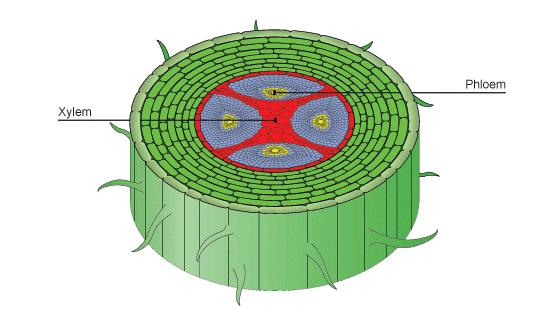
Specific type of plant tissue that transports water and minerals from the roots, through the stems, to leaves
vascular plant
nonvascular plant
xylem
phloem

Specific type of plant tissue that transports food (sugar) made in the leaves to the entire plant
vascular plant
nonvascular plant
xylem
phloem

