
 Worksheets
HS20 - Final Review - Unit 13 - Human Reproductive System
Total questions: 59
Worksheet time: 30mins
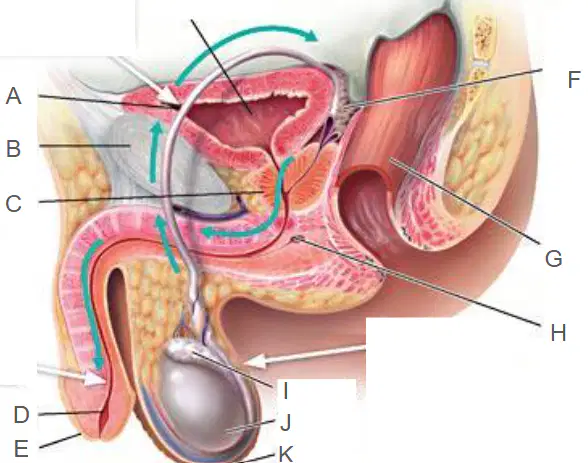
Label structure H
Seminal vesicle
Prostate gland
Bulbourethral gland
Epididymis
Label structure I
Seminal vesicle
Prostate gland
Bulbourethral gland
Epididymis
Label structure D
Urethra
Vas Deferens
Scrotum
Testes
Label structure A
Urethra
Vas Deferens
Scrotum
Testes
Label structure K
Urethra
Vas Deferens
Scrotum
Testes
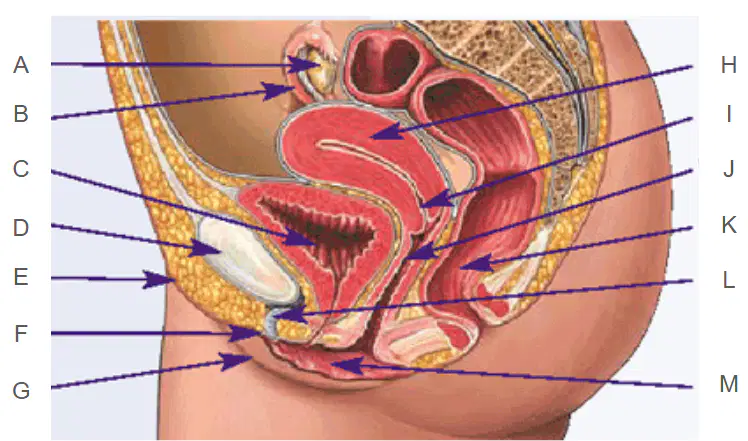
Label structure H
Cervix
Fallopian Tube
Uterus
Vagina
Label structure I
Cervix
Fallopian Tube
Uterus
Vagina
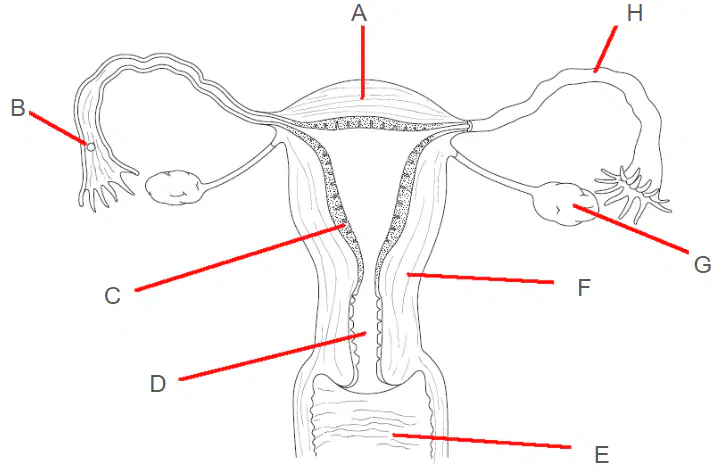
Label structure G
Egg
Oviduct
Ovary
Vagina
Label structure H
Egg
Oviduct
Ovary
Vagina
Label structure E
Egg
Oviduct
Ovary
Vagina
Which organ is responsible for producing sperm in the male reproductive system?
Prostate gland
Testis
Urethra
Seminal vesicle
What is the function of the urethra in the male reproductive system?
Produces sperm
Stores sperm
Transports urine and sperm out of the body
Produces hormones
Which part of the female reproductive system is responsible for housing and nourishing a developing fetus?
Ovary
Uterus
Cervix
Vagina
Compare the roles of the testis in males and the ovary in females in the reproductive systems.
Both produce hormones only
Both store urine
Both produce gametes (sperm in males, eggs in females)
Both are responsible for fertilization
Which system is responsible for allowing humans to create new human life?
Digestive system
Respiratory system
Reproductive system
Nervous system
What are the names of the reproductive cells involved in human fertilization?
Neurons and glial cells
Red and white blood cells
Sperm and eggs (oocytes)
Platelets and plasma
What is formed when sperm and egg fuse during fertilization?
Haploid cell
Diploid cell
Triploid cell
Polyploid cell
At what stage does the ability to reproduce typically occur in humans?
Infancy
Puberty
Adulthood
Menopause
Which hormone is produced by the hypothalamus to stimulate the anterior pituitary in the reproductive system?
Estrogen
Testosterone
GnRH
Insulin
What are the two hormones produced by the anterior pituitary that are involved in reproduction?
Estrogen and Testosterone
LH and FSH
GnRH and Insulin
Progesterone and Oxytocin
Increased fat deposits during female puberty are most likely to occur in which areas?
Buttocks, thighs, and hips
Arms, neck, and hands
Feet, ears, and nose
Back, chest, and forearms
Arrange the following structures in the order that sperm passes through them from development to ejaculation.
Testes → Epididymis → Vas deferens → Urethra → Penis
Penis → Urethra → Testes → Vas deferens → Epididymis
Testes → Vas deferens → Epididymis → Penis → Urethra
Testes → Urethra → Penis → Epididymis → Vas deferens
Where are the testes located in the male reproductive system?
Inside the abdominal cavity
Outside the abdominal cavity in the scrotum
Inside the kidneys
In the bladder
What are the tubes called where sperm is produced in the testes?
Fallopian tubes
Seminiferous tubules
Urethra
Vas deferens
Which hormones are produced by the testes?
Estrogen and progesterone
Testosterone and androgens
Insulin and glucagon
Adrenaline and cortisol
After maturing, where are sperm moved to in the male reproductive system?
Urethra
Epididymis
Prostate gland
Seminal vesicle
Explain how the anatomical location of the testes supports sperm production.
Sperm production requires a lower temperature than body temperature, and the testes are located outside the abdominal cavity in the scrotum to maintain this lower temperature.
Sperm production requires a higher temperature than body temperature, so the testes are inside the abdominal cavity.
Sperm production is not affected by temperature, so the location of the testes is irrelevant.
Sperm production requires sunlight, so the testes are exposed to the outside.
Which structure in the male reproductive system is responsible for the maturation of sperm?
Vas deferens
Urethra
Epididymis
Prostate gland
What is the main function of the vas deferens in the male reproductive system?
Produces sperm
Stores sperm and leads to the urethra
Matures sperm
Produces testosterone
Which of the following best describes the seminal vesicles in the male reproductive system?
Two small glands that join the vas deferens at the base of the bladder
Two large glands that join the urethra at the top of the bladder
One large gland that joins the vas deferens at the base of the bladder
Two small glands that join the urethra at the base of the bladder
Which of the following components is NOT mentioned as being present in the fluid produced by the seminal vesicles?
Glucose
Fructose
Amino acids
Prostaglandins
Why is buffering important in the seminal fluid produced by the seminal vesicles?
It keeps the pH constant
It increases the acidity
It provides nutrients for sperm
It helps sperm attach to the egg
Explain how the composition of the fluid produced by the seminal vesicles supports sperm function and survival.
The fluid is slightly basic, contains fructose for energy, amino acids for nourishment, prostaglandins to aid movement, and buffers to maintain pH, all of which support sperm function and survival.
The fluid is acidic, contains glucose for energy, and has no effect on sperm movement.
The fluid is neutral, contains only water, and does not affect sperm.
The fluid is highly basic, contains only proteins, and prevents sperm movement.
Where is the prostate gland located in relation to the rectum and urethra?
Behind the rectum and below the urethra
In front of the rectum and around the top of the urethra
Above the rectum and beside the urethra
Below the rectum and inside the urethra
What is the function of the fluid secreted by the bulbourethral glands?
To digest food
To neutralize urine in the urethra
To produce hormones
To filter blood
What is formed when seminal fluid combines with sperm?
Urine
Blood
Semen
Mucus
What is the primary function of the urethra in the male reproductive system?
It only transports urine
It only transports semen
It is a double purpose tube for both semen and urine, but never at the same time
It produces sperm
Why does the penis become erect and firm during sexual activity?
To allow urine to be expelled
To allow semen to be deposited in the vagina near the cervix
To produce testosterone
To protect the urethra
Explain why semen and urine cannot pass through the urethra at the same time.
Because the urethra is too small
Because the body has a mechanism to prevent both from passing simultaneously
Because semen is thicker than urine
Because urine is acidic
What is the function of the acrosome in a sperm cell?
Produces energy for movement
Contains enzymes that digest the barriers surrounding the egg
Stores genetic material
Provides structural support
Why does the sperm cell have a tail (flagellum)?
For storing nutrients
For swimming
For digesting the egg
For producing enzymes
Which of the following is NOT a part of the female reproductive system?
Ovary
Fimbria
Clitoris
Bladder
Which structure is responsible for producing eggs in the female reproductive system?
Uterus
Ovary
Cervix
Labia
Which hormone is produced by the ovaries from follicles?
Testosterone
Estrogen
Insulin
Adrenaline
What is produced by the ovaries from the corpus luteum?
Progesterone
Estrogen
Testosterone
Insulin
What is the primary function of the ovaries in the female reproductive system?
Produce sperm
Produce eggs, estrogen, and progesterone
Produce urine
Produce bile
Explain how the ovaries contribute to the regulation of the menstrual cycle.
By producing insulin and adrenaline
By producing eggs, estrogen, and progesterone, which regulate the menstrual cycle
By filtering blood
By digesting food
What is the main function of the fimbria in the female reproductive system?
To produce hormones
To sweep the egg into the oviduct
To fertilize the egg
To attach the egg to the uterus wall
Where is the egg fertilized in the female reproductive system?
Uterus
Oviducts
Fimbria
Endometrium
What is the function of the endometrium in the uterus?
It produces eggs
It lines the uterus wall
It sweeps the egg into the oviduct
It fertilizes the egg
Why is the wall of the uterus described as muscular and thick?
To help the egg move to the oviduct
To provide a strong environment for fetal development
To produce hormones
To fertilize the egg
Explain the process that occurs after the egg is fertilized in the oviducts and reaches the uterus.
The egg is expelled from the body
The fertilized egg attaches to the uterine wall and develops into a fetus
The egg dissolves in the uterus
The egg is fertilized again in the uterus
What is the primary function of mucus produced by the cervix in the female reproductive system?
To help or stop sperm depending on hormones
To nourish the egg
To provide lubrication for childbirth
To protect against infections only
During pregnancy, what does the cervix do to help hold the baby in?
Closes off
Expands in width
Secretes more mucus
Contracts frequently
What type of tissue does the clitoris contain?
Muscular tissue
Erectile tissue
Cartilage tissue
Nervous tissue
Explain the difference between the clitoris and the vulva in terms of their anatomical location and function.
The clitoris is an internal organ, while the vulva is responsible for menstruation.
The clitoris is located above the vaginal opening and is sensitive, while the vulva refers to the external female genitalia.
The clitoris produces eggs, while the vulva is the site of fertilization.
The clitoris is the opening of the uterus, while the vulva is a muscular tube.
What is the menstrual cycle?
A monthly sequence of ovarian and uterine events controlled by hormones.
A weekly process of digestion.
A daily process of respiration.
A yearly sequence of bone growth.
What is the main function of Follicle Stimulating Hormone (FSH) in the menstrual cycle?
Stimulates the follicle to mature and causes it to produce estrogen.
Maintains the corpus luteum and causes it to produce progesterone.
Increases blood sugar levels.
Stimulates milk production.
How does Luteinizing Hormone (LH) affect the ovaries during the menstrual cycle?
Maintains the corpus luteum and causes it to produce progesterone.
Stimulates the follicle to mature and causes it to produce estrogen.
Increases heart rate.
Regulates calcium levels in the blood.

