
 Worksheets
Microbiology Ch. 1/2
Total questions: 88
Worksheet time: 44mins
Which of the following pairs is mismatched?
Pasteur - proof of biogenesis
Ehrlich - chemotherapy
Koch - aseptic surgery
Jenner - vaccination
Archaea differ from bacteria in that archaea
Use organic compounds for food.
Lack peptidoglycan.
Reproduce by binary fission.
Lack nuclei.
Are prokaryotic.
Which one of the following does NOT belong with the others?
Eukarya
Archaea
Fungi
Bacteria
Which of the following processes in making blue jeans is incorrectly matched?
Plastic - bacterial PHA
Cotton - fungal hyphae
Debleaching - bacterial enzyme
Stone-washed - fungal enzyme
Blue dye - E. coli indigo
Which of the following CANNOT be made by using recombinant DNA technology?
Pest-resistant crops
Vaccines
Life
Pharmaceutical drugs
Human hormones
Which of the following lack a nucleus?
Protozoa
Fungi
Bacteria
None of these
Animalia
Which of the following statements about fungi is true?
All require organic material for growth.
All are multicellular.
All are plants.
All grow using sunlight and carbon dioxide.
All are prokaryotic.
An agent that reproduces in cells but is NOT composed of cells and contains RNA as its genetic material is a(n)
Virus.
Helminth.
Alga.
Fungus.
Bacterium.
Which of the following organisms lack cell walls?
Animalia
Bacteria
Fungi
Plantae
Which of the following statements is false?
All bacteria lack nuclear membranes.
All fungi have nuclear membranes.
All fungi are multicellular.
All viruses are parasites.
All protozoa are unicellular.
Which of the following findings was essential for Jenner's vaccination process?
A weakened microorganism may produce immunity.
Someone who recovers from a disease will not acquire that disease again.
A weakened microorganism will not cause disease.
Vaccination provides immunity.
Disease is caused by viruses.
Who observed cells in plant material?
Hooke
van Leeuwenhoek
Pasteur
Lister
Koch
In the name Escherichia coli, coli is the
Specific epithet.
Discoverer.
Domain.
Genus.
Kingdom.
A multicellular organism that has a mouth and lives in an animal host is a(n)
Alga.
Bacterium.
Virus.
Helminth.
Fungus.
Who proved that microorganisms cause disease?
Semmelweis
Pasteur
Koch
van Leeuwenhoek
Fleming
Which of the following statements about insect control by microorganisms is true?
The microorganisms may cause disease in other animals.
The microorganisms are specific for the insect pest.
This technique is just as dangerous as the use of chemical pesticides.
The microorganisms are permanent in the environment.
The insects develop resistance to the microorganisms.
Who was the first to observe microorganisms with a microscope?
Weizmann
Hooke
Koch
Pasteur
van Leeuwenhoek
Regarding Pasteur's experiments with the S-neck flask, which of the following statements is true?
Any possibility of contamination was removed.
All microorganisms were killed before beginning.
All of these.
There was air involved.
There was a food source involved.
Regarding the experiments that "proved" spontaneous generation, which of the following statements is probably true?
The food source could not support life.
Too much heat was applied.
Excess carbon dioxide was present.
Air was lacking.
Microorganisms were already present.
Which of the following pairs is mismatched?
Immunologist - studies ecology of Legionella pneumophila
Virologist - studies human immunodeficiency virus
Microbial physiologist - studies fermentation of sourdough bread
Molecular biologist - studies recombinant DNA
Microbial ecologist - studies bacteria that degrade oil
Which of the following statements about viruses is false?
They have both DNA and RNA.
They lack cells.
They cannot metabolize nutrients.
They cannot reproduce themselves.
They are parasites.
Which of the following statements about protozoa is false?
All are eukaryotic.
All have complex cells.
All are unicellular.
They are classified by their method of locomotion.
They have rigid cell walls.
Regular use of antibacterial cleaning products
Prevents occurrence of infections, Is necessary for good health, and Prevents bacteria from growing
Prevents bacteria from growing.
Prevents occurrence of infections.
Is necessary for good health.
Promotes survival of bacteria that are resistant.
Which of the following is NOT a domain in the three-domain system?
Archaea
Animalia
Bacteria
Eukarya
Which of the following statements about biofilms is false?
Biofilms in your body protect mucous membranes from harmful microbes.
Biofilms in pipes block the flow of water.
Biofilms on rocks provide food for animals.
Biofilms on medical implants cause infections.
Compared to free-living bacteria, biofilms are more sensitive to antibiotics.
What is the type of bond between the hydrogen of one molecule and the nitrogen of another molecule?
Hydrogen bond
Hydrophobic bond
Disulfide bond
Ionic bond
Covalent bond
Which type of molecule contains the alcohol glycerol?
Nucleic acid
Lipid
Carbohydrate
Protein
The antimicrobial drug imidazole inhibits sterol synthesis. This would most likely interfere with
Genes.
Eukaryotic plasma membranes.
Prokaryotic plasma membranes.
Fungal cell walls.
Bacterial cell walls.
Identify the following reaction: Glycine + Lysine --> Dipeptide + H2O
Reversible reaction
Hydrolysis reaction
Dehydration synthesis reaction
Covalent reaction
Exchange reaction
Which type of molecule contains -NH2 groups?
Carbohydrate
Lipid
Protein
Nucleic acid
Which of the following is a base?
H2O --> H+ + OH-
H2CO
NaOH --> Na+ + OH-
C2H5OCOOH --> H+ + C2H5OCOO-
C2H5OH
An E. coli culture that has been growing at 37°C is moved to 25°C. Which of the following changes must be made in its plasma membrane?
The number of phosphate groups must increase.
The number of unsaturated chains must increase.
The number of saturated chains must increase.
No changes are necessary.
The viscosity must increase.
Which of the following is the type of bond holding K+ and I- ions in KI?
Ionic bond
Covalent bond
Hydrogen bond
Identify the following reaction: Glucose + Fructose --> Sucrose + Water
Reversible reaction
Hydrolysis reaction
Dehydration synthesis reaction
Exchange reaction
Ionic reaction
Structurally, ATP is most like which type of molecule?
Carbohydrate
Protein
Lipid
Nucleic acid
Which molecule is composed of a chain of amino acids?
Nucleic acid
Carbohydrate
Lipid
Protein
Which type of molecule NEVER contains a phosphate group?
Lipid
Protein
Nucleic acid
Carbohydrate
Which type of molecule is composed of (CH2O) units?
Nucleic acid
Protein
Carbohydrate
Lipid
Assume Saccharomyces cerevisiae is grown in a nutrient medium containing the radioisotope 32P. After a 48-hour incubation, the 32P would most likely be found in the S. cerevisiae's
Water.
Cell wall.
Plasma membrane.
Carbohydrates.
Proteins.
Identify the following reaction: NH4OH ⇌ NH3 + H2O
Reversible reaction
Dehydration synthesis reaction
Ionic reaction
Exchange reaction
Hydrolysis reaction
Which of the following is the type of bond between molecules of water in a beaker of water?
Covalent bond
Ionic bond
Hydrogen bond
Oil-degrading bacteria are naturally present in the environment but cannot degrade an oil spill fast enough to avoid ecological damage. How can the actions of these bacteria be sped up?
Provide oil for them.
Provide nitrogen and phosphorus.
Add water.
Provide sugar as a carbon source.
Add NaCl.

Using the information in Table 2.1, calculate the number of moles in 92 grams of ethanol, C2H5OH.
Can't tell
3
4
1
2

Which of the following statements about the reactions in Table 2.2 is false?
They are dissociation reactions.
They are ionization reactions.
They are reversible reactions.
They occur when the reactants are dissolved in water.
They are exchange reactions.

Using the information in Table 2.1, calculate the molecular weight of ethanol, C2H5OH.
Can't tell
33
46
96
34

Its atomic weight is 12.
It has 6 electrons orbiting the nucleus.
It has 12 neutrons in its nucleus.
Its atomic number is 6.
It has 6 protons in its nucleus.

It has 8 neutrons in its nucleus.
It has 8 protons in its nucleus.
Its atomic number is 8.
It has 8 electrons in its nucleus.
Its atomic weight is 16.
Identify the following reaction: H2O + CO2 ⇌ H2CO3
Exchange reaction
Reversible reaction
Dehydration synthesis reaction
Hydrolysis reaction
Covalent reaction
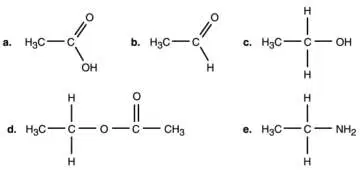
Which compound in Figure 2.1 is an ester?
b
e
a
c
d
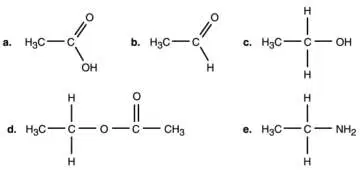
In Figure 2.1, which is an alcohol?
c
a
b
e
d
Which of the following requirements was NOT necessary for Pasteur to disprove spontaneous generation?
Keeping microorganisms out
Providing a food source that would support growth
Supplying air
Identifying bacteria
Removing microorganisms that were initially present
Bacteria differ from viruses in that bacteria
Can live without a host.
Have DNA and RNA.
All of these.
Are composed of cells.
Which of the following is the best definition of biotechnology?
The use of living organisms to make desired products
The development of recombinant DNA technology
Bacterial production of foods
The curing of diseases
The use of microorganisms in sewage treatment
You are observing a cell through a microscope and note that it has no apparent nucleus. You conclude that it most likely
Moves by pseudopods.
Is a plant cell.
Has a peptidoglycan cell wall.
Has a cellulose cell wall.
Is part of a multicellular animal.
Classification of organisms in the three domains is based on
Nucleus.
Number of cells.
Cell wall.
Type of cell.
Nutritional type.
You are looking at a white cottony growth on a culture medium. Microscopic examination reveals it is multicellular. Which of the following conclusions about this organism is false?
It is eukaryotic.
It has cell walls.
It is a bacterium.
It absorbs organic nutrients.
It has DNA enclosed in a nucleus.
Which of the following statements is true?
Viruses cannot reproduce outside a host cell.
Fungi are plants.
Algae are parasites.
Protozoa have rigid cell walls.
Bacteria cannot move.
Which of the following pairs is mismatched?
NaOH ⇌ Na+ + OH- - base
HF ⇌ H+ + F- - acid
H2SO4 ⇌ 2H+ + SO42- - acid
MgSO4 ⇌ Mg2+ + SO42- - salt
KH2PO4 ⇌ K+ + H2PO4- - acid
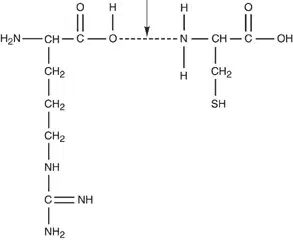
What kind of bond is at the arrow in Figure 2.3?
Single covalent bond
Hydrogen bond
Double covalent bond
Peptide bond
Ionic bond
Assume Saccharomyces cerevisiae is grown in a nutrient medium containing the radioisotope 35S. After a 48-hour incubation, the 35S would most likely be found in the S. cerevisiae's
Water.
Proteins.
Carbohydrates.
Nucleic acids.
Lipids.
What is the type of bond between ions in salt?
Covalent bond
Hydrogen bond
Ionic bond
What is the type of bond holding hydrogen and oxygen atoms in the H2O molecule?
Ionic bond
Covalent bond
Hydrogen bond
The following chemical reaction is used to remove chlorine from water. What type of reaction is it?
HClO + Na2SO3 Na2SO4 + HCl
Ionic synthesis reaction
Reversible synthesis reaction
Hydrolysis synthesis reaction
Dehydration synthesis reaction
Exchange synthesis reaction
What do genes consist of?
Lipids
Proteins
Carbohydrates
Nucleic acids
Identify the following reaction: Sucrose + H2O --> Glucose + Fructose
Dehydration synthesis reaction
Exchange reaction
Reversible reaction
Hydrolysis reaction
Covalent reaction
Starch, dextran, glycogen, and cellulose are polymers of
Amino acids.
Nucleic acids.
Fatty acids.
Glucose.
Acids.
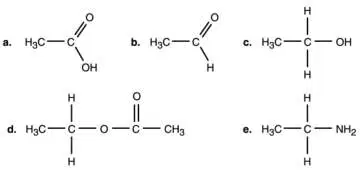
Which compound in Figure 2.1 is an organic acid?
e
a
b
c
d
A nucleated, green cell that moves by means of flagella is a(n)
Virus.
Bacterium.
Fungus.
Alga.
Helminth.
Fungi differ from bacteria in that fungi
Spoil food.
Have cell walls.
Have a nucleus.
Are cellular.
Have DNA.
A multicellular organism that has chitin cell walls and absorbs organic material is a(n)
Virus.
Bacterium.
Fungus.
Alga.
Helminth.
Which of the following pairs is mismatched?
Normal microbiota - harmful
Pathogen - disease causing
Chemotherapy - treatment of disease
Vaccine - a preparation of microorganisms
Penicillin - antibiotic
Which of the following groups include members that lack DNA?
Bacteria
Viruses
Fungi
Helminths
Protozoa
Which of the following does NOT belong with the others?
Protista
Helminthes
Plantae
Fungi
Animalia
Which of the following is a scientific name?
Hansen's bacillus
Acid-fast bacteria
Mycobacterium leprae
Leprosy bacterium
Who disproved the theory of spontaneous generation?
van Leeuwenhoek
Pasteur
Koch
Hooke
Virchow
What is the type of bond between carbon, hydrogen, and oxygen atoms in organic molecules?
Covalent bond
Hydrogen bond
Ionic bond
Identify the following reaction: Lactose + H2O --> Glucose + Galactose
Dehydration synthesis reaction
Exchange reaction
Hydrolysis reaction
Reversible reaction
Ionic reaction
Which are the primary molecules making up plasma membranes in cells?
Proteins
Lipids
Carbohydrates
Nucleic acids
Two glucose molecules are combined to make a maltose molecule. What is the chemical formula for maltose?
C12H23O10
C12H22O11
C12H24O12
C3H6O3
C6H12O6
Which of the following statements is false?
Water freezes from the top down.
Water is a part of a dehydration reaction.
Water molecules are formed by hydrolysis.
Water is a polar molecule.
Salts readily dissolve in water.
Antacids neutralize acid by the following reaction. Identify the salt.
Mg(OH)2 + 2HCl MgCl2 + H2O
Mg(OH)2
MgCl2
None of these
HCl
H2O
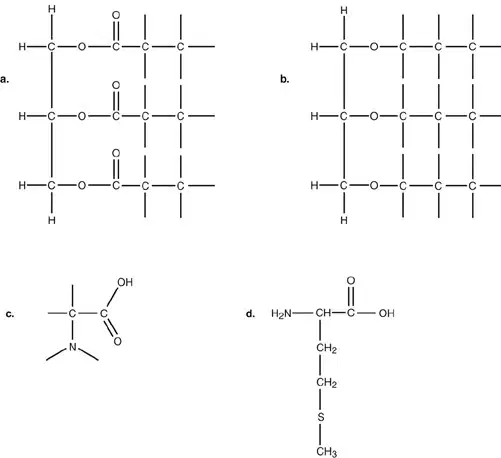
Use Figure 2.2 to answer the following question. Archaea differ from bacteria in the composition of the cell membrane lipids. Archaea have ether-bonded lipids, shown in part ________ of Figure 2.2, and bacteria have ester-bonded lipids, shown in part ________ of Figure 2.2.
b; c
c; d
d; c
b; a
a; d
Which of the following pairs is mismatched?
van Leeuwenhoek - germ theory
Hooke - cell theory
Pasteur - fermentation
Jenner - vaccines
Lister - aseptic surgery
Which of the following pairs is mismatched?
Jacob and Monod - microbial genetics
Jenner - immunology
Winogradsky - microbial ecology
Lancefield - immunology
Weizmann - virology
Which of the following is NOT an example of biotechnology?
Bacterial production of French bread
Bacterial production of human insulin
Bacterial production of yogurt
Bacterial production of vinegar
Bacterial degradation of a dead animal
Which one of the following does NOT belong with the others?
Cellulose
Chitin
Peptidoglycan
Nucleus
Identify the following reaction: HCl + NaHCO3 --> NaCl + H2CO3
Reversible reaction
Hydrolysis reaction
Exchange reaction
Ionic reaction
Dehydration synthesis reaction
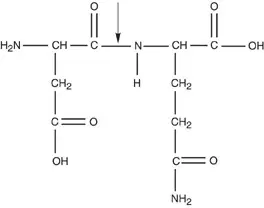
What kind of bond is at the arrow in Figure 2.4?
Disulfide bridge
Double covalent bond
Hydrogen bond
Ionic bond
Peptide bond

