
 Worksheets
Chronic Wound Healing Aids
Total questions: 36
Worksheet time: 18mins
Which of the following best describes the main purpose of Negative Pressure Wound Therapy (NPWT) in treating chronic wounds?
To increase the amount of fluid in the wound
To remove excess fluid and promote healing
To introduce more destructive molecules into the wound
To prevent the formation of granulation tissue
Why do some chronic wounds become stalled in the healing process, according to the provided material?
They lack exposure to air
They are too dry for healing to occur
They remain in the inflammatory phase due to destructive molecules
They are exposed to too much sunlight
Explain how the imbalance of molecules in chronic wounds affects the healing process, based on the information provided.
High levels of growth factors speed up healing
Low levels of proteases help build the extracellular matrix
High levels of destructive molecules and low levels of growth factors impede healing
Excess fluid in wounds always promotes faster healing
What is the role of the extracellular matrix in wound healing, as described in the material?
It prevents fluid from leaving the wound
It is the foundation of healthy granulation tissue
It increases the inflammatory response
It destroys proteases in the wound
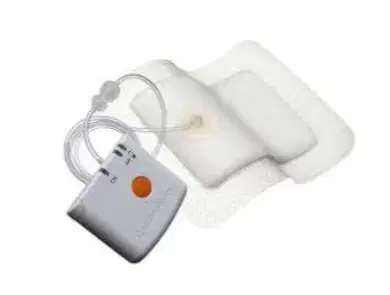
What is the function of the device shown in the image in the context of wound healing?
To add moisture to the wound
To apply negative pressure and remove excess fluid
To inject growth factors directly into the wound
To increase the temperature of the wound
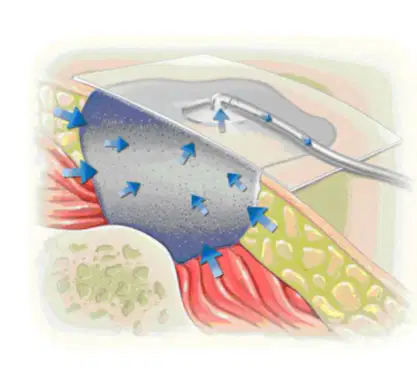
Which of the following best describes the primary function of negative-pressure dressings in wound care?
They add moisture to the wound to speed up healing.
They remove excess fluid from wounds, improving healing time.
They inject antibiotics directly into the wound.
They are used only to cover wounds without any additional function.
What is the main purpose of the special plastic film used in negative-pressure wound therapy (NPWT)?
To provide nutrients to the wound.
To keep the wound dry by absorbing all fluids.
To seal the wound from the environment and protect it from contaminants.
To make the dressing easier to remove.
Explain how the vacuum mechanism in negative-pressure wound therapy (NPWT) contributes to wound healing. Use evidence from the process described to support your answer.
The vacuum injects medication into the wound, which directly kills bacteria.
The vacuum pulls the plastic film tightly over the wound, sealing it and continuously removing fluid, which protects the wound and keeps it warm.
The vacuum only serves to keep the dressing in place.
The vacuum increases blood flow by massaging the wound.
A patient is being treated with a negative-pressure dressing. What would likely happen if the plastic film was not sealed tightly over the wound?
The wound would heal faster due to increased air exposure.
The wound would be protected from contaminants, but fluid would not be removed.
The wound would be exposed to outside contaminants, and the vacuum would not effectively remove fluid.
The dressing would still work as intended.
A patient with a heavily exudating wound is being treated with NPWT. According to standard practice, how often should the dressing typically be changed?
Every 24 hours
Every 48–72 hours
Once a week
Every 10 days
Which of the following wound types is NOT typically an indication for negative-pressure wound therapy (NPWT)?
Chronic wounds
Venous ulcers
Closed, non-infected surgical incisions
Pressure ulcers
Explain how negative-pressure wound therapy (NPWT) supports the healing process at the cellular level.
By increasing the growth medium for bacteria
By stimulating new cell growth through the pull of negative pressure on cells
By preventing oxygen and nutrients from reaching the cells
By causing wound inhibitory factors to accumulate
A patient has a complex wound that requires extended treatment. What is the maximum duration negative-pressure wound therapy may be continued, according to the material?
1 week
2 weeks
3 weeks
4 weeks
A HCP is planning care for a patient with a traumatic wound. Based on the indications for NPWT, what evidence supports the use of this therapy for the patient?
NPWT is only for burns and pressure ulcers
NPWT is indicated for traumatic wounds as well as chronic and acute wounds
NPWT is not suitable for any open wounds
NPWT is only used for skin grafts
Which of the following best describes the primary benefit of NPWT (Negative Pressure Wound Therapy) in the early treatment of deep pressure sores?
It increases the size of the sore.
It reduces the depth of the sore via granulation and aids in healing chronic pressure ulcers.
It prevents any granulation from occurring.
It is only effective in late-stage wound healing.
Which of the following is a contraindication to the use of NPWT?
Chronic pressure ulcers
Necrotic tissue with eschar present
Granulating wounds
Superficial abrasions
A patient with an exposed blood vessel in a wound is being considered for NPWT. Based on the contraindications, what should be the clinician’s next step?
Proceed with NPWT as planned.
Delay NPWT until the blood vessel is no longer exposed.
Increase the pressure in NPWT.
Ignore the contraindication and monitor closely.
A wound with untreated osteomyelitis is being evaluated for NPWT. Using your understanding of contraindications, explain why NPWT should not be used in this case.
NPWT is ineffective in all bone-related conditions.
NPWT may worsen the infection or prevent proper treatment of the underlying osteomyelitis.
NPWT will immediately heal the osteomyelitis.
NPWT is only contraindicated in soft tissue malignancy.
Which of the following is a benefit of using artificial skin, laboratory-grown skin, or skin substitutes in wound treatment?
They can permanently replace all damaged skin in every case.
They help cover, protect, and facilitate healing of wounds that cannot epithelialize themselves.
They are only used for cosmetic purposes.
They are less effective than traditional bandages.
Why are growth factors and constructive biochemical molecules increasingly used in wound healing?
They slow down the healing process.
They induce healing in chronic wounds.
They are only used for minor cuts.
They are used to prevent infection only.
What is a limitation of sterilized cadaver allografts when used as wound dressings?
They provide permanent coverage.
They eventually slough off.
They are never used in modern medicine.
They are more effective than autografts.
A patient requires permanent coverage for a large wound area. Which treatment is most appropriate, and what is a key consideration for its use?
Sterilized cadaver allografts; they provide permanent coverage immediately.
Cultured keratinocyte autografts; 3 weeks are needed for graft cultivation.
Artificial skin; it is always permanent and ready to use.
Growth factors; they provide instant permanent coverage.
How do skin substitutes and growth factors contribute to the healing of recalcitrant wounds?
By preventing any new tissue from forming.
By providing a temporary or permanent cover and promoting healing in wounds that cannot heal on their own.
By causing wounds to become chronic.
By eliminating the need for any further medical intervention.
Which of the following best describes the main hypothesis behind using Electrical Stimulation (E-STIM) Therapy for treating chronic wounds?
To promote chronic wound healing by imitating the natural electrical current that occurs in cutaneous wounds.
To sterilize the wound area using electrical currents.
To increase the temperature of the wound for faster healing.
To deliver medication directly into the wound using electricity.
What is the term used to describe the electrical charge of human skin?
Skin battery
Skin capacitor
Skin generator
Skin resistor
What is the role of the “current of injury” in wound healing?
It is involved in numerous processes of wound healing.
It causes infection in the wound.
It prevents the wound from closing.
It increases the risk of scarring.
How does E-Stim therapy contribute to the wound healing process?
By reinitiating the inflammatory process of healing.
By cooling the wound area.
By removing dead tissue only.
By preventing blood flow to the wound.
Which of the following is NOT an effect attributed to E-Stim therapy?
Increased oxygen and nutrient transport to the wound
Reduction of edema and pain
Increased fibroblast and collagen development
Decreased blood supply to the wound
Why are electrodes placed on moist wound beds and moist skin at a distance from the wound during E-Stim therapy?
To complete the electrical circuit necessary for therapy.
To dry out the wound faster.
To prevent infection from spreading.
To deliver medication directly into the wound.
Why is ultrasound used in the treatment of wounds?
To decrease the elasticity of collagen
To increase muscle and joint stiffness
To increase the elasticity of collagen and decrease pain
To reduce oxygen transport to the wound
A physical therapist is considering E-Stim for a patient with a surgical wound. The patient also has a malignancy and a cardiac pacemaker. What should the therapist do?
Proceed with E-Stim as usual
Only use E-Stim if electrodes are far from the heart
Avoid using E-Stim due to contraindications
Use E-Stim but reduce the intensity
A patient with a venous ulcer is experiencing muscle spasms and edema. Which treatment modality could address both issues and also accelerate wound healing?
E-Stim
Ultrasound
Surgery
Manual therapy
For which of the following types of wounds is ultrasound therapy most appropriately used?
Chronic non-healing wounds
Severe arterial insufficiency wounds
Necrotic wounds
Profuse bleeding wounds
Which of the following is NOT an appropriate indication for the use of ultrasound in wound treatment?
Pressure ulcers
Venous ulcers
Osteomyelitis
Trauma wounds
A patient presents with a venous ulcer and no signs of infection or severe arterial insufficiency. Based on the information provided, what would be the most appropriate next step regarding the use of ultrasound therapy?
Proceed with ultrasound therapy
Avoid ultrasound therapy due to the ulcer type
Only use ultrasound if there is profuse bleeding
Use ultrasound only if the wound is necrotic
Explain why ultrasound therapy should not be used in cases of necrotic wounds or severe arterial insufficiency.
Because ultrasound is ineffective and may worsen these conditions
Because ultrasound is only used for bone fractures
Because ultrasound is only used for muscle injuries
Because ultrasound is required for all wound types

